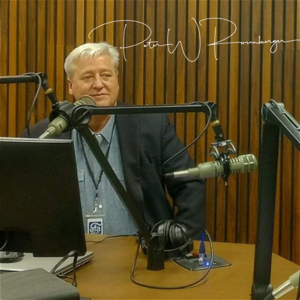
This is the Truth Network. Welcome back to Hope for the Caregiver. This is Peter Rosenberger here on American Family Radio. Glad to be with you today. Hope For the caregiver.com.
Hopeforthecaregiver.com. We're talking about health. And yes, I'm dealing with a little bit of a health issue right now. Checking off a few boxes, getting ready to make some adjustments based on whatever we're going to find out. Uh, next week, I'll have some more data to share about what's going to happen.
And why am I doing this? I mean, you know, a lot of people don't necessarily share it, their health issues, and so forth.
Well, look, I'm a caregiver. You're a caregiver. You wouldn't be listening to this program if you didn't have a stake in this. And the best way to deal with some of these things is to talk about it and I'm going to talk about it. Look, isolation is one of the most crippling things that we as caregivers can deal with, and I understand that in ways that I hope you all never do.
And I'm committed to going into this situation. And said, okay, look, I understand the stakes, I understand what's going on, I understand the gravity of this. I understand the challenges. But here's what I've learned through them.
So, if I'm going to laugh about, you know, a colonoscopy, I'm going to laugh about this. I'm going to do it because Lord knows we've cried plenty of tears, you know, and yes, we deal with serious issues. You know, I told you all, it's not just my physical health. I've had, I've dealt with it, all of it. I remember after an appendectomy that I had many, many years ago, and it was supposed to be just, you know, a quick thing.
They did a, you know, it was supposed to be kind of not outpatient, I guess, but I don't know what it was. But anyway, whatever it was supposed to be, it didn't go that way. And I think the surgeon, I got the luck of the draw of this guy. Italy wasn't a very good draw. You know, if life was a game of poker, I drew I didn't even draw a pair of twos.
But it's one of those things that. uh I got a post-op infection with afterwards. which led to a pretty large hernia. And I had a lot of stuff going on. And It it was a Telling moment in my life as a caregiver because, for a very brief amount of time, people had to step in.
Now, Gracie was far more independent back then. than she is now. And her health plummeted not too terribly long after that. But it was still challenging. It was still a lot of work.
And nobody knew what I was carrying. Nobody knew the reality of our life and how fragile that was until I went down unexpectedly for a very short amount of time. And so Gracie didn't know how to help me. And nobody knew how to help Gracie. It was a bit tough there for a while.
And I wasn't sleeping. And I've come to understand sometimes with anesthesia and so forth that it's hard for me to sleep. And my cousin called me up this week, who deals with a, she's a long-time caregiver for her severely disabled daughter. And she's dealt with some very serious health issues herself. and she said, you know, I couldn't turn my mind off and I couldn't rest.
And boy, I understand that. I've been there and done that, and we just kind of talked it out. And I remember during this time, I couldn't. Turned my mind off. I couldn't sleep.
I couldn't get any rest. And nobody knew how to help me. And I couldn't turn it off from all the work I had to do with Gracie. And she didn't know how to help me. And it was just a mess.
And I was so exhausted, I thought, I'm going to check myself into a mental health facility and get some sleep. Maybe they'll treat me for exhaustion. Turns out that's not a real diagnosis. That's more like 1940s Hollywood. And I've told you this story, or some of you have heard this story.
So I go over there and I'm standing in the lobby at this place in Nashville when we live there, of course. And they looked at me and said, Are you lost? And I kind of teared up a little bit. And I said, Well, yeah. I guess I am.
And then I kind of sniffled and I said, Do y'all take walk ins? And they looked at me odd. And I'm thinking, I wasn't dressed like a pirate or anything. This is a mental health hospital. That's not the weirdest question y'all have gotten.
I mean, at least I didn't say, Do y'all have a drive-through? I just said, Do y'all take walk-ins? And they said, Okay.
So they took my wallet, took my keys, took my blood pressure, and left me in this room that looked like it had been an interrogation room on the early episodes of Law and Order. It was kind of a dingy place.
So I'm sitting there wondering, okay, I'm in the bowels. of a mental health facility. Nobody really knew where I was. And I had just gone over there to do this, and I didn't tell anybody where I was going. I just went.
And And I thought. This could go really south here. And so the counselor came in and talked to me. And said, and I just kind of verbally vomited on the table. You ever done that?
You ever just kind of just let it all out? And the counselor was very patient. She was a real nice lady, and she listened very carefully. And after a while, She looked at me, she said, Well, you know, we can't keep you here. And she she said, we don't treat people for exhaustion.
And you're not crazy. And I said, Are you sure? You know, I said, Can I get that in writing? Because there's some people that really want to see that. She said, No, you're not crazy.
She said, You are burnt out. And you are exhausted. But that's not what we do here. And I said I really could use Some rest, you sure about this? And she said, No, no, no, you're not.
And I can give you some names of some people you can go see. And she wrote down a few names of some clinicians, and then as I was getting ready to leave, she said. We've been giving out box launches all day long. And we got one left. It's tuna fish.
Do you want it? When I look here, I've got a policy that I never turn down a tuna sandwich. Not one time in my life have I done that, not even. When my mother made my best friend and me go over to this crazy lady's house At our church. She went to our church, older lady, and pulled weeds over there.
She needed somebody to pull some weeds. And mom said it would build character. It did not. She said that about a lot of tasks that we didn't want to do. And we trotted off, or we walked, or took our bikes, or sometimes we got a ride and went over to these people's homes or their farms and everything else and did these character-building things that mom assured us would build character, and they did not.
We were characters, but they didn't do it.
So we're out there toiling away in the South Carolina heat. You know, we're. 14 years old. And she comes out and says, Would you boys like to pause for lunch? And We said, okay.
And so we go into the house. She brings us in there. She said, How about a tuna sandwich? And we said, of course, because we never turned down tuna sandwiches. And then she reaches for the blender.
And I looked at my buddy and I said, What sorcery is this? And she gets all the ingredients for the tuna sandwich. And she Dumps it all in the blender. I mean, celery, the relic, everything. And then she just mashes it, you know, with an OCD kind of flair to it.
And this thing turns into this tuna puree. And then she gets this like pepperidge farm type bread, and she pours this on there. And his nickname is Swoofed. And don't ask.
So Swift and I, we're getting this thing, we're eating it, and the tuna juice is dripping down our elbows, but we're powering through it because we don't turn down tuna. And we ate this stuff, and the lady was crazy, I'm telling you, with a capital K. And to this day, mom, you're listening, mom listens to this program. Mom, she was crazy. And who blends up a tuna salad?
So flash forward decades later, I'm in a crazy hospital. And this lady's offering me a tuna sandwich, and I'm looking around for the blender because I thought, well, maybe if I asked to blend it up, that they'll keep me there at the place and I could get some rest. There was no blender.
So I'm holding my tuna sandwich. By box, it's a little box lunch. and I'm walking out and she says something to me. That changed my life. She said I would would recommend a book for you to read.
But you're the guy to write it.
So I walk out into the parking lot and I'm sitting there with my little box lunch and I'm eating my tuna sandwich. And it was a good tuna sandwich, by the way. and chips and coke and a cookie and and and I thought I'd recommend a book for you to read. But you're the guy to ride it. And I kind of snorted to myself, you know, what would I say to caregivers?
And then I thought, what would I say to myself? And I started this process and I went to see One of the counselors she had recommended was a psychiatrist.
So I went and sat in this guy's office for a minute, told him my story, what had gone on. And you know what he offered? Medication And I looked at him and said, I don't need medication, I need sleep. I need to know how to carry this. I need to know how to endure.
How to persevere. I don't need A shrink. I don't need to be m medicated. How do I carry this? And nobody could answer that question.
So I started writing it myself. Yeah. I answered my own question of what I wish people would say to me. What I needed to hear. What worked?
I have field tested everything that I talk about on this program, and I field tested it on me. And I have pushed this to the limits. of so many different Scenarios. the stressors that we get as caregivers. And I Started writing, and that's when I came up with that phrase: healthy caregivers make better caregivers.
I'm not trying to be happy, happy, happy. I want to be healthy. and the healthier I am. I have found the more happiness chases me. And I tested these things of God.
People would always say, well, trust Jesus. We'll trust Jesus. We'll do this. We'll just trust God. God is sovereign.
You know, Romans 8:28. And they say all these things, and they have no idea how to apply it. in a scenario like my life. They say that from a place of safety and security. And I want you to know.
As listeners to this program, that I don't say these things from a place of safety. I do say it from a place of security, because I am secure in Christ. But my life is treacherous. My life is difficult, my life is hard, my life is tough. and these principles sustain me.
When I tell you something in Scripture that is equipping me, I have field-tested this long before I bring it to the air. And I'm seeing it play out. I ask better questions. I do these things, not because I have this. Grandiose plan of somehow being America's caregiver, of which I am.
But that, no, that what I'm just kidding. But what I'm doing is saying, look, Here's what you can bank on. Here's what you can count on. Here's what this looks like. When we trust in him.
When we put our faith in His character. in His immutable traits. that he doesn't change. He is faithful. His word is true.
Here's what this looks like. And here's how to apply this in this moment. And this is what we're going to continue to unpack in this program and the programs to ensue. This is what I write about. You can go out to caregiver.substack.com right now.
Well, wait till the program's over. Caregiver.substeck.com, and you can see the library that I have of things available for you. Look, do you want to To try to convince a mental institution to admit you. I've tried that. It didn't work for me.
I mean, you can give it a shot. It didn't work for me. But you know what? I've got things that will help. And those things really are hope for the caregiver.
This is Peter Rosenberger. We'll be right back. Gracie, when you envisioned doing a prosthetic limb outreach, did you ever think? The inmates would help you do that. Not in a million years.
What does it do? I would have ever thought about that. When you go to the facility run by Core Civic and you see the faces of these inmates that are working on prosthetic limbs that you have helped collect from all over the country that you put out the plea for. And they're disassembling. You see all these legs, like what you have, your own prosthetic legs.
And arms, too. And arms. When you see all this, what does that do to you? Makes me cry. Because I see the smiles on their faces and I know.
I know what it is to be locked someplace where you can't get out without somebody else allowing you to get out. Of course, being in the hospital so much and so long. When I go in there, and I always get the same thing every time. These men are so glad that they get to be doing, as one man said, something good finally with my hands. Did you know before you became an amputee that?
Parts of prosthetic limbs could be recycled? No, I had no idea. I thought we were still in the. 1800s and 1700s. I mean, you know, I thought of peg leg, I thought of wooden legs.
I never thought of. Titanium and carbon legs and flex feet and C legs and all that. I never thought about that. I had no idea.
Now that you've had an experience with it, what do you think of the faith-based programs that Core Civic offers? I think they're just absolutely... Awesome, and I think every prison out there. have faith-based programs like this because The return rate. of the men that are involved in this particular faith-based program.
and other ones like it, but I know about this one. Are just an amazingly low rate compared to those who don't have them. And I think that that says so much. The test so much. About just that doesn't have anything to do with me.
It just has something to do with God using somebody broken. to help other broken people be whole. If people want to donate a used prosthetic limbs, whether from a loved one who passed away, Yeah. You know, somebody who outgrew them, you've donated some of your own. What's the best place for them to do?
How do they do that? Where do they find it? Please go to dannywithope.com/slash recycle, and that's all it takes. It'll give you all the information on that. What's that website again?
DannywithHope.com slash. Slash recycle. Thanks, Crazy. Take my hand. Lean on.
Yeah. We will stay