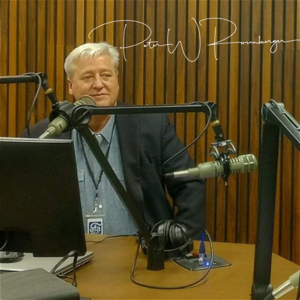
This is the Truth Network. Welcome to Hope for the Caregiver. This is Peter Rosenberger. Glad to be with you here today on American Family Radio. Hope for the Caregiver.
Dot com. where everything on this program is caregiver related. Why?
Well, I'm glad you asked. Because 65 million Americans right now serve as a family caregiver, it's a tough job. It's a tough job. Just look, go out to my website and look at my face. It's a tough job.
Don't let that happen to somebody you love. At hopeforthecaregiver.com. I'm glad you're with us today. I want to run something by you very quickly. I just want to jump right into this.
Following the assassination attempt last week at the White House, Press Correspondence Center. I noticed something that I see on a regular basis with this kind of stuff. I saw this enormous rush to the microphones. from media and members of Congress and so forth, we need to tone it down. We need to be better.
We need to lower the temperature. And the statements just came out almost reflexively. You know, like the script was already there. They had the note cards. We need to do this.
We need to do this. And I. I remember this scene, and you don't have to watch the movie, but I remember this scene in Blazing Saddles where Mel Brooks played this. Just worthless governor named William J. Lepitamaine.
And he gathered his cabinet together and he was outraged. He said, gentlemen, we need to do something to protect our phony baloney jobs. And there's a bunch of harumps from his cabinet. Harump, harump, harump. And one guy didn't, he said, I didn't get a harump out of you.
And it's just they're all echoing the same thing. It was absurd. And it was meant to be absurd. But I watch what happens in the aftermath of things like this, particularly just this last week. I see the same thing.
They're all just sitting around just saying harump. And we need to do this, we need to do this. And their language is more polished and the settings are more formal, but the instinct is still the same for these people. And it's a a unified sound. That just sounds carefully rehearsed.
That's what I see when I see these people. We need to tone it down. And so I just got a question. Who's we? Who is we?
The rush to say we need to tone it down, or that both sides must do so, reveals. really to me something else. And the media knows that it has a credibility problem. If nothing else, they know they got a ratings problem. But what it refuses to admit It is that it has an ownership problem as well.
We is a convenient place to hide behind. The same people now saying we have spent years writing and rehearsing the very script that they're now decrying. They didn't simply argue policy or question judgment. They reached for language that cast their opponents as existential threats and terms like Hitler and Fascist. as routine descriptors.
Rather than You know, historically loaded warnings, I guess, is what they were, you know, what you could make a case for, but that's not what they were doing. And by the way, they did this against George W. Bush, too, twenty-something years ago. I remember seeing this. you know, some of us are older and can remember when they did it with Reagan.
And that kind of language doesn't stay contained. It shapes how the listener understands the stakes. It tells them that what they're seeing is not a disagreement, but it's a moral emergency. Remember, Joe Biden gets up there and said, it's an existential threat. Donald Trump is an existential threat to our country.
Well, guess what?
Some people take that seriously. And that kind of language It wraps around people and then they act on it. And there will always be someone who hears that not as a metaphor, but as instructions. And that's what this kid was. You look at his manifesto, and he's reading out The very things that you could hear on MSNBC or MS LSD or whatever they call it now, you could hear that.
Regularly. That kind of inflammatory stuff from late-night shows and everything else. And I'm thinking. Wow, and they're saying we need to tone it down. We need to reach across the aisle.
We need to do this. We need to do this. But it doesn't excuse the person who acts, by the way. But the responsibility for that guy, that's his issue and he's going to have to deal with it. But it does expose the gap between Those who help set the tone and those who later step forward to warn about it.
And the problem is not the call for restraint. The problem is the distance they're building into the language. What would it sound like if that distance were removed? Not we need to dial it back, but I need to. Not we have to be more careful, but I have to be more careful.
That's the kind of sentence that lands differently because it costs something. and it doesn't distribute the burden. It accepts it. and I did not learn that in Washington. And I doubt that anybody else will either.
I learned it as a caregiver. There are days when everything compresses at once on me. You're a caregiver. Tell me you've had those kinds of days when the routine just collapses. You get a phone call, the body gives out.
You know, everything. Feels like it's just descending on you, you're getting dumped on, and sometimes that's true. But caregiving has a way of stripping away The illusion. including the ones that I prefer to keep about myself. And I've come to understand that some days I'm the statue and some days I'm the pigeon.
And I have to admit that. There's no we that I can hide behind, like these people of the media and Congress and everything else are saying. We need to tone it down. No, no, I got to do this. I make impatient decisions in the middle of exhaustion.
I don't know if you've ever done that or not. I speak more sharply than I should. You ever done that? Or I in some some ways I try to elevate myself at somebody else's expense. And that doesn't excuse any of it.
I gotta own it. I'm guilty of it. I Can imagine that there is anyone who would not agree that Washington, D.C. has a massive hypocrisy problem. and that the media has a major credibility problem.
But I also remember that old axiom, if you got it, you can spot it.
Well, if you spot it, sometimes that means you got it. And I've done the same thing that they're doing, but I've done it in smaller rooms with the smaller stakes and there's less cameras. But I've used tone. Timing. and words to shift blame around, to justify myself, to make someone else carry what was mine to own.
And that recognition has steadied me more than any sweeping call. that we need to do better. We all need to all of us need to do better. You know, you did you remember that when you were in school and that you knew there was one kid that was just being a certain way, but the teacher punished the entire class for it. Instead of calling out the one person that we all knew was doing it, because we didn't want to be confrontational, whatever.
I don't want to single them out, but that always made me mad. That's the kid that's doing it. Deal with that kid. But in my case, I found that I'm the kid that's doing it. And I'm I'm not in a position to correct This culture of ours that rewards outrage and then acts surprised when it produces consequence.
I'm not in a position to correct that. I mean, I'm. Just me. But I am in a position I am in a great position. to confront myself with the truth.
And when you speak in first person plural, it spreads the blame until it disappears. We us. hour. But when you speak in first person singular, There's no more cover. This is where we live.
Aye. I own this. I need to do this. And once the cover is gone, then something else becomes possible. It's not performance, it's not the statements, it's not that sculpted outrage that you saw in the media and everything else from after last weekend.
None of that's there any more. It's repentance. Not we will do better, but I will do better. I will turn from this. And that's where leadership begins.
Not on a stage, not Not behind a podium, not in a ballroom full of cameras, but in decisions of one single person. owning what is theirs to own. life, whether it unfolds in in Washington, or in a hospital room. It's shaped the same way. One voice, one decision, one sentence at a time.
Which means it can be corrected the same way. Not we. But I I will do this. I will look at my own stuff. and I will deal with my own behavior.
And that is the beginning of repentance, and that is the beginning of hope. the caregiver. This is Peter Rosenberger. We will be right back. Gracie, when you envisioned doing a prosthetic limb outreach, did you ever think?
The inmates would help you do that. Not in a million years. What does it mean? I would have ever thought about that. When you go to the facility run by Core Civic and you see the faces of these inmates that are working on prosthetic limbs that you have helped collect from all over the country that you put out the plea for.
And they're disassembling. You see all these legs, like what you have, your own prosthetic legs. And arms, too. And arms. When you see all this, what does that do to you?
Makes me cry. Cause I see the smiles on their faces and I know. I know what it is to be locked someplace where you can't get out without somebody else allowing you to get out. Of course, being in the hospital so much and so long. When I go in there, then I always get the same thing every time.
These men are so glad that they get to be doing, as one man said, something good finally with my hands. Did you know before you became an amputee that? Parts of prosthetic limbs could be recycled? No, I had no idea. I thought we were still in the 1800s and 1700s.
I mean, you know, I thought of peg leg, I thought of wooden legs. I never thought of. Titanium and carbon legs and flex feet and C legs and all that. I never thought about that. I had no idea.
Now that you've had an experience with it, what do you think of the faith-based programs that Core Civic offers? I think they're just absolutely Awesome. And I think every Prison out there should have faith-based programs like this because. return rate. of the men that are involved in this particular faith-based program.
and the other ones like it, but I know about this one. Are just an amazingly low rate compared to those who don't have them. And I think that that says so much. That test so much. about Just that doesn't have anything to do with me.
It just has something to do with God using somebody broken. to help other broken people be whole. If people want to donate a used prosthetic limb, whether from a loved one who passed away, Yeah. You know, somebody who outgrew them, you've donated some of your own. What's the best place for them to do?
How do they do that? Where do they find it? Please go to stanningwithhope.com/slash recycle, and that's all it takes. It'll give you all the information on the what's that website again? Danningwithope.com slash.
Slash recycle. That's crazy. Take my hand. Lean on me. We will stay