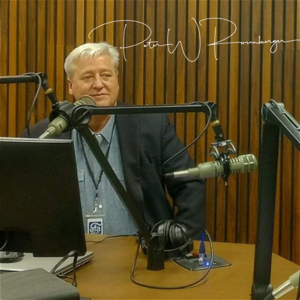
This is the Truth Network. Um Mm. Welcome to Hope for the Caregiver. This is Peter Rosenberger here on American Family Radio. Glad to be with you, HopefortheCaregiver.com.
Hopeforthearegiver.com, the program that is designed to help strengthen you. as a family caregiver to be a little healthier, a little calmer, and dare I say it, a little more joyful while you serve as a family caregiver. I want to jump right into something here, just take you right into scripture, Matthew 9, 9. How many of you know what that is right off the top of your heads? You know what Matthew 9, 9 is?
Well, let's go there. As Jesus passed on from there, he saw a man called Matthew. sitting at the tax booth, and said to him, Follow me. and he rose and followed him.
Now, Luke adds another detail in this that Matthew In his gospel, he left this detail out.
Now, maybe Matthew left it out because of humility. He doesn't say this. I don't know. But Luke adds. and leaving everything, he rose and followed him.
Leaving everything.
Now, the tax booth was not a folding table set up on a quiet corner. It was likely in Capernaum, along the northwestern shore of the Sea of Galilee.
Okay, let me give you a little background on this. In that area, set the Via Maris, the major trade route connecting Egypt to Damascus, or via Maurice, or however you say it.
So anyway, they would tax. The spices and the textile, the produce of fish, everything that was going through there, the Sea of Galilee was not this nice, peaceful retreat. It was a commercial engine, and fishing was an industry. Boats landed there daily with taxable goods, and Rome taxed the imports, the exports, the road use, the harbor traffic. If something moved, it was taxed, but Rome did not collect it directly, they farmed it out.
So a man like Matthew would pay for the franchise. And then he would collect more than Rome required in order to make his profit. The system created wealth. It also created resentment, and tax collectors were seen as religiously unclean traitors, socially isolated. There was a line of men that were willing to sit in that booth, though.
It was profitable. It required flexibility of conscience, moral ambiguity. But it paid well. Rome did not struggle to fill these positions.
So when Jesus walked by and said, follow me, Matthew was not leaving a side job. He was leaving security, wealth, and the only system he had known. And unlike the fisherman, he couldn't go back. Do you remember in in John 21 after the resurrection Peter said to everybody, Hey fellas, I'm going fishing. And the others joined him and they knew that world.
They had boats. They had nets, muscle memory, family infrastructure. It may not have been faithfulness, but it was possible. But Matthew could not say, hey, y'all, I'm going back to taxing. The moment he stood up, That booth would have been filled.
Rome would not hold his position open and his former associates would not welcome him warmly. After he had aligned himself with a rabbi who confronted hypocrisy and warned about the love of money, when Matthew got up from that table, His old life was severed. There's a story often told about commanders who eliminated the option of retreat by destroying their own ships. It's most commonly associated with Herman Cortez. In 1519, the message to his men was simple, we're not going back.
Forward is the only direction. This is what Matthew did.
Now in the television series The Chosen, Matthew is portrayed as kind of a socially awkward, possibly on the spectrum, gifted with numbers, a gentle heart trapped inside a misunderstood frame, that kind of thing. It's a compelling story, but scripture does not support that. Scripture says all have sinned and fall short of the glory of God. Matthew was not a hidden saint in a bad job. He was a sinner inside a corrupt system, and Christ called him anyway, and he left everything.
because the irresistible call of God the effectual call. You cannot resist this. When God calls you, you get up. He called Lazarus out of a tomb. Lazarus didn't have a conversation with him, he just got up.
Now let me turn this to you. Fellow caregiver, caregiver to caregiver, when the diagnosis comes, when the accident happens, when the first surgery turns into the 10th and the 91st and the 98th.
Something closes behind you. You do not announce it. There is no ceremony, but the old life is gone. Friends can return to routines. Colleagues can change careers.
Peter could go pick up nets for the night and go fishing again. but caregivers do not go back to life before the hospital room. before the diagnosis. You cannot return to the version of marriage that is untouched by illness. You cannot resume the independence you once assumed was permanent.
There is no tax booth waiting for you. They're not giving you family paid leave, but from your life. You can take your family medical leave from your work for a season. But as a caregiver, there is no family medical leave from the task of being a caregiver, from the call of being a caregiver. Just like when Matthew stood up, just like with Cortez.
The ships were burned. There's no going back. When you said yes to love and suffering, Something, whether you knew it consciously or not, something behind you closed as well. And here's where this matters. Matthew left wealth and predictability and stepped into uncertainty.
You left control and stepped into responsibility.
So did I. Neither of us, including Matthew, stepped into clarity. We did not know what was waiting for us. He stepped into obedience. And this is what Matthew did.
Caregiving is not a hobby. It's not a phase. It's not a temporary inconvenience. while you wait for things to get back to normal. It's a calling that often removes the option of retreat.
Just like The Apostle Matthew. And the temptation in that place is to resent it. To wish for the booth To wish for the boats. to fantasize about the life that might have been. But here's what we must understand.
When Matthew rose from that table, He did not step into a downgrade. He stepped into purpose. The world would say that he lost status. But he gained a gospel bearing his name. The world would say he lost income, but he gained Christ.
As caregivers, We've lost things. We've lost freedom, independence, simplicity, sleep.
Sometimes friendships, sometimes family relationships, sometimes recognition, a lot of money. A lot of quote unquote opportunities. But we have not stepped into meaninglessness. We have stepped into a deeper form of faithfulness. And faithfulness rarely comes with a return ticket.
You cannot go back. That is true. But you are not walking alone. The same Christ who said, Follow me, and walked ahead of Matthew. through misunderstanding, rejection, and ultimately the cross.
is the one who walks ahead of you, into the oncology unit. The rehab centers. The memory care centers. The pharmacies. kitchen table where the pill boxers are sorted.
the one who's waiting for you in the middle of the night when you're cleaning the bathroom or doing laundry. You may not have chosen all of these things. But you are choosing how you walk in it. Matthew most likely did not. Understand the full nature of what was going on with him.
Paul had an idea of it. Jesus told Peter.
some things that awaited him. But Matthew eventually was put to death. I had no idea. What what awaited. But the call was sufficient.
The call summoned him. And he followed him. This is the model for us as caregivers. I doubt there's many of us, including me, who signed up knowingly as a caregiver. that knew what waited for us.
down this road. But that's okay. It's alright, we don't have to.
Okay. The question I have for each of us is, do we know who is waiting for us? That none of this is happening inside of a vacuum that's outside the the providence of what God is doing. that he is actively involved in this, and if we can lift our eyes And answer the call that he has on our life to do this as unto him. Not to do this out of a sense of bitterness and resentment or fear or all those kinds of things.
but to basically burn our ships and say, okay, we're leaving that life behind. and we're pressing on to Christ and we can learn more about the things of God in this thing that we're doing as caregivers. than we could without it. Can we adopt that into our life? Matthew left everything.
There was no going back. There's no going back for you and me. But that's okay. Because guess who is leading the way? He gave up coins, he got Christ.
What have we given up? that is not worth What we gain in Christ. He is no fool to give up what he cannot keep in order to gain what he cannot lose. And we see more of Christ in this than we would. if we did not do it at all.
And that is what gives me hope. As a caregiver. This is Peter Rosenberger. This is Hope for the Caregiver. We'll be right back.
Gracie, when you envisioned doing a prosthetic limb outreach, did you ever think? The inmates would help you do that. Not in a million years. What does it mean? I would have ever thought about that.
When you go to the facility run by Core Civic and you see the faces of these inmates that are working on prosthetic limbs that you have helped collect from all over the country that you put out the plea for. And they're disassembling. You see all these legs, like what you have, your own prosthetic legs. And arms, too. And arms.
When you see all this, what does that do to you? Makes me cry. Cause I see the smiles on their faces and I know. I know what it is to be locked someplace where you can't get out without somebody else allowing you to get out. Of course, being in the hospital so much and so long.
When I go in there, then I always get the same thing every time. These men are so glad that they get to be doing, as one man said, something good finally with my hands. Did you know before you became an amputee that? Parts of prosthetic limbs could be recycled? No, I had no idea.
I thought we were still in the 1800s and 1700s. I mean, you know, I thought of peg leg, I thought of wooden legs. I never thought of. Titanium and carbon legs and flex feet and C legs and all that. I never thought about that.
I had no idea. Now that you've had an experience with it, what do you think of the faith-based programs that Core Civic offers? I think they're just absolutely Awesome. And I think every Prison out there should have faith-based programs like this because. return rate.
Of the men that are involved in this particular faith-based program. and the other ones like it, but I know about this one. Are just an amazingly low rate compared to those who don't have them. And I think that that says so much. That test so much.
about Just that doesn't have anything to do with me. It just has something to do with God using somebody broken. to help other broken people be whole. If people want to donate a used prosthetic limb, whether from a loved one who passed away, You know, somebody who outgrew them, you've donated some of your own. What's the best place for them to do?
How do they do that? Where do they find it? Please go to stanningwith.com/slash recycle, and that's all it takes. It'll give you all the information on the what's that website again? StanningwithHope.com slash.
Slash recycle. That's crazy. Take My hand. Lean on me. We will stay