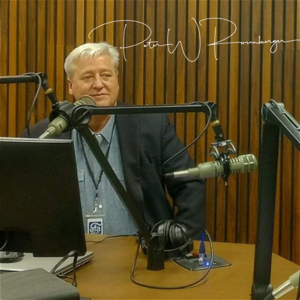
This is the Truth Network. Welcome to Hope for the Caregiver here on American Family Radio. This is Peter Rosenberger, and this is the program for you as a family caregiver. More than 65 million Americans right now are doing this. Are you one of them?
If so, Welcome, you're in the right place. If not, welcome, you're in the right place. Because if you love somebody, You'll most likely be a caregiver. If you live long enough, you're going to need one. We all got some skin in this game.
We're all going to deal with this issue. And how do you help the family caregiver? How do you help somebody stay strong and healthy as they take care of someone who is not? And that's where this program comes in. And I'm bringing you 40 years now of experience.
Most of it through failure, most of it the hard way, but things that I've learned along the way. that I want to offer to say, okay, look, here's where I found solid ground. Here's where I was able to stand a little more securely and catch my breath. Here are the things that I've wrestled with. I've looked at this mountain for a very long time.
And I've come to some understanding, and I'd like to be able to share that with you. And I thank you for taking the time to listen. Hopeforthecaregiver.com. Hopeforthecaregiver.com. Let's talk about failure.
A great way to start off the program. But I listened to a lot of caregivers, I've talked to thousands of caregivers. And failure. and the fear of failure. is heavy on the minds of a lot of us.
Is it on yours? Is this something you struggle with? And and and if it is Well Let me just go ahead and say it is my belief that for the most of us, that that is something that looms large in our mind. I was interviewed some time ago by AERP and they asked me a strange question. about caregivers who struggle with the task of caregiving and their perfectionist.
and how did they reconcile the two and what advice would I have for them?
Well, the premise of the The question Stop me a little bit. What is a perfectionist? Who who of us is a perfectionist. What do we mean by that? Do we get it perfect?
Do you know anybody who does? And I would suggest there's a right way and a wrong way to do certain things, you know, math, for example. Math is perfect, but that's not because I'm perfect, it's because math is perfect. Math always works. You can't argue with math.
I mean, well, in today's world, people argue with, you know, a brick wall, but you know what I mean.
So Who of us is perfect? How many times I've heard A lot of musicians over the years. I remember when I was in eighth grade, I met Van Klyburn. arguably one of the absolute best Concert pianist. Ever.
I even got his autograph. I got to talk to him when I was eighth grade. That was a pretty amazing moment. And Yet even he was not Perfect. At what he did.
Salvador Dali said, Have no fear of perfection, for you shall not achieve it. And I think about that.
So we throw this term, I'm a perfectionist. And people throw that around as if somehow that delineates them from everybody else who just wants to get the job done. I've watched carpenters, I've watched ranchers. I've watched Name of every kind of profession, surgeons? Which of them are perfect.
And when you say you're a perfectionist, that means you're striving for perfection. I understand that. I understand that you want to get it right. But perfect. Perfect is something different, right?
imperfect are not the same words. Perfect is without flaw. Are we going to do that? As caregivers? as human beings.
What have you gotten in your life Perfect. Ever. And if you call yourself a perfectionist, Give me an example of something you've got perfect. that was generated by you.
Now I can affirm Something. That is perfect. Like I said, math. I could affirm That this is done the right way. But perfect, we're real casual with that word.
One of my favorite hymns, it was the one we started off this whole series I do of hymns that every caregiver ought to know, has the word perfect in it. Mm-hmm. Holy, holy, holy, perfect in power and love and trinity. Perfect. There's only one perfectionist.
And that is God. The rest of us are poor shadows of that. We aim to get it right. We really want to get this right. and we want to do the best.
Michael J. Fox once said. Perfection is God's business. Excellence is ours.
Now, when we're talking about excellence, now we're in a little different category.
So For people who say, well, I'm a perfectionist, you know, and I always look at them and say, well, Spend some time in my world. That'll sand that perfectionism off of you. Because you realize as a caregiver we're going to fail. And we're going to fail sometimes miserably. And if you say, well, Peter, I'm not going to, then you haven't done it long enough.
Let me tell you something, I shook hands with failure a very long time ago. I can't keep up with it.
Now, you may have a different story. You may be doing this for 40 years through a medical nightmare that is every day dealing with this kind of thing. And you may say, no, no, no, Peter, you don't understand. I achieved this. Yeah.
If you have done that, then I want you to write a book because I'll read your book. But I haven't met anybody that has. In fact, all the caregivers that I know, that I've talked to, Sometimes just sigh and hang their heads. And I tell you what, we become not perfect at, but really, really good at. Is saying we're sorry, and making amends.
which I think is closer to perfectionism than we think it is. Because that reflects the repentance and the heartache that we have of seeing our own failures. We're going to make failures. It is baked into the recipe here, baby. We are going to fail at this thing.
It is not a matter of if it is how many times a day is it going to happen. The question is what do we do with that failure? And then I want to throw something else at you. If you. If perfectionism is something that weighs heavy on you.
And you are wrestling with that, and you're seeing your own record as a caregiver. And you're you're in despair.
Okay, there is a glimmer of hope that maybe this will help. Look at your attendance record. Look at your attendance record. See, I don't terribly worry about failure anymore. It is a given, it's going to happen.
It's going to happen today. I will fail at something to day. But I'm still here. I don't stay up late at night worrying about failing at things. I understand that.
I I've I've I've already accepted this. But what does trouble me is shirking responsibility. I want to be. faithful to complete this task. And that's where I bend the knee to the Lord.
and say, Lord, I'm not up to this. I've seen my failure. I'm not up to this in of myself, And that's why I love the line from the hymn, Greatest Thou Faithfulness: strength for today, bright hope for tomorrow. Because he does provide strength for today, knowing that I'm not up to this. I have a huge record of failure.
But I also have a huge record of attendance. And I've been here, and I'm still here, and I'm going to be here, and I'm going to see this through because that's what Paul talks about. Run the race well.
So that when we arrive in heaven and face our Saviour, we hear those words that we long to hear, well done. I don't care how bloody, beat up, bedraggled.
Well, what shape are we in? I've already determined I'm having a clothes casket. There ain't gonna be nothing left of me. My sister thinks I'm gonna go out in a poof of smoke. That's okay.
Because when I cross the finish line, will I look at my Saviour's eyes? and hear from him well done. Not because I did it perfectly. Because I showed up and trusted Him to work through my imperfections. Look, the standard is perfection from God.
That's the standard. The problem is that we're not. And the gospel is that Christ was perfect. is perfect. I've spent a lifetime discovering all the ways that I'm not perfect.
The good news of the gospel is that my hope doesn't rest in my perfection, but in Christ. God never lowered the requirement of perfection. He provided it in his own son. That's hope for the caregiver, and we will be right back. Nobody taught me how to be a caregiver.
I've spent forty years. Learning the hard way. And that's why I created caregiver.substack.com. No scrolling and hoping to find a nugget. Just articles, audio, video, and practical insights I've learned over four decades as a family caregiver.
When I post something new, it goes straight to your phone. or your inbox. And by the way, every bit of it is in Fluent Caregiver. Caregiver.substack.com Two. Yeah.
Welcome back to Hope for the Caregiver. This is Peter Rosenberger. Glad to be with you. HopefortheCaregiver.com. Hope for the caregiver.
If you want some more information, you want to see what we got out there: books, music. You can link to my sub stack out there, all kinds of things at hopeforthecaregiver.com. What are you doing today? What are your plans for today? What are you accomplishing today?
And you say, well, Peter, you know, you... I'm just trying to get through the day.
Well, you've got a day. What do you at the end of this day What do you think you'd like? to look back on just Since you got up this morning, And say I accomplished that. I did this. I am convinced of something.
I've been thinking about this for a very long time. I'm convinced that we as caregivers are so busy trying to just survive in this. that we're not accomplishing things that give us a deep sense of satisfaction and purpose. COVID really showed the world. what it was like to try to not die.
versus living. And and we were so risk averse. in in in the COVID time And we were led astray by a lot of these people in office, sadly. But it also illuminated a. A character defect in the human condition.
Is that we have this built-in, baked-in problem. Just not trying to die. It's not enough to live. You know, Jesus said he came to give us life and life more abundantly.
Now is that on hold until we're in heaven? Or is any of that abundant life now? We have a huge. swath of the Christian community that looks at abundant life like the prosperity gospel. And which by the way, I'm a huge proponent of the prosperity gospel.
I have all the riches of Christ that are bestowed upon me. Through the redemptive work of God through Christ. I may not see them all in this lifetime. In fact, I'm certain I won't. But that's okay, because that's the promise.
But Some people hijack that to think, okay, we're supposed to have this now and this kind of car and this kind of life and this kind of this and this kind of well, that that's all a bunch of hooey, you know that. They don't spend any time in our world as caregivers. That'll burn that out pretty quick. But life abundantly, what does that mean for us as believers? And I've been lately going through the book of Matthew, and there was the parable of the talents, and when the.
Master gave the talents. It was weights. Talents were considered weights of measurement of whatever. It wasn't necessarily the talent to play the piano, it was a talent of some type of. Value.
And there was the assumption that these individuals who received the talent would do something productive with them. And then, when the third one did not do anything, just buried it and walked away and did something else. The amount of time to bury. whatever that was that he had. was almost insignificant.
And it wasn't being lost, but it wasn't doing anything. And you see what scripture says, what Jesus said, you know, wicked servant, called him a wicked servant. Do we do that? Are we prone to do that as caregivers and give ourselves a pass on that?
Well, hey, we didn't die today. You know, I it I didn't lose it. Is is that enough for you? Is that enough for you to look? at the Lord one day and say, Well, hey, you know, I d I I you know I kept it buried in the backyard and I didn't do anything with it, but it didn't get stolen.
You know that That's not going to fly. And there is the underlying expectation. as believers, that for us, that we are to be productive. Productive about what?
Well, were to provide For our families? were to be good stewards of what we have? And We're to be productive in the kingdom. of advancing the kingdom. And that requires resources.
profit and income and all those kinds of things. And you think, well, what could I do, Peter? I'm a caregiver.
Well. I'm glad you asked. You've you've asked the right question to the right person. because we can do something as caregivers.
Now I don't know what that looks like for you. I really don't. and and money may not be an issue with you. That's fine too. All of that's great.
But productivity is always an issue for us. And money is not the driving. Urge for us. I mean, we just saw this thing where Elon Musk is now worth $1.1. one trillion dollars or something like that.
And there are a lot of people in this country who are just losing their minds over this.
Well, what could he do with all this money?
Well, it's not like he is sitting there. In a vault full of gold, just diving around like Scrooge McDuck. You know, that's not what this is. It's tied up in capital. If he cashed all that out right now, hundreds of thousands of people would lose their jobs.
It's all tied up in working capital as being productive. It's not like he's got it buried in the backyard. People that complain about that don't understand wealth and capital. And I'm sorry for that because that's a reflection on our education system, but that's a different conversation. The point of it is that.
That productivity, it's working. What kind of capital do we have? And what is it doing? What is it accomplishing? What can you do?
What do you enjoy doing? What do you enjoy doing that's productive, that is advancing? Your Mm. talents that God has given you. The weight of what he's given you.
And you say, Well, you know, Peter, my time is filled up taking care of my mother or this or whatever. I get all that. But what is your mind doing? Do you know when I do this program? For example.
I don't do this program. I look at a wall sometimes in my studio here.
Sometimes I open the curtains, but it's real bright usually when I'm doing this. And so I can't see the screen and anything else I'm doing. But I don't know who's listening. I know that there's one guy that's in Jackson, Mississippi that listens. And he He sends me a note about every month.
Now, well, I don't know if it's even a he because it's anonymous. He just signs it as a friend. And he usually puts a small donation in there of cash to standing with hope. And it always comes at the absolute Right time for me. And I don't know how to thank you.
You're listening to this program. My friend and Jackson, you know what? Thank you. I don't know how to properly thank you because I don't even know who you are. But I know that you send a verse, you send a quote, you send a scripture, and then you he puts a $20 bill, or she puts a $20 bill in it.
I have no idea who this person is, but it always comes. At a time where I need to hear that kind of encouragement, I never know quite who's listening to this program unless you write me and tell me. And so, to my friend in Jackson, I thank you. You do not know what an encouragement you are to me. And I'm very, very grateful for that because it's been a.
It's been quite a journey. And I'm very, very grateful. But when I do this program, I don't just Get in my studio and start talking about these things. I'm thinking about this all the time while my head is in the dryer pulling out clothes, not in the stove.
So don't call anybody, y'all. It's not even a gas stove, which I want to get, by the way. I had one in Nashville and I missed it. I miss it very much. But out here, we've had an electric one that was kind of inherited with this old cabin.
And so I'm going to, when I can afford it, I'm going to get me a gas stove because I do like cooking with gas, but my head won't be in the gas stove.
So don't panic. But when my head is in the laundry or when I'm mopping or cleaning or putting away clothes or when I'm doing all the chores that are involved in being a caregiver, my mind is working. I'm thinking about this program. I'm thinking about the next article that I'm going to write. Most of the stuff I write.
I I I write in my head. Whether I'm on the way to the pharmacy, whether I'm on a horse, whether I'm out working in the yard, whether I'm cooking a meal or cleaning the kitchen, whatever it is. You know, I've written articles while I've cleaned the toilet. You know, I do this all the time in my mind so that when I do sit down and I have those moments, I'm being productive.
Now, my question is: what are you doing? Are you being productive with what you have where you are? We somehow think that maybe our efforts are paltry, and to man, they look that way. But not to God. Because if you're doing it as unto the Lord, Lord, this is what you've given me.
And I want to be the best steward. Remember, I talked about in the last block. I don't want to shirk my responsibilities. One of these days, we got to look at him in the eye. And we're going to have to give an account.
I don't have to give an account for Elon Musk's one-point something trillion dollars. but I do have to give an account for what I do with to day. And how I take care of Gracie, and how I take care of the things that God has entrusted with to me, and the talents that He's given me, the weight of value that He's given me. Whether it's my ability to write, whether it's the money that I have, whether it's this radio program, whatever it is I have that has been entrusted to me, I have the ability. the responsibility to work it.
And if I don't know how to do it, Then that's when you raise your hand and say, I need some help with this. That's one of the reasons I stay a little bit chagrined that more and more people in the church don't see, for example, a single mother with a special needs child. And that mother has to make a living. Does anybody with any kind of business acumen come up alongside this woman. Or this man, there's a single father with a a special needs child.
And say, what do you want to do? Let's explore this. And what can I offer you out of my business skills to help you achieve a sense of financial stability and even grow your wealth while serving as a caregiver, a home-based business, or whatever else? But to do that, nobody did that for me. I wish they had.
I wish they taught me a lot more about business. I've had to learn everything. I've had to forage for all this stuff.
So I want to put this out there for people to say: okay, look, I don't know what I'm capable of. But I sure would like to explore that, and I want to be a good steward of what I have. I want to I don't want to hear you wicked servant. I want to hear well done. I want to hear that what I have done with what God has entrusted me has value to Him.
Ultimately to further the kingdom. And to tithe to our church. To be involved in ministry and supporting other ministries, to lift others up and point them to Christ. That's the whole point of all this as believers. It's not to amass wealth for the sake of amassing wealth.
It is for us to be industrious, productive people. Adam's first job in the garden was to be a steward of the garden, name the animals. I saw a great thing the other day, I think it was on the Babylon Bee, when Adam named the fly a fly. And he said, Now you're just being lazy, Adam. And I thought that was pretty funny.
So, what are you doing today? What do you have in your life? at your hand that you could be productive with today. I don't care. How insignificant the world may look at it is, what can you say to God?
God, I want to be productive with this. I want to do something to advance your kingdom. I don't know what that looks like. Would you show me? Would you teach me?
Get into His Word and see the things that are possible for us as believers. That's how we do it as family caregivers. That's how we do it as believers. This is Peter Rosenberg, we'll be right back. If you're feeling overwhelmed, exhausted, or carrying more than you could put into words, I've created something just for moments like that.
Go to hopeforthecaregiver.com. Right at the top of the page, click the blinking Caregiver 911 light. That page will take you to a short guided audio I made to give caregivers a quiet place to pause, breathe, and set the load down. You don't have to fix anything. You're allowed to rest here.
Hopefortharegiver.com. Click on Caregiver 911. Welcome back to Hope for the Caregiver. This is Peter Rosenberger. Glad to be with you.
Hope. For the caregiver.com, hopeforthecaregiver.com, or you can go straight to my substack, caregiver.substack. Yeah. Either way, you can find all the things that I have out there for you as a family caregiver. Things that I've learned.
over a lifetime. The learning curve is a bit steep, so I would encourage you to take advantage of the fact that somebody has put these thoughts down there, and that somebody just happens to be me. Don't look at the messenger, look at the message, because the messenger, well, you know, he's Well. Look at the message. It's out there at caregiver.substack.com.
Father's Day It was this weekend. And Father's Day can be Complicated. For some, it's a day of gratitude. It is for me, even though it comes with a bit of sadness, because my father's no longer on this planet, but his words His love, his life, his legacy still. Um are Ever with me.
I can hear his voice at times. It it's just uh and I miss him terribly. For others, though. It can be a um a day of grief, of anger, of regret. of longing Some remember fathers they dearly loved.
Others struggled to remember a father at all. Thinking about Father's Day. Recently a friend of mine sighed and said I I guess I'll have to figure out. A way to honor my father. The hesitation said more than the sentence.
Years ago a caller called to my program here and I remember this guy very well, and his father was an abusive alcoholic. And he had had some kind of event. I think he broke his leg or had some kind of stroke, something happened, and he required assistance, but he had still. He was still drinking. He had not stopped drinking.
And he was still. what he was. And the caller was fifty-two years old. You may be listening now. I'll never forget your call.
and he confessed that whenever he was around his dad he felt like he was eleven years old again. Not fifty-two. Eleven. The years had passed. But the wounds had not.
Another friend Put it bluntly and said My father was a pedophile. There was no explanation attached to the statement? There's no attempted to soften it. It was just it it just was what it was, the stark reality of a life marked by a father's betrayal. I once heard a well-known minister.
Very famous minister. Recount. He was standing at his father's grave. He was 16 years old. And he said he felt like he was going to lose his mind.
'Cause he was looking at the headstone and he cried out through his just his anguish. Y you can't leave. You didn't tell me what you thought of me. And he wasn't grieving the loss of the money or advice or even protection. He was grieving the loss of a verdict.
Who am I? What do you think of me? For all our confusion in this culture about identity. And there seems to be quite a bit. I mean, when we got a Supreme Court justice who can't even ad identify what a woman is.
There's a truth that remains. No matter how Askew, the culture is, and how ridiculous some of these people are. There is a truth that remains remarkably stubborn. People know when something essential is missing. Despite all the pretzels that our society is trying to turn itself into with our media and our news and academia and all that kind of stuff.
People are spending their lives searching. For the same thing millions, millions and millions. A father.
Now men sire children every day. But being a father is something else. You know, I live out here around cattle. I see bulls getting cows pregnant. all the time and then when they're done with breeding The bulls are off at another pen.
They just sit there and sit out in the sun and eat, and they don't care anything about it. We have a lot of men like that in our culture, sadly. But being a father is something different. A father forms, he blesses, he corrects, he protects, he teaches. He commissions.
Remember, last week I talked about it is well with my soul. Whatever my lot thou hast. Yeah. me to say With a with one word a father can instil courage or fear. He can strengthen a child for the journey ahead or leave wounds that that linger for decades.
A father's voice can penetrate places. Explanations never can. I remember one of the lasting testaments to my father. is the time that I I was going to speak at a conference in Maryland. With Huntington's disease.
And this was a very big conference. There's going to be like 900 people there. I went there the night before to meet and greet everybody. And then the next morning, I was the keynote. And the suffering in the Huntington's disease community is.
is over is overpowering. And I'm no stranger to these kinds of things. And I went back up to my room and I was talking to my father, and Huntington's disease had been in his family. And I said that I don't feel qualified to talk to these people. And this is, you know, I'd been doing the show.
I'd even had a new book that was coming out. But I was faced with suffering on a on a pretty it was pretty rough to see this. And he about came through the phone. Normally he didn't do that, but he about came through the phone. He said, You have been uniquely equipped and prepared by God.
to talk to these people, and there's nobody in line behind you to do it.
Now get down there and do your job. And you know what I said to my dad? Yes, sir. Yeah. 'Cause there's no other words to say at that point.
He commissioned me to do it. He wasn't interested in my excuses. Remember, we talked about productivity. He was interested in me using what God had given me and going out there and advancing the kingdom and being productive. There was no other question about this.
Father's voice can go into places explanations can't. Yeah. Forty three years ago Gracie woke up from a three week coma following her her car wreck. She was broken, she was disoriented, she was in unimaginable pain. and she's not known a day without it since then.
Even in her dreams she says she's in pain. She didn't know where she was, she didn't understand what had happened, she couldn't comprehend what lay ahead. But the first words she heard when she came into consciousness were spoken by her father. And as she groaned, her father's voice, and he has his very rich, dig. Big voice.
said Daddy's here, Gracie. That is here. She didn't even know what here was. But she knew her father's voice. Many, many years after that, you know, we had gotten married and had children, and our oldest son was a toddler at the time.
And he fell on a playground and and split his chin open. And I rushed him to his pediatrician. Where he got stitches. And I held him while the doctor sewed him up and Our son looked at me with fear and confusion. I mean, he was terrified.
and I was having to hold him down while this this was happening to him. And he was like, well, you know, you can see in his eyes, he felt just betrayal. Why are you allowing this to happen? You're my dad. You know, kind of thing.
He didn't have the vocabulary. He didn't understand. And he knew nothing about infection. He knew nothing about wound care or why stitches mattered. He didn't know anything about any of those things.
He was just a toddler. And there was nothing I could say to him that was going to bridge that gap. He did not have it in him at the time to understand this.
So I repeated the only thing I knew to say. It came out of me instinctively: Daddy's here. It's all right. Daddy's here. Daddy's here.
Daddy's here. It's all right. The explanation would have meant nothing to him but this, but the presents that I brought. meant everything. That's what Gracie's dad did in that room when she woke up in ICU.
Daddy's here. There are fathers who leave too soon, fathers who abandon, fathers who wound, fathers who spend a lifetime trying to repair the damage they've done. There are fathers whose voices still comfort decades later. And fathers whose words still wound. I knew one guy, a very prominent author, said he spent a lifetime trying to wipe his father's face off of God's.
That's how dysfunctional his relationship with his father was. But scripture doesn't ask us to measure God by our fathers. It asks us to measure our fathers. My God. Even when Jesus cried out, My God, my God, why have you forsaken me?
The Father had not surrendered his authority, abandoned his purpose. He hadn't ceased loving the Son. The darkness was real. The suffering was real. But the.
But the cross was was not chaos. it was the predetermined plan of God for the redemption of his people. Life eventually leads us all into very terrifying places that we don't understand. Hospital rooms, funeral homes, gravesides, cancer centers, long nights. at hard diagnosis.
In those moments we really want explanation. This audience understands this better than most. Yet faith does not require complete understanding. The older I get, the more I understood how my son felt laying on that table. He was too small to grasp what was happening to him.
He couldn't understand why I allowed it. He only knew I was there. Living out here in Montana, I'm reminded daily of how small we are. The mountains were here long before any of us arrived. The rivers carved their courses before our names were spoken.
The winds that. Come across this valley, pay very little attention to my plans, fears, or accomplishment. I'm smaller than I can ever imagine. Yet older than the mountains, the rivers, and the wind itself. there is a voice that has never fallen silent.
When Gracie's father sat beside her bed and whispered Daddy's ear, it was a gift to a frightened young woman waking to a world she could not understand. But even that voice. was only an echo. Every good father's voice is. The best father's point.
to the greater voice. The worst fathers. Can't eclipse it. When explanations fail. And they will.
You know this as a caregiver. You know this. You know that there are no explanations. that you're going to be able to wrap your mind around as you look at the things that you deal with. That voice still calls.
To his children. And perhaps That's why those words Still move me after all these years. Daddy's here, Gracie. Daddy's here. In a frightened world And this audience understands a frightened world.
That phrase, Daddy's here. reminds me of a greater promise.
So this Father's Day, it may be complicated for you. It may be one of sadness, it may be one of longing, may have a wistfulness, grieving still. or it may be one that you just look at your dad with just amazement. There is a greater one. Who's always here?
and is keenly involved in the lives of his children. And that gives this caregiver A lot of hope. This is Peter Rosberg. My wife, Gracie, is a double amputee, both legs. Over the years we've learned something important.
It's one thing to stand. It's something entirely different when you're Standing With Hope. Through Standing With Hope we provide prosthetic limbs for Gracie's fellow amputees. And we strengthen and equip my fellow family caregivers. Both are rooted in the hope of Christ.
for the wounded and those who care for them. If you'd like to stay in with us, Visit standingwithhope.com slash giving that's standing with hope dot com Slash giving. Welcome back to Hope for the Caregiver. This is Peter Rosenberger. Glad to be with you.
HopefortheCaregiver.com. HopeforthTecaregiver.com. And by the way, while you're out at that site, Lots of stuff that I have out there for you. written video everything. Take advantage of it, but also uh our Facebook group.
We have a Facebook page, Hope for the Caregiver. We have a Facebook group that you have to answer a few questions to be able to join. You could like one, join the other, whatever you want to do. But I put out there different kinds of things, and I put out there a picture this week. I've been doing this, a series of these, because I snap.
pictures all over the place where we live here. And let you guys vote on it on whether it should be in the caregiver calendar. Every year I do a caregiver calendar. Of of just scenes from where we live here in Montana. And I put usually a quote there that drives home the point for us as caregivers that kind of settle us.
And people seem to love it. It's one of the ways that we. Thank people who support Standing with Hope. And, you know, a lot of ministries give out gifts and, you know, trinkets and so forth. You know what I'm talking about.
But I thought, you know, I don't want to just. You've got something kind of Mm-hmm. generic. I I I thought I'd I'd like to do something that You know, it's real personal. And so people love the pictures that I take around here.
And I thought, okay, let me just marry that with a quote of something we've said on this program for family caregivers and put it out there. And so I'll put a picture out on the Facebook page or the group and let people decide, is this something that needs to make the caregiver calendar? There was one I had the other day of a moose in a field and a snow-capped mountain behind it. It was just stunning. And it was just on the drive home.
And then I snapped one this week of the horses out in the paddock. And there were the neighbor's horses had gotten out. This is real early in the morning. The sun hadn't come over the ridge yet. And the neighbor's horses, I texted my neighbor and said, are these yours?
They came over to visit. And so I put that out there and all the horses were gathered together. We live on a dirt road. I mean, we're. almost 10 miles from a paved road.
And so it's not like it's a crisis if one of the animals get out. And his horses came over and talked to ours, and they were fellowshipping, and it was just such a great shot. And you could see his on the other side of the fence, and ours were there. They were like, hey, what's going on here? You know, kind of thing.
But it was a beautiful morning. And I thought, well, that might make a good caregiver calendar moment. And so, you could go out there and see for yourself and like the page. And I put stuff out there from my sub stack and everything else that I do.
So, I hope you'll enjoy it. Let's go to our hymn. That every caregiver ought to know We've been doing this series for some time of just hymns that I have found to be meaningful in my journey as a caregiver.
Some people don't care anything about this.
Some people just You know, they said, We're done. Peter, we don't talk about that. We don't care about that. That's boring. And some people didn't grow up with hymns.
They don't have any kind of appreciation for it because they didn't, it wasn't part of their life. Others Cherish them. But If you don't have any kind of background with hymns, I'm hoping that I can introduce them to you in a way that you find meaningful. And I talk a little bit about the music and how I do the chords sometimes and gets a little bit of a piano theory lesson.
So if that bothers you, Sorry, there's some that really like that.
So I try to kind of hit a smorgasbord. It's a buffet. Take what you want. Leave the rest. For this weekend I thought I would do a father-related hymn.
It was one of my father's favorite hymns. He loved the hymns. It was written by a Anglican clergyman. Originally, in 1849, his name was Frederick William Faber. But then he uh left the Anglican Church and converted to Catholicism.
And England's Catholics at the time were enduring quite a bit of persecution following the Reformation, and priests were in prison, tortured, and executed. They didn't for not renouncing their faith. It was a dark time. It was not the church's finest moment. Faber wrote this hymn to Honor those martyrs who remain steadfast despite suffering and death.
And um the the first words are faith of our fathers living still in spite of dungeon, fire, and sword. Oh, how our hearts beat high with joy whenever we hear that glorious word. It was not dungeon, fire, and sword was not a poetic exaggeration. There was real. bloodshed going on here and It was, like I said, it was just a dark time for the.
the church but many Protestants Interestingly enough. Embrace the hymn and simply broadened its meaning. What began as a tribute to Catholic martyrs. Under Protestant Uh persecution? became a general Christian anthem about remaining faithful under pressure.
Does that sound familiar to us as caregivers? Most congregations singing it today are unaware of its Specifically, Catholic origins. I mean, this has been in, you know, pretty much every Protestant church I've ever been in. Faith of our Fathers, holy faith, we will be true to Thee till death. You know, whether this is sung by Catholics, Protestants, missionaries, or persecuted believers around the world.
The message is the same. Faith worth living for is faith worth suffering for. Most people hear Dungeon, Fire, and Sword and they think of dramatic martyrdom, but you know, many of us as caregivers face a different kind of endurance. We we don't have prison walls and there's no executioner's blade. Um There's another day, there's another appointment, there's another surgery, there's another long night.
They're painful things in our life. This guy was writing about brutal Hard. agonizing things. And this is what he landed on. Um it it's A roadmap for us as caregivers.
Okay, if they can land on this. Then that gives me the courage to trust him with my stuff.
So let's go to the caregiver keyboard. Shm. The faith of our fathers live still in spite of. Oh, how our hearts beat high with joy whenever we hear that glorious world. And then a great lyric.
Oh, how our hearts beat high with joy. Whenever we hear that glorious word, Faith of God forever. Thank you. Yeah. Mm.
faith we will be true To thee till death. Our fathers chained in prisons dark, We're still in heart and conscience free. How sweet would be their children's fate if they, like them. could die for thee. Faith of our fathers, we will strive to win all nations unto thee.
And through the truth that comes from God, mankind shall then be truly free. Faith of our fathers, we will love Both friend and foe in all our strife, And preach thee too, as love knows how, By kindly words and virtuous life. What a great hymn for us as caregivers because it's talking about: look, this is not going to have a rosy. scenario here. In fact, it's going to be hard.
and it's probably going to get harder. but by modeling out what we believe. we are able to preach a Preach the gospel. People are watching.
Okay, what You say you're a Christian, but look how you're striving. Look how you are at odds with your life. How does that reconcile with the Christian faith? That's the kind of question people ask, whether they ask it directly or subconsciously. They're still seeing the disconnect if we're striving as believers.
But when we are not striving as believers and we're dealing with what we have right now, even through tears. It doesn't mean that we're just going around, just happy, happy, happy all the time, time, time. It just means that we're not striving with it. We're trusting God in it, and it shows on how we do this. And that's what preaches to people because this world is crazy with a capital K.
And Mm. People are looking for solid ground. Do we have it? As caregivers who are dealing with nonstop, relentless stuff, do we have that solid ground under our feet? Are we at peace with ourselves, with God, with others?
in the midst of all this craziness? If so, how would people know? If so, what would that look like? What would be the words that you would use? And this, these may be some of them: faith of our fathers.
Hmm. Hold these pain we will. It sounds like a little bit of a morbid hymn, and you certainly don't want to play this. Mm. I've heard it that way.
That's awful. I mean, take your time with it. You know, and just have some fun with it. It's a beautiful hymn to be able to do that with. But Hebrews says: remember those who spoke the word of the Lord to you, and when appropriate, imitate their faith.
Well, that's what this song is about. It's looking back at the faith of those who came before us. of our church fathers. the the apostles go back even to the prophets. The faith of our fathers.
How did we get here? How do we know these things? And to answer that question, we go to Ephesians 2, 19 through 20.
So then you are no longer strangers and aliens, but you are fellow citizens with the saints and members of the household of God, built on the foundation of the apostles and prophets, Christ Jesus Himself being the cornerstone. That's. How we got here. Listen to what the scripture says. This is the foundation, faith of our fathers.
And they devoted themselves, Acts 2:42, to the apostles' teaching and the fellowship and to the breaking of bread and prayers. The point of it is that we're not just doing this in a vacuum. even as a caregiver, so in the middle of the night, when it all seems like it's coming unglued. This is a hymn that you can sing, Faith of our Fathers. Living faith.
Living still, in spite of dungeon, fire, and sword, Oh, how our hearts beat high with joy Whene'er we hear that glorious word, That is a hymn that caregivers can sing in the middle of the night at any time in the hospital. Just hum it to yourself. And that's a hymn that every caregiver ought to know. We're out of time. This is Peter Rosenberger.
Go to hopeforthearegiver.com for more. We'll see you next time. Gracie, when you envisioned doing a prosthetic limb outreach, did you ever think? The inmates would help you do that. Not in a million years.
What does it do? I would have ever thought about that. When you go to the facility run by Core Civic and you see the faces of these inmates that are working on prosthetic limbs that you have helped collect from all over the country that you put out the plea for. and they're disassembling. You see all these legs, like what you have, your own prosthetic legs.
And arms, too. And arms. When you see all this, what does that do to you? Makes me cry. because I see the smiles on their faces and I know I know what it is to be locked someplace where you can't get out without somebody else allowing you to get out.
Of course, being in the hospital so much and so long. When I go in there, and I always get the same thing every time that these men are so glad that they get to be doing, as one man said, something good finally with my hands. Did you know before you became an amputee that... Parts of prosthetic limbs could be recycled? No, I had no idea.
I thought we were still in the. 1800s and 1700s. I mean, you know, I thought of peg leg, I thought of wooden legs. I never thought of. Titanium and carbon legs and flex feet and C legs and all that.
I never thought about that. I had no idea.
Now that you've had an experience with it, what do you think of the faith-based programs that Core Civic offers? I think they're just absolutely... Awesome, and I think every prison out there. Have faith-based programs like this because Return rate. of the men that are involved in this particular faith-based program.
and other ones like it but I know about this one. Are just an amazingly low rate compared to those who don't have them. And I think that that says so much. But that's so much. about Just that doesn't have anything to do with me.
It just has something to do with God using somebody broken. to help other broken people be whole. If people want to donate a used prosthetic limbs, whether from a loved one who passed away, Yeah. You know, somebody who outgrew them, you've donated some of your own. What's the best place for them to do?
How do they do that? Where do they find it? Please go to stanningwithhope.com/slash recycle, and that's all it takes. It'll give you all the information on there. What's that website again?
DanningwithHope.com/slash. Slash recycle. Thanks, Cracie. Take my hand. Lean on.
Yeah. We will stay.