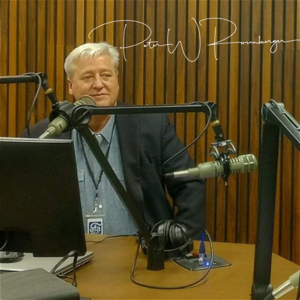
Um I'm Peter Rosenberger and after 40 years as a caregiver for my wife Gracie through a medical nightmare that has soared to 98 operations, both legs amputated, treatment by more than 100 doctors in 13 different hospitals and you can't imagine the medical bills.
Well I've learned some things and I've learned every one of them the hard way. And in my new book, A Caregiver's Companion, it's a journal from that journey. It's filled with hard-won wisdom, practical help, and yes, an ample dose of humor. Because let's face it, if we don't laugh, we're going to blow a gasket. and I've learned that I am no good to my wife if I'm fat, broke, and miserable.
How does that help her? Healthy caregivers make better caregivers, and that's what this book is about, pointing my fellow caregivers to safety, to learn to live calmer, healthier, and dare I say it, even more joyful as a caregiver. It's one truth I've learned, punctuated by either a verse from scripture or a stanza from a hymn, and a space for you to share your own thoughts. While this is my journal from a 40-year journey, you can journal along with me in this book. It's called A Caregiver's Companion, available August 20th from Fidelis Publishing, wherever books are sold.
Learn more at peterrosenberger.com. Welcome to Hope for the Caregiver. This is Peter Rosenberger. This is the program for you as a family caregiver, and I'm so very glad to be with you. HopefortheCaregiver.com.
HopefortheCaregiver.com. Today's opening topic, and we're going to cover a lot of ground today, is one that is, it's an old-fashioned word. We don't talk about it a lot, but it's a very important word. And it's part of a strategic plan that I have for myself and for fellow caregivers to help us navigate through the craziness. You remember I talk about the the fog of caregivers a lot, fear, obligation, and guilt.
Fear, obligation, and guilt. And we get lost in this. We can actually get hurt in it, just like in a real fog. What do you do when you come to a real fog? In uh in in driving and so forth.
Well, you slow down. Do you turn on your high beams? No. Why? because the glare will reflect back at you.
So you turn on your low beams and you slow down. How is that any different for us as caregivers? We also need to slow down. and stop looking so far into the future. We're we're straining to see way down the road.
But we can't. just going to glare back at us.
So we look right here. Thy word is a lamp unto my feet. and a light into my path, not a searchlight. And so we bring it. to write here in the moment.
and deal with that, and that fear, obligation, and guilt. And obligation is a terrible task, master. We start saying things like, we have to, we need to, we're supposed to, we should have, I must. That's obligation. The the word I replace that with is stewardship.
Now, admittedly, Archive. Our country, our culture, does not understand stewardship. I mean, we're almost 40 trillion dollars in debt. Honestly, we don't understand it. It's a kind of an old-fashioned word that has gone by the wayside.
Part of that is a culture that is leaning towards my, me. It's mine. But see, we were not designed this way. God gave us dominion over things as He is the owner. We are the stewards.
Sin has corrupted this. That's why you get things like abortion, for example.
Well, it's my body. My choice. My, my, my, my, my. Is it? Is there no accountability to any one other than myself?
Once you start having that conversation, is there an accountability other than to me. Then we're pursuing a much different path, and we're we're stepping into wisdom. Because there is an accountability. Scripture says, What do you have that you have not received? The hymn writer said it.
We covered this in our series of hymns that every caregiver ought to know, and this hymn we covered about. I don't know, about a month or so ago, great is thy faithfulness. And Thomas Chisholm wrote this, and he said, All I have needed thy hand hath provided. Again, where is the ownership? The ownership is God.
And everything we have, we have to give an account for. Scripture says we gotta give an account for our thoughts, words, and deeds. Take a look at what Scripture says, Matthew 12, 36-37. But I tell you that everyone will have to give an account on the day of judgment for every empty word they have spoken. For by your words you will be acquitted, and by your words you will be condemned.
Romans 14, 12.
So then each of us will give an account of ourselves to God. Hebrews four, twelve thirteen. For the Word of God is alive and active, sharper than any double edged sword it penetrates even to the dividing soul and spirit, joints and marrow it judges the thoughts and attitudes of the heart. Nothing in all creation is hidden from God's sight. Romans I'm sorry, Second Corinthians five ten, for we must all appear before the judgment seat of Christ, so that each of us may receive what is due for us for the things done while in the body, whether good or bad.
I could go on and on, but you get the picture. We are stewards We are not owners. We are stewards and not owners. and we will have to give an account. For our money?
for how we spend our money, for how we spend our lives, what we do.
Now how does that apply to us as caregivers?
Well, this is a conversation I've had many times as I have looked at this thing with Gracie. And the thing that I have that maybe a lot of people don't have is that there's never a plateau with us. It's always a roller coaster. There's always something that is forcing the issue. There's the crisis du jour, sometimes the crisis of the hour, you know, but it's it's always there.
So when you have something that is relentless, it forces you to deal with the underlying precept of what what's going on here? And I had to come to an understanding that I don't own this with her. I didn't do this to her. I I I wasn't even In the same state with her when she had her car wreck. I didn't even know her.
I didn't do this. and I can't undo it. I have no power to heal her, I have no power to fix this, I have no power to deal with this at all in any way capacity, as relates to what happened to her in her car wreck. In fact, the only power I have is my own thoughts, words, and deeds. That's what I will be held accountable for.
and the ownership belongs to God. He alone has ownership over this, not me. He can do something about it right now. I've had this conversation in this last year here when I when we were in the hospital for so long in Denver and I I said Lord you have not seen fit to heal her and you've not seen fit to take her home. She belongs to you.
And I need your help to be able to care for her. to be a steward for her. Stewardship alleviates me from results. and focuses only on my actions. It doesn't mean I don't have a job to do, because I do.
In fact, if you remember, Adam's first job was to be the The gardener, basically. And to name the animals and so forth. There's a stewardship component. We have to give an account for it. And if I know that I have to give an account, for all that I do on Gracie's behalf to God.
Do you think that changes anything for me?
Well, I can tell you from first-hand experience, yes, it does change something. It changes something dramatically. Because this is not about me. and I have to give an account.
Now, who do I give an account to?
Well, according to John five, twenty two through twenty three, Jesus said, Moreover, the Father judges no one, but has entrusted all judgment to the Son, that all may honour the Son just as they honour The father. Paul said it in 2 Timothy 4.1, in the presence of God and of Christ Jesus, who will judge the living and the dead.
So I will have to look Christ in the eye and give an account for how I took care of Gracie. Do you think that changes anything for me?
Yeah. What I do with our money, what I do with my physical body, because he has. seem fit. to entrust her to my stewardship.
so I have to be a good steward of my body. My thoughts, my words, my deeds, everything about me in order to better care for her because I have to answer to him. Do you see how that changes everything for us as caregivers? I'm not working for Gracie. I don't work for family members.
I don't work for friends of Gracie's. I work for good. And she belongs to him, and I have to give an account. and one day I will have to do that. That doesn't terrify me like it used to anymore, but what it does is instills a deep sense.
of responsibility And accountability, knowing that there's more going on here than I could ever imagine. And it's not about me somehow, well, I'm afraid God's going to get mad at me. No, that's not what it is. I don't want to disappoint him. I've given him enough to disappoint him, believe me.
So I don't want to do it anymore. But it takes all the burden off of me and results. And it's an act of faith to look at him and say, God, you have power over this. Abraham said this very clearly in his back and forth with the Lord over destroying Sodom and Gomorrah. And finally, Abraham got to the point where he just said, you know.
Shall not the judge of the whole earth do what is right? He recognized God's sovereignty. It's not something we need to walk around and just shaking and quivering in that sense because we are in Christ, but it's recognizing the hierarchy of command. He has entrusted me with this.
So when bills pile up, When stress piles up, what do I do?
Well, I go to Him with it now. I don't have to figure this out. I can't figure it out. She's twenty million dollars. I can't figure this out.
So I go to him. and I seek His counsel and His word. And thy word is a lamp unto my feet. I go slow, I don't try to look too far ahead, and I trust him with the light that he's given me to do, and I do the next right thing. Verified against Scripture.
Everything I do has to be under that rubric. because he owns all of this. and it is an act of faith to recognize as such. By the way, without faith, it's impossible to please God. And by recognizing Him as owner, that is a great step.
a great part of being able to please him. Father, you own this, and that is hope for this caregiver. We'll be right back. Welcome back to Hope for the Care Giver. This is Peter Rosenberger.
Glad to be with you. Thank you, Rob Galbraith and the Not Ready for First Service Players. I want to touch back on what we talked about in the opening monologue here about obligation and stewardship. Obligation uses words like I must to, I have to, I'm supposed to, I should be. Stewardship says I'm entrusted with.
I'm entrusted with. Yeah. will give an account. I want to be able to give a good report. See the difference?
See how that changes the way we look at these things. Obligation comes from this self-imposed or people-imposed sense of you'd better do this. Versus What does Jesus say? Take my yoke upon you. It's easy.
Just Give it to him. Hey, I can't do anything about this. It doesn't mean that you won't grieve over it. It doesn't mean that it won't hurt. It doesn't mean that it won't be difficult.
It just means that you're not responsible to fix it. Look down at your hands. If you don't see nail prints, this is not yours to fix. I've been saying that since I went on the air back in 2012. If you don't see nail prints on your hands, this is not yours to fix.
My wife has a Saviour. I am not that Saviour. And so that obligation drives me into very, very dark places, and it takes about microseconds to get into resentment. And if we're doing this filled with resentment. Either towards our loved one, towards ourselves for being in this situation, towards family and friends who are putting pressure on us to do certain things, or even towards God.
We have landed squarely. in the land of obligation. As opposed to stewardship, Let's reverse this thinking. Take this mind in you, which is also in Christ Jesus. Do not be conformed to this world, but be transformed by the renewing of your mind.
Do you see how all these things start to domino now? You realize, oh, my thinking is wrong on this. I'm not in line with what Scripture says. I'm aligned with what I want. And that's what gets us into these uncomfortable places, and sometimes very dangerous places.
Once we understand that we're not responsible. I go back to what Gracie said before we went into surgery on the 91st surgery.
Now she's gone up to 98 now, but this was at number 91. and I was in pre up with her, and I said, I was praying and I said, Lord, it's just too much. And she corrected me. Right after I, you know, I didn't already finish the prayer. She said, she corrected me.
She said, no, it's not too much. It's however many he says. That's a much different way of looking at things. Then saying, I have to, I'm supposed to. It's obedience.
And when you start going down that path of trusting God with this, I don't understand this. I don't like it. I've told you all this, I'd say this almost every show. I've offered my consulting services to God I don't know how many times. He hasn't taken me up on him.
He he he's not Worked up about that. I have seen no nothing in my inbox that said, Hey, Peter, what do you think? Nothing's there for that. And it's always about His decree, his purposes, what he ordains Now the question then we are all faced with then once we have this conversation going like we're having right now. The question then becomes, do we believe this?
I mean, do we really believe this? And if so, how would anybody know? How would we know? What does that look like? Let me go to the caregiver keyboard here.
We all know the. The hymns we sing it oh, tis so sweet. Interesting. In Jesus. Is it?
Is it sweet for us to do that? Just to take him at his word. We all sing this and kind of sway gently when we're at church. Just to rest. Upon his promise.
Just to Now that sounds really nice when we're singing that in church. And it's all that sweet. We just hum that around the house. while we're baking and so forth. Sing that when you're going into your wife's 91st surgery.
Tis so sweet to trust in Jesus, just to take him at his word. Do you see the difference now? Christian, what do you believe? Do it again. I see this.
Do we have Our culture here in so many different ways, whether it's in TV churches or just whatever, and people just say these things. And it's almost like they just glibly just say it. You you know you when you walk up to somebody say, How you doing? Fine, thank you. But you know they're not fine.
You're not fine. But we say these things because it's uncomfortable to go down into the basement here. But God's word. Over and over and over, he wants to deal with the internal stuff. I just read that the last.
Uh last block there. He wants to deal with the internal stuff. T that you know, that you know, that you know. Christian, what do you believe? Do you believe that he owns this?
As you look at your mother with Alzheimer's, as you look at your sister who's a drug addict, as you look at your father who has Parkinson's, as you look at. Y you're family member that is mentally challenged. Do you believe that God owns this? that he is lord of this. And if so, how does that affect your daily life?
Is there any change that goes on in your life? because of that. I know a girl. That lives his entire life Talking to people about Jesus. But when things hit him that are very uncomfortable, he melts down.
Now explain to me How those two reconcile? It's not that we're not going to grieve. It's not that we're not going to cry. It hurts. If I stub my toe it hurts.
If I, you know, what is it? I saw the thing about Legos being on the on the floor when you when your kids have Legos. My sons were both at the Legos, particularly our youngest one. And, you know, you step on a Lego in the middle of the night in a barefoot, and you're going to understand what's in your heart.
So just write that down. And the point is, though, are you questioning God in those moments when things that happen are so painful? Are you reverting back to this Infantile type of faith. or even if it can be called faith. And again, I'm gonna I'm going to tell you another story.
I've watched this with Gracie. She came out of surgery. And this brings us to our hymn of the day, by the way. See how I did that? That's why I have a radio show because I know how to segue.
This brings us to our hymn of the day. And it's not tis so sweet. How watch Gracie come out of surgery? After losing her left leg. She'd already lost her right leg four years earlier.
And she's halfway sedated. The right leg is healed up of course she'd been wearing a prosthesis But now she's a double amputee. And this was thirty years ago this summer. And she's Now got this uh Bloody bandage on it, drainage tubes, and everything else. And she is now a double amputee, and she's laying on the gurney.
They're taking her from recovery into basically step-down ICU. They didn't call it that at the time, but that's what it was. And she's laying there halfway sedated. and her hands are lifted to heaven. And she's singing a hymn.
Now you know what hymn she was singing? I kid you not. Let me go here to the caregiver keyboard and I'll play it for you. She was singing this hymn. Yeah.
Now you know that hymn. It's all one hundredth. That was written in, I think, in the fifteen hundreds, the tune by Louis or Louis Bourgeois. For the Genevan Psalter. And it was originally used for Psalm 100.
All people that on earth do dwell. But in the seventeen hundreds of This Gentleman, he was a priest, he was an Anglican priest. He was actually a bishop. Thomas Kinn. Thomas Kin.
He was a scholar and a bishop, and he was a poet. And it's just a short stanza of a longer hymn that he composed for the students at Winchester College. In England, and he wrote the morning hymn and the evening hymn and the midnight hymn, and then each hymn ended with the same final four lines, what we now know as the doxology. Praise God from whom all blessings flow. Praise him all creatures, here below Praise Him above, ye heavenly hosts Praise Father Son, and Holy Ghost.
And you You we've sung this m I don't know how many times. How many times have you sung it? I've been singing it my entire life. A lot of times it was done When the processional came after taking up the offering, the ushers would bring the offering up to the front and we would sing the doxology.
Now you remember what I told you a couple weeks ago. You don't have good theology If it doesn't lead to a A doxology. You don't have good theology if it doesn't lead to with doxology. It comes from the Greek doxa, meaning glory or praise. Logia, words or saying, doxa, logia, doxa, logia, mean basically.
Word of glory. It's a way of giving glory to God. And that's why you're not going to have good theology unless you have a doxology, unless you're giving glory to God. Again, I go back to this seminary, I won't tell you the name of it. I should, but I won't.
and the New Testament professor. at this seminary and you would know the name if I told you. was a was a Jewish woman. Not a believer. in Christianity.
and she was the New Testament professor.
Now how what kind of glory to God are you going to hear in that classroom? What kind of glory? to God.
So you a lot of the you know The demonic forces believe in God. Satan knows theology more than we will, but he doesn't give glory to God. It's not academic. It's what leads us to praise, to erupt in praise. And in the midst of what arguably was one of the worst days of her life when she became a double amputee, my wife was giving glory to God in front of nurses and that and she didn't care she was halfway out of it, but her spirit knew.
And she's praising God. Christian, what do you believe? Do you see the difference now? We're going to talk more about this. I've got another story about that when we come back from the break.
This is Peter Rosenberger. This is Hope for the Carecomer. We'll be right back. Welcome back to Hope for the Caregiver. This is Peter Rosenberger.
This is the program for you as a family caregiver, and I am very glad to be with you. HopefortheCaregiver.com. Hopeforthecaregiver.com.
Okay. We've Covered some ground here. We started off in the first block with one of the things that caregivers struggle with. I didn't identify it as such, but it's one of the things that caregivers struggle with that we don't want to talk about, and that is obligation. I feel obligated.
We're not doing this out of a sense of anything other than just, I'm supposed to do this. And that's what leads to resentment. We flip that, we retrain our mind, we're doing this as stewards. Biblically speaking, this is a biblical worldview. We're stewards.
and we're doing this as unto the Lord. You can go through lots and lots and lots and lots of scriptures on this. And then in the second block, I've segued into our hymn of the week, which is the doxology. Praise God from whom all blessings flow. And I have a different mic at the caregiver keyboard when I rotate and switch, so you'll hear a different sound.
See the difference? See the difference? See? I mean, I'm all right here together, but it makes it easier. But I love this hymn, and I've grown up singing it my entire life.
But I play it slower. Remember, we talked about this. I don't play things fast. Yeah. I mean, if we do it in congregational style, you'll want to go.
But I don't do it that way. I'm not in a hurry to play this because think about what it's saying. Praise God from earth. And I like to go to this. Basically, it is the inverted major three seven chord.
With a flat nine in there.
So sorry about that. But here's in context with it when you come to this Uh And then you do this. See how that goes to that minor six chord? Um which is the E minor and the key of G. But what happens if you go to the minor six right here?
Uh Isn't that nice? Uh I must put it in context here.
So you got. Still throw Now, some churches will go, Blessings, and they'll kind of race through it.
Some will hold it out, blessings. There's a formada right there, so you just hold that out. Uh Yeah. Yeah. Yeah.
Another formatta there.
So Now, watch this. I'm gonna go to the minor six. Um But you see the difference it makes when you have a song that that is. Like what we say is the doxology. It's a holy shout-out to God, if you will.
It's just erupting in praise. You're praising Him. If you are not praising God. With all that you know about him, What what does that say? Because you'll read in Paul and Peter's epistles, they'll just, in the middle of a sentence, just start breaking forth into this.
Jesus said if These don't praise him, then the very rocks are going to cry out. all of creation cries out. And that's why this hymn is such a significant hymn. And written, again, the tune was old 100th. It was written back in the 1500s.
The text was put in here for the evening prayer by Bishop Thomas Kin. And it's been a staple in churches for. Yeah. I don't know how. I mean, for hundreds and hundreds of years, it still is.
Let me tell you another story about this. You heard about Gracie singing this. Let me tell you another story. This is many years ago when we first started Standing With Hope, and it was in our first year, actually. We've been 20 years now this year that we've been doing prosthetics.
And I got an email from a guy that went to an internet cafe who wrote me about his son. This is before we had cell phones and WhatsApp and all that kind of stuff in the as widely spread as we do now.
So he had to go to an internet cafe and he wrote me. His son's hands were both burned off. He was an electrical worker, a line worker, and he was electrocuted, and he lost both of his hands. He was 21 years old. and he pleaded with me to put hands.
on his boy.
Well, the ministry is called Standing With Hope. We do prosthetic legs, we don't do a lot of arms and hands. But he pled with me and I met with our prosthetic team and I said, okay, what do we need to be able to make this happen? What are the materials that we need? You know what needs to happen here.
And so I gathered as many materials as I could. We went over there with the trip, and this was. I think this is the First full year we've been doing this is my third trip over there, I think. And I took our youngest son Grayson and his cousin Drew went over there. Grayson had just come off of winning this big bubble wrap contest of creating a new use for bubble wrap.
He was in middle school for a science project. And he formed a shell covering for below-knee prosthetic legs that you could then wear it, put a pull a hose over it, and it made it look like you had a real leg instead of a robot leg. It is an amazing story. You can go out and see it and just go Google it. It's a pretty amazing story that he did.
And he won first prize. He was in People magazine on the Today Show and everything else. It was kind of a cool thing.
So We're over there, and all week long the young man comes in there, and he had to basically wore kind of a smock thing so he could put on his shirt by himself. It didn't have sleeves or buttons or anything like that. And he kind of cradled a bowl of food that he had to eat, kind of like a dog, because he didn't have any hands. And he was a real sweet young man, and his father was very sweet. And we got over there, we took the mold of his limbs and said, Okay.
Come back at the end of the week, and we worked through the week. I had two prosthetists there with me. And we had the wrong part. We found that out on Tuesday.
Well, we're only there for one week at this particular time, or maybe I think we're there in 10 days, but it was Monday. He we casted him And Friday he's coming back. And we didn't have a lot of time.
So I called a prosthetic company in Tennessee and I said, we need these parts. They were real tiny parts, but they were important, and we didn't have them, and you couldn't just r go run and get them. And so they overnighted them on DHL And we kept working knowing that those parts were going to come, we hope.
Well, next day delivery to Ghana was not next day. Tuesday came, wasn't there. Wednesday came, wasn't there. Thursday came, wasn't there. And Friday a motorcycle showed up and it had the little box, DHL box, you know, on it, on the back, and he had the parts.
And it was so we worked through the the day to get those parts integrated into make the the hands for the the hooks. We're making basically hooks. And the power kept going off. Back in those days, the the generator that they had with the system wasn't firing properly and their electricity was it was just a pain to deal with it. We stop and start, stop and start.
Finally, we got everything made, but then the power went off because they shut the power down at six o'clock at night for whatever reason back there, so we couldn't have power. And we brought the van that we were using to the front of the The facility there, there was a ramp built by Johnny and friends and her Wheels for the World team, and we put this young man there, and I had one prosthetist on each arm. And we're finishing up assembling these things by the light of the van with the headlights. And then my nephew Drew held a video camera with a this again before cell phones, 20 years ago, so with the light from the video camera, and he's spotlighting it so they could see. And to my knowledge, we are the only ones that have assembled prosthetic arms by headlights of a van in Africa, to my knowledge.
And we finally got it, and then I we got this young man, we put the harness on him and he had the hooks, and then I held out the plastic card for my hotel room key. And I said, Can you grab it? And he reached out and because he's flexing muscles and the hook opened and then he flexed again and the hook closed on that little key card and he was able to grab the key card. from me, and take it and pick it up. and do it.
And you can imagine the cheers. That erupted from not only the young man, his father, the workers there at the clinic, our team, everybody was just, you know, we were exhausted. We were leaving the next day. And so this was it. We had to get this done.
And it was. It was dark. Everywhere else, because there was no power on any of the facilities except for the headlights of our van, and we got it done. And then the father looked at me and he said, You gave me your word a year ago. that you would do this for my boy.
And you did. And I'm most grateful. And we were all kind of tearing up at that point. And then someone, and I'm really not sure who. May have been me, but I don't know if that it was me that started with this tune Praise God.
Oh. From whom all blessings flow. Praise Him, all creatures. Here below praise in love of ye heaven we're singing this. Outside a dark clinic in Ghana.
lit up by the headlights of a van. This young man and he held his hooks up to give praise to God. Praise the Father. I can't even hardly get through it. And I thought.
You know. Just 10 years earlier. Gracie had raised raised both of her hands up. from her hospital gurney with both of her legs gone. And then here's this young man.
In God. Lifting up to prosthetic hooks. that were put on him because Gracie trusted God with her amputation. And both that had the same response. Praise God from whom all blessings flow.
There's something more going on here, folks. And as believers, if we're not If we're not dialed into that, we're going to miss it. We're going to be so consumed with our resentment. We're going to be so consumed with the the anger and the frustration and the despair and everything else that we're going to miss something else is going on. And God is weaving his purposes and all these things.
I don't understand it. Again, I don't pretend. It's uncomfortable. It's painful. But I cannot deny the efficacy of what I've seen.
Explain that. Without God. Explain that. Without the redemptive work of Christ.
Now do you understand why I'm doing this series on hymns that every caregiver ought to know?
Now, do you understand this? And now, do you see why the doxology, praise God from whom all blessings flow, is one of those hymns that you can sing. Anywhere because I've seen it sung from a gurney. And I've seen it sung outside a prosthetic clinic in Ghana by Hitlight. And I've got one more place I'll tell you about when we come back.
This is Peter Rosenberger. We'll be right back. Welcome back to Hope for the Caregiver. This is Peter Rosenberg, and I'm so very glad to be with you. HopefortheCaregiver.com.
HopefortheCaregiver.com. Okay, we covered one of the topics that caregivers struggle with that we don't want to talk about, which is that feeling of obligation and how to flip that into stewardship. We've covered One of the hymns that every caregiver ought to know. I said there would be thirty, there's gonna be probably three hundred. I don't know.
No, there'll be a lot. But I went with Old 100, the tune of Doxology as we know it. I wanted to tell you one more story about that. I've heard this performed and sung and sung it myself many, many, many, many times since I've been a kid. I don't have a conscious memory of not knowing.
the doxology. As we call it. But there are a couple places that really stand out, like the the time when Gracie sang it from the gurney, or this young man with both of his prosthetic hooks raised to heaven singing it. There was another time I was speaking at a church, and I'd gotten to know some of these folks, and this was a. little more of a rambunctious church.
Do I say that well? I I don't come from a rambunctious church background. But I've been in many of them, and there's a lot of excitement and a lot of, well, there's a lot of yelling. And it gets loud and people yell a lot and they yell right into the microphone and it's it's Pretty Bombastic. I d I don't Necessarily subscribe to that type of worship service because it's just.
It's a bit jarring, particularly when you live with what I live with. And I'd like to sit and kind of think about what I'm saying. I don't want to have my senses numbed by the time the service is over. I don't require being yelled at musically or personally. preaching was.
But that's what they did, and that's fine. And I appreciate them having me there. And I was speaking, but I was. Talking about some of the things that I talk about on this program, this church, when they sang it was with the full-out worship band, I mean, it was loud. I mean, it's just overpowering at times.
It's pretty loud. But I told the story of Gray C. Singing from the gurney. and I said, Sing this with me. And I watched something happen, with this group of people.
That are so used to Loud. They're so used to this thing being just over the top. But whether it was my subject matter or my delivery, whatever, but they were in a much calmer. Yeah. see them and and then I started off just a cappella not doing it with the piano.
Praise God from Mm-hmm. And I kind of conducted them a little bit, so they kept the time with me. Blah. seeing some pop. and they started singing with me.
And they started singing softly. Not yelling it out. Not saying, come on, church, you know, you're going to get your breakthrough. None of that stuff. It was just very.
Soft. And you could just see a ripple effect. throughout the congregation. you you could see a a remarkable change. when they slowed it down.
And we talked about that at the beginning: of this obligation that we have that we feel like we got it, we got it, we got it, we got it, we got it. But when you slow down, When you get to that fog, if you will, of caregivers, when you get to that fog of anything, slow down. We're not in a hurry. Just slow down. And they slow down, they sang it with me.
And by the time we got to the end, They were almost whispering it. And you could see tears. in their eyes. And it's not that everything has to be slow and plotting and all that stuff. I mean, I like stuff too, man.
I mean, I'm, you know. You know, I mean, I'm I'll Get it. Get after it. But there's a place for that. But again, Who am I speaking to?
Who's my audience? My speaker speaker told me years and years ago, he said, we don't have a speaker quite like you that understands who their audience is the way you do. And I was surprised by that because I was thinking, well, how could you be a speaker and not know who your audience is? How can you not read the room? But evidently that's a thing.
I know exactly who I'm talking to. I'm talking to people whose nerves are so raw. Because the concussive grenades going off of suffering in their life and trauma and frustration and weariness, they do not want to go into a worship service and hear people just screaming all the time. And they don't want to go into a worship service either and just hear dirge music. And when they hear somebody speak about these things, they don't want them to be just, well, well, well, well, well.
There needs to be passion, but it has to be appropriate passion for the subject matter. for the audience, and more importantly for God. What are we saying here? And if I'm shouting out over and over and over, go to get my breakthrough, go to get my breakthrough, go to get my breakthrough. I never forget.
I was watching Christian television one time, and there was this band up there playing, and they really were very good. I mean, they had it going on musically. And they were just thumping, but the lyrics they were singing were: I have been crucified with Christ, I have been crucified with Christ. And they just sing it over and over and over while the bass was thumping, the drums were just kicking it, the guitar was going. And I'm thinking, you have no idea what you're singing.
And if we slow it down a little bit. And think about wh what are we saying here? What are we seeing? You know, Gracie did not come out of surgery screaming. Praise God from whom all blessings flow.
She didn't do that. And this young man in Africa, you know, nobody was dancing around and jumping up and down. They just erupted in praise and lifted their hands and saying, Praise God from whom all blessings flow. Do you see the difference? One of the things I'm hoping to accomplish is to provide a vocabulary.
Both text vocabulary and musical vocabulary of what this looks like. For us as caregivers, I can't speak to everybody else. My audience is for caregivers. My audience is people who are. at their wit's end.
And I get letters and text. And phone calls from so many in this audience. And that's the overwhelming place that you're in. It's just you're just bone-tired, you're frustrated, you're despairing, you're angry, you don't know what to do. And I'm not going to come at you and just say, you're going to get your breakthrough, you're going to get your breakthrough.
Come on. That that is just insulting. But what I can do is redirect you. to the things of God. Because this is how I do it.
This is what I I I I'm only giving you what I what I cling to. I'm just one beggar telling another beggar where the bread is. This is what I found that sustains me in my four decades of doing this. And so, when I saw that congregation, I saw just a ripple. Of Peace.
of settledness, of calmness. That permeated over the entire congregation. And I thought Hmm. And it always comes back to these great hymns of the faith when you just slow it down a little bit and draw their attention to what the text is saying. Remember.
Good theology is always accompanied. Biodoxology. And that's why a lot of this stuff that we promulgate In so many different formats, and our culture is weak and it doesn't hold up. It's not good theology. It's just weak.
i in in some respects is just downright in error. You know, th you get the Churches, where they say, tell your neighbor, he's going to show up. Tell your neighbor, he's going to show up. They did that to me at one church. Every time somebody stuck their hand out, he's gonna show up.
And I took their hand and I said, he already has. He already has. He already has. Do you see the difference? I'm not trying to rain on anybody's parade, but it's time to grow up.
Suffering Does not touch. tolerate infantile theology. You can't do it. I've got a new book coming out this month, and I hope you'll get it. You can go out to my website and see the thing for it.
It's called and it'll click right to the link. It's called A Caregiver's Companion: Scriptures, Hymns, and 40 Years of Insights for Life's Toughest Role. And I put all these different quotes that I've clung to and discovered throughout my Four decades of this. And then all I do is marry that with a particular scripture. or a stanza from a hymn.
And then I give the reader a chance just to write my thoughts here. This is my journal. This is my journal for 40 years. as a caregiver. but I'm giving the reader an opportunity to put their journal in alongside mine.
Here's one of the quotes. Hospital rooms have a way of prompting honest reflections about how we feel about ourselves. one another and God. Caring for a declining loved one forces internal conversations that rarely come. any other way.
Now the Psalm that I put with this is Psalm one nineteen seventy one.
Sometimes I use a hymn, sometimes I use a scripture. In this case I used a scripture, and it's Psalm one nineteen seventy one. I'm going to give you the quote one more time. Hospital rooms have a way of prompting honest reflections about how we feel about ourselves, one another, and God. Caring for a declining loved one forces internal conversations that rarely come any other way.
And the scripture I used is, It is good for me that I was afflicted. that I might learn your statutes. That's not something you hear every day, but that's good that we were afflicted. But God uses these things to bring us to a greater understanding of Himself. the more we understand about him.
the more our hearts, then, are equipped to erupt in praise. Praise God from whom all blessings flow. Gracie's not the only one who can do this from a gurney. That young man is not the only one who could hold up hooks and praise God. We can praise God with whatever afflictions we have.
It is good that I was afflicted, that I might learn thy statutes. And whatever affliction we have, we can praise God with them. Praise Father, Son. and Holy Ghost. This is Peter Rosenberg.
We're out of time. Thank you for spending the time with me. If you found this program to be helpful to you, Would you help us share it with others? Go out to hopeforthecaregiver.com. Hopeforthearegiver.com, there's a donate button there.
It's a tax-deductible gift. You can help us do more of this.
Alright, we'd welcome the help. Healthy caregivers make better caregivers, and today is a great day to start being a healthier caregiver.
Okay, slow down. Don't look too far ahead and let's deal with the moment recognizing that you too Can sing a doxology wherever you are. HopefortheCaregiver.com. We'll see you next time. Gracie, when you envision doing a prosthetic limb outreach, did you ever think?
The inmates would help you do that. None. In a million years. What does it mean? I would have ever thought about that.
When you go to the facility run by Core Civic and you see the faces of these inmates that are working on prosthetic limbs that you have helped collect from all over the country that you put out the plea for. And they're disassembling. You see all these legs, like what you have, your own prosthetic legs. And arms, too. And arms.
When you see all this, what does that do to you? Makes me cry. Because I see the smiles on their faces and I know. I know what it is to be locked someplace where you can't get out without somebody else allowing you to get out. Course, being in the hospital so much and so long.
When I go in there, and I always get the same thing every time that these men are so glad that they get to be doing, as one man said, something good finally with my hands. Did you know before you became an amputee that? parts of prosthetic limbs could be recycled? No, I had no idea. I thought we were still in the 1800s and 1700s.
I mean, you know, I thought of peg leg, I thought of wooden legs. I never thought of. Titanium and carbon legs and flex feet and C legs and all that. I never thought about that. I had no idea.
Now that you've had an experience with it, what do you think of the faith-based programs that Core Civic offers? I think they're just absolutely Awesome, and I think every prison out there should have faith-based programs like this because the Return rate. of the men that are involved in this particular faith-based program. and other ones like it, but I know about this one. are just an amazingly low rate compared to those who don't have them.
And I think that that says so much. That says so much. about Just, that doesn't have anything to do with me. It just has something to do with God using somebody broken. to help other broken people be whole.
If people want to donate a used prosthetic limbs, whether from a loved one who passed away. Yeah. you know, somebody who outgrew them, you've donated some of your own. What's the best place for them to do? How do they do that?
Where do they find it? Please go to stannywithhope.com/slash recycle, and that's all it takes. It'll give you all the information on that. What's that website again? DannywithHope.com/slash.
Slash recycle. Thanks, Gracie. Take my hand. Lean on me, we will stay.