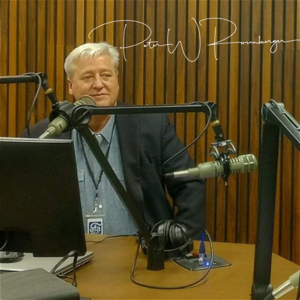
This is the Truth Network. The phrase jumped out at me last week during a military briefing about what's going on in Iran. It was the chairman of the Joint Chiefs, and he was describing the Straits of Hormuz. And he used four words that particularly described What I felt like was a lot of life. He called it a tactically complex environment.
Now that's a military phrase. But the more I thought about it, the more I realized it applies to far more than geopolitics. It applies to us as caregivers. Welcome to Hope for the Caregiver. I am Peter Rosenberger.
Glad to be with you today. Hopeforthecaregiver.com. HopeforththeCaregiver.com. If there's one thing caregivers quickly learn, it's that life rarely unfolds. In neat, predictable lines.
Have you noticed that? Most of the time we're operating inside what the military might call a tactically complex. environment. Think about it. You're sitting in a doctor's office and you're listening to test results.
You're trying to make sense of medications and procedures and. Diagnostic. Events that happen and decisions that affect someone you love. Everyone wants to know the same thing. How's this going to turn out?
Listen to the reporters at this event. What's going to happen? What are we going to do? What are we going to do? How's this going to, you know, they're freaking out about it.
I understand that. I want to have certainty too. And the honest answer most of the time is that we don't know. Caregivers live in that space. We make decisions with incomplete information.
We navigate emotions, exhaustion. Finances, family opinions, medical realities, all the time. We live in a tactically complex environment. That's our life. And the military understands important moments like this, you know, when the outcomes are uncertain.
What do you do? What do you what do you revert back to? You know, what do you think about? I'll tell you what the military does. That's what he said the other day.
If you watch the whole press conference, General Kane was going back to the mission, going to the mission, mission clarity, mission clarity. What are we here to accomplish? What's going on? The Navy can't control the currents there. If you look at the on the map, they look at the Straits of Hormuz.
I think it's about 30 miles across in one place. But look at the look at the map. Navy's not going to control the water. They don't know how to, you know, you can't ch change the currents. It can't control every ship that's moving through that passage.
I mean, look at all the ships that are going through there. And it certainly can't control what these people are going to do in Tehran. in different parts of Iran, but it can control the mission. What is the mission?
Well, they're going to protect that shipping. They're going to maintain security. They're going to avoid escalation when possible. But guess what? They're going to respond when it's necessary.
Mission clarity matters over outcome certainty.
Something's going to happen.
Some boat's going to get hit.
Something's going to happen.
Things just happened. Mission clarity, mission clarity. Does that sound familiar at all to us? We can't control everything that's going to happen with our loved one.
Something's going to happen.
I mean, it may have happened this morning before you even turned on this program.
Something's going to happen.
How we respond. reflects our clarity of mission. Do you see the correlation now? from that military term a tactically complex environment to us as caregivers. We cannot control the diagnosis.
We cannot control the future. We cannot control the complications that may come our way, maybe even just this afternoon. We can't control these things. But we stay clear about the mission. And what is our mission?
Let's talk about that. What is the mission that you have as a caregiver? Are you just a glorified babysitter? Are you just there to stand watch if somebody declines and we'll just get them on to Jesus and then go about with our life? Is that our mission as caregivers?
I don't think so. It's not mine. I've had to learn this over the years. It's not just to sit with Gracie in a hospital and wring my hands. That's not my mission.
My mission Is to I learned this at Bible College. I went to a great Bible college for a couple of years. They all agreed that it was probably not the best fit for me, but I enjoyed it while I was there. And I still stay in touch with them. Wonderful people down in South Carolina, Columbia International University.
And they have their mission statement. It's a very missions-driven school. Mission statement is. to know him and make him known.
So my mission as a caregiver is to know Christ and to make him known to Gracie in this situation. How can I better help her understand the gospel? in the midst of her distress. How can first I understand it better? And then how can I help her do it?
And by extension now, with you all as well as listeners. How can I do this? This is my mission. I am not here to fix your situation because I can't even fix mine. But I'm here to pass on what I've learned, to offer the clarity of mission, to know him and to make him known.
And so that's what I always fall back on instead of just freaking out and saying, you know, what's going to happen, Lord? What are we going to do? Watch a press conference sometimes with these guys. Just watch it. It's fascinating because you'll hear the reporters asking some of the same questions that.
We ask as caregivers.
Now, I admit loving to watch press conferences sometimes, to watch these reporters make fools of themselves because it reflects their commitment to their ideology and their lack of understanding. And they're trying to play gotcha and get, you know, get certainty out of certain things. And they wanted that certainty the other day.
Well, how many people are going to get hurt?
Well, what are we going to do about this? How much is this going to cost? But they go through the litany.
Well, I again, I love to make fun of the of the press. Because quite frankly, they've earned it.
However, their questions sound an awful lot like mine. And if you go back and look at your own prayers. The things that you go to God with in those dark places of the night. Do they sound like yours too? What are we going to do?
How much is it going to cost? How are we going to pay for this? What's going to happen? What's the certainty? Lord, tell us what's going to happen.
How many answers have you gotten out of that? You know, scriptures are filled with The same kind of prayers. God allows it throughout his entire word. How long, O Lord? Go through the Psalms and look at it.
These are not People in apostasy. These were these righteous. Saints of the Lord. who were still asking these questions. God understands that.
But if you go back and look at Jeremiah 3, Lamentations 3, Jeremiah is writing, and he struggles. He said, I remember the wormwood and the God. He's just groaning in his soul. And he said, but this I recall to mind, and therefore I have hope. Great is thy faithfulness.
That's where the hymn comes from. Go back and look at it. Lamentations 3. And it's okay to struggle with the reality of a tactically complex environment. It's really okay to struggle with it.
Scripture's filled with this. What's the mission? Jesus himself modeled this in Gethsemane. Lord, if it be possible Please let this pass for me. Nevertheless, what's the mission?
You see that clarity of thought? What that does is it steals our resolve, not steel as S T E A L, it's S T E E L. And it strengthens our backbone and our endurance and our perseverance till we understand what we're here to do. We're not here to simply endure the diagnosis of our loved one. There is something bigger going on.
And maybe we won't see any of that until we get to heaven. Then we'll have an understanding. We'll see things more clearly. of what the mission was. It may be things that God is sanctifying in you right now.
dealing with things in your life. I know it's been that way for me. Maybe for you too. It may be to prepare you for I don't know. I have no idea.
That's that's that's God's business. That's God's business. My job is to take the word that was given to me. through his Scripture, and act on it. And what was that word?
Well, The Bible college I had had to know him and make him known, but that is simply a derivation from the core word, which is preach the gospel and make disciples. Share the good news. and make disciples and teach people. And it starts with us understanding the good news, us having that embedded in our hearts, our hearts that are changed now from hearts of stone to hearts of flesh. It starts with that, and then to extend that.
to the circle of influence that we have which is primarily us as caregivers our loved one who is hurting Now, of course, the question is: can we preach the gospel and make disciples in the midst of suffering?
Well, I would say, yes, we can. Ask me how I know this. Nothing like experience. This is what we're called to do. That's the mission.
And yes, it is a tactically complex environment. But you've heard the stories here on this program. I've shared with you things that Gracie and I have done in the hospital in very dire circumstances.
Now I would love to tell you That I'm spiritually wise and mature, but you know better than that. Y'all have been listening to me, you know that. What do I have that I have not received? And what I have now is clarity of the mission. And that's what gives me hope as a caregiver.
That's why I call the program Hope for the Caregiver. And this is Hope for the Caregiver. And I am Peter Rosenberger, and we will be. right back. Welcome back to Hope for the Caregiver.
This is Peter Rosberger. This is the program for you as a family caregiver. More than 65 million Americans are serving as a caregiver right now. If you're one of them, welcome. You're in the right place.
If you're not. Welcome, because you're still in the right place. If you love somebody, you're most likely going to be one you live long enough. And you're going to need one. The purpose of this program is to help my fellow caregivers stay strong and healthy as they take care of someone who is not because.
Healthy caregivers make better caregivers, healthy caregivers make better caregivers, and on that note. I'm going to talk to you about health for a few moments here. You know, I've been on a kick about this for some time and also working on my weight. I've got a friend of mine who helps coach me through that, and I'm still maintaining that. I'm, pushing my way down to eventually losing fifty pounds.
and that may put me a little bit on the thin side, but that's okay. But I also get regular physicals. and try to get blood work on a regular basis, that kind of thing. And I had my regular physical in January. I had my schedule got interrupted a bit with all the surgeries that Gracie's had.
You know, she's had now sixteen or seventeen surgeries in the last six years. And we've had 11. Months. almost almost 11 months of inpatient hospitalization. In the last four years.
So that can be. A bit problematic for your schedule.
So I got a little bit behind, but not much on my regular physical, and I'm still a little bit overdue. For my colonoscopy, I'm going to get that here the next couple of weeks, and I'll tell you why. Because in my blood work I got in January at my physical, there was a marker that said, hey, we need to check this out. And they upgraded it. to a specialist, a urologist.
And They said they took some more blood work, x-rays, and ordered MRI, but they said we're going to escalate this up a little bit more here. because we're seeing something we don't like. and got the results of the MRI back. And We're going to do a biopsy. And that's going to happen here in the next several weeks.
And early detection worked. That's the good news. But they are about 80% sure it's cancerous.
So I was getting the they uploaded the MRI report to my chart my online portal chart that I have with my health. And so I saw the results. The Monday night I had a MRI on Monday evening. And I was going to meet with the doctor on Wednesday, and I saw the results. That evening, they were posted up to the chart, and I was able to go out and get that information from the results.
I did some research on what those results said. And I knew going in that this was probably going to be the next step: to order a biopsy. I didn't know. For sure, and we still don't for sure 100% know that it is cancerous, but they're 80% sure it is, but there's no symptoms. There's no interruption to my life, I would have never known.
Had I not gone and got a test.
Now, prostate cancer is not an uncommon thing in a lot of men, and it's very treatable if you detect it early. but detecting it early involves showing up. And uh and so I've been very regular on my physicals, but I Am a bit tardy on my colonoscopy, so I'm going to fix that problem. I just haven't had anybody that could go and take me over there and sit with me. But my son has moved out here now, and so he's going to go and help me out with that and make sure, and just to rule it out.
I'm not having any symptoms of anything, I never get sick. And that is alone a been a bit of s unsettling for the family. And I went and shared it with Gracie and what's going on. But I read the report in my office that night. I didn't tell Gracie that night.
She had already gone to bed and I was up late and I'm looking at that. And I got to tell you, that was a bit of a surreal moment. You know, and I'm thinking, well, this is just great. You know, but once the. conversation Um Once the conversation was had, with my specialist.
And I realized a couple of things. One of them is it's my first time and it's not theirs. And they weren't freaking out. They have. Three categories of ordering the biopsy.
One is we got to do it like today. And The other one is, we can wait a couple of weeks. And the third one is, we can wait about a month and we'll get this done. And that's where they put me. They said, look, you are so early to this game, and it's very, very, very, very small.
It's not causing any problems. It's not done anything. We can't see any adverse effects at all, but it is there. And so let's deal with it. And you know, this is not an uncommon thing for men of a certain age.
And um You know, it's going to be uh Um just a process I got to go through and deal with it. But what is the lesson? What is the lesson? The lesson is early detection. Always.
Always, always. And that happens when we as caregivers take care of ourselves. And so I've worked hard to do this. And like I said, I never get sick. I've had a knee surgery.
Um And I had an appendectomy that went horribly awry.
some years ago, almost twenty years ago, and the they tried to do a laparoscopic thing or whatever. And when they did it, I ended up getting a post op infection that resulted in a hernia. I've had you know, they had to fix that. And, you know, I mean, but I I just don't have Medical things. I get a cold.
the sign of stuff sometimes, but that's about it. And that's pretty astonishing. For anybody in today's world, but certainly when you're a 40-year caregiver. And my sister Uh, said to me, she said, Well, as much as you carry, you know, we knew something would break, and we just thought it would be your mind. And I thought, well.
That's thank you very much for that. But I um And I'm not so sure that has it. But I wanted to share this with you all. This is part of my journey now. And I know that many of you all, as you serve as caregivers, also get.
Tough news about yourself. And, you know, we're all in this together. The things that I learned and share with you all, I do not go through them and understand them and grasp them from a place of safety and ease. Every day is a challenge for me. Every day.
without exception. Um There is a full load of caregiving responsibilities, of work responsibilities when you're in charge of all the laundry, cooking, cleaning. And Breadwinner, the whole thing. It's it and making all the appointments. It's It's on me in that regards.
And so these are things I learned while doing that. And I recently had an opportunity for that to kind of come to play. I took Gracie to an office visit. AARP did a story on me, and you could go out and see it on my Facebook page. You could see it.
Join the Facebook group, you go out to Hope for the Caregiver. The page, and then I have hope for the caregiver, the group. And if you join that, you get access to all these things. And then you can also see more at my substack, caregiver.substack. Dot com, S-U-B-S-T-A-C-K.
And I have a, you have to sign up with your email for that. There's a paywall for some of it, and there's a bunch of stuff I just put out there. And then you can also sign up for E-letters at Standing With Hope. And we'll send you out things. And I send a lot of this kind of communication out there of things that I'm doing and what I'm learning through the process.
And I hope you'll take advantage of it. Those of you who follow me on this program and been listening for some time, understand these things and know it. You may be new to this.
Some people, I mean, I just got a letter last week.
Somebody said, 'I just heard your show for the first time,' and they were so grateful. That somebody was talking about these things, that they've been feeling and they've been feeling them in isolation. And often don't have the vocabulary. They just, because they haven't had a chance to talk about it with somebody or listen to somebody talk about it in the way that we do on this program. C.S.
Lewis wrote about that in The Four Loves. And he said: friendship is born at that moment when one man says to another, What, you two? I thought I was the only one.
Well, that's that's a little bit of a paraphrase of the quote, but that's close enough. And so the reason I'm sharing this today with you all is The same Point. What? You two? I thought I was the only one.
And I again, I don't learn, grasp. and talk about these things from a place of ease and safety. I am right here. in the battle with you and I am just one beggar telling another beggar where the bread is. And so I asked myself that question when I saw that diagnosis and I hung up the phone from the um video conference to go over that with it with my specialist and and Now, Christian, what do you believe?
And what I said it to Gracie. I said the same thing to her. Christian, what do you believe? And because she said, you know, what are we going to, how do we respond to this? I said, Christian, what do you believe?
And she reaffirmed again what it is that we believe. In the Heidelberg Catechism, my only comfort in life and death is that I belong body and soul to my Lord Jesus Christ. The Apostles' Creed, this wonderful confession. This is what Gracie said back to me. I believe in God the Father Almighty, Maker of heaven and earth, and in Jesus Christ, His only Son, our Lord.
Who was conceived by the Holy Spirit, born of the Virgin Mary, suffered under Pontius Pilate, was crucified, dead, and buried. He descended to the dead. On the third day, he rose again. He ascended into heaven and is seated at the right hand of God the Father Almighty, from whence he shall come again to judge the living and the dead. I believe in the Holy Spirit, the Holy Catholic Church.
That's the universal church, not the Roman Catholic Church. The communion of saints, the forgiveness of sins, the resurrection of the body, and the life everlasting. And this is what Gracie and I said to one another as we talked. Dealt with this particular issue. This was not written by the apostles, it was comprised of their teaching.
The apostles and prophets. together form the foundation what the church is built on. Ephesians 2.20 says this. And it says, built on the foundation of the apostles and prophets with Christ Jesus himself as the chief cornerstone.
Now, what does that mean to us?
Well, a lot of times people say, well, I believe just the red letter words. I've heard that before. And they want to dismiss the things that Paul said, or that James said, or that Peter said, because it wasn't as elevated as what Jesus said. But that's what Scripture teaches. Scripture teaches that it is all the inspired word of God, superintended by the Holy Spirit.
Jesus didn't write. any books of the Bible. They were written and documented of things he said and did, but he laid down the foundation as well for the whole. teaching of the prophets and then commissioned the apostles with his authority. And that's the difference.
And so, when you say these things, you're looking at these teachings and say, okay, well, Christian, what do you believe? And you're distilling all this down into a confessing creed like that, and it gives clarity of thought. Even in the midst of a diagnosis of cancer.
Now Look here. I'm gonna be okay. I got this very early. And it shows how important it is for us as caregivers to deal with this and to make sure that we're going to our doctor. treating our bodies with stewardship.
because we're standing between our loved one and even worse disaster. And so we're going to be okay. And I'll walk you through the process as I go through the process. How about that? We'll just do it together.
Takes away a little bit of the sting and the scariness of it, doesn't it? We're going to do it together. And we're going to get healthier together because healthy caregivers make better caregivers. They really do. This is Peter Rosenberger and this is hoping the caregiver will be like that.
Welcome back to Hope for the Caregiver. This is Peter Rosberger. Glad to be with you today. HopefortheCaregiver.com. HopefortheCaregiver.com.
In the last block, I was telling you about this. I did with the ARP and I got On a different exit ramp, and I went off on a different subject, but you can't go wrong when you go to the Apostles' Creed. But I wanted to finish the story of what we were doing with AERP. They contacted me, they've actually done several things. with me over the last several um Last year and over the last really several years, where I've Been asked to write some articles and then also been interviewed for various articles.
And this one was called Advocating for a Loved One During a Medical Crisis. Do you think I know anything about that?
Well, they seem to think I did.
So that was the nature of the article, and several things that I put in there about the way we as caregivers. Are able to articulate what's going on with our loved one and the burden that is on us to do so. in the midst of difficult things and I one of the lines that I had in there was: I have a PhD in Gracie. You know, I don't necessarily know the science. But I know Gracie, and I can bring the history of it.
And I had many opportunities. when we were in Denver last year. Uh for example, for five months Where my The history of Gracie was in high demand because as she started having more and more complications. that conversation became Increasingly on the front burner.
Okay, how did we get here? And so I was able to bring that narrative here. Hospitals are busy places, high pressure environments, and Sometimes they're gonna say things and Do things that may feel like a slight to us as caregivers, but it doesn't necessarily require us to jump in and have a fight. That's another point I brought out in this. It's just basically how to navigate through all those things about how to focus our enemies knowing when to push, when to step back, how to navigate the system that protects both you know, the the patient, but also our stamina as a caregiver.
And that was the context of this article. If you want to take a look at it, it's out there on my Facebook group as well at Hope for the Caregiver on Facebook. And that's the page. And then there's also the group name. You can subscribe to the page or like that and follow it.
And in the group, you have to join, and there's no cost for that, but you could certainly. Join that group, and I post quite a bit of information there. But I think the thing I'd like to spend a little time with on this. in this block is What happened at As a result of this interview, they wanted to get some pictures of us. And I Worked with them to have them come to a clinic visit that Gracie had with her prosthetist.
Okay, so we had her prosthetist in Tennessee came out here, measured her, built her sockets. Made some adjustments. And since we we we Jessica got her up on the legs. He came back again to fit the legs. And then he wasn't real happy with the right socket, so he made another one, sent it back.
And the prosthetist here in Bozeman works for the same company. Gracie's prosthetist has been working with her since 1991. And he himself is an amputee, and he's been a prostitute. He started on-the-job training back in 1967. Thor.
Think about that. He was a young man in the Navy who got hurt, lost his leg, and he started getting into prosthetics back then.
So, you think about the wealth of information he's had. And he deals with very complex cases like Gracie. He does only with legacy patients from now on, and no pun intended with legacy. But he's. He only works.
one or two days a week. plays a lot of golf and is an amazing prosthetist. And he's been over to Africa with us many times. He helped set up the the model for what we do at our clinic there and working with Ghana Health Service and over twenty years ago. And so it's just been an amazing journey with him.
And he flew out here to measure Gracie. We couldn't figure out how to, we couldn't move her very easily. And we didn't want to start a new prosthetist on her. That's a little bit risky when you got somebody as complex as Gracie.
So he came out here, measured the legs. And he wasn't real happy with the socket, but he worked with the local prosthetist here and explained some things with him. And then he built a new socket for Gracie that he felt like would fit her better, mailed it back, and then he's the the local prosthetist here, his name is Joseph. And he swapped it out. And so we knew we were going to have a clinic visit.
And so AERP asked if they could join us for that. And to see a little bit more of our journey in that regard, to go along with this interview they did with me. And so here we are in the prosthetist office. I've got a photographer just snapping away and took an awful lot of pictures, and you can see all of those. But when you read the article.
Some wonderful pictures, just some great candid shots of Gracie learning this, and the two of us as we've journeyed this together. But The prosthetist here, Joseph, he had some. used prosthetic supplies that he wants to give to us for the work in Africa. And then he wants to go on a trip with us. And so I'm and I'm working on that.
That's one of the things I hope to be able to do this year is to go back this summer.
Now, Gracie wants to go, but I'm not really ready to take her just yet. Let me get through this stuff with me. Let me get hers a little more stabilized that we can go. But I'm hoping that I can go towards the end of the summer. And go back there and just at least.
You know, re-engage a little bit because of COVID and because of Gracie's health. I haven't been able to be over there, and I talk with them all the time. In fact, I was getting a message this morning from them. And so we regularly purchase equipment and materials and so forth, work with patients, sponsor patients, all that kind of stuff. But I really want to be there on site, and I just have not been able to do that.
But he wants to go with us.
So they're at a clinic visit, and this is kind of the point of all this. In the clinic visit there at the uh while Gracie's being treated. We're dealing with the prosthetic limb outreach. and the caregiver outreach of standing with hope all at the same time. And I realized something.
The entire ministry of what Gracie and I are all about, and what we've done, and what God, more importantly, God has done in our life. At Standing With Hope, and at standing with Hope dot com. all coalesced in one Clinic visit. And You know, the reporter wanted to know about my four decades as a caregiver and the work that we do through this program and others, encouraging caregivers across the country. And they're sharing this with their vast audience.
And then The Prostatus is wanting to go with us. To Africa, and he's got donated supplies, and we're extending that work, and more amputees are going to be able to walk because of this. And I think I just realized in that moment that These hospital visits that we have, these clinic visits that we have. They are not interruptions to the work we do. They are the work.
That's where it happens. Most of my book that's right now, we're waiting for the publisher to make a decision on. This is my new book, and I think you're going to love this book. I think you guys are going to be really proud of this book. And It was written most of it at the hospital last year.
Right in Gracie's room. I just sat there and wrote it. Uh some of it in the ICU. A lot of it in the ICU. And so I thought this is this is the work.
And it goes to my point of caregivers that we are not to sit around and just wait for life to get to the point where we want it to be better or the way we want it before we start becoming productive. And I have an article that you can go read about this this weekend out on Blaze, and I'll put it out on some other things. I'll share it. But if you go out to the group, you'll get all this stuff, okay? But you got to go out there to it.
I can't. Put it out here on the radio. You have to read it. But I talked about, for example, a thing with Gavin Newsom, and he was over at the Munich Security Council conference that was going on last month. And he basically said, and I saw Alexander Ocasio-Cortez and some others, and they dismally failed on that stage.
They looked very, very unqualified, very. Unable to lead But I saw something different with Gavin Newsom. He was unwilling to do so. And he told them, he said, Look, we just got to wait out Donald Trump. He said, he's not going to be around forever.
In three years, he'll be gone. And then basically, we can get that back to what we were doing before.
Well, that's not leadership. That's saying, hey, I've got some adversarial things in my life that I don't like, and so I'm going to postpone being productive. I mean, the Munich Security Conference is not a campaign stop, that's a place where they're discussing cybersecurity and just all kinds of things. And California is like one of the largest economies in the world, and they could have really. Address some of those issues, and can you imagine what would have happened?
Had he said, Hey, look, we got some political friction at home, but let me tell you what I got in the showroom. Let me let me go back in the stock room and show you what we got here at California, and that kind of thing. He could have represented and led with this thing instead of saying, We're going to wait until this gets to a point where I like it and then we'll be productive. And I thought, as caregivers, we don't get to do that. We can't put our life on hold and our productivity on hold until things settle down the way we feel like they should.
Some people have said that, you know, I just got to get mama to Jesus, and then I can get on with my life. But Gracie and I discovered a long time ago: this is our life. And it's not a bad life. It's just a hard life. But Hospital rooms and clinic visits, microphones, keyboards, long nights at home, caring for Gracie.
That's not separate from the ministry we have at Standing with Hope. That's where it happens. This programme airs on more than two hundred stations every week. This is where it happens. I'm doing this, but I'm doing this 25 feet away from Gracie.
at any given point. And and this is This is the journey for us to be productive in it. God does not say, Look, wait till things feel better and then go out and be productive. Paul was riding from prison. He didn't wait for another Caesar.
You know, he was writing scripture from prison. Jesus was ministering from the cross. We are called to do this As this is this is our life. And that's one of the things I've tried to learn in my own life. And I want to be able to share this with as many fellow caregivers as possible: that you do not have to suspend your life.
In order for this situation to resolve, to get better or get worse. But you can be productive right now. And these are articles that I hope you'll take advantage of and go out to. Hope for the caregiver on Facebook. The Hope for the Caregiver group that you have to sign up for.
Go to the website, standingwithhope.com. and you can sign up for our e-letter and you'll get all these things. And while you're there, Have you been getting a lot out of this program? Does it mean something to you? Would you do Consider two things.
Number one, share it with someone else. There's got to be another caregiver in your life that is struggling on this. Or somebody that you know, share it with somebody, tell them about it. And number two, help us do more. I don't often ask for help.
We have no fundraisers. We have none of that kind of stuff. But I I could use the help.
Okay. We're just a mom and pop, mostly pop, right now. But we're doing this. And if you're tuning in every week and you're getting something out of this. There's a way for you to be involved today.
To say, you know what, this has value. I'm going to do something monthly every month for this. That kind of thing. I I'm I would just ask if you find value in what I'm doing here. and the work of this ministry.
Would you consider supporting me? StanningWithHope.com slash giving. today. SteadywithHope.com slash giving. Help us.
Reach the wounded and those who care for them. This is Peter Rosenberger. We'll be right back. Welcome back to Hope for the Caregiver. This is Peter Rosenberger here on American Family Radio, Glad.
to be with you today. HopefortheCaregiver.com. Hope for the caregiver. If you want to find out more information about what we do, why we do it, how we do it, all those kinds of things, it's all out there at hopeforthecaregiver.com. And look around at some of the things, the resources I put out there for you as a family caregiver.
I mean, it's, you know, caregiving is hard enough. Don't try it by yourself. Friends don't let friends caregive alone. Today, we've talked about quite a few things. In our opening block, we talked about tactically complex environments, which I love that phrase from the military.
I talked about the new diagnosis with me. We're working on that health in the second block, third block, a bit more of what we're doing to standing with hope, and some of the media stuff that's going on with this. I hope you'll go out and investigate that. And now we come to our hymn that every caregiver ought. To know And I think I may have done this.
Before, but not part of this series, so it's worth going back to again. I'm having a little bit of technical problems with the Caregiver keyboard today, so I'm actually going to do something a little bit different from my C D songs for the Caregiver and play a song that I've already recorded for that. But there's an old hymn. That I love.
Well, I love all of them. You know I do. And this one is a particularly meaningful one. I enjoy playing it. Um it it doesn't require big production, it's a little more simple.
It just takes you by the hand and and leads you somewhere Maybe more times than you can count. The moment you hear it, you know it, and that is. Sweet hour of prayer Sweet hour of prayer.
Now, most people know the melody. Many can hum it da da da da da da da da da da da. But the story behind it and the life behind it is what gives this hib its weight, like so many does. It was written by a guy named William Walford in the 19th century England. He he was blind.
Okay, I want you to remember that. Keep that in mind. He made nets for a living. He lived in a small village that probably many of us will never be able to find on a map. He didn't have any kind of social media following.
Nobody really. He was just a blind guy that made nets. Um but he prayed. And he prayed faithfully. and a visiting pastor Once noticed something about him.
He didn't talk about prayer the way other people do. He didn't speak of it as an obligation. You know, we need to pray more. Oh, uh he just spoke of it as a as a place. A destination.
He goes into a prayer. It's a place that calls you. And one day he He shared with this visiting pastor some lines he'd written. The pastor was so struck by them that he wrote them down. And sent them off to be published, and those lines became: sweet hour of prayer, sweet hour of prayer that calls me from.
a world of care.
Now think about that for just a moment. Calls me from a world of care Doesn't remove the care. It doesn't fix the care. It doesn't eliminate the burden. It just calls me from it.
That's a much different thing. If you're a caregiver, you already know something. Most of the world is still trying to figure out that there are problems that just don't go away. And we have to learn how to shake hands with them. There are situations that just don't resolve very neatly.
Your diagnosis is the note reverse. Yeah. There are losses that don't get restored, and there are nights that don't suddenly become easier just because you said the right prayer. We know this as caregivers, don't we? We know this.
So what do you do with that?
Well William Walford gave us an answer, and it's not theoretical, it was experiential for him. He didn't have sight. He didn't have mobility in the way others did. He didn't have what we would call... Options.
But he had a place. You need a place where the noise quiet D does the noise sometimes overwhelm you? Did the noise of life Oh, it just overpower you sometimes. I had a good friend of mine who has been sober many, many, many years, but struggled bodily with alcohol when he was young. And he's going on, I think, thirty-seven, thirty-eight years of sobriety.
But he said one of the things that alcohol did for him is it helped quiet the noise. because he had so much drama in his life that he turned to alcohol. But when he came to Christ and and he walked away from that and went into sobriety. That that that the way the noise was quiet and was much different. Alcohol is a is a fake remedy.
And he learned that very painfully. William Walford learned that prayer was the place that quietened the noise, sweet hour of prayer. And you know, if you've ever sat in a hospital room at 2 in the morning or Waiting for another surgery, or you know, steadying yourself after looking in your office at night and seeing there's cancer. You understand the differences. We're not looking for relief.
We're looking for. steadiness, the presence of God in it, And I think my favorite line of the hymn is: In seasons of distress and grief, my soul has often. Found relief. often not once, not occasionally, but often. Yeah.
I love that. My soul has found it. Not the physical things that I'm dealing with. I haven't been able to, you know, my journey as a caregiver is still going. But have I found relief in my soul?
And you you don't show up with um Answers, you show up with questions sometimes in life, frustrations, and all kinds of things. But as you pray, you realize that God's listening. And prayer becomes a destination, a place. This is where I go. And I love that final verse.
Till from Mount Pisca's lofty height, I view my home. And take my flight. and Mount Pisgah is where Moses stood. Looking then at the promised land, he didn't enter it. Moses didn't get to go into it, but he saw it.
And Walford is saying, there's coming a day when prayer will give way to sight. That's an amazing thing for a blind man to say, when faith will give way to fulfillment. And then the the burdens we carry now will not just be eased, they'll be gone. And until then. Until then.
We return. Again and again and again to that place of prayer, sweet hour of prayer, not because everything is fixed, but because that's where we're held. We don't see the relief from the necessary the challenges we face, but our soul finds it. It's a different kind of experience when you're not soul weary. Our bodies are weary, but our souls are also weary, and that's where prayer comes in to that speak that we can get sleep.
for our bodies, but what do we do for our souls? we go to that place, even if it's just For a moment, if all you can. Muster is a whisper. I've learned that sometimes the best prayer is a sigh. Because that's where God meets you.
For a little while. that our prayer becomes a place of sweetness. A place. Sweet hour of prayer. Sweet hour of prayer.
And so this is the song that I wanted to play for you all. This is from my C D Songs for the Caregiver. It is the Caregiver keyboard, but it is a recorded version of it, me doing it, not doing it live.
Sorry about that. But we had some technical difficulties. But here's our hymn this week that every caregiver ought to know. In our series on hymns that every caregiver ought to know, that is. Sweet Hour of Prayer, written by William Walford in 19th century England.
A blind man who made nets for a living but looked at prayer as a place to go. not an obligation, not a function, not a duty or responsibility, but a place to go. And what an amazing way of looking at that and of considering what prayer is. And so I think this will be meaningful to us as caregivers. Do we have a place to go when we are overwhelmed by things?
Thanks so much for spending the time with me today. Go out to the website again if you want to be a part of what we're doing at standingwithhope.com/slash giving. Thanks so much for being a part of this program today. We'll see you next time. Gracie, when you envisioned doing a prosthetic limb outreach, did you ever think?
that inmates would help you do that. Not in a million years. What does it mean? I would have ever thought about that. When you go to the facility run by Core Civic and you see the faces of these inmates that are working on Prosthetic limbs that you have helped collect from all over the country that you put out the plea for.
And they're disassembling. You see all these legs, like what you have, your own prosthetic legs. And arms, too. And arms. When you see all this, what does that do to you?
Makes me cry. because I see the smiles on their faces and I know. I know what it is to be locked someplace where you can't get out without somebody else allowing you to get out. Of course, being in the hospital so much and so long. When I go in there, and I always get the same thing every time.
These men are so glad that they get to be doing, as one man said, something good finally with my hands. Did you know before you became an amputee that? Parts of prosthetic limbs could be recycled? No, I had no idea. I thought we were still in the.
1800s and 1700s. I mean, you know, I thought of peg leg, I thought of wooden legs. I never thought of. Titanium and carbon legs and flex feet and C legs and all that. I never thought about that.
I had no idea.
Now that you've had an experience with it, what do you think of the faith-based programs that Core Civic offers? I think they're just absolutely... Awesome, and I think every prison out there should have faith-based programs like this because. return rate. of the men that are involved in this particular faith-based program.
and the other ones like it, but I know about this one. Are just an amazingly low rate compared to those who don't have them. And I think that that says so much. But that's so much. about Just, that doesn't have anything to do with me.
It just has something to do with God using somebody broken. to help other broken people be whole. If people want to donate a used prosthetic limb, whether from a loved one who passed away, Yeah. You know, somebody who outgrew them, you've donated some of your own. What's the best place for them to do?
How do they do that? Where do they find it? Please go to standingwithhope.com/slash recycle, and that's all it takes. It'll give you all the information on there. What's that website again?
StanningwithHope.com/slash.com Flash recycle. Thanks, Crazy. Take My hair. Lean on me. We will see.
Yeah.