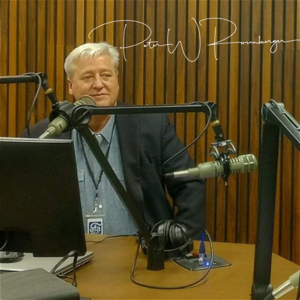
I'm Peter Rosenberger and after 40 years as a caregiver for my wife Gracie through a medical nightmare that has soared to 98 operations, both legs amputated, treatment by more than 100 doctors in 13 different hospitals and you can't imagine the medical bills.
Well I've learned some things. I learned every one of them the hard way. And in my new book, A Caregiver's Companion, it's a journal from that journey. It's filled with hard-won wisdom, practical help, and yes, an ample dose of humor. Because let's face it, if we don't laugh, we're going to blow a gasket.
And I've learned that I am no good to my wife if I'm fat, broke, and miserable. How does that help her? Healthy caregivers make better caregivers, and that's what this book is about: pointing my fellow caregivers to safety, to learn to live calmer, healthier, and dare I say it, even more joyful as a caregiver. It's one truth I've learned, punctuated by either a verse from scripture or a stanza from a hymn, and a space for you to share your own thoughts. While this is my journal from a 40-year journey, you can journal along with me in this book.
It's called A Caregiver's Companion, available August 20th from Fidelis Publishing, wherever books are sold. Learn more at peterrosenberger.com. Welcome to Hope for the Caregiver. This is Peter Rosenberger. This is the program for you as a family caregiver, and I am so very glad to be with you today.
Hopeforthecaregiver.com. Hopeforthecaregiver. If you're one of the 65 million Americans right now who are serving as a family caregiver, You're in the right place. If you're not, you're still in the right place. Because if you love somebody, you're going to be a caregiver.
If you lived long enough, you're going to need one. How do you survive this? How do you thrive in this? How do you stay strong and healthy while taking care of someone who is not? That's where I come in and I'm bringing you four decades of experience to offer a lifeline to my fellow caregivers.
Glad to be with you. HopefortheCaregiver.com. Every so often I will do an interview on someone else's program. And such is the case with a fellow broadcaster here on American Family Radio. Dr.
Jessica Peck, who is also known as Doctor Nurse Mama. And she had me on her program recently, last month, to talk about my new book that has come out, A Caregiver's Companion: Scriptures, Hymns, and 40 Years of Insights for Life's Toughest Role. And I was thrilled to be with her on the program. We had a great time, so I thought I'd play a lot of that interview for you today.
So, here's my conversation I've had with Dr. Nurse Mama. Peter, I am so delighted to have you on the show today. Thank you so much for joining us.
Well, thank you, Doctor Nurse Mom. I'm going to call myself Doctor Caregiver Daddy. Hey, um I love it. I feel like this is already an inspiring collab. I love it.
I'm America's caregiver. And no, I appreciate what you're saying about training people. I just did an interview with AFR. No, I do an interview with AFR every week. I did it with AARP, and they wanted to talk to caregivers who do complex medical things at home.
And I have been doing this for a very long time, and it is a bit nerve-wracking at times. This summer, I had an opportunity to pull out two drains out of her legs because she came home from a five-month stretch in the hospital in Denver this year. It wasn't supposed to be five months, but she had 11 surgeries just this year alone. And they sent her home with three drains and a catheter. And um her doctor Now, don't tell anybody what I'm about to tell you.
Okay, just it'll be just between you and me and a few million listeners.
Okay, just twixt us. But her doctor out here makes house calls. And at least you will for Gracie. And she's about as good a primary care doctor. We live in Montana, and she's about as good a primary care doctor as I've ever seen with Gracie.
We lived in Nashville for many, many years, and she had a great primary care doctor. But this one right here, she's just very special. I call her Dr. Quinn Medicine Woman. Oh, I love it.
And she is, but she pulled out the first drain and the cather, but she told me, she texted me on the second and the third. She said, you can do this, just do this and this.
So I'm doing a text and getting from her doctor, saying, okay, pull this drain out. I didn't learn any of this in music school because I'm a pianist by training.
So they didn't teach me this. I have adjusted prosthetics by FaceTime with her prosthetist. I have changed very complex dressings. I have done shots. And, you know, just I even helped with a blood patch one time in recovery in post-op with an anesthesiologist many, many years ago.
And so these are things, like I said, my piano professor at Belmont and Nashville. Still alive, and he's in his 80s. I called him up and I said, Hey, You overlooked some of the things in our curriculum when you were teaching me about music theory. But, you know, it's true. We've had to do it and we do it without pay and without training and with a great deal of trepidation at times.
Absolutely. You know, I just recently, my mother-in-law started to need some injections, and my sister-in-law thought she could do it. And she started to look at everything. And she called me and said, you know, as soon as I uncap that needle, I'm like, I'm going to need some help. And it is overwhelming to think, you know, to see that journey of where you are.
And I really want to talk a lot about that, Peter. But before we go any further, I think it's important to just acknowledge the obvious that you have a great sense of humor. And I think that's so important. You talked about your collaboration with AARP.
So I looked online. I saw your collaboration with Jeff Foxworthy, who, yes, the Jeff Foxworthy of you might be a redneck if. And you guys did the most hysterical video about you might be a caregiver if. And you said a bunch of things, but. One of the things that just made me absolutely fall on the floor laughing is you said, if a hospital bed has not hampered your love life, and Jeff said, no sense in wasting a semi-private room, you know, 78 surgeries, spending nights in the hospital.
It was hilarious. And I think a lot of people would look from the outside and think, oh, this is such a sad, tragic story. It's so hard. Where do you find the humor in it? How do you still have a good sense of humor?
Well, I And by the way, I have the distinction of being the only Person on American Family Radio who have brought both Jeff Foxworthy and Larry the Cable Guy to a show on American Family Radio. I've done this. I like it. I love it. I grew up in a large family.
I have four brothers and a sister, and my sister's the worst of all of us. She's the baby. And she is she if she was listening this day, she'd be texting me right now saying, Shut up. But no, she is we have a very large family and we speak fluent sarcasm. And we tussle and joke and clown around, and that's part of being in a large family.
But the other thing is, and my mother, by the way, my father was a minister for many, many years, 60 plus years. And he passed away a year ago this month, this week, actually. And he is just an outstanding guy, but he's a little bit more stoic. a Presbyterian minister. My mother, on the other hand, came from Irish stock.
And she has a rapier-like wit. She's quick. She's still, I mean, even this morning when I was talking to her, she's still just a kind of thing. And so we get that a lot from our mom. And We also know that this isn't the end of the story.
That that we have joy. Um and yes, it's hard. And we got plenty of tears. Plenty of tears. You don't go through all the stuff that Gracie and I have gone through without tears and anger and frustration and all those kinds of things.
But for whatever reason, God just gave me this mind that sees the weirdness in things. You know, I remember her team of surgeons came in one time, this is during COVID, and I'm sorry, by the way, you have COVID right now. But by the way, y'all don't have to wear masks while you listen to her. It ain't transmitted. I don't care what Dr.
Fauci says, it doesn't come through the radio. I'm just telling you that right now. I have that on good authority. But I was in the room with her. This has been several years ago when she had a very, very serious back surgery, about a nine-hour surgery.
And the neurosurgeon and his team came in and this is at a teaching hospital and they're all You know, you know how teaching hospitals are. They just come in herds, and they've all got their clipboards. And of course, they used to do it on paper, but yeah, and so therefore, you know, you've got to crawl. Crowd in the room, and everybody's mashed up. It's very serious.
Gracie's, you know, dealing with a lot of stuff. And her neurosurgeon looked at me and he said, Now, you have any other questions? And I said, Well, I have one. And he looked at me. I said, Doc, is Tourette syndrome a byproduct of this surgery?
I just want to know that up front. And even in their mask, you can tell they've all just kind of been down laughing. And it just broke everybody up enough that we said, you know what? It's okay. You know, this is painful.
This is hard. There's nothing about this that's easy. But you know what? We can still live life. This is our life.
Gracie and I do not, okay, this isn't, we're going to get through this surgery, then we'll go on and live our life. This is our life. And we've had to learn to carve it out in a hospital room. We've had to learn this year, in the last couple of years, we've had. Two Valentine's Day, both of her birthdays, I think, or at least one of her birthdays.
We've had just Christmas. all kinds of things in in the hospital. You know, what do you do? You can't put your life on hold. You live it, and you live it with reckless abandon sometimes, knowing that he who began a good work in us is faithful to complete it.
If he can save us, he can keep us. And that's what gives us that confidence to say, okay, we don't like this part of it. We really don't, but here's how we're going to live. And I, for Christmas one year, a couple years ago, when we had to spend in the hospital, I brought a keyboard into the hospital room and I had the room all decorated up for when she came out of surgery. And there's lights and a little Christmas tree.
I went down to Walgreens and got all the cheap stuff there and had it there. And I played, I think we won best decorated room on that floor that year. What are you going to do? I had stockings hung up. And, you know, what are you going to do?
You're going to just sit around and be morose, or are you going to have a good time? and do the best you can with it and that's what we do. I love that. And you know, no caregiver journey is the same. And so they can't be compared head to head, but I can relate to a lot of what you're saying.
So my husband had a really bad dental injury that resulted in needing a complete jaw reconstruction. And he had more than 20 reconstructive surgeries. And we spent a lot of anniversaries, holidays in the hospital, in the surgical suite. And he really inspired me. I hope you're enjoying my conversation with Dr.
Nurse Mama, Dr. Jessica Peck. We had a great time. There'll be more of that when we come back from the break. This is Peter Rosberger.
This is Hope for the Caregiver, HopefortheCaregiver.com. Don't go away. There's more. Uh Welcome back to Hope for the Caregiver. This is Peter Rosenberger, HopefortheCaregiver.com.
We're continuing on. With our conversation with Dr. Nurse Mama. I love the title of her program, Dr. Jessica Peck.
And she's a pediatric nurse practitioner as well as professor, author, and mother of four. And I was thrilled to be on her program last month to talk about my new book. And I thought you all might enjoy the conversation. Here's more of my interview with Dr. Nurse Mama.
He's dubbed himself Doctor Caregiver Daddy, which is just making me laugh so hard. And Peter, you were just in the middle of telling us a little bit more about your journey and what you have learned. And so I'm going to let you pick it back up right where we left off.
Well, I've learned a couple of things. One of them is, and it is the overarching message of everything I did when I started doing this radio program, for example, on AFR. And I remember Jim Stanley, AFR's Jim Stanley, said, Look, this is either going to be the greatest decision I've ever made for programming, or it's going to go down in flames. It's just this ultimate disaster to have you on. And they've kept me on for eight years because, and we have here on American Family Radio, there is the largest.
This is the largest radio program for caregivers. I've got the longest running and the largest radio program for family caregivers. And that tells you about the need that's out there. And here's what I've learned. Healthy caregivers make better caregivers.
That is my overarching message. A lot of caregivers struggle because they're not happy. And I say, stop trying to pursue happiness.
Okay? Don't do that. That's based on things that make you feel better. What's going to make you feel better as you take care of somebody with Alzheimer's? What's going to make you feel better is you take care of somebody who has mental illness or who and I'm the only one that I know of with a national platform that talks about family members of alcoholics and addicts as caregivers because it's a chronic impairment.
Whether they're in recovery or not, you're still dealing with this. And so what's going to make you happy? but you can be healthy right now. And I have found that the more I choose healthiness, the more happiness chases me. And I can do something right this moment.
I can put down a soda, pick up water, I can go for a walk, I can say no to certain things that are going to be unhealthy for me on any level, spiritually, emotionally, physically, financially. But if we're trying to be happy, we're going to make knee-jerk decisions and then we're going to become resentful when it doesn't happen. And this is where caregivers live. I don't give caregiving test. Task Tips because I'm not interested in that.
I can't tell you how to take care of your husband as he's going through all the dental stuff he went through any more than you tell me how to take care of Gracie other than just basic stuff that we can all Google and find in five minutes. You know, that's task. Where a caregiver struggle and where I step in is the matter of the heart, where we live in this fear, obligation, and guilt, what I call the fog of caregivers. And we get so disoriented in there.
Well what happens when you drive in a fog? They tell you to slow down. and they tell you not to turn on your high beams.
Well, why? Because it'll just glare back at you.
So how does that work for us as caregivers? Slow down. Just slow down. And don't try to look too far ahead. Thy word is a lamp into my feet, not a searchlight.
We're not going to know what's coming down the pike. I listen to people talk about having a five-year plan. I have no idea what that is. I can't have a five-month plan. In many cases, with Gracie, I can't have a five-week plan.
And some days, I can't even have a five-day plan. I just go about my business and deal with what's going to happen. I went down to Denver this year for two surgeries with her. and it morphed into eleven and five months in the hospital.
So I can't look way down the road. I can't put on the high beams and say, okay, when we get through this, we'll do this. No.
So I learned to deal with today.
Well, what does that sound like?
Well, that sounds like scripture. Give us this day our daily bread. Don't worry about tomorrow. Tomorrow will take care of itself. Doesn't mean I don't plan.
It doesn't mean I don't, you know, put on a seat belt when I get in the car. But it means I'm not Striving to see, okay, we got to get through this, we got to get through this, we got to get through this. No.
I'm going to live in it, and I'm going to expect God in this to reveal himself in ways that I would never have seen otherwise. Scripture says, The Lord thy God in the midst of thee. is mighty, not on the other side of your travails. He's waiting there, too. But he's going to walk us all the way through this.
And around midnight Paul and Silas were singing What? Hymns. They've been beaten. They've been stripped naked and beaten, and they were in stocks, and this is at midnight, and they're singing hymns. They were living life.
In the midst of this they were rejoicing.
Now if they can do that, Can we as well? And I say to you, not only can we, I say we must. We are called to. Because this is what separates us as Christians from the world. And the world marvels at this.
And I'll give you a perfect example. I don't know how much time we got. We were in the hospital earlier this year, and Gracie had these wounds that didn't want to heal. They released her hip flexors. It's a complex procedure to straighten her back up.
And they move the hip flexor down a little bit. They dissect that. And then where they move it, it releases it. She's able to stand up straight. And Bob's your uncle, we're ready to go.
Well, it didn't heal up. And I told the orthosurgeon before we did this, I said, now look, if something can go wrong with her, it usually does. Just be prepared, okay, because she'll have complications. And sure enough, he did. And they were trying to figure this thing out.
And he told me later, he said, you know, Peter, I haven't seen anything like this in all my years as an orthopedic surgeon. He's not a young man. And I said, Doc, the first time a surgeon told me that, Ronald Reagan was present.
So I I understand the journey.
Well, they called in Plastics, and Plastics came in and re reconstructed her legs, and they had to do a what they uh basically a surgical flap and They did this, but she was having a lot of edema, a lot of swelling in her leg. I'm getting medical jargon here because I don't get to talk to docs very often.
So I'm just throwing it at you because you and I'm not. I'm in.
So she's on her left leg, she's got this.
So they redid it, and it's about a foot-long incision site on the top of her leg where they go in there and they did this. They dealt with the seroma that was in there, they dealt with the edema. I'm trying to get the swelling down on that. But they put the flap there. and then they're going to take the stitches out.
surgical resident took about two days ahead of time, which kind of concerned me a little bit, but I was on the way over there because I was staying in a hotel across the street.
So I get over there and I'm walking into the room. Gracie's laying on her back and the the surgeon had just left, the the chief resident. And so I Gracie takes my hand and I help her sit up. and the entire top of her leg de hissed.
Now, for those of you in McDuncan, that is when the whole thing just opens right up. And it reminded me that day, again, why I am not a surgeon. Because there's the entire, it's four inches wide by a foot long. I mean, it was gruesome. and Gracie about had a panic attack.
Uh Quickly lay her back down. I open the door, call the nurses in there, tell them to call the surgical team. I go around the other side of the bed so they can get access to her. And I'm saying that I'm holding her hand. I'm telling her, baby, don't look down.
Just look at me, don't look down. Nurses came rushing in there, they start packing the wound, getting ready. The surgical team is on their way back, and I didn't know what else to do. Except the first thing that came to my mind was this little chorus. I'm going to go, part of the microphone sound.
I'm going to move the microphone for just a second, Richard. And I'm going to go to the caregiver keyboard. They don't let me sing, but Gracie can't come to the microphone right now. She's the one that needs to sing. But I started doing this in my life.
Lord. Be glorified. Mm. Glorified in my life. And I started singing that.
Gracie started singing with me. Just. almost hyperventilating while she was doing it. And then Gracie took over. And she started singing In my Leg lord Be glorified today.
And the nurses, there's a team of them. You know, when when you have something like that, you don't have a small amount of people in the room. And I got I got nurses, I got surgical tech, I got all of them coming in there. And Gracie's singing, In my leg, Lord, be glorified.
Now they've heard people cuss, they've heard people scream, they've seen people throw up, they've seen people pass out, they've heard it all, except they hadn't heard that. I know that, and they were stunned. They marveled. Who sings In my leg, Lord, be glorified when it's laid bare to the bone? And you've got a team of people working on you, and you've been in the hospital already for months and months, and you've had 40 years of this, like she's had.
Who does that? I'll tell you who does it. The people of God do that. That's right. That people who are equipped by the Holy Spirit, just like Paul and Silas were singing hymns, so was Gracie.
And singing them. And the same Spirit that gave Paul and Silas the courage and the strength and the wherewithal to do that, and the same spirit that gave this to Gracie. will also give every listener here dealing with whatever they're dealing with. That same strength. Johnny Erickson Tyler called Gracie in recovery.
And I had her on speakerphone next to Gracie's ear. And Johnny started singing, and Gracie started singing. She could barely whisper it out during one of the surgeries this year. And the two of them who have. a hundred years of disability between the two of them.
And Johnny's in the hospital today, as a matter of fact, right now. And so they started singing together, and it was echoing through the post-opera. Other people are hearing it.
Now, I don't know if they knew that was Johnny. I don't know if they knew anything. But the point is: where the Spirit of the Lord is, there is what? There's. Freedom, there's liberty, there's peace, all of those things.
And so, where two or three are gathered, and the other was it was over FaceTime, but they did it. Who does that? I'll tell you who does it. The people of God do this. This is what we're called to do.
The world marvels at this. They don't know how to process this. The world does not know how to process this. But we are called to do this. We are called to stand firm in this.
And I would love to tell you that Gracie and I have been the model of this for a lifetime, but we haven't been. I've been the model of failure. I have had ample time to fail at everything. And I'm the crash test dummy of caregivers. I'm the wily coyote of caregivers.
But we're still here. And what have we learned through this? We've learned that He who began a good work in us is faithful to complete it. to the day of Christ Jesus. This is what we've learned.
This is what we anchor on, not anything of our own. but what we have been w witnessed to We've seen too much. We've seen too much of the provision of God. for us to do anything other than to throw ourselves at this. And I was standing in the ICU earlier this year looking through the glass at Gracie, and she was brought down solo.
This is a woman who has stood with presidents. and sung on massive stages. and I saw all the tubes, all the and just it was tough to look at. And nobody was around me, which is unusual for ICU. Normally it's just a You know, flurry, a hive of activity, but everybody was evidently in the little pods, and I was there.
And nobody was around with 20 feet on either side. and I looked at that glass. And I looked at Gracie and I said, Christian. To myself. Christian.
What do you believe? Do we believe this or not? Do we anchor ourselves in this or not? It's nice to talk about this in Sunday school. It's a whole different thing to talk about it in the ICU.
And that's what I wanted to share with every one of my fellow caregivers. Anybody who's listening to this program who's dealing with stuff who knows somebody who's a caregiver. I if you love somebody, you're going to be a caregiver. You live long enough, you're going to need one. And I wrote this book in fluent caregiver.
I speak fluent caregiver.
However, I've learned that it's our Saviour's native tongue. That's who he is. He is the ultimate caregiver of a wounded bride. He is the bridegroom, the church is the bride, and we are a wounded bunch of people. And he's the ultimate caregiver of a wounded bride.
And this is what I've learned through this, Jessica. I hope you're enjoying this conversation with Dr. Jessica Peck and the Dr. Nurse Mama Show. I had a marvelous time doing the interview, and there's a little bit more to go, so don't go away.
We'll be right back. This is Peter Rosenberger. This is Hope for the Caregiver. Hope for the Caregiver. Yeah.
Welcome back to Hope for the Caregiver. This is Peter Rosenberger. We're continuing on our conversation with Dr. Nurse Mama, Dr. Jessica Peck, who is a pediatric nurse practitioner as well as a professor, author, and mother.
Of four, we're talking about my new book that came out, A Caregiver's Companion, Scriptures, Hymns, and 40 Years of Insights. For Life's Toughest Role. The book is available wherever books are sold. Please go out and get one today. Pick up a second copy for a caregiver you know who is struggling.
It's written in fluent caregiver. I speak fluent caregivers. That's the good news. The great news is that It's our Savior's native tongue. That's who he is.
He is the ultimate caregiver of a wounded bride. The book is titled A Caregiver's Companion: Scriptures, Hymns, and Insights for Life's Toughest Role. By the way, Dr. Nurse Mama Show, it's on every weekday on American Family Radio from 2 to 3 Central. You can also stream it, and you can also find her podcast out at her website, drnursemama.com.
DrnurseMama.com. Let's get back to the interview. Even the story you shared is just one little sliver of what you have experienced. How do you still find a hope and a confidence that God is still good even in the midst of these trials and pain?
Well, first off, I think the best way to do that is when you focus on the right things, which is the cross. It always comes down to the cross. Every sermon that you hear from your pastor should always point you to Christ and the redemptive work of God through Christ. Because that's what fortifies you. Christian, what do you believe?
Is what I said in the last block. And the Heidelberg Catechism we talked about in number one, it says, What is our only comfort in life and death? and our only comfort is that we belong completely to Christ. That we are in Him. That's the only comfort we have.
So, when Paul says to go out and comfort one another with the same comfort you yourself have received from the God of all comfort.
Well, what comfort have I received? I've been doing this since Reagan was President. Gracie was was hurt back in nineteen eighty three. What comfort have we received? She is in an enormous amount of pain all the time.
And that hasn't changed. I was talking about my friend Johnny. She's been in a wheelchair since Lyndon Johnson was president. What comfort have we received? And the comfort we have, and that word comfort in the English language has been diluted a little bit.
We think of it as a comforter, like, oh, okay, they're there, they're there. No, it means come forth. Forte. come with strength. You know, a piano used to be called a pianoforte, a soft and loud, because it replaced the harpsichord, which only had one volume.
but a pianoforte, and it's that strength of the of the the sound.
Well, we have come for it. We are equipped. We are fortified. Jesus said, Another helper I'm going to send you that will don't worry about what you're going to say when you get in front of people. He's going to fortify you.
And that's what my message is. I'm not here to say they're there to my fellow caregivers, and I don't want anybody saying it to me. What I say to my fellow caregivers is, don't go down there. That's a bad place. I went down there because I've got the scars to prove it.
I'm not a there-there kind of guy. I'm a don't go down there. Stand here. And do you remember in Indiana Jones in the last crusade when He had to go through those tests to get to the holy ground at the end, and he had to step on those letters that reflected the name of God. And if he got it wrong, he would go crashing through into a pit of despair, that kind of thing, whatever.
I'm showing you where the safe stones are. You could stand on this. and you can catch your breath here. Take a knee, if you have to. But staying right here.
And that's what my book is about. They're just quotes I've learned over the years, and I marry it with the scripture and a hymn. It's not a linear book that you've got to read start to finish. You can pick it up any place you want to read, and I give you a quote. One of the quotes is, Just breathe.
Four seconds in, eight seconds out. Breathe And the scripture, I mean the hymn that I put with that is Breathe on Me Breath of God. Fill me with life anew. That I would do what thou wouldst do and love what thou you know. I love that hymn.
And Gracie does an amazing version of that on the record: Breathe on Me, Breath of God. She just sings it a cappella. And you talked about in the last block when you said, you know, when I talked about I've seen so much. I was praying before she went into her 91st surgery.
Now, this was back in. March, I guess, this year. And and as I was praying in Preup, And I said, Lord, it's it's too much it's too much 91's too much. And I finished the prayer. I don't remember what I said, but Gracie corrected me after I prayed.
And she's laying there in bed, getting me to go in for her 91st surgery. And she looked at me and she said, It's not terrible. too much. it's however many he says is necessary.
Well That's a different kind of faith than you hear from the blab it and grab it crowd. That's why that whole prosperity doctrine and all that kind of stuff doesn't hold up in the ICU. It doesn't hold up going into your 91st surgery. There has to be something greater to stand on. And we stand on the goodness, you say, How could he allow such this?
I don't know why he allows all this suffering. I don't know why he's done this for Gracie, and anybody that tells you different will lie about other things. I don't know. But I know this He came into our suffering. and he has walked with us every step of the way.
He was waiting for her when she slammed into that concrete abutment. He was waiting for her before her ninety first surgery. He was waiting for her this and that. And I can tell this to everyone I'm... That's listening.
He's already waiting for you there, and he's going to walk you all the way through it. He entered our suffering, He who knew not sin, put it on himself.
So that we don't have to be doomed to this. He has saved Gracie and me from something far worse than we've gone through. and I don't know why. I've offered my consulting services to the Almighty on numerous occasions. He has yet to take me up on it.
And I've been very persuasive, I thought. But nope, he hadn't done it. And so I trust him. Why do I trust him? because he stretched out his hands.
And he took my sin on him. and bore that, and he lived his righteous life, and imputed that to me.
So that I can stand before the Father. faultless. That's what the hymn says: Faultless to stand before the throne. My hope is built on nothing less than Jesus' blood and his righteousness. We always think about him dying on the cross for our sins, but we forget about the part that he lived a righteous life and imputed that righteousness to us.
We can't just go before God without that righteousness. And it covers us. And this is what I've learned, and this is what sustains Gracie, and this is what fortifies me. I do not want to hear people say they're there. Or I feel sorry for you, and neither does Gracie.
What we want to hear, and I'll give you a preview of what's going to be on my show for this Saturday. Because I go through a hymn every week of what a caregiver, a hymn that a caregiver needs to know, is where to focus our eyes. And in this particular case... Um and the things of earth. Even in the ICU.
will grow strangely dim. In the light of His glory and grace. And so I ask your listeners, I ask everyone listening to, whoever's listening to this. Christian. What do you believe?
Do you believe this or not? I don't want to talk to people who just get excited on Sunday mornings and sway to a nice beat that they're listening to at service. I want to hear people that are. Fortified with the gospel. to understand that You know, nothing is going to separate us from the love of God through Christ Jesus.
I got to hear this over and over and over. And I was telling this to one guy, it was a pastor, and I said, We got to hear the gospel every Sunday. He said, He said, Well, I'm pretty comfortable knowing the gospel. I said, Well, I'm not. I got to hear it all the time.
Sing them over and over again. Wonderful words of life. Beautiful words. Wonderful words. I've got to hear this.
I have caregiver amnesia. I've got to be reminded of stuff that I, you know, all the time as a caregiver, and I have gospel amnesia. I've got to be reminded of this over and over and over. And that's the message that I've learned through this. And I've written it down.
It's kind of like a journal of 40 years, and you can turn to any page. And there's a place for you to write down your thoughts about what I just said there. A hymn or whatever it is that I put there, that you're going to be able to hang on to that moment. I know my fellow caregivers, they don't need this long treatise. They need something that can help them right now, not six months from now, not six days from now, not six hours from now, right now.
to help them breathe a little bit.
Now, by the way, if I sound like I'm talking fast, it's only because I've had a lot of coffee today. That's okay, unless you get in more hymns and more scripture. And honestly, Peter, those are just flowing out of your mouth. And you can tell you've spent time in God's Word. And as you were speaking, I was thinking of Isaiah 53.
He is a man of sorrows, acquainted with grief, but he has borne our griefs and carried our sorrows, and yet we esteemed him not. You know, just thinking about God knows, Jesus knows the sorrows that we have. And when you talk about opening your book, I open it to just a page here, and you said this: you said, when a caregiver answers direct questions in third-person singular, he, she, et cetera, or first-person plural, we are us, it's a good indicator the loved one overshadows the caregiver's identity. When asked about our own hearts, however, we find ourselves caught off guard and usually struggle to share our feelings. That is why it is imperative for caregivers to find a trusted individual.
to whom they can speak in first person singular.
So meaning that, you know, you're overshadowed by she, you know, Gracie, these are her problems, we are dealing with this. But then you forget about your own heart. And then to accompany that, the simple truth here is Jesus loves me. This I know, for the Bible tells me so. And that's just a great example.
Play it, play it, sing to our hearts. That's what we need to sing as caregivers. And you know when I learned that? At Covenant Presbyterian Church in Nashville, Tennessee, I was playing at the Prelude before, as people were coming in. Our pastor had asked me to play as people were coming in just to quiet it down.
This is where the shootings took place many years later when we went, we lived in Nashville and we went there for many years. And I was up there playing, and our pastor said, Look, it's like a barnyard out here, and we need to calm people down. Would you go out and play and just, you know. Reflective music and so forth, hymns and so forth.
So I did. But I've been accompanying Gracie for a lifetime. And so I'm used to playing around Gracie's voice.
So I was getting up playing. And They're great chords. But nobody knew what I was playing. I realized. In front of hundreds of people.
I wasn't playing the melody. And I had to go back and teach myself, Jesus. Loves. Me. This I know not, we know, I know.
I know. Me subu.
So he loves Gracie. I have no doubt of that. But he knows and he loves Peter. And this is what I've learned as a caregiver. This has been my interview with the Dr.
Nurse Mama Show with Dr. Jessica Peck. Heard weekdays from 2 to 3 Central on American Family Radio. I had a marvelous time doing this, and I hope you enjoyed the conversation we had as well. We have to take a quick break, but we'll be right back with another hymn that every caregiver ought to know and the caregiver keyboard.
This is Peter Rosenberger. This is Hope for the Caregiver, HopeForthearegiver.com. Welcome back to Hope for the Caregiver. This is Peter Rosenberger. Glad to be with you.
HopefortheCaregiver.com. Hopefully caregiver.com.
Okay. We're going to return to our series on hymns that every caregiver ought to know. This is one I've actually talked about on the program before, it's one of my all-time favorite hymns. It is, I actually included it on my C D, Songs for the Caregiver. And it's the opening hymn on this.
It is a magnificent hymn. It was written by a man named Cleland McAfee. and he was a Presbyterian minister. My father was a Presbyterian minister, so he already had me at Presbyterian minister. He um he wrote this song, let me go to the caregiver keyboard here.
Um Now for those of you paying attention, I'm doing this in D-flat. Does that sound familiar? There is a place of quiet rest, Near to the heart of God.
Now, let me tell you the story behind this hymn. The story is that his brother had two daughters. They were both young kids. I think one was nine, one was eleven. And they got diphtheria, and they died in the same week.
There's a little town in Missouri where he lived, and he was the pastor of the church, and he's the pastor. This is his brother, this is his family. And he's the pastor. And he didn't know what to say. I mean, he was struggling with this.
I mean, think about it. I've watched my father struggle to prepare for funerals. It's a struggle. And I've been around a lot of pastors who I've played a lot of funerals, and I've watched. The struggle.
to be able to speak to people in such a difficult time. You see all this on the heels of what's going on in our country right now. You've got these mass shootings, you've got Charlie Kirk's assassination, you've got this LDS church up in Michigan. This is the time, though, for us as believers. as Christians, Biblical Christians, to be able to speak into all of these situations with clarity And if we don't have the words, that's okay.
Show up. and minister to people. And so here's this dilemma that this wonderful man of God Cleland McAfee had with his own family. And he wrote this hymn. There is a place of quiet rest.
Near to the heart of God, a place where sin cannot molest. How many of you all know that sin Molest. How many of you know that? How many of you seen that? It's visceral to you.
You see how sin molests us. But there's a place. near to the heart of God that it can't. And then the chorus, he goes on to say. O Jesus, blessed Redeemer.
sent from the heart of God, Hold us who wait before thee, near to the heart of God. You could just hum that. and it will soothe people. It'll just soothe their hearts. They went one step further when This song was introduced to his family, the choir of the church.
We're The family went where the the the the grieving father and mother, the the brother and brother-in-law was the pastor. And he wrote this. tremendous hymn. the choir gathered out on the lawn. of this family that was grieving and sang this song.
There is a place of quiet rest. Near to the heart of God. And they just sang this to the family from the lawn. A quiet rest near to the heart of God. There's a place where sin cannot molest.
Near to the heaven Jesus, blessed Redeemer. Sent from the heart of God hold us who wait before. Where do you think he got that? Hold us who wait before thee.
Well, I'm landing on that five-chord there. It'll probably just make a lot of people crazy that I don't resolve it. But where do you think you got that? From Hebrews we have a great high priest who is interceding for us, who is praying for us all the time. Hebrews seven twenty five, Consequently, He is able to save to the uttermost those who draw near to God through Him, since He always lives to make intercession for them.
Hebrews 4.14. Since then, we have a great high priest who has passed through the heavens, Jesus, the Son of God, let us hold fast our confession, for we do not have a high priest who is unable to sympathize with our weaknesses. but one who in every respect has been tempted as we are yet without sin. Let us then with confidence draw near to the throne of grace. that we may receive mercy and find grace to help in time of need.
Hebrews 9.24. for Christ has entered not into holy places made with hands, which are copies of the true things, but into heaven itself, now to appear in the presence of God on our behalf. And that's you you had to I mean Cleveland McAfee knew this Scripture. He went on to serve as the moderator of the General Assembly of the Presbyterian Church in the United States. I mean, this is no lightweight man of learning and scholarship, and he knew these things.
And this is what came back to him. in that moment of great grief. Jesus blessed. Redeemer sent from the heart of God hold us who wait before thee dear to the heart of God and that in that just a great I mean that is just such a marvelous hint. And that is a great hymn for us.
as we go through whatever we're going through. and to share with others who are going through things. There may not be much of an opportunity to speak to people. in their distress. But you can play this song for them.
If you say, well, Peter, I can't play the piano.
Well, I can, and it's on my CD, and you can get it, you can download it, wherever you stream music. Go get it, and give it to him and tell us send him that song. Just say here, listen to this. It's on Spotify, it's on Amazon Prime, wherever you stream music, it's there. It's the first song on my CD, Songs for the Caregiver.
And you can just send that as a text to somebody who's grieving. You said, listen to this. Let me tell ye the story behind this hymn. I mean, doesn't that just wrap around you? The place.
Where sin cannot molest. Near to the heart of God Near to the heart. Sing with me. Let's go. Dear to the heart.
Now you know why this is a song that every caregiver. Oughta know. As we go about our task, as we're dealing with very painful things, harsh things. heartbreaking things. There is a place where sin cannot molest.
And we are kept safe there. We don't understand all the things that we have to go through. We don't like it for sure. We're not called to like these things, we're called to trust Him. to take him at his word.
One of the issues that we struggle with is: well, there's two things we struggle with in this world. One of them is that we don't really understand how big a problem sin is. And they all would just We don't understand the character of God. Once we step into that place of better understanding his character than these other things start to fade away. It doesn't mean that they don't hurt, it doesn't mean they're not important, but we understand his character.
It is immutable. It doesn't change. Thou changest not thy compassions they fail not. As Thou hast been, Thou for ever will be.
So in those moments of heartbreak and distress and all the things that we deal with, we can say there is a place of refuge. The name of the Lord, is a strong tower. The righteous run into it and are safe. That's what it says. That's what the text says.
Now the question I have for each of us. Do we believe that? And if we do. Then let's run to that place. Let's wrap ourselves in the name of God.
Of his characteristics, of his immutable characteristics that don't change, knowing. That in Him we are safe no matter what this world throws at us. Martin Luther said it beautifully: the body they may kill. We did this on one of our hymns that every caregiver ought to know: the body they may kill. God's truth abideth still.
It does not change. A hymn that every caregiver ought to know. There is a place of quiet rest near to the heart of God. I hope you're enjoying this series as much as I'm enjoying doing it. I love these hymns.
If you're finding that this program is meaningful to you, it's helpful to you, help us do more, go to hopeforthearegiver.com. There's a donate button right there, you can click on it. be a part of what we're doing. Thanks so much. Hopeforththecaregiver.com.
We'll see you next time. Gracie, when you envisioned doing a prosthetic limb outreach, did you ever think? the inmates would help you do that. Not in a million years. What does it mean?
I would have ever thought about that. When you go to the facility run by Core Civic and you see the faces of these inmates that are working on prosthetic limbs that you have helped collect from all over the country that you put out the plea for. And they're disassembling. You see all these legs, like what you have, your own prosthetic legs. And arms, too.
And arms. When you see all this, what does that do to you? Makes me cry. 'Cause I see the smiles on their faces and I know. I know what it is to be locked someplace where you can't get out without somebody else allowing you to get out.
Of course, being in the hospital so much and so long. When I go in there, and I always get the same thing every time that these men are so glad that they get to be doing, as one man said, something good finally with my hands. Did you know before you became an amputee that? Parts of prosthetic limbs could be recycled? No, I had no idea.
I thought we were still in the. 1800s and 1700s. I mean, you know, I thought of peg leg, I thought of wooden legs. I never thought of. Titanium and carbon legs and flex feet and C legs and all that.
I never thought about that. I had no idea.
Now that you've had an experience with it, what do you think of the faith-based programs that Core Civic offers? I think they're just absolutely Awesome. Every prison out there. should have faith-based programs like this because The Return right. Of the men that are involved in this particular faith-based program.
and the other ones like it, but I know about this one. are i it's just an amazingly low rate. Compared to those who don't have them. And I think that that says so much. That says so much.
About Just that doesn't have anything to do with me. It just has something to do with God using somebody broken. to help other broken people. Yeah. Ho?
If people want to donate a used prosthetic limb, whether from a loved one who passed away. You know, somebody who outgrew them, you've donated some of your own. What's the best place for them to do? How do they do that? Where do they find it?
Please go to standingwithhope.com/slash recycle. And that's all it takes. It'll give you all the information on the What's that website again? DanningWithHope.com. slash recycle.
Thanks, Chris. Take my hand. Lean on me, we will stay with the warmth of the panel.