Avizandam In Scots law, this term describes the careful consideration given by the judge before an important decision. Join me each week as we explore various topics from a spiritual perspective and take matters. Avise endum Dispensationalism has recently taken a bit of a hit.
Some have belittled dispensationalism in their attempts to criticize so-called Christian Zionism. We'll get to the subject of Israel in a moment, but I do want to say a few words about dispensationalism. First of all, I don't like putting labels on Christians. Apparently, there are many who are not content with just calling themselves Christians or followers of Jesus Christ. But want to put extra labels on themselves and others, such as reformed or charismatic.
While I do believe in dispensations in Scripture, I don't call myself a dispensationalist or say that Calvary Church is dispensational. we welcome all authentic followers of Jesus Christ. The spirit of Corinth, where we label one another and follow particular individuals, threatens the unity. of the local church. Dispensationalism is sometimes contrasted with covenant theology.
Although covenants such as the Abrahamic covenant are very important in dispensationalism. which recognizes the progress of revelation. The Old Testament must be interpreted in its own terms. and not have the New Testament reread into it. A critical element in this regard is the interpretation of prophetic promises given to Israel in the Old Testament.
While there certainly is discontinuity between the Old and the New Testaments, we must also take seriously the continuity of Scripture.
So for example While the church does participate in some of the blessings of the Abrahamic covenant. That does not mean that the promises to the nation of Israel are abrogated.
So there is continuity. and discontinuity.
Well, what about the dispensations? Seems to me there are clearly at least two main dispensations in Scripture. John writes in His Gospel chapter one verse seventeen. For the law was given through Moses. Grace and truth came through Jesus Christ.
And Hebrews 7, verse 12 makes it clear that with the coming of Christ the Levitical priesthood is gone. For when the priesthood is changed, of necessity there takes place a change of law also.
So few would disagree that there is a radical difference between the Old Testament and the New Testament.
Furthermore, prior to the giving of the Mosaic law, There was the dispensation of promise. We see this from Galatians 3. Verses fifteen through nineteen.
So there is at least a dispensation before the law, then the law, and after the law the coming of Jesus Christ. And I believe there is another dispensation which will occur in the 1,000-year reign of Jesus Christ. as described in Revelation twenty. When our Lord Jesus returns with power and great glory, the millennial kingdom will be set up. in fulfilment of all of the promises given in Scripture, and also contained in the Abrahamic and Davidic covenants.
So these clear Dispensations, or if you prefer the word ages in scripture. should stop the derisory dismissal of dispensationalism. What about covenant theology?
Well, covenant theology is a system of interpreting scripture. by understanding two or three covenants.
Some covenant theologians believe in two covenants, the covenant of works and the covenant of grace. Others say there is also the covenant of redemption. It said that the covenant of works was established between the triune God and Adam. This covenant, it is said, was established between the creation and the fall. God required perfect obedience of Adam, who is promised eternal life, in return for his perfect obedience.
Because of the failure of Adam to keep the covenant of works, God then established the covenant of grace. But it would seem to me that these covenants are theological constructs. where does the covenant of works appear in the opening chapter of Genesis? What are these other covenants?
So, covenant theology also proposes that the church existed in Old Testament times. rather than beginning in Acts two on the day of Pentecost.
So the Church is often said to be the continuing covenanted community. But Paul does teach in 1 Corinthians twelve, verse thirteen, the necessity of spirit baptism for the formation of the church. That baptism didn't begin until the day of Pentecost. The Church was a mystery unrevealed in the Old Testament. The fact that Jew and Gentile would be equal heirs and equal members of the same body was not known.
Our Lord Jesus promised to build his church. I will build my church, Jesus said. The implication is that the church was not in existence when Jesus said this. Also, the foundation of the church is not Israel in the Old Testament. but rather the apostles and prophets of the New Testaments, as Paul teaches.
In Ephesians 2, verse 20. Yeah. One of the areas of difference between dispensationalism and covenant theology is the place of Israel. I believe that Israel stands for the covenant nation, both in biblical history and predictive prophecy. There is a distinct future for Israel.
As a nation, which will be realized in the Millennial Kingdom. Paul writes that a partial hardening upon Israel. until the fulness of the Gentiles has come in. And in this way we have All Israel will be saved. as it is written.
That's Romans eleven, verses twenty five and twenty six.
So The blessings to Gentile believers do not abricate a future blessing for ethnic Israel. And as an aside, I would say That Believing that there is a great future for Israel as a nation, does not necessarily mean that Christians agree with all of the decisions of the present political administration in Israel. Whatever you may think of dispensationalism and covenant theology, it's clear. that both approaches attempt to take Scripture seriously. And neither position.
can be or should be said to be heretical. Listen to Paul's admonition. to the Corinthians. Let all that you do Be done. In love.
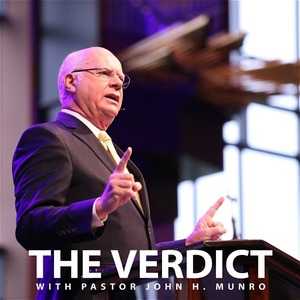
Abyssandum. You're listening to the weekly Avizandam podcast from The Verdict, featuring Pastor John Monroe. John is senior pastor at Calvary Church in Charlotte, North Carolina. Listen to John's daily program, The Verdict, on broadcast radio or major podcast platforms. For more information about the Verdict Ministry, visit us online at calvarychurch.com slash the verdict.