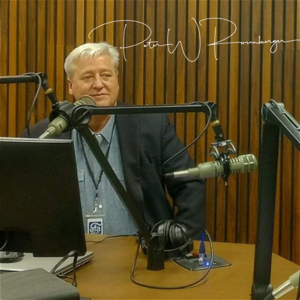
Welcome to Hope for the Caregiver here on American Family Radio.
I am Peter Rosenberger and this is the program for you as a family caregiver. How are you doing? How are you holding up?
What's going on with you? These are the questions I ask. These are the questions that I feel like every caregiver should be asked because that gives a caregiver an opportunity to talk about the things that are going on in their own hearts. We know as caregivers we can recite our loved ones chart.
Some of us can do it backwards and forwards. But what good is that when our own inner thoughts and our own heart is kind of a train wreck? And that's why I launched this program.
That's why I write books. That's why I do all those things because I'm bringing four decades of experience to help you stay strong and healthy as you take care of someone who is not. And healthy caregivers make better caregivers. That is an axiom that will not change.
The healthier we are, the better we can care for our loved one. Well, we're into a new year, 2025. What do you think so far? Are we off to a rousing start? Are any of you dreading a new year? We've got some painful things coming our way this year, this month. And I'm not necessarily looking forward to it.
Gracie certainly isn't. But at the same time, each day is an opportunity. And each year is an opportunity. So we don't have to live all the way out for the whole year. I think that's the tendency we as caregivers tend to do is we live way out in the wreckage of our future. What is 2025 going to bring?
Who knows? Why don't we just worry about what is Saturday going to bring? What are we going to do today?
And what can we do today? My father's birthday is today, January 4th. He would be 90 years old.
Missed it by just a few months. But he is doing just fine. And I can't help but think of him. You know, every day I do, and particularly on a day like today, it's his birthday. And I think about the life that he lived. And it was a life marked by duty and service, focusing on the job. And I never knew him to be out of uniform.
And I don't mean just as military uniform. He was a captain in the United States Navy, a chaplain, a full bird. And the uniform was incredibly important to him. But the other office that he held, which was the office of pastor, he was never out of uniform.
He was ready to pastor at a moment's notice. Even the few times that we took vacations as a family. There were times when he got called back to do a service or this or that. There was just always something. But even if he met a complete stranger that was going through something, he was always prepared at a moment's notice to go about the job that God had for him. And I think that's a good way to start off this year of remembering that. Are we always prepared at a moment's notice?
Not just for the task of caregiving. I mean, that's part of our journey. We get that.
Okay. We're always going to have to do stuff. There's just logistics. There's tasks. But are we aware of the kingdom responsibilities and opportunities? Are we prepared at a moment's notice to share the gospel with someone?
A friend of mine told me, he listens to this show regularly, and he told me last week after the program, he said how much he appreciated the things that we're talking about. He said, you know, one of the things that you do is you don't remind people of the misery and the difficulty of caregiving. Because that's not what I want to do here.
I don't want to delve deep into those weeds. We all know what the task is. I don't need to tell you how to take care of your loved one and that you got to do this and this and this and this. And nobody needs to tell me that. I have no supervisor that says, oh, by the way, Peter, you got to do the laundry today and you got to do this and you got to do this.
Nobody tells me to do that. And nobody needs to remind me of that and nobody needs to remind you of that. But what I need reminding of every day without question is the Gospel. And I think that I had a pastor friend of mine back in Nashville tell me, he says, too many pulpits are bored with the Gospel.
Have you ever noticed that? Have you ever just listened to a lot of sermons? And there was a seminary professor that he had his homiletic students. And for those of you in McDonkin, homiletics is the study of preaching. It is a class that you take and it's not just public speaking. It is to learn how to develop and present a cohesive sermon message. Now you've heard the old story of the homiletics professor told his class, if you haven't struck oil in 10 minutes, quit boring. You know, so there's things like that, but those are just funny quips. But the reality of it is how to structure a sermon.
How do you do this? And this professor would challenge his students. He would sit in the back of the class while they got up and preach a sermon. They would have to write it out and organize their thoughts and preach a sermon. An exegesis of scripture, some type of passage they were preaching.
Whatever they're doing, that's the assignment, they would do it. And then at the end of the assignment, he would ask them a very pointed question. Where's Jesus in that sermon? Where's the Gospel?
And I've always remembered that. That's a powerful tool to ask of any pastor, where was Jesus in your sermon? And I think that when we understand our desperate need to be reminded of the Gospel over and over and over and over again, if you're bored of hearing the Gospel, if you're bored of hearing the Gospel, I would suggest to you that you may not understand it enough. Because I don't see how anyone becomes bored of hearing that God set out a plan of redemption, became flesh, lived a sinless life and imputed that righteousness of his son to us and imputed our sin to him. And then rose from the dead for in Adam all sin, but in Christ, the greater Adam.
I mean, how do you become bored with that? And I would suggest to you that the crux of it is that we are not keenly aware of our own sin so that we can marvel greater at the cross. And dad was like that. Dad understood that redemptive message on such a core level, and he was willing at a moment's notice to share that with someone else. Not an evangelistic way that you've got it rehearsed down and if you died tonight would you, you know, that kind of thing.
That becomes a little bit trite sometimes, I think. There was an earnestness to the way he would minister because he saw the broken pieces and he would want the person he was talking to to understand the redemptive work of God in the midst of that heartache. He would want them to understand that God has not abandoned them.
Of what it means to trust God with sometimes the unthinkable. And this was incredibly important to him and there were times that it troubled him because he couldn't articulate the words properly. He said that to me one time. It frustrated him. It troubled him greatly because he didn't always have the words to say to me. He knew the words of scripture, he knew them, but he couldn't figure out how to make it connect deep in my heart to be able to speak with such precision. And it's not that the words were ineffective because the word of God never is, but if the person that is hearing it doesn't understand it, if you're speaking Chinese to somebody who speaks Spanish, then it's going to be very difficult to communicate.
And dad was laser beam focused on making sure he properly communicated the gospel. So as we start this new year, let's resolve to properly communicate the gospel first to ourselves and then to anyone and everyone that God would bring in our path. Everyone that we know is dealing with something. We as caregivers understand that. Can we take the hope that sustains us and extend that to others, as Paul said, the comfort that sustains us that we received from the God of all comfort.
Can we do that at a moment's notice? Are we ready to do that and speak words of life into people's lives? Because that is hope for the caregiver. This is Peter Rosenberger and we will be right back. Welcome back to Hope for the Caregiver.
This is Peter Rosenberger. This is the program for you as a family caregiver. Glad to have you along with us today as we journey into all things related to helping the family caregivers stay strong and healthy as they take care of someone who is not. And I'm bringing you four decades of experience to help you along that journey.
Saying things that I wish people had said to me, I wish I had understood many, many years ago. But I've aggregated a lifetime of things that I've learned and offering a lifeline to you as a caregiver. So glad you're with us. Hopeforthecaregiver.com. By the way, we still have an opportunity, if you want it, you can get our 2025 caregiver calendar. It is a gift that we give out from Standing with Hope, which is the presenting sponsor of this program.
It's the ministry Gracie and I founded. And if you want one of these calendars, they're pictures that I've taken out here where we live in Montana. And I think you'll be quite moved by them. And then I married them with a quote that I had in my books or things I've written or said here on the program that punctuated the picture, if you will. And they're breathtaking photos. Even if I say so myself, all I did was point the camera. I mean, I'd love to tell you I'm a great photographer, but I'm not. I just work with great material. And out here, it is beautiful in Southwest Montana.
And I was able to capture every season, you know, for that particular month. And there are some stunning photos. And then I'm hoping that as you see it, but with things that remind you of some basic core principles for us as caregivers to help get back on the road to safety. For January, for example, the quote I used is, when recovery is no longer possible, the journey of discovery beckons. Some things we're not going to recover from in this world, but we can discover all kinds of things. And mostly the most important thing we can discover is the goodness of God. And that transcends all of these things. Paul understood this by the time he got to the end of his life. He was like, the things of this world are not worthy to be compared. He had a glimpse of this and related it to us. And he was willing to go to his death proclaiming it. Because it doesn't matter.
The body they may kill, Martin Luther said, God's truth abideth still. And I put that in our January picture for the calendar. And the photo I used was one I took coming from my father-in-law's place. And we had so much snow, but it was a breathtaking Montana morning. The sun was coming over the range that is across the valley from us.
And it just lit up the sky and the snow, everything. And then you see the snowmobile tracks, because we live backed up to the forest. So the people that like to snowmobile in the forest on the trails back there will park down in front of our cabin. And that's the end of the county road. And then it goes up into the forest. But before it gets to the forest, my father-in-law's driveway is there. So we have to remind the county sometimes to plow up to his driveway, because they'll forget it will have a lot of snow when there's quite a bit of snow. But on this day, you can see the road clearly that's been groomed. And then you've got the snowmobile trails that run alongside it. And then you look out over this magnificent vista and see the range across the valley, which is the back of Big Sky Ski Resort.
And it was just stunning. But it just looks like a journey that beckons us to say, you know, I want to go on this journey. And I think for us as caregivers, I want to be able to inspire us to step out a bit and realize that we're not just biding time. We're not just trying to get through this so that we can get on with our life. This is our life, but we can find even greater life in the midst of this. This is what I talked about in the last block. I'm not interested in reminding us of how difficult it is.
We're going to just, you know, endure this and woe is unto us until this is done. No, come on. I mean, I've been doing this for four decades. I'm living life large. Yes, I have great constraints and so does Gracie. We have difficult things that we carry every single day, but we laugh and we make music and we do these things.
Why? Well, we have found something that transcends all this. The journey of discovery beckons. And see, I think this is the advantage I have that others don't because I've been doing this so long because the journey Gracie and I have has now spanned a lifetime. We were not easily tempted to, well, we'll just, you know, grit our teeth through this and then get on with our life. We had to learn to figure out life in the midst of this.
And other people don't do that. It's episodic. It's okay, we're going to do this for one, two, seven years, maybe ten, and then we're going to try to build some other new life after this. But with Gracie now, we have, this is it. This is our entire life is filled with surgeries and doctors and hospitals and oh my, you know, it's just, it's filled with this stuff and chronic pain and multiple trips to the pharmacy and tons and tons of laundry and just saying no to a lot of things that we would like to say yes to. But then we learned that we could say yes to a lot of things that we hadn't considered. That we could find joy and beauty and excitement and meaning in the midst of this. And more importantly, that we could understand God better than we would had we not gone through this.
And I think this is what I want to impart to all my caregivers. Here we are at the beginning of the year, so I thought, well, okay, let's revisit some of these things. That we don't have to operate as somehow that we are beset with all this craziness and God is walking on us with golf shoes and that kind of thing. That we have an opportunity to go deep into the things of scripture, the promises of God, and hold them up to Him and say, Lord, help me better grasp this.
Help me better understand this. Show me more of you. Because in the valley of the shadow of death, He didn't say, I'll give you a cure. I'll give you relief. I'll give you.
No, He said, He's going to give us Him. Say it with me. Yea, though I walk through the valley of the shadow of death, I will fear what? No evil.
Because what? Thou art with me. Not thou bailed me out of this. Thou has removed this burden from me. Thou has fixed my life and I am healthy, wealthy, and prosperous all the time. He didn't say all that. He said, thou art with me.
What do you think about that? You know, I go back to my father's service that we had for his life. And the last hymn was a favorite hymn of his.
And again, this is his birthday today and I can't help but think about it. But the last hymn was Lead On, O King Eternal. That was his favorite hymn.
Well, he's like me. Every one of them was his favorite. But he loved that hymn. And that was the closing hymn.
And what a great statement of faith that is. Lead on, O King Eternal. The cross is lifted over us. We journey in its light. The crown awaits the conquest.
Lead on, O God of might. And there's no dictation from the hymn writer. The man's name was Ernest Shurtleff. Ernest Shurtleff. But I don't know who he is.
He wrote it back in the late 1800s. But there's no indication for him that we're going to put constraints on God on what he can lead us through. The crown awaits the conquest implies that there is something to be fought. There's something to be conquered. And if we are dictating to God, Lead on, O King Eternal, through health and wealth and happiness and prosperity or yea, though I walk through the valley of abundance, I will fear no evil. You follow my train of thought here. We are slugging it out, you and I, in the trenches of caring for someone who has a chronic impairment.
We are doing this daily. There is the conquest. But what is the conquest for us to be the best caregiver we can be? Well, yeah, that's part of it, I guess. But that's not really the conquest.
There are a lot of people who are very good caregivers as far as the task of caregiving. But what about us? What is the conquest? And the conquest is that we will emerge victorious through this broken sinful world.
To represent the kingdom of God and to represent it well. My friend Larry who is a wonderful pastor, he taught me years ago by his own example when he prayed, Lord may we suffer well. That's a prayer. I got to tell you when I first heard him say it and he was not kidding. And he understands pain. He understands sorrow and heartache and loss. And he was not kidding when he said this. He was pleading with God, may we suffer well.
And I kind of gulped on that one until I understood the context and the deeper meaning of what is he trying to convey here. That Jesus said we would have, in this world, you will have this. You will go through this stuff. These are Jesus' own words. And yet we have an entire cottage industry in our society that wants to deny that and say we're going to have a piece of heaven here on earth. We're going to have abundance and this and that and this and that. And if you have enough faith you can have these sort of things.
If you just squint your eyes real hard when you pray, do you ever feel that way when you look at some of these people that we have in our pulpits and on our airwaves? How many ministries are out there talking about you're going to have a hard time. Life is going to be brutal.
It's going to be tough and it may be tough for the rest of your life. And let me tell you about the gospel. Do you hear these kind of messages very often? Because I'm telling you, most people don't want to hear that. But we're caregivers and we need to hear the unvarnished truth. And the unvarnished truth is it's brutal. It is a hard journey.
It is filled with tears. I look at a woman who suffers every single day and it breaks my heart. And so I have to remind myself of the gospel. And I'm reminding you because if you're listening to this program, it's because you are keenly aware of how brutal life can be, of how sorrowful life can be, how disappointing, how painful, how frightening it can be. And you get reminders of that on a regular basis. Otherwise you wouldn't be listening to this program.
Okay? That's the unvarnished truth. It is tough. As Marty Fife said, men, it's going to get tough and it's going to get tougher. That's what Marty Fife said. Always throw in a Marty Fife quote when you can.
It is tough and it's going to get tougher. Let me tell you about the gospel. Let me tell you about the redemptive work of God through Jesus Christ. Let me point you to this great savior.
Let me help you lift your eyes to see a higher view of God. Because that is Hope for the Caregiver. I'm Peter Rosenberger and we'll be right back.
Welcome back to Hope for the Caregiver. This is Peter Rosenberger and I'm so glad that you're with us. PeterRosenberger.com, PeterRosenberger.com. While you're out there, take a look around. I've got a lot of stuff for you, particularly from my Substack page.
You'll see the link right at the top of the site. Substack is kind of an online newsletter and I put a lot of stuff out there. Video articles I've written, some podcasts, some music, all kinds of things. I hope you'll take advantage of it out there.
And there's more as well. I've got a Caregiver 9-1-1 to help those who are in acute distress. Where do we start? Where do we go? What do we do from here? Sometimes it's hard to know where to go.
It's hard to know how to start this process. When you're getting slammed from all sides and the grenades in your mind are just deafening. You just feel like you're just being barraged.
And it's really hard to know what to do. The purpose of this program and all that I do is to help provide a bit of a respite for the family caregiver. Whether you're reading my book in those one minute chapters from a minute for caregivers when every day feels like Monday, or you're listening to this podcast and you're able to take a few moments that you have to stop and start it maybe, or you're listening to the live broadcast here on the air with the American Family. Whatever you're doing, I want to give you a little bit of a respite so you can catch your breath. And take a knee if you have to. We're going to help back away from the cliff. But while you're in this sphere, in an area where I can connect with you, my goal is that I give you at least a moment just to catch your breath. Okay? Because I know. Caregiving is like repeated gut punches at times. And it's just hard to breathe.
And so that's what I've done on my website and through my books and everything else. I'm just trying to present things to you that help you back away from the cliff a bit. You're in a lot of danger as a caregiver. Make no mistake about this.
Your blood pressure, your depression, your wallet, your weight, all of those things can be affected by caregiving dramatically. What are you doing about it? And I was just sharing with a friend, don't try to be happy.
That sounds odd, doesn't it? But hear me out. Try to be healthy. Try to do something that's healthy. I may not be able to do something that's going to make me happy today. You may not be able to do something that's going to make you happy today. Happiness is desired things happening on our timetable. Okay?
As a caregiver, I mean, desired things and our timetable are some of the first things to go. Nobody desires to do this. And certainly not on my watch.
Not on my timetable. Not when I'm trying to do other things. So stay with that thought for a moment and realize happiness is going to be elusive. But healthiness is right at your fingertips.
And you can start doing healthy things today. They don't come without sacrifice. They don't come without intentionality.
But they come. I'll go down to the minimalist. You can put down a soda and pick up a bottle of water. Okay?
At minimum. It's a healthy thing to do. You can resist the urge to impulse buy.
Even if it's, you know, a donut. You cannot buy it. My friend Dale who helps me with all my weight loss stuff here and you can see her, by the way, on my website. Peter recommends. Just go look at that page. And Dale will help you if that's something you want to tackle here at the beginning of the year.
A lot of people do that. Dale's a good person to talk to about that. And I would recommend you give her a call. Reach out to her. It doesn't cost you anything to talk to her. She's been very good with a lot of people.
She's really helped a lot of people lose weight, but not just the weight around their waist, but the weight around their heart of learning to do something different. But she says, one of the things we can say to ourselves is not right now. Instead of saying no, just say not right now, you know, to that piece of food. I'm not talking about to sin. With sin, you say no. With illicit drugs, you say no.
But to donuts, you say, I don't need that right now. And you're able to kind of mentally reprogram yourself so that you're not succumbing to these impulse decisions to make. And it's not just with food. We do it with rage. We do it with arguments. We do it with depression.
We do it with all kinds of things. We indulge ourselves in things that are not healthy for us. But it gives us a measure of comfort for just a few moments. And we are drawn then to something that anesthetizes even slightly. But is the goal to be anesthetized? Is the goal to feel better?
Or is the goal to be better? And I go back to chronic pain management, what I've learned with Gracie over the years from her doctors and so forth. Gracie could be out of pain today. We could get her out of pain right now. But she wouldn't be able to function. She'd either be so sedated or she would be numb. They'd have to numb all of her nerves.
And she wouldn't be able to function. So the goal becomes to help Gracie learn how to deal with this. Fix the things we can fix. Don't make worse the things that are already broken.
And use what is necessary to function and live life, a quality life. Pain management, physical pain management, I've learned is, you know, the vast majority of it is philosophy. You know, what is the appropriate thing to do here? How is that any different from our emotional pain?
What's the appropriate thing to do here? And we can drown our sorrows in booze, in illicit drugs or relationships, all those kinds of things. That doesn't help anything. That just compounds the problem.
And you're adding more challenges. Or we can turn and face it and see what's going on and get an honest assessment of where we are and then start doing healthy things right now. That's not just what I want for fellow caregivers.
That's what I want for myself. And I'm having to reprogram my mind on this. You know, let this mind be in you which is in Christ Jesus. Do not be conformed to this world but be transformed by the renewing of your mind. Love the Lord your God with all your heart, your mind. You know, do we check our minds at the door?
No. God gave us a good mind so let's use it. And let's train it. Let's bring it into understanding. It's one thing to go through painful things in life and we all do. It's another thing to go through and be stupid.
I think John Wayne said that. Life's hard. It's harder when you're stupid. And I get that.
I don't want to be stupid. And so I'm going to say no to certain things or not right now to certain things and say yes to healthier things for myself. This is what you'll find at my website of things that I've learned to say yes to.
This is a path through this and I hope you'll take advantage of it. I also have, as I mentioned on my Substack page, I do an excerpt for my book every week. And the book is titled A Minute for Caregivers When Every Day Feels Like Money.
They're just one minute chapters. And the one that's out there for this week, starting the new year, is risk is a part of life but joy is a choice. Happy New Year can often feel perfunctory and even meaningless in the caregiving world. Most of us know that January 1, 2, 3, and here's January 4, usually brings the same challenges as the previous weeks and years. Yet, although our responsibilities may not change, we can.
While many fall into the trap of ambitious but unrealistic New Year's resolutions, I usually give mine up for Lent. You could write that down. Caregivers can instead determine to live rather than just survive.
How important is that? For us to live in the midst of this. Not just survive, not just get through this and we can get on with our life, but to live our life in it.
I remember one time in the movie Tombstone where Doc Holliday said to Wyatt Earp, there ain't no bad life or good life, it's just life Wyatt. It's just life. This is life. Living, however, requires risk. Life is perilous. Despite our culture obstinately working to mitigate all risk, you can thank the lawyers for that, isolating to avoid disease, injury, rejection, or failure is no way to live.
You cannot put yourself in that kind of bubble. Nor is avoiding death the same as living. From gardening to music. Anything that involves life, art, and creativity comes with the risk of failure, as do relationships, business ventures, and caregiving. This year, here we are at the beginning of 2025, I intend to push myself to learn, try, accomplish, and even fail new things. History teaches that risk and heartache remain unavoidable, but joy is a choice.
And one of my favorite books and miniseries was Lonesome Dove, written by Larry McMurtry, and there was a great character in there played by Robert Duvall in the miniseries, Augustus McCrae, an old Texas ranger, and he's talking to Captain Call, his long-time friend Woodrow F. Call, played by Tommy Lee Jones in the miniseries, but he said, it ain't dying I'm talking about, it's living. I doubt it matters where you die, but it matters where you live. It matters where you live. And so I'm asking you, my fellow caregivers, where are you living?
Where are you living today? Are you just biding time? Are you just kind of waiting around to wait this out and get mama to Jesus and then you get on with your life? Do you have somebody in your life you just, if I just get them to do this and this and this, then I can do this and this and this. Do you have those kind of moments?
Or are you purposing to live today, today right now as you listen to this program, to live today with excitement, with passion, with intentionality, with purpose, with the zeal of knowing that yes, there are painful, painful things. You know what Gracie told me the other day? I was down at the barn and she wanted me to get her snow suit. She wanted me to get her snow suit.
Now Gracie can't hardly walk right now. She's in so much pain. We've got to go for the surgery here this month and it'll be her 87th and 88th surgery, you know, in the same admission.
She'll be there for two months. She hurts all the time and she wants her snow suit so she can get out on the snowmobile. Look, she ain't getting out on the snowmobile today.
I'm not going to do that. But she's wanting to. She's wanting to. She looks at the snow and she says, I need to be a part of that. And so I'm asking you, what are you looking at that you need to be a part of right now, even with your broken body? You may not be able to do it exactly the way you want right now, but go back to when I said that quote from the caregiver calendar I put out there for this month. When recovery is unattainable, discovery beckons.
What are we discovering? Gracie discovered she wants to put on her snow suit, even with a broken body. She's planning for it.
By the way, that makes me tired to think about, but that's okay. But you go, Gracie. This is Peter Rosenbergers. This is Hope for the Caregiver.
We'll be right back. Welcome back to Hope for the Caregiver. This is Peter Rosenberger and this is the caregiver keyboard playing a hymn that I would imagine most of you all know. I'm playing it for my mother who listens to this program every week. And mom likes this song. She was referencing the other day.
And you know what? If you pay for my piano lessons like she did, I'll play for you too. I'm very grateful for mom and dad for sacrificing to help me learn how to play the piano. And if my mother wants to hear me play the piano, I'm going to play for her. And I'm going to play this great hymn. What a friend we have in Jesus. Everything to God in prayer.
And then I do this little turnaround there to repeat that phrase. Everything to God in prayer. Or as you can see in the last verse, in his arms he'll take and shield you. You will find a solace there. A great text that has probably meant a lot to most of you all for a lifetime. Mom referenced this hymn the other day. She met someone who was really lonely and discouraged and just felt isolated. You know how caregivers feel.
Human beings feel that way at some point. And she referenced this hymn for them. And she was telling me how much she loved this hymn. So mom, there you go. And I think I'm the only one that has a radio program like this that plays my own bumper music to come back from the break. But the caregiver keyboard is fired up today.
I love that text. It reminds me of an event that happened when I was very, very small. I was maybe five. I did not like to get shots as a child.
I mean what a child does. And we had to get our vaccinations. Now I'm not going to get into a conversation with Robert F. Kennedy Jr. about vaccinations and all the things that go on in this country. Just suffice it to say when we were children we had to get vaccinated to go to school. And when I had to get shots I would kick and scream and just, it was awful. And my poor mother. And they would have to hold me down and everything else. Well, the time I was getting ready to go to kindergarten.
I had to go through another round of these. And I was with my granddaughter in November and she was asking about Gracie, Gigi, she calls her Gigi. And she's so cute. Her name is Iley. And just adorable as you can, I mean, you know, she's my granddaughter.
She owns me. And the little brother, my youngest grandson, his name is Gunner. And for whatever reason my son Parker nicknamed him Gooney.
And I don't know why. But Iley was asking me, she said, how's Gigi? And I said, well, Gigi has a lot of medical problems.
She has to go to the doctor a lot. And Iley looked at me, she was very serious. And she said, does she have to get shots like me and Gooney? And I looked at her and I said, yes, she has to get really big shots. But she and her brother got shots the other day and they were very brave. She said she didn't like it, but they were very brave.
Well, I was not brave. I was a holy terror as I got shots. And my poor mother was reaching for her helmet to go into another ordeal with me to get shots. Mom, you probably didn't know that I remembered all this. I mean, I was only five. But I do remember this because mom pulled me aside before we went in and she said, look, this is painful and we don't like it, but it has to be done to protect you from getting a disease that would cripple you, that would hurt you badly. And she explained to me as best as you can to a five-year-old, she said, I'm sorry that it has to be done, but it has to be, and it's going to hurt, but here's where we are.
And why don't we pray and ask Jesus to be with us in this? And we did. And my mother prayed with me. I was just five years old and I went in there and the nurse came in with the needle and I gotta admit, I winced a bit, but I didn't scream. I didn't cry.
I sat very still. And afterwards I looked at mom, gave me a big hug and I looked up at her and I just smiled and I got through it. Now look, y'all cannot tell this to Gracie because to this day I hate shots and I will look away sometimes. I don't like it when I have to give blood or anything like that. I just don't like it. And I've had to give shots to Gracie.
I don't like it. And I've given shots to Gracie and she's never woken up because she had to have them on a schedule at the time. And I promise you, she never even woke up. I was like, darn, that girl is tough. I mean, she's tougher than a Waffle House steak. And I thought, my goodness, Gracie is tough.
She is truly tough. And I'm embarrassed to say that I'm not. But I'll do it. I'll take the shots.
I'll get them, but I don't like it. But when my mother set me down, that lesson stayed with me. That there are things that we're going to have to go through that are going to be painful. They're going to be hard. We're going to go through them this year, y'all. You and me and our loved ones. Gracie's got two surgeries here in just a matter of weeks.
87 and 88. That's how many surgeries she's had in her life. Not to mention how many times she's had to go to the hospital and had to have procedures, smaller procedures done and things like this. Believe you me, she hates it. But she knows this is her path. And it's necessary.
There's just no way around it. In order for her to have any kind of quality of life, this is just part of it. This choice was made for her way back in 1983.
You can read about that at my blog at PeterRosenberger.com. Actually, it's her blog. She's been writing on pain. Why does she have so many surgeries?
What happened? There'll never be another patient like Gracie. But the decisions made at the time set her on a path for all this orthopedic trauma.
She's an orthopedic train wreck. And here we are. And this is the path we have to go. And just like my mother sat down with me just as a child and said, look, this is going to hurt.
It's going to sting. But we're going to get through it and God will be with us through it. Let's just ask Jesus, who's our friend to be with us. This is what she said to me.
And Jesus said, come as a child. So you know, that's it. To me, that just makes perfect sense that that's the kind of conversation we need to have with one another. There are things ahead of us that are going to be painful. I was just talking with a friend of mine right now who's going through a very messy relationship issue.
And I said almost those same words. This is going to sting. It's going to hurt, but it's necessary.
It's going to have to happen. And I said, but God is not going to abandon you in this. He's not going to leave you in this.
He will walk with you every step of the way. And He's waiting for you on the other side. And I think that's one of the truths that Gracie gave me years ago when she faced her first amputation. And she said, I didn't know what was on the other side of that operating room door, but I knew who waited for me.
And I thought, wow, that's extraordinary, isn't it? What a friend we have in Jesus. All our sins and griefs to bear. What a privilege to carry everything to God in prayer. Oh, what peace we often forfeit. Oh, what needless pain we bear. All because we do not carry everything to God in prayer.
Are we weak and heavy laden and covered with a load of care? Precious Savior, still our refuge. Take it to the Lord in prayer.
Do your friends despise, forsake you? Take it to the Lord in prayer. In His arms, He'll take and shield you. You will find a solace there. That's a good hymn for today, isn't it?
That's a good hymn to hang our hat on. And there are things, like I said, that you and I are going to walk through this year. Some of it we know, and there's a lot of things we're going to walk through that we don't know yet. And a lot of it's going to sting. Some of it, for some of us, is going to drive us to our knees. And we will feel the crushing weight of loss, sorrow and grief and physical pain and emotional pain.
It's going to sting. Can we, instead of screaming and pitching a fit like I did as a child, and sometimes as an adult, can we look at these things as this is the direction God has for us? And He's not going to take us through something that is not going to accomplish His purposes. And it's not ultimately going to edify us. We don't necessarily like it.
We don't necessarily know how that's going to work. I really don't get it. I don't know, and I've had that conversation with God many times. I've said, you know, how much suffering does this woman need to go through in order to accomplish your purposes? And I've told you all this.
I've offered my consulting services on a regular basis to the Almighty, and He hasn't taken me up on them yet. And so I trust Him. And why do I trust Him? Well, I trust Him because of the cross.
And I trust Him because He is the one that bore this, the penalty for all of this. And He endured the cross. And He gives the grace and strength for us to endure what we endure.
Like I said, I don't have to like it. I don't know that Jesus liked it that much. You can see in Gethsemane He was struggling with it. But we trust Him. What a friend we have in Jesus.
In His arms He'll take and shield you. You will find a solace there. And that is hope for the caregiver.
That is my hope. Thank you so much for joining us. I hope you'll go out to the website and take advantage of what I have out there.
PeterRosenberger.com. It's not too late to get our caregiver calendar. Look at the giving page there for Stating with Hope and you'll be a part of what we're doing and we'll send you one of those, okay? And we'll also, we have the tumblers that we have, the Healthy Caregivers Make Better Caregivers tumblers that we give out as just gifts for people who support what we do. We appreciate it very much. We've got a lot of work to do this year and thank you for helping us go about the business of it.
Healthy Caregivers Make Better Caregivers. Let's do something healthy today. This is Peter Rosenberger. We'll see you next time. PeterRosenberger.com.