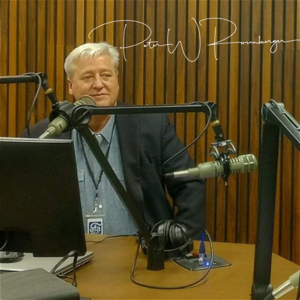
This is the Truth Network. Um Well welcome to Hope for the Caregiver. This is Peter Rosenberger and I am very, very glad to be with you today. HopefortheCaregiver.com HopefortheCaregiver.com And the reason we do this show. Why do you think that is?
Well, it's hope for the caregiver. We do this because family caregivers are an at-risk population. I've been convinced of this for a very long time. I've been a caregiver for a very long time. 40 years now that I've been caring for my wife, going through operations with her, taking her to doctor's appointments.
staying in hospitals, spending the night in hospitals, up at night, taking care of all kinds of things as she has now approached almost 100 operations in her lifetime. It's been a bit of a journey. That's the tough news. Here's the good news. Yeah.
We have been sustained by this. From before the foundation of the world. because God knew And he equipped us and he sustains us. Like the hymn says, O God, our help in ages past, our hope for years to come, our shelter from the stormy blast, and our eternal home. Isaac Watts wrote that.
That's one of the hymns we've covered in our series on hymns that every caregiver ought to know. That's a good one. But think about that when you look back, oh God, our help in ages past. We have a reference point now. We can see things.
Gracie and I have a reference point. We can see what He has sustained us through through many dangers, toils, and snares. I have already come. We can see this when you have a 40-year-plus track record. of going through many dangers, toils, and snares.
You can look back and see his provision. And every now and then it's very helpful for us as Christians. to look back and see the hand of God that delivered us from things. That becomes an anchor for us to say, Oh, yeah, he sustained me through this. I've seen this before.
I've seen this before. I went and spoke at a church when I was in Aurora last year with Gracie at the hospital for so long, and I went and visited this church there, a wonderful church. And Deliverance Jesus is coming, church. And the pastor just called us the other day. He had a long talk with Gracie.
It's just wonderful people. And They uh Uh the the young man that worked at the hotel I got to know that's how I found out about the church, and he was a keyboard player. And I heard he was pretty good.
Well, it turns out he's more than pretty good, he's really good. But anyway, we got to talking. I said, Well, look, I need a place to go to church. And I'd love to come hear you play with your worship team there at your church. He said, Now look.
I wanna I want to make you aware of something. I said, what's that? He said, well, we get a little wild in our church. I said, well, that's okay. That's all right.
And he wasn't kidding, by the way. but he gave me the wrong address. And it took me a while to get there. I was a little bit late.
so forth and so on, but I finally got there. And then the pastor reached out to me. He came by, he and his wife came by to see Gracie. And then they called me. They had me the next week.
I showed up there and I got there on time. And then he asked if I would just say something to the congregation, just to speak to them. Tell them what's going on with Gracie and me.
So I got up and I spoke, and I referenced the young man at the keyboard. I said, Last week when I showed up, I was late because he gave me the wrong address. And they all kind of laughed at him, and he put his head down there at the keyboard. And then I looked at the congregation and I said, but I wasn't late today. You know why?
Because I've been here before. And at that point, now remember, this is a Pentecostal church, and they know how to be a little bit more demonstrative than what I grew up in Presbyterians. In Presbyterian churches, the motion light, you know, if you have motion lights, they'll go off halfway through the service. You know, there's nothing going on. We're all sitting there in stony silence there.
But in this church, they're a little bit more demonstrative. And I said, I've been here before. And all of a sudden I hear the organ Kick in, you know, and it was kind of funny to watch that. And then I just kept talking. I said, and as I went through these things with Gracie at the hospital, we've been here before.
We've been here before. And we have. And that's the thing that sometimes we as Christians Do ourselves A service by reminding ourselves, we've been here before. We've seen God move before. Just to show o' hands.
How many of you all have seen God provision in your life before. Before you tune in today on this program, And as you look back at it, you say, oh, you know what, that was God. There was God sustaining me. That was God working that out. How many of you done that?
Just look at all those hands out there. All right, you put your hands down. But that that's the That's the point for us as believers.
Now I remind myself a lot of the things I've learned over the years. as a caregiver. Because I have caregiver amnesia and I forget these things. I gotta go back and read my own book. I've got to listen to my own show.
But more importantly, I have to go back and remind myself of the gospel. Because I have gospel, Amnesia. I forget these things. I have to be reminded every day. I remember talking with a pastor one time.
And I was saying, you know, we need to make sure that we share the gospel every Sunday in a clear way to the people. And the pastor said, well, you know, I'm pretty comfortable knowing the gospel. And I looked at him and said, Well, I'm not. I got to hear it every day. All the time.
Do you feel that way? Are you Pretty comfortable hearing the gospel, and you can.
Okay, we're moved on. Another pastor friend told me this about. A lot of folks in the churches, he said, people have become bored with the gospel. Do you feel that way? I doubt you do if you're listening to this program.
I doubt you do, because here's the thing about suffering, here's the thing about watching suffering, here's about the thing about being a caregiver. It creates what can be termed as accidental theologians. We are accidental theologians. You know why? Because we're forced to look at something so broken So relentless, and it doesn't change.
And we have to wrestle with those questions. We have to wrestle with these thoughts.
Well, where is God in this? I have a theology tutor. He listens to this program. He grades me. No, he does it greatly.
He's a wonderful man. And he pushes me pretty hard. on some things because I went to him and I said, Look, I need to learn. I can't go to seminary. I can't go to sit in the classroom anywhere.
I just can't do it. But I can study, but I need somebody to help me understand these things and to study with me and to push me. And he's done that. And I remember turning in, I didn't turn into paper, but I let him look at things that I write in the news and for different. places and so forth in my books.
And I'll discuss it with him. And he said to me, You take very difficult concepts. And you show An enormous practicality to it, the practical application of the gospel. And you put it down where people can understand that. And I would love to take credit for that, by the way, but that's not me taking credit for it.
That's just me doing it for 40 years, having to figure this out. It looks like me wrestling with v Difficult things in scripture. Say, well, what does this mean in this situation? How does this work in the ICU? How does this work in the middle of the night when you're dealing with whatever issue, the crisis of the evening kind of thing?
How does this even work? And by doing so What we as caregivers do is we we literally step into being theologians. Because we're struggling with Deep concepts in Scripture. to understand more of what God is doing.
So, that we can get to these points along this trail that we're on, well, we can do like the Israelites did with Moses in Deuteronomy. And Moses took them through the history of how did you get here? Think back on this The God of your fathers. who brought you forth out of Egypt. And he went through all the things that they had done.
Sometimes it's very healthy for us. particularly as caregivers. to go through all the things. that God has done for us. There is no question.
That the things we deal with are painful and they're difficult, they're hard, they're challenging. But that's not what's at stake here. What's at stake is do we understand? Are we aware? Do we know?
That he who began A good work in us is faithful. To complete it to the day of Christ Jesus is that bedrock in our life. And if it is. What joy we have knowing that this is not even worthy to be compared, even if that's not bedrock. It can be starting right now.
To know that He is who He says He is, if He could save us. He can keep us. And that is hope for the caregiver. This is Peter Rosenberger. We'll be right back.
Welcome back to Hope for the Caregiver. This is Peter Rosenberger. HopefortheCaregiver.com. You go out to that website, you go on the front page, look up there at the top. It says Caregiver 911 is blinking.
If you're struggling, you don't know what to say today, if you're just trying to keep your head above water. I got something just for you, just something real simple. Take advantage of it. It's out there and look around the site as well. There's other things that are available to help you as a family caregiver.
And I was talking last block about me going to this church. And when I say that, the organ jumped in, do you know what that kind of sounds like? I mean, some of you may have no clue to what I'm talking about, but they start coming in with the band. And punctuating everything you're saying, so you'll be going along speaking and And I said that, and all I had to do is repeat what I said. I've been here before.
And then you hear this. I've been here before. And then And then the band comes in. And it just, it was quite enjoyable. And I thought, you know.
I grew up Presbyterian. We didn't have things like that. Yeah. So it it's you know, but I I've I've been teaching myself. I mean, going to class and learning to play gospel music like that because um Gracie has always made fun of me because of my rhythm.
I mean, you know, but I didn't think she needed to say Indiana Peter in the Tempo of Doom. I didn't think that was called for. And say that I had the honkypox. I mean, that wasn't right. That's not right, y'all.
But I've had to deal with it.
So I'm one of those kind of guys that have to practice with a metronome, or at least I had to for a long period of time. And it just, I just couldn't feel it. And I play, I mean, y'all. That have been listening to the program know how I play. I tend to play a little bit slower, a little bit more expressively.
I'm not in a hurry. And I admire these guys who could just get out there and just. Throw down. But You know I'm working on it. This should give me time.
I'm working on it. I wanted to. Follow up on a little bit what we're talking about in the last block about Looking back and seeing How we got here. And what has sustained us through it, and some of you maybe have heard me say this before. But I think it bears repeating.
back in 2023. Gracie had this nine hour surgery. It was it was it was a brutal surgery. And they had to go back and basically take out the hardware that was in her back and then completely fuse her back. And she ended up having it.
done twice.
Okay, because we had a complication, so they had to do it twice before we even got to the stuff we did last year that kept us in the hospital for five months. This big neurosurgery. and she knew what it was going to be like. She knew it was going to be tough. And just before we got on the plane, we were here at the house and we were heading out to the airport.
And she looked at me and she said, I can't go. And she said, I feel like I'm going to throw up. She was so nervous about this And rightly so. She knew what was coming. And managing Gracie post-operatively is no easy thing to do.
It's very difficult. And when you're going down we're we're going we were going down to Denver, For this, we weren't back in Nashville where she spent so many of her surgeries there. Same hospital, same surgeon, same anesthesiologist. You know. dozens of years.
And that's all changed now. She's at a new hospital, teaching hospital, but it's where this surgery needed to be performed and and the right team and the the time was right. Her back was bent over forty eight degrees. I mean, she's just doubled over. And it and it's causing all kinds of problems with her.
And so It's gotta happen. We're commanded in Scripture to comfort one another with the same comfort we ourselves receive from the God of all comfort. Paul talks about this in Corinthians. You've heard this scripture. And that's my commandment.
Now I I'm not a pastor. Let me just get that out of the way. I I have the heart of one and I people have told me that I probably you know, would make a good one. I don't know. I don't know that I would go to a church that have me as a pastor.
But Either way, I have a congregation of one. Husbands love your wives as Christ loved the church who gave his life. for her, laid down his life. I have a congregation of one, and that's Gracie, and I have a responsibility to shepherd her.
So how do I give comfort to this woman? What does comfort look like? What does comfort look like to me? What comfort that have I received? that now I can extend to her in the midst of this very difficult journey.
And that's when I came up with two words. Two words the comfort that I have received And now I'm going to extend it to Gracie. And by extension I'm extended to you all. Aggressive? Assurance.
Now, you can put that to the hymn if you want, aggressive assurance, Jesus says, but you can do that if you want. You don't have to. But. I named this operation back in 2023, I named it aggressive assurance. Actually this is 2022.
Operation Aggressive Assurance. That's what I named it. And I just committed all the way down there. that I was going to assure Gracie of undeniable truth. Of foundational things that would sustain her in this.
And I pulled aside her surgeon. the neurosurgeon, disguised top notch neurosurgeon. his PA, his staff, all of em And Every one of them that I had a contact with before the surgery, the anesthesia team that was doing her anesthesia during the operation. Say the same thing. Aggressive assurance.
This is how you talk to Gracie. I didn't tell him what to do. I just told him how to talk to her. I speak fluent Gracie.
Now, it's not a gift of tongues, that's just me knowing Gracie for forty years. And I speak fluent Gracie. And I know how to speak to her in a way that's going to calm her down because stress on this level. can exacerbate the pain even more for her. and anxiety, they I they know what to do with pain.
Terror is something different, and she was terrified of this.
Now, Gracie's tough. I mean, she's tougher than a waffle house steak. I mean, this is a tough woman, tougher than train smoke. But you know, this is this was terrifying to her. You know, I've never seen her quite this way.
when she felt like she was just going to throw up. She didn't want to get on the plane. But she knew she didn't have any choice And so I started assuring her. I didn't say baby's going to be all right. I said he's already there waiting for you, Gracie.
Because that's biblical truth right there. He goes before us. He's waiting there for us. He is not surprised by anything. Remember what I talked about last block?
If he could save us, he could keep us. That's the doctrine of the perseverance of the s of the saints in Just a nutshell. If he can save you, he can keep you. And he keeps us. Thou wilt keep him in perfect peace, whose mind is stayed on thee.
And these are things that I did. I talked with all of the the folks there. And after the surgery uh the anesthesiology team came in. And this is now we had the anesthesia during the surgery. And then you had a acute Pain management team.
postoperatively. That we're going to manage her pain. And that's where the real work begins. How do you keep her from just climbing the walls? And they did an excellent job, but she's unconscious for five days following this surgery.
And I'm in ICU with her. She's intubated, which she hates being intubated. And oh, she hates it. And and that's another Segment: I'll talk about when she woke up and she's intubated and she's just panicking. But but they wanted to keep her absolutely still.
for the first uh five days of this thing. And so the here comes the attending. physician. He's the attending anesthesiologist, and he's got the the alphabet after his name. And he comes into the ICU with all the residents with him because he's the professor.
He introduced himself, I introduced myself, and I shared again how we got here. How did we get here? What is Gracie's history?
Now I don't know the diagnosis. I can't I mean, I know some diagnosis, but I don't give the diagnosis. I'm the historian. I hold the narrative, just like you do for your loved one, by the way. We are the historians of this.
And we have caregiver authority. And I laid out and I told him what my thoughts were about Operation Aggressive Assurance. And you could tell he just lit up. Uh he really did. He demonstratively lit up.
And He said to his students, he turned around and he said, did you hear what he said? And he gave the word to them, said what he is saying is absolutely critical, and it is a huge part of managing someone's pain. And I mean, he just he was so gracious and went through it, but he but he wasn't being gracious, he was also being clinical. And he recognized that there was more going on here than just putting medicine into somebody's arm or in their IV and helping them feel a little bit better. Much more going on.
And and we talked a lot about the clinical stuff, and I mean, I can keep up. You all know me by now, you know I can hold my own with most of 'em. But that was not my purpose there. My purpose there was to give them the language on how to take care of Gracie. to help them speak a little bit more.
in Gracie's language. To assure her that, okay, Gracie, we got you. We're not going to drop you. We're here. We got it, darling.
We got it. We we got you. It's okay, we're right here. We're watching. We're not going to drop it.
All those kinds of things. Just aggressively assure her.
So that she doesn't feel like, Do they forget it? Do they know I'm in here? You know, that kind of stuff. You could you could really lose perspective in the ICU, particularly when you've been there as much as we have. And This wonderful anesthesiologist.
I mean, this guy's a player, man. Got the alphabet after his name. And he he was so attentive and and and receptive to what I was saying. And they all filed out to leave and he then he stopped and he hung back and he walked across the ICU. And he put his hand on my shoulder.
He's right in front of Gracie's bed. He just walked across, and she's. intimated she's out. and he put his hand on my shoulder. And he said very quietly, Caregivers also benefit.
from aggressive assurance. And I got to tell you, tears filled my eyes. And then he shook my hand, and he said, Don't worry. We've got her. Don't worry.
We've got her. And by then I'd begun to realize something that I I really hadn't set out to learn. I thought I was preparing a medical team to care for a uniquely vulnerable patient, of which Gracie is. But what I was really circling was the human condition. That's what I was talking about.
When fear overwhelms us. You know, and explanations aren't going to help. What we need most is credible assurance. spoken by somebody who knows what they're doing, stays with us. and refuses to leave us alone In our territory.
error. Gracie may be my congregation of one. But what she requires in moments like that one. is not unique. to her disability.
It is simply what all of us need. When suffering strips away our strength and leaves us listening. for a voice that will not Abandon. Us. Oh God, our help.
in ages past. our hope for years to come. our shelter from. The stormy blast into our eternal home, and that, my friends, is hope. For this caregiver.
and it's hope for all caregivers. This is Peter Rosenberger. We'll be right back. Welcome back to Hope for the Caregiver. This is Peter Rosenberger, and this is the program for you.
As a family caregiver, glad to be with you. HopefortheCaregiver.com. Hopeforthearegiver.com. Last week I It took some time. To go through my book, A Caregiver's Companion, Scriptures, Hymns, and 40 Years of Insights for Lifestuff is Rollin, evidently connected.
Very well.
So I thought I'd do a little bit more of that today. And these are just nuggets, I mean, just quotes that I put in the book, and then I married it. With A a hymn or a particular passage from Scripture that Anchored. It would serve as bedrock under it. And then there's a place for you to write your thoughts as well.
And this book's available wherever books are sold. And I wanted something simple for my fellow caregivers. I think I've said in this book. Everything that that Certainly, that I could think of in my 40 years that would cover the spectrum of what we deal with in our hearts, on a heart level, not things that are caregiving tips. I'm not going to tell you which handicap accessible bars you need to buy, that kind of thing.
That's easy to find out. My thing is to help my fellow caregivers back away from the cliff.
Okay, just let's let's step back over here for just a second. Let's just take a take a breather, let's cool down for just a minute. And think this through. How did we get here? And where are we going?
What what's the goal here? And so that's what the nature of this book is about.
So, on one side of the page, you have a simple quote. I told you, this thing takes seconds to read. The other side is a a hymn or a scripture.
So here here's one today. When we become isolated, our own dark thoughts take us down, often quickly. To best fight that, we need to surround ourselves with healthy, positive individuals.
Sometimes it's as simple as a Facebook group, which I have one by the way. It's Hope for the Caregiver Facebook group. You have to answer a few questions to join. I encourage you to join. You can post whatever you want and look at some of the things that other people are posting.
And I moderate it, okay? I'm in charge of it. But that can only go so far. Regular phone conversations, regular face-to-face conversations, and when possible, group events serve as the path. toward pushing back against isolation.
I have people like that in my life. that I call pretty regularly. I live on North Meadow Creek. I've got a friend of mine who lives on South Meadow Creek. I call him the sage of South Meadow Creek.
And we talk all the time, man. We don't talk about caregiving. We look at the news of what's going on and we kick around ideas of what's going on. You know, what he's a he's a real fascinating guy. And so we just talk about policy things.
He's really into policy stuff, and it's just a fascinating conversation. And I talked to him.
Well I'm Cleaning the house, doing the dishes, making breakfast, whatever. I got an earpiece in my ear, but I can talk.
So I'm not just alone with my own thoughts. I've got several people like that that I have these conversations with that I enjoy talking with and then I see people here, certainly. I've got another buddy of mine lives down the hill from us, and we talk about things and we don't necessarily, again, talk about caregiving. But I'm engaged all the time. Mm-hmm.
And and I started uh a Facebook group for that reason, but I also started a support group Physically, six years ago, And I had to suspend it for a couple of, well, almost a year while I went to the hospital with Gracie. And I was gone for so long. But I'm restarting it back this month. And Looking forward to Getting back in the throes of this. This was such a good time.
When I first started this thing six years ago, over six years ago, I was the only one that showed up for three weeks. And then, little by little, people started just coming, and pretty soon we had a pretty good regular crowd. And we sit around a table, we have some coffee and we talk and we don't fix problems. We just talk. We just spend time together kicking around some ideas.
We learn from one another. And um We go through various things. I mean, there's some tough stories in there that are hard to hear. here and and and yet we don't flinch from them. We Go after it.
We say, okay, let's talk about it. And sometimes we'll take a room temperature kind of thing where a decision has to be made by one of the attendees. I mean, they're at a decision point. And so we'll go around the room, and people weigh in on it.
So, what do you think? And then I will ask that person who has to make the decision, okay. You've heard now from You know, eight people who have significant and credible caregiving experience. Do you feel that you've heard some good wisdom today? And they're not required to do anything.
We're not saying, okay, you got to do this. But the request is for counsel. And Scripture says what about counsel?
Well, there's wisdom. and a multitude of counsellors. And again, we're trying to avoid Our opinion. One of the things we've done is work hard as a group to avoid giving our opinion as much as: here's what I'm seeing in my experience, here's what my experience has been. And when you put that many people together with that kind of collective experience as caregivers, you get some pretty good insights.
And so that's how we push back against that isolation because isolation is what cripples us. And we really do get into dark thoughts. When we do that, so here's the quote again: When we become isolated, our own dark thoughts take us down often quickly. To best fight that, we need to surround ourselves with healthy, positive individuals.
Sometimes it is as simple as a Facebook group, but that can only go so far. Regular phone conversations, regular face-to-face conversations, and when possible, group events serve as the path towards pushing back against isolation. That took what, 15 seconds? Maybe. And then here's the hymn I put Nicholas.
Von Zisendorf wrote, Christian Hearts and Love United, and here's the hymn: Grant, Lord, that we with thy direction love each other, we comply, aiming with unfeigned affection thy love to exemplify. We're just loving one another. That's a little heady way of saying we're loving one another. That's the southern translation. Y'all, we're going to love up on you.
But that's what we're doing. It's nothing any more complicated than that than to bear one another's burden. And then you turn the page Right after that, in this book, and this again is A Caregiver's Companion: Scriptures, Hymns, and 40 Years of Insights for Life's Toughest Role. And I wrote this specifically so that you don't have to. Read it in a straight line.
You can pick it up, drop it, whatever you want to do. Turn a page, you can play page roulette and just flip through it and let your finger land on a page and you'll find something. But here's the next page over: Serving as a caregiver is simply too difficult to do alone. Don't lean on your own understanding. Ask for guidance and help.
Don't believe everything you think. Again, mirrors right along with what we just said.
Well, Proverbs 12:15 The way of a fool is right in his own eyes, but a wise man is he who listens to counsel. You see that? And that's it. And then there's a spot for you to write your thoughts there. How does that particular scripture grab you?
Or what does that quote say to you? What are your thoughts on this? And there's not, you know, you don't have to write a whole book if you don't want to. Just scribble something down. Just say, you know what, this is where I'm thinking.
Because what I've done here is just give you my journal for 40 years. And I don't journal very much. I mean, not like I'm writing. You know Thousand-word entries every night. I mean, these are little things because I'm a caregiver.
We don't have time for all this. Brigamorolle. And and You know The things we carry are just too too big. And and that brings me to another one. This is on page 224.
Respect The trauma. That's it, three words. Respect the trauma. I mean, you I'm sure you respect other people's trauma. Do you respect yours?
Do you look at yourself and say, you know, What you've been through is exceptional. I mean there was a lady that came to the support group and that was the conversation, is that she was just overwhelmed and she didn't know what to do. And I asked her a simple question, well, what would you say to somebody who's doing what you're doing? And if you want to hear that, you can go out to the Caregiver 911 and you can hear what I said and what that interaction was like and why it means something to fellow caregivers. You know, and and Do you respect your trauma?
Well, let me tell you what. What the Word of God says.
Now, this is. Yeah. Yeah. five, six through seven.
Now the context is Jesus going to the pool. There were supposedly an angel would come and stir the water and peep up to get in and whoever got in got healed.
Okay. And Jesus shows up. One man was there who had been an invalid. For thirty eight. eight years.
When Jesus saw him lying there, and knew that he'd already been there a long time.
Now that may seem something like something obvious to you. It may seem, well, you know, of course, even though he'd been there a long time. But scripture, every word in scripture is important. Do do we believe that let's let's let's establish that first. Do we believe that every word in Scripture is important?
Well, okay. that if we have accepted that and that we we stand on that, Then For Scripture to mention that twice, that he had been there thirty eight years, and said that thirty eight years is a long time. Then that is significant. That is not trivial. There's no trivial words in Scripture.
And Jesus knew that he'd been there a long time, and he respected the trauma this man had had. He respected the journey. Scripture put it in there for all eternity that this is a long time.
Now, think about for just a moment of that reality. The the infinite said this finite amount of time this guy has had is significant. He didn't gloss over it. The Infinite God The infinite Triune God, Father, Son, and Holy Spirit, put it into the infinite word that thirty-eight years is a long time. Do you see that our God Respects that kind of trauma?
That he doesn't dismiss it lightly? He put it in His Word for all eternity. That same saviour Cease your trauma. Cease your pain. Recognize it.
He's already established the principle that he sees things that are painful and he is going into them. He's not abandoning you. He's thought She said, well, you know, pull yourself up by your bootstraps. All right, get over it. He sees what Gracie's gone through.
He sees what I go through. He sees what you go through. And it's important to him, and he meets us in it. We talked about this at the beginning of the show today: about looking back and seeing all the things. That he is done.
Here to now. Through many dangers, toils, and snares. O God, our help in ages past. He sees it. He is the God who sees.
You know, the only place in Scripture where he gets that name, El Roy, is when Hagar She was cast out with Ishmael. She was a tangential to the covenant. And yet God saw her in her distress. He sees. He sees you.
So that's just a sample of the things that are in this book. A Caregiver's Companion, Scriptures, Hymns, and 40 Years of Insights for Life's Toughest Raw makes a great gift. For you, for yourself as a caregiver, for your pastor, for somebody you know. This is Hope for the Caregiver. This is Peter Rosenberger.
We'll be right back. Welcome back to Hope for the Caregiver. This is Peter Rosenberger. Glad to be with you. HopefortheCaregiver.com.
Hope for the caregiver. Dot com This is the program that helps you stay strong and healthy as you take care of someone who is not because. Healthy caregivers Make better caregivers. Healthy caregivers make better caregivers. We're continuing on our series of hymns that every caregiver ought to know.
I've been marching through the hymn. I've actually talked about this hymn a while back, but it's not part of this series, but I'm bringing it into the series now. And do you know who Philip Bliss is? You probably know a lot of his songs. But let me tell you a little bit about him.
He was born in 1838 very poor family. in rural Pennsylvania. His childhood was unstable at best. His family moved often and money was pretty tight. Actually it was scarce.
and his formal education was almost nonexistent. What he did have, though, was music. Musicians' families are not known for having lots of money or being staple, but he did have his music, and he had an abundance in Scripture. And he learned early on that when material things disappear the words remain. Spoken words, sung words, scriptures.
The word in scripture. As a as a young man, he was able to get musical training You know Musical training was not always offered to a lot of people. That was more of a privileged thing, but he didn't get it through that. He got it just for persistence. I mean, he the guy was relentless.
And he eventually became one of the most influential hymn writers of the nineteenth century, partnering closely with Dwight? Moody in Arasenki. during the Great Revival movements and One of the things I liked about Philip Bliss is that he did not write hymns to stir emotions. He wrote hymns to anchor souls. That's what draws me to his stuff.
He believed that music was not meant to replace the word of God, but to. carry it. to lodge it deep enough that it would still be there when everything else was stripped away. And that conviction gave us the hymn that we're going to talk about today. It did not come from a mountaintop experience, it came from an ordinary Sunday.
After he had heard a sermon on the enduring power of Scripture, someone Just made a passing comment about how easy it is to lose our sense of wonder. at God's Word through overfamiliarity. And we talked about that at the beginning of the program where, you know, we just have people that are bored with the gospel. We're not staring with wonder at the text on our pages in our Bibles. if we open them at all.
C.S. Lewis described it as: we've lost our imagination. Uh because we're not we're not enthralled with this. You know, think about with children, they're enthralled by everything. It's the best ice cream you've ever had, it's the best this, but we're not enthralled anymore.
We've heard it over so many times that we just kind of get bored with it. And he took that personally. He got actually pretty angry about it.
So he sat down and wrote a hymn that doesn't celebrate novelty. Um Or the spiritual adrenaline, so many of him, even today that we deal with, they just kind of like to get everybody worked up. Instead, he just. wrote something countercultural. Just Simple.
Don't show me something new. Don't give me something dramatic. Don't make me feel something powerful. Just say the words. Over and over again, Because the soul Philip Bliss new does not grow strong on constant innovation, it grows strong on faithful repetition.
So Here's the text of this. Wonderful words of life. words of life and beauty. Teach me faith and duty. Uh uh that's not emotionalism.
You know, that's not trying to Elicits something from the audience. That's discipleship. He understood that the scriptures form slowly, patiently, often imperceptibly. And he wrote music for people who would still need truth when clarity didn't come quickly. you could say that he wrote it for caregivers.
We need truth when clarity seems so elusive. There's a sad ending to his story. In December of 1876, he and his wife Lucy boarded a train heading to Chicago. for a Christmas meeting and the train crossed a bridge um over in Ohio and the bridge collapsed. and the cars plunged into the ravine below and caught fire.
He survived the initial fall. But witnesses later said he escaped from the wreckage only to realize that Lucy was still trapped inside the burning car, so he went back. And he did not survive. He was thirty eight years old. And they found A small trunk among the wreckage, and inside was the manuscript of a hymn that Philip Bliss had just written.
It would be published after his death. The name of the hill, this just chokes you up. I will sing of my Redeemer. I will sing of my Redeemer. Think about that.
His final song was not about healing. or rescue or earthly triumph or anything like that. It was just about redemption that was already accomplished. Tells you everything you need to know about his faith, doesn't it?
Now we go back and look at this text. Of wonderful words of life. Maybe next week I'll do I will sing of my redeemer. By the way, you know, he wrote the uh music to um It is well with my soul. Horatio Spafford wrote the lyrics, You Know That Story.
But Philip Liss wrote The the music to that. Seeing them over and over again is not the request of someone who hasn't suffered. That's what we do as people who watch suffering and suffer ourselves. We want to hear it again and again and again and again. Words that are spoken when nothing can be fixed.
And uh Maybe that's what we're looking for: words that are sung when our prayers run out. Do you ever feel that way? And it words that carry truth. When Circumstances just don't want to cooperate. You know, he didn't live very long.
But he gave us something extraordinary in what he wrote. And this hymn matters. It doesn't shout at it. And I don't play it fast. You know me, I don't play things fast.
It doesn't rush. It's not meant to manipulate you. It simply hands us the word. again and again and says here You're going to need this. And you know what?
He was right.
So let's go to the caregiver keyboard for wonderful words of life. Sing the bo for And all over again to me. Wonderful words of life. Let me more of their beauty see. Wonderful words.
of life. Words of life and beauty. Teach. Teach me faith and duty. And I love this car.
It's beautiful. you Wonderful words. Wonderful words. Fly. Beautiful, beautiful words.
Wonderful words. Wonderful words of love. Then you go to the second verse here, Christ the Blessed. One gives to all. Wonderful words.
And I was just doing a walk down, by the way, on this. I'm just doing a walk down. Center. List to the loving. Called.
Wonderful words of life. Then you just do this little bridge section. Oh, so freely giving. Ever Woo. Wing uh Close to heaven.
Into that nine-inch suspension. Beautiful words. Wonderful words. Wonderful words. A fly.
Yeah. Beautiful words. Wonderful words, wonderful words of love. You could just sing that around the house. Beautiful words.
Wonderful. Words. Wonderful words of love. Beautiful words. Yeah.
Wonderful words Wonderful. Mm works. Love life Is that not a marvelous hymn? And certainly was not written by a guy. Who sat somewhere apart from life and looked out at life, he was immersed in it, dealt with very painful things.
Family growing up was such poverty, but he worked and worked and worked. And the thing that drove him was this. absolute conviction. of the Word of God. And he wanted to have songs that reflected that.
And look at what he left. Hallelujah! What a savior! That was him. I will sing of my Redeemer.
It is well with my soul. Wonderful words of life. And there's so many more. What a body of work. And he was 38 years old.
when he died so tragically. And the last hymn he wrote was, I will sing of my redeemer. I love that hymn, by the way, and it's easy to play for those of you who are people Church pianists, and if you want to know those chords. Feel free to write me and I'll tell you. But all you do is just do a walk down from the major seven, okay?
And just.
Well You can listen to it and figure it out. And if you need some help, Email me and I'll be glad to help you. This is Peter Rosenberger. Thanks for letting me spend the time with you today. Go on to standingwithhope.com.
Slash giving, standingwithhope.com slash giving and help us do more of this. If you like what you heard today, we could use the help standingwithhope.com slash giving. We'll see you next time. Gracie, when you envisioned doing a prosthetic limb outreach, did you ever think? The inmates would help you do that.
Not in a million years. What does it mean? I would have ever thought about that. When you go to the facility run by Core Civic and you see the faces of these inmates that are working on prosthetic limbs that you have helped collect from all over the country that you put out the plea for. And they're disassembling.
You see all these legs, like what you have, your own prosthetic legs. And arms, too. And arms. When you see all this, what does that do to you? Makes me cry.
because I see the smiles on their faces and I know. I know what it is to be locked someplace where you can't get out without somebody else allowing you to get out. Of course, being in the hospital so much and so long. When I go in there and I always get the same thing every time, that these men are so glad that they get to be doing, as one man said, something good finally with my hands. Did you know before you became an amputee that?
Parts of prosthetic limbs could be recycled? No, I had no idea. I thought we were still in the. 1800s and 1700s. I mean, you know, I thought of peg leg, I thought of wooden legs.
I never thought of. Titanium and carbon legs and flex feet and C legs and all that. I never thought about that. I had no idea.
Now that you've had an experience with it, what do you think of the faith-based programs that Core Civic offers? I think they're just absolutely... Awesome. And I think every Prison out there should have faith-based programs like this because. return rate.
of the men that are involved in this particular faith-based program. and other ones like it, but I know about this one. Is just an amazingly low rate compared to those who don't have them. And I think that that says so much. That test so much.
about Just that doesn't have anything to do with me. It just has something to do with God using somebody broken. to help other broken people be whole. If people want to donate a used prosthetic limbs, whether from a loved one who passed away, Yeah. You know, somebody who outgrew them, you've donated some of your own.
What's the best place for them to do? How do they do that? What do they find? Please go to standingwithhope.com/slash recycle, and that's all it takes. It'll give you all the information on them.
What's that website again? Standingwithhope.com/slash. Slash recycle. Thanks, Crazy. Take my hand.
Lean on me. We will stay