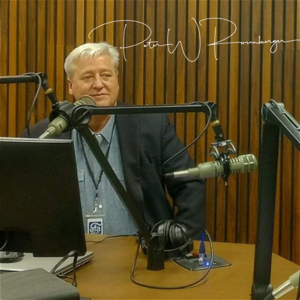
Um I'm Peter Rosenberger and after 40 years as a caregiver for my wife Gracie through a medical nightmare that has soared to 98 operations, both legs amputated, treatment by more than 100 doctors in 13 different hospitals and you can't imagine the medical bills.
Well I've learned some things and I've learned every one of them the hard way. And in my new book, A Caregiver's Companion, it's a journal from that journey. It's filled with hard-won wisdom, practical help, and yes, an ample dose of humor. Because let's face it, if we don't laugh, we're going to blow a gasket. And I've learned that I am no good to my wife if I'm fat, broke, and miserable.
How does that help her? Healthy caregivers make better caregivers, and that's what this book is about: pointing my fellow caregivers to safety, to learn to live calmer, healthier, and dare I say it, even more joyful as a caregiver. It's one truth I've learned, punctuated by either a verse from scripture or a stanza from a hymn, and a space for you to share your own thoughts. While this is my journal from a 40-year journey, you can journal along with me in this book. It's called A Caregiver's Companion, available August 20th from Fidelis Publishing, wherever books are sold.
Learn more at peterrosenberger.com. Welcome back to Hope for the Caregiver. This is Peter Rosenberger. Glad to be with you, PeterRosenberger.com. H D.
Huntington's disease. done Several things with them over the years, with the organizations, and talk with patients who are going through this and their caregivers. It's a horrific disease. And it was in our family, my dad's side of the family. And I look at families that are dealing with this, and I marvel.
And I have one said family here today, and that is DJ and Jessica Rowland. DJ is caring for his wife, who has HD. They're both here with me today. And I wanted to give them a chance to share their story and what's on their hearts, what's on their minds, and how they're. Dealing with this, what's going on in their life today as they navigate this very, very difficult disease.
So, DJ and Jessica, welcome to the program. Glad to have you here. We're happy to be here. Thank you. Yeah, we are.
DJ. Yes. before they're spoken. That's just my journey. But that kind of sixth sense, if you will, comes at quite a cost to be able to learn that.
What do you do? What do you do when you feel spent? or when you realize you've been running on empty for a while. How do you tank back up? You know.
It's a little different for me than it is for a lot of people because. I'm caregiving for my best friend. She's who I want to spend my time with. She's who I. Who I enjoy to be around, so she's also who I recharge around.
when she rests I take time for myself and and take care of myself, but What does that look like for you? A shower by myself, take my feet up, maybe have a beer once in a while. You know, it it's just, you know, get a little relaxation and and downtime before I go to bed. And, you know, I still work quite a bit, so we have a little bit of help from. From family members that come in and hang out with Jessica while I'm at work.
What do you do, by the way? I do truck repair.
So I own a mobile truck repair business.
So wherever the semi trucks break down I go out to them and fix them on site. Are you able to leave her for extended times like this comfortably, or do you have to have somebody with her? I I tend to rather have somebody with her, or we do what we call take your wife to work day, and she'll. Get in the truck with me and and she'll just kind of sit and hang out in the truck while I'm working on On other trucks, and then whatever she needs, we'll go do in between calls. Jessica, is he pretty good at it?
Yeah, see yes. I had to supervise him.
Well, she's saying she has to supervise me on taking. I don't doubt it at all. How big a territory do you cover?
So I'm all of South East Michigan right now.
So, I don't know if you know Michigan, but I cover from Saginaw South to the Ohio border and from Lansing East to the water.
So, when you go out on the site, you could be going up to two to three hours away. Yeah, about two hours away is my max. Yeah, we're pretty centrally located in between those borders. But what happens if it's in the middle of the night?
Well, you know, she sleeps pretty soundly through the night, and she's got a guardrail on the bed and stuff like that. We also have a sun. Yeah, we have an eighteen year old son at the house, so if there's a feeling. I'm basically gonna wake up, but She's not completely by herself then. Correct.
And if she is, she's good for a few hours. You know what I mean? She just, like this morning, she didn't want to go to work with me.
So. I just set her up with what she needed. We went and used the bathroom. Took her meds. Took her meds.
We uh you know, set up a T V show to keep her company for a while and she just She just relaxed. Do you use smart technology? At all to help with stuff? As in, you know, Alexa or things such as that.
So no, our house isn't really set up. For stuff like that, we do have a smart thermostat.
So, if it was like wintertime or something, and she needed. the house to be warmer, I could turn the the heat up. But other than that, I mean she She has her phone and she can navigate her phone pretty well. She has an Apple Watch that has fall detection and stuff like that. But After this past winter, she really doesn't walk at all.
unassisted.
So She she just, you know, she'll call our son if she needs help to get. Get into the bathroom or You know, I I have made adjustments to the bathroom. We have a walk-in tub now that I put in. We have grab bars everywhere. If it's a towel rack, it's actually a mounted grab bar.
So, anywhere you turn in the bathroom, there's a grab bar right there. I'm building an addition. For us, and um, I'm incorporating as much smart stuff in it, you know, so Gracie doesn't have to get up and try to turn off the lights or turn on the lights, that kind of thing, and she can do it all from her devices. That's a good idea.
Well, every now and then I'll come up with one, Jessica, but don't tell anybody. We'll just keep that as our little secret there. You want to make sure it. Yeah, let's see.
Well, those are things that are really helpful, I found, because when you have somebody with a mobility impairment and fall risk, you want to minimize that as much as possible.
So that's some of the things I've done because we've had too many falls. Let me ask: one of the issues that caregivers struggle with, DJ, is what I call the three I's. We lose our independence, we become isolated, and we lose our identity. How has that affected you? What about your identity?
So Ever since I was little, I've always had this need for a need. Like I need for the people around me to need me. And I believe that's because my mom was Also disabled. She had major heart problems. She always needed help.
And I always felt in my element when I was able to help with the needs around the house.
So Caregiving actually fulfills me. Which is Kinda weird to say, but it it really does. It just It it makes me feel like I've done My due diligence for the day if I was able to help somebody I love get through their day.
So Oop, there. I really don't struggle with any of that. I do have a lot of friends that really understand. The position that I'm in, and they don't really get upset that I'm not available. they tailored avili availability to My lack of availability.
So they'll come to the house and hang out. here at the house because I can't leave or they'll invite us. Yeah, they'll invite us together and they'll make sure that, you know, they they set their place up to be inviting to her. Or Yeah. We'll go do something that we all like together.
That we can plan ahead for so that we can make sure that she's able to get to whatever event we're doing.
Well, it sounds like your friends and family, your church group, they're shoulder to shoulder with you in this. Yeah, absolutely. We're not actually members to any church group, which is something that she would like to do again. But I think we're gonna wait until we move. Yeah.
We're planning on moving away from Michigan so that we can get away from the Michigan winters.
So we're we're thinking like Northeast Tennessee. Or Eastern Tennessee.
Well, there there's some winters down there. My wife was born there in East Tennessee, and there's some winters down there.
Now, not like what we have here. Yeah, they're not missing down but uh but you guys get a lot of cold, wet snow there in Michigan. Yeah, yeah, and the cold is what really stops her from being able to progress day to day. Is it the cold or is it the dampness or both? I think it's a little bit of both, but the cold is just so bone-chilling cold.
It's so bad. It it that you know coming off of Lake Michigan, the coldest I've ever been, and I've skied in 32 below out here in Montana, and the coldest I've ever been was off that wind coming off of Lake Michigan. And that is just bitter, bone-chilling cold. And so I applaud you for getting out there. You'll like Tennessee.
Now, we get some cold weather in Tennessee. You know, we lived there for 35 years, and now we moved out west because the dry, cold air is easier on my wife's joints. And it helps her with that. You know, back to this the three eyes when we Lose our own independence, but we also watch somebody else lose their independence. And, you know, we feel helpless watching this.
Absolutely. What's been the hardest thing for you watching? Jessica go through this. What's what's what's grabbed at your heart and you just Y it Bend your shoulders down.
So You know, I don't mind doing for her. But her Noticing that she has to be assisted and noticing that she can no longer do for herself, Hers hurt. and seeing her hurt, Hurts me. Um she is my heart. And I I do not like to see her struggle with the fact that She needs help with simple tasks.
What do you do with that hurt? Let her know that I'm here, I'll help in any way I can and you know, if if she wants to work on some Different types of like physical therapies or anything else that might help her regain some of that. I'm all ears. That helps her, but what do you do with your hurt? I cried.
I mean, I just deal with it. What did Jessica say? Right. Yeah. What else can you do?
Well, that's that's the question. And there are things we can do, but it's painful. It's painful to watch helplessly through somebody you love suffer. And you got to deal with that hurt some way, somehow. We we talk about See when Grief after someone dies, we talk about that.
But for us as caregivers, We have a thing called, I've labeled it, incremental grief. Where we just grieve. incrementally every day. Yep. Does that resonate with you?
It absolutely does. It absolutely does. I mean, we're going through.
Some of that with some of our friends. I mean You know, we we see people, we call them our H D family actually. We we really like Going to these HD events. And seeing the community, and you know, you build relationships with a lot of these people. The only thing is, is you only see them like three times a year.
And that time in between There's progression. And then you see them again, and you notice all their progression. you grieve all over again, but you don't want to do it in front of them.
So You know, Jessica's actually been dealing with a lot of that herself too. Jessica, when were you diagnosed with HD? Yeah. Uh how was it two thousand seventeen? 2017 you took the test and 2018 we got the results.
Were you already having symptoms at 2017? Yes. I think it was I was clumsy and And it all kinda mean, like, mentally She had some psychological symptoms, stress, anxiety. aggravation She also had some clumsiness issues. And I also had a hard time with keeping my job that I felt like the loviniers.
And I couldn't even keep it.
Well, the psychological effects are what caused her to to leave the one job that she had for many years. She got so fed up with with something kind of trivial, And You know, slid her keys to the manager and said, I can't do this anymore and walked out.
Well, hey, listen, there's a lot of us that have done that without HD. Right, right.
Well, and that she just thought that she was frustrated, and then she went to their direct competitor and she worked there for a few weeks. and decided Oh wait a minute, this isn't this isn't just the place I I had worked for all these years. This is the whole industry And I think it's just. the workforce. Yeah.
I am having trouble psychologically dealing with the workforce. and and I'm not able to pull myself out of it. And what would happen with her is, she would reach a level of frustration. I call it the cliff. It's like going off a cliff, there's no coming back from it.
And once she's over that cliff. It's There's no consoling it, there's no coming back from it. She just needs to leave that situation completely. And it it could take Up to twenty-four, forty-eight hours for Her to be able to get back to the level she was before going over the cliff. Was did you know that H D was in your family?
Jessica? Who who had it in your family? My uh grandpa is and my mom. and my aunt and now my brother too and me. And um what about your son So we she has three children.
that would have been considered at risk. Um The oldest is autistic and has not been tested. The middle child has been tested and tested negative. And the youngest child, he's 18, and he's now eligible to task. And once you get a negative test on HD, that holds up.
You don't have to worry about it anymore. Is that correct? Correct, yes. And that that means that his children will also be negative. Right, once it's broken, it's broken.
That's it. And now, these are your children from a previous relationship, or are these both of your children? Uh they're hers from a previous relationship.
Well, when did you all get married?
So, we actually met a little over 18 years ago, and we've We've lived Like a married couple since day one, meaning we've lived together and everything since day one, we've raised her children together. Their father was not really in the picture much so I took over that role. He also has kids from a previous relationship too. Are you all married are you all married now? Yes, we are.
We got married in twenty twelve. But you didn't get diagnosed until twenty seventeen. When did you start having symptoms, Jessica? Uh 2017. Yeah, well twenty seventeen was when she attributed the the symptoms to Huntington's disease.
Up to that point, had you had been noticing any kind of behavior changes?
So, yeah, it it was kinda slowly, progressively getting worse. Um, her clumsiness, you know, we used to laugh and and say it was, you know, The blunt-headed nature. She would start getting worse at driving where she was curb rashing the wheels and stuff, and I quit tariffing really. Yeah, she quit driving really early on because she realized that all those little driving snafus were. reaction time because of Huntington's disease.
So, I mean there yeah, there were symptoms, but we did not put two and two together until towards the end of twenty seventeen. When you got the diagnosis. Mm-hmm. Were you two together when that when you got the when the diagnosis came in? Yeah, and really it it it's a hard Situation to discuss because it was not a good testing situation at all.
We were at a regular neurology center. We didn't know much about the centers of excellence. We didn't know much about making sure that doctors knew about Huntington's disease.
So we were at a neurology center But It wasn't A place that was experienced with Huntington's disease. And they treated us.
Well, it was awful. They lost her blood, her, her. Um Blood sample. They treated us horrible at the window. Like the girls at the window were just horrible, slammed the window in our face when we're asking questions.
Um They they lost the sample.
So you're at the neurologist and they they didn't automatically think H D. They just started testing you for all kinds of different things. No, we could have only just asked them we just asked them for the The DNA test for Huntington's disease. There was absolutely. Yes.
Yeah, we We literally went there to ask them for that test. And they did absolutely no genetic counseling. They lost her sample, they treated us poorly, they took forever to get the results back. I mean, we didn't get the results until April of 2018. And I want to say it was like November of 2017 that we went in for the test.
Did you send him a sternly written letter? Uh no, I showed up in person and and I I refused to leave the The lobby without some answers. Yeah. That's why they slam the door with the window on us. I was so happy getting here.
Anything from that? But we did finally get the results. In You knowing about Huntington's disease, you know that a CAG repeat of 49 on one of the alleles is. Obviously a uh Positive for Huntington's disease? It was a tough day, in other words.
Absolutely. But at the same time, you know, there's a little bit of relief in knowing. You know, like She had been noticing different things going on with herself that she couldn't find answers to. The answer was Huntington's disease.
So from that place, we went ahead and we found a neurologist that was treating her brother at the time. Who knew?
Something about Huntington's disease. And You know, he's the one that actually diagnosed some of her chorea and stuff like that. prescribed medications. I've got a buddy of mine who was very much involved with it. He's a neurologist.
This was one of his. Bigger areas of expertise.
So I was able to delve deeper into this because of him. But I I'm curious as to the treatment that they have for this. What does this drug do? To put it simply, you know, there's involuntary movements with Huntington's disease. Right.
And helps to block those involuntary movements. from happening. It doesn't do anything to stop the mental decline. It just keeps it from the Korea part, where, you know, the dance, if you will. Yeah.
Correct. It it helps to to control the Korea so that the involuntary movements aren't getting in the way of her day-to-day activities. Could you tell a difference when you started taking this, Jessica? Uh Pretty quickly. I mean, how long did it before you say, hey, this is working?
Couple days, it was pretty immediate, wasn't it? I thought it was pretty quick when she noticed. things starting to slow. But visually, it took a couple of weeks for it to visually. be noticeable.
Her career wasn't horrible when she started taking it. Um so you know we were doing some of the the tests that the the doctor was doing so that we could see where the The disconnect was. Um, but she started taking it early on in her diagnosis and before the Korea actually got. I don't like that. She doesn't have a whole lot of visible Korea at all.
Now, not every HD patient gets the chorea. Is that correct? That is correct. Jessica's brother actually has Dystonia really bad, and he's really stiff, so he doesn't get a whole lot of choreatic movements at all.
Okay.
So, yeah, that I mean every patient is different. What other, besides this treatment for the Korea, what other medications do they? Offer to you to kind of help deal with this symptomatically. There are medications that she takes that are. like antidepressants and stuff like that.
So they have you on a. When you go into this pathway, With Huntington's, they're going to evaluate whether or not you have the movement disorder. And if they do, then they're going to provide this particular drug for you because this is what helps with that. Correct. And then they'll treat other things like depression and other things.
Now you're not in a lot of pain, are you? Jessica? No. She she did have some lower back pain. It was really bad.
And I mean, for the longest time. I don't know. I don't know either. It was so bad. to where I had to have a lift chair and all that, and then I fall all the time.
It was really bad. So, we did find a natural remedy for the back pain that. has completely gotten rid of it. I don't have it at all. Yeah.
And it was chronic back pain to the point where it was immobilizing. And to even is that because of the falls? Is that because of the wheelchair? What do you think was driving that? I believe that was actually Dystonia.
Yeah. Because you can have both Dystonia and Korea. And she was very dystonic in the in the beginning. Do muscle relaxers help that at all? Oh, they didn't.
Not really for her. They do for some people. But Uh no. It didn't really help with the pain. It helped.
To keep Her from being so stiff, but she still had enough stiffness to where her lower back was just on fire all the time. What about swallowing? Do you have difficulty with that? Yeah. Uh I think I do.
She she does. Um We just we deal with it in different ways. We either uh you know I'll help cut her food. or I'll prepare her softer foods sometimes. Her drinks, she uses straws 'cause she has better control Over the amount of liquid.
Even with my coffee, I have to have it in the morning. Yeah, she likes to have a straw in her coffee, so I I make her coffee to where it's a little milder temperatured. and I use a tumbler with a lid and um We have these metal straws with Silicone pads on top of them. And she uses those and and everything's great. Is he a good cook, Jessica?
Yes, he is. What does he make that you like? I look his uh gulash and I like his uh lasagna. I don't try to make lasagna anymore. I I'm not very good at it, but I've turned out to be a pretty good cook, but I'm not I'm not Italian.
That Rosenberger just doesn't, you know, it doesn't lend itself to doing good Italian food.
So I think I'll just do Stouffer's lasagna if I have lasagna. But I'm trying to watch I'm also trying to watch my carbs on that and watch Gracie's as well. But I enjoy cooking. And I make her some nice meals, but that's impressive that you could do a good lasagna. That's phenomenal.
I actually do a lot on the grill and stuff too. He's really a lot. sweated up from time to time. We have many kids in the house, we used to, so we have a lot of left doors.
Well, it if it tells you anything about my cooking ability Um the kids actually have friends Like, obviously, all our kids want me to cook for all their events, but they've had friends have me cater their Graduation parties and stuff because they wanted my food at their graduation. Yeah. I've done that too, but I usually just call somebody and have them bring it into. I'll cater it by making a phone call because I'm not cooking for a party. Before I let you go here, I wanted to ask you a couple of things.
One of them is. If you And I'm sure you will because when you go to these meetings with HD groups and so forth, and it is very meaningful to go, and I've been to enough of them now, and I see the camaraderie and the sweetness there, the solidarity there of standing. But I also know that there will be. Significant decline between meetings, and that's hard to see. But when you see a new patient, going through this and a new family, new husband and wife.
What do you offer them at that point?
So when they're brand new to this journey, what do you say?
So we usually exchange Facebooks and I I always let People know they can reach out if they have any questions, if they want an event, they need a friend. Like we just make ourselves available To our friends and our HD family. And I mean, right now we have a really close friend that's really going through some troubles and. It it's looking like the end of his journey. And right now, we're all trying to band together and figure out a way to get him home because he's.
He's still in Denver, Colorado. where we had our last event this past weekend, He's in ICU and he he lives down in Florida. and he currently can't get on a commercial flight.
Well, we just came from five months in Denver, and I think I'm going to stay away from Denver for a while. That was uh not as not as much fun as you'd think. Yeah. You said you were looking to get into a church when you maybe moved down to Tennessee or whatever. One of the things that I really work with a lot of churches, a lot of pastors, on how to even talk to folks that are going through something of this magnitude.
knowing that this is a grim road. And it's going to get more difficult. You know it. Jessica knows it. I know it.
We know it. It's just, it's not, nothing about this is easy. What would you like to say to a pastor? Say you're going to go visit a church or something, but when you're looking for a church, what would you like to say to a pastor? Particularly about this disease, or about where you are spiritually, or a lot of things.
You know, I think the best thing to do when you're looking for a church. Is find one that's welcoming and just show up and see how people treat you, see if people are intrigued. To say hello and learn a little bit about you. Oh. Lot of people, but was that just yeah, and I'm an open book, you know.
You, yeah, you walk up, yes, she was she was saying that I'm not scared to let people know. What about you, Jessica? Yeah. What about you, Jessica? She's very timid.
Well, hold on. I'm going to talk to Jessica for just a minute, DJ. What about you, Jessica? I don't know. Do you feel embarrassed to go to church?
No. Well a lot of the terms even in the past. We had issues with their son and with the autism. He wasn't accepted at the church, and that's why we quickly. I mean, it was exactly the first world whatsoever.
And we were going for help ourselves, you know? Does he have problems with sensory stuff? I mean, too much noise, whatever. Because I actually had this conversation with some folks with autism. I said, What would you say to pastors?
Because one of the things I'm on a mission to do is really better equip churches and church folk to know what's going on when you have a chronic impairment like this and how to care for them. They said the first thing to do is turn the lights down, turn the music down. Yeah. And so I think that's pretty good advice on that. Is there a particular hymn that you like, Jessica?
I can't think of it. You know that that uh hallelujah We have a friend that is a uh Jazz musician and oh about Cohen? Yeah, in his version of Hallelujah. That's a wonderful song. Is there a particular church hymn that you like?
That you remember from childhood or other churches? Not really? No. I love music, but I can't think of the name.
Well, you'll have to listen to my series I'm doing on hymns that every caregiver ought to know. Because I go through the hymns. I have what I call the caregiver keyboard, so I do all kinds of hymns.
So I'll play hymns for it. Do you feel that? What do you think? This is just, there's no wrong answer. I'm just asking you: what are your thoughts on?
what God is doing. Could do, won't do, has done in this situation? What are your thoughts towards the Almighty? Do you have resentment towards this? Or is it what do you are you?
You say you're willing to go back to church on it and you'd like to get involved in the church. How important is your faith to you on this? These are, what are your thoughts on this? This wasn't part of the normal interview process, and you don't have to answer anything you're not comfortable with. I personally draw a great deal of strength for what Gracie and I have gone through for these four decades because of understanding the things of scripture.
What moves me quite a bit is That footprints poem. A lot of people really know it. Oh, yeah, when he said those are the ones I carried you. Yeah. And then the long, straight line is the one where he drugged me.
So. It it brings me a lot of comfort. When I see that, so I actually have it in multiple places in our house because. That's kind of how I feel. Like, when I can no longer carry the weight of.
everything on my own shoulders. And You know, I feel like I'm only seeing one set of footprints in the sand. It it lifts me up to know that That's when the Lord has carried me. through the troubling times. and helped me get back on my feet.
Through many dangers, toils, and snares, the hymn writer said. Do you know this hymn, by the way? Do you know that one? That sounds familiar. When sorrows like sea billows roll.
Yeah, you know, my grandma actually used to play that quite a bit, and she was a Baptist preacher. Whatever. My lot. Thou hast taught Me too say. It is well.
It is well. With my soul. I would really encourage you to get that hymn out. You look it up online and read the story behind it. I'm going to be talking about that in the next couple of weeks on this series I'm doing.
But the guy that wrote that hymn, I think it would speak volumes to you. To you both of the story behind it. Horatio Spafford was his name. Philip Bliss wrote the music to it. But that's one of the things that we have.
Yes. to the stuff that you're doing with the hymns? Yeah, and it's out of my podcast. It's all out there at my podcast. And I'm going through one.
I started off doing 30, and I think it's going to morph to about 300 because I love them all. And the hymns are filled with what I call compact theology, where it takes very, very difficult, painful things. That hymn writers have wrestled with, and they put it to beautiful music. And the stories behind these hymns are amazing. And the story behind that hymn.
I think would speak enormously to you and and Jessica and your Difficult journey that you have, and I recognize the magnitude of what you both carry. And I hurt with you both, but I also stand and applaud. For what you're doing and what you're doing for others to be a source of encouragement to others. And it's deeply meaningful to both of you. We've found a phrase that's been very helpful in our journey, and we've come to be known for it.
Um I do not know the original writer of it, but I now have it tattooed on my arm. and it is fear does not stop death It stops life.
So we are going through every day living life to the absolute fullest that we can and facing Jessica's fears. Um Which used to be like motorcycles and parasadling and stuff like that, we've gone and done everything that we can. That we know that she's scared of, that would be exciting for her to do. We even went in the hot air balloon. You know?
I think that'd be marvelous to go in a hot air balloon. I think that what you've hit on something. DJ is just. Amazing is that the goal is not to not die. The goal is to live with whatever we have to live with.
And we saw that during COVID, where a lot of people were trying so hard at risk aversion that they weren't living. They were closeted away because they were so afraid of dying that they weren't living. Yeah, they even had that with their own family. They'd be like, Why do you go out and do stuff? They're like, We go out on a bike and they'd be like, Why yeah?
I don't remember it was like uh You should be inside. I'm like, no. I'm gonna live my life. I I watched when I watched my wife. Go down over the ski slopes.
She learned how to ski as a double amputee on both of her prosthetic legs. Oh, wow. And I watched her go down the blue slopes, watched her go down one black slope. And she hadn't skied in a while, but we're going to get her back, hopefully. That's been a bit of a challenge.
But I watched her do this. and the look on her face Of sheer joy. Yeah. You know, and it was painful. I mean, she's always in pain.
Yeah. But she did it because she's living. People say, why are you doing this? She said, Are you kidding me? You know, I'm literally Yeah.
And at whatever level she can, she's going to do it. And she lives large. And I want you to as well. The future is going to be what the future is going to be, but we're not guaranteed anything. We're guaranteed today.
That's all we have is right now. What we do here. Oh, and and and what are we what are we doing here? What are we accomplishing here? I've got a song that I wrote f for caregivers and and you can you can see it out online and YouTube or whatever.
It's called I Can Only Hold You Now. the one of the lines and it says, I know it uh it's uh And you can go out and listen to it if you want. But it's I know there will be sorrows. We'll face that somehow. But my hands can't hold tomorrow.
I can only hold you now. That's awesome. As for you guys, I I know be sorry. Face that somehow But my hands can't hold tomorrow. I can only hold you now.
I think it'll mean something to you if you want to go out and listen to it, or you can stream it online in any of your streaming services. I can only hope to now. My wife sings it. There's some other people that have cut it too, but I think you'll like it.
So, listen, you two have been a real treat today to talk to, and I want you to know how much I appreciate you. I want to hear how the journey progresses for both of you, okay?
Well, it's totally been our pleasure. We really appreciate you having us on. You got some homework. I want you to go out and look at the story behind It Is Well With My Soul and look at the lyrics of that hymn.
Okay, that's your homework. Because I think that song is going to end up wrapping its arms around both of you. Like it has for millions and millions of people. But read the story behind it, because that's what's going to really touch your heart. And you recognize this guy that wrote this lyric knew what he was.
He knew he understood grief. He understood sorrow. And yet he understood, more importantly, the provision and the faithfulness of God in the midst of it. And that's what I want you and all the others that I talk to with everything in me, I want you to grab a hold of that. And understand that there's more going on here.
And what God has done, Gracie and I will testify. You can go see it on my stuff, my website, and the songs we do and everything else. This is not theory to us, this is 40 years of this. Pretty, pretty brutal 40 years. But we've seen God to be greater than all of these things and the redemptive work that He's done through Christ, this is what sustains us.
So, my prayer is for you all that it will also sustain you as well. I know it can, and I'm asking you to go out and look at that hymn and see if it just wraps its arms around you. Thank you so much for taking the time to just talk with me today, okay? Absolutely. Thank you.
Bless you both. Thank you. This is Peter Rosenberger. This is Hope for the Caregiver. We'll see you next time.
Gracie, when you envisioned doing a prosthetic limb outreach, did you ever think? The inmates would help you do that. None. A million years. What does it do to you?
I would have ever thought about that. When you go to the facility run by Core Civic and you see the faces of these inmates that are working on prosthetic limbs that you have helped collect from all over the country that you put out the plea for, and they're disassembling, you see all these legs, like what you have, your own prosthetic limbs. And arms, too. And arms. When you see all this, what does that do to you?
Makes me cry. 'Cause I see the smiles on their faces and I know. I know what it is to be locked someplace where you can't get out without somebody else allowing you to get out. Course, being in the hospital so much and so long. When I go in there, and I always get the same thing every time, that these men are so glad that they get to be doing, as one man said, something good finally with my hands.
Did you know before you became an amputee that? Parts of prosthetic limbs could be recycled? No, I had no idea. I thought we were still in the. 1800s and 1700s.
I mean, you know, I thought of peg leg, I thought of wooden legs. I never thought of. Titanium and carbon legs and flex feet and C legs and all that. I never thought about that. I had no idea.
Now that you've had an experience with it, what do you think of the faith-based programs that Core Civic offers? I think they're just absolutely Awesome, and I think every prison out there should have faith-based programs like this because the return rate. of the men that are involved in this particular faith-based program. and the other ones like it, but I know about this one. Are just an amazingly low rate compared to those who don't have them.
And I think that that says so much. About just that doesn't have anything to do with me. It just has something to do with God using somebody broken to help other broken people be whole. If people want to donate a used prosthetic limb, whether from a loved one who passed away. or you know somebody who outgrew them you've donated some of your own What's the best place for them to do?
How do they do that? Where do they find it? Please go to stannywithhope.com/slash recycle, and that's all it takes. It'll give you all the information on there. What's that website again?
DannywithHope.com/slash. Slash recycle. Thanks, Crazy. Take. My hair.
Lean on me, we will stay.