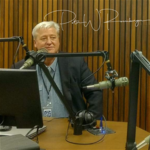
This is Stu Epperson from the Truth Talk Podcast, connecting current events, pop culture, and theology, and we're so grateful for you that you've chosen the Truth Podcast Network.
It's about to start in just a few seconds. Enjoy it, and please share it around with all your friends. Thanks for listening, and thanks for choosing the Truth Podcast Network. A daily program powered by the Truth Network. This is kind of a great thing, and I'll tell you why. Where pop culture, current events, and theology all come together. Speak your mind. And now, here's today's Truth Talk Live host. Welcome to Truth Talk Live. This is your guest host today, Peter Rosenberger. I'm coming to you from Montana where we are way up in the Rockies.
It is a beautiful day in big sky country. I sent a picture of a bear from my neighbor's trail cam. I sent it to Stu Epperson, and Stu asked me, he said, how do you outrun that thing? And I said, I don't. I just have to outrun you, Stu.
No, I'm just kidding. We're glad to be here with you. I do a program here on the Truth Network every weekend for family caregivers, and you can see more about that at PeterRosenberger.com.
I've got a couple things in store for you all today to talk about. Notably, the whole issue of being a caregiver. This is where I focus.
This is an issue affecting 65 million Americans. Maybe you're one of them, and if you are, this is your time. And you can call in 866-348-7884, 866-34-TRUTH, and I'd love to hear from you. Just as a way of introduction for those of you who may not know me or anything that I do, you can go see PeterRosenberger.com.
That's B-E-R-G-E-R, Rosenberger.com, PeterRosenberger.com. I've been a caregiver now for my wife for more than, well, almost four decades, so that's a long time. She was hurt terribly back in 1983 in a car accident right outside of Nashville, Tennessee, where we went to school at Belmont University. I didn't know her at the time. I met her a couple years later. She set out for a while, recovered, she came back, and I just was floored by meeting this extraordinary individual.
And against all wisdom and conventional sense, she married me. And her surgery count, she'd had about 20 by the time I met her, and now it's over 86 that I can count of what she's had to endure. Both of her legs were amputated, 13 different hospitals and 100-plus physicians.
I stopped counting at 100. This has been our journey, and it's still going on. I've had a physical therapist here at our home today working with her and a nurse, and she has significant challenges following this latest surgery she had in Denver just six months ago.
It's been a haul. So many in this country, there are 65 million right now, are doing this, are caring for somebody with some kind of chronic impairment. Maybe it's not orthopedic like in our situation. Maybe you're dealing with somebody who is mentally ill, somebody who has Alzheimer's, Parkinson's, a child with special needs, autism, Down syndrome. Maybe you're in a relationship with somebody who's an addict or an alcoholic. How are you doing? How are you holding up? That's what my thrust is all about, and that's what I do on the Truth Network on the weekends is hope for the caregiver. And I'd like to hear from you.
This is your time. I'd like for you to say how you are doing. And there's no right answer or there's no wrong answer.
There's just a factual answer. How are you feeling? Are you flailing? Are you able to find solid ground?
What does solid ground look like to you? These are the things that we explore, and if you want to call and tell me about it, 866-348-7884. 866-344-TRUTH. I've got a new book out. It's called A Minute for Caregivers When Every Day Feels Like Monday, and these are just one-minute chapters that I timed, every one of them, because I know my audience. They don't have the time to read lengthy diatribes and treatises. They want to get right down to it, and I thought I'd share some of that with you today as we talk about this. Now, this is an issue that is front and center in our country. You look at the amount of drug overdose and mental illness that's going on in this country where we have people who don't even know who they are anymore. They've lost themselves in someone else's story, in some type of gender dysphoria. They've lost themselves in all kinds of things. Then you have people that are enabling others.
I've written about this extensively. What happens when somebody enables somebody with a mental illness or that's in cognitive decline? Are we seeing this paraded out in front of us all the way to the White House?
That's not the first time that's happened, by the way, at the White House. Back in the early part of the 1900s, you had that with Edith Wilson, and Woodrow was incapacitated, and she basically was the de facto president for about, I don't know, a year and a half. So how do you deal with those kinds of issues, with enabling? Do you struggle with enabling? Do you find yourself propping someone up, way past their abilities to do so?
These are common issues that caregivers find themselves in. They are struggling to come to grips with this, and if you've got somebody who's an alcoholic or an addict, you know this. That you have bailed them out. You have paid for rehab. You have covered for them.
You have tried to hide all their bottles or tried to hide their drugs, monitored them. How's that working for you? How's all this happening for you? And if these are things that you're struggling with, I'm glad you're here. I'm glad you're listening today, and we want to unpack some of the principles that I've learned over a lifetime in dealing with this. These are not easy things, but they are solid things.
It's bedrock. I'm kind of the Wile E. Coyote of caregivers, and if you could fail at it, I've failed at it. But I've learned a few things along the way, and what I've learned are the principles that are laid out in Scripture apply every time. Do we take the time to know them? Do we take the time to understand them?
Do we take the time to implement them? Do we know what we believe and why we believe it? And if we say that we believe something, what are the implications of it? If He is Lord at all, then He is Lord of all. What are the implications of that?
What do you think? Do we live our lives in a way that reflects that? And are we able to then talk about that in an intelligent, cogent manner to a society that is just floundering out of control?
I can't see anybody, no matter what political side of the spectrum you live on, that thinks the country is heading in the right direction. Are we as Christians able to speak with clarity into that situation? We're going to talk about that and many more things. I'm Peter Rosenberger.
This is Truth Talk Live. I hope you'll join with us and give us a call. We'll be back in just a little bit. 866-348-7884.
You can go to PeterRosenberger.com. We'll be right back. You're listening to the Truth Network and TruthNetwork.com. Welcome back to Truth Talk Live.
This is Peter Rosenberger filling in today for Stu and Robbie. We're glad that you are with us. 866-348-7884. 86634-TRUTH if you want to be a part of the program. My thrust in everything that I do is for the family caregivers.
So that's where I'm going to hang out today. I will certainly bleed over into other areas, but everything I do is for family caregivers. Why? Because I've been one for four decades and I understand how difficult the journey is. And I know that this audience is filled with people who are taking care of somebody. And if you love somebody, you will be a caregiver.
If you live long enough, you will need one. So we're all invested in this. And currently there are 65 million Americans right now doing this and they are responsible for about $600 billion annually. That's billion with a B.
$600 billion annually of unpaid, untrained, usually, health care. I mean, those of us who've been doing this for a long time, we've done all kinds of things. I was a music major. They didn't teach me how to do all the things I do in music school. They didn't teach me all these things. I had to learn on the job.
It is the ultimate on the job training. I've actually scrubbed in a couple of instances and I actually was assisted with the procedure with my wife. It was just one of those situations where I had to scrub up and just do it.
Now with a last name like Rosenberger, I've been called Dr. Rosenberger many times and I tell them I'm a cranial proctologist. I'll let them figure that out, what that means. But it's part of the job. Maybe you have too. And if that's your life and you're taking care of somebody and you feel overwhelmed and you feel like you're unqualified, well first off, you're in the right place. Secondly, that's a conversation I'd like to have and you're why I do my program. You're why I write books. You're why I do all these things because I understand what that feels like.
So what does solid ground look like to us as caregivers? How do we get to the point where we realize, okay, I can't undo this and I'm not even well trained for it. But yet here I am.
What do I do? How do I stay strong and healthy while taking care of someone who is not? I came to a conclusion a while back that I'm no good to my wife if I'm fat, broken, miserable.
You know, you think that's pretty obvious, but it's not because I see way too many caregivers who are all three, if not one of three or some combination thereof. I was that way. I mean, Stu's real proud of me because I'm losing weight. A friend of mine fussed at me and I wasn't obese, but I needed to lose some pounds. And, you know, you gain too much weight when you go out in the forest and the bears are hiding their food. That's when you know it's time to make a change.
If you're having to iron your shirt in the driveway, yeah, it's time to take a step back and do something different. I was moving some cattle the other day. I got on a horse. I actually did a show with Stu. He called me while I was out on horseback. And I think that's the first time I've ever done a live radio show while I was on horseback. I think it was Truth Talk Live and I was out somewhere up in the hills. And so I did the program with Stu.
He thought that was kind of a novelty. But the horse appreciated when I got up on the saddle that I was less. And that's important to me, though, to stay in good physical shape because the demands on me are pretty intense. And I'm no good to her if I'm broke. I'm no good to her if I'm miserable. And if you're miserable today, I understand it.
Been there, done that. But that's when somebody helped me better understand the gospel. And that's what permeates all the way down so that I'm able to dig deeper and recognize that God has not abandoned me. This is not punishment. This is not punitive. This is not in any way penance. This is an opportunity to see His redemptive work in ways that I would not have seen it before nor would my wife. For a believer, no suffering is futile. For a believer, no suffering is wasted or somehow accidental. We all have purpose in this.
God has purpose in this. And once we start wrapping our mind around this, it changes everything. Doesn't mean it's going to be easy. Doesn't mean it's going to go away.
Doesn't mean it's going to be more enjoyable. Doesn't mean any of those things other than it means that our souls are lifted higher. Paul said this is not even worthy to be compared to the glory that awaits us with Christ Jesus.
Let everything go and press on to what we have. Martin Luther said, let goods and kindred go, this mortal life also, the body they may kill, God's truth abideth still. Do we believe that? And if so, if we believe this, then what are the implications as we take care of somebody who suffers? Or maybe you're that person that is suffering.
What are the implications? These are things that are important to me to sustain me as I go through this journey. And I am passionate about helping my fellow caregivers. You know, there's nothing quite like caring for someone with challenges or impairments to expose the gunk that's in our souls.
And regardless of our best intentions, selfishness will rear its ugly head. And our jaws are going to tighten and our fists clench. I'm a pianist. And I've got the caregiver keyboard hooked up here.
They told me the levels are okay. So I may just burst forth in the song at some point. But my hands always have to remain open to make beautiful music.
As caregivers, I've got to ask, what kind of music do we forfeit when resentment curls our hands into fists? Try pushing a wheelchair with clenched fists. Not with them in it. Don't do it with them in it. Just go to an empty wheelchair and try that way.
But you can't do it. You cannot push a wheelchair with clenched fists. In fact, clenched fists accomplish few tasks.
And it seems that fighting is the only suitable task for them. Caregiving is going to push every one of your buttons. And people who tell you differently haven't done it long enough. But it's in those moments, when seeing our character defects, that we can remind ourselves to unclench our fists and hearts and allow beautiful music to flow from our souls. That's an excerpt from my book, A Minute for Caregivers, when every day feels like Monday. I did this book. Oliver North published this book and asked if he could write the foreword to it as he's serving as a caregiver. And these are just one minute chapters that I wrote for my fellow caregivers. I wrote most of it while I was in the hospital with my wife. I was down the hall at a little vending area and I had a table set up and the doctors and the PAs and all would come down after they met with Grace. They'd come down and see me.
They knew that I was keeping my office down there sometimes to work because we were there for two months. And I love these little one minute vignettes that speak just in time. And I close every one of them with a quote. And this one, it's called, the quote is from, I don't even know where I found this quote, but it's, Let it hurt, let it bleed, let it heal, and let it go. We cannot carry resentment and the challenges of caring for a vulnerable loved one. We can't do it.
Scripture speaks an awful lot about resentment. Let it hurt, let it bleed, let it heal, and let it go. This is Peter Rosenberger. This is Truth Talk Live.
PeterRosenberger.com. Don't go away. We'll be right back. Welcome back to Truth Talk Live.
This is Peter Rosenberger filling in for Stu, for Robbie. And we're glad that you're with us. 866-34-TRUTH if you want to be a part of the program.
866-34-TRUTH. We'd love to have you give your thoughts on whatever it is. But mostly today I'm focusing on the family caregiver because that's what I do. I am passionate about reaching those who are struggling as they care for a vulnerable loved one. And I've often said that caregivers can feel isolated in a crowded room. We can feel isolated on a crowded pew. And isolation is one of the most difficult things that a family caregiver deals with. It is one of the seven caregiver landmines I wrote about in one of my books that we just feel so cut off. And disease and sickness and so forth and injury are isolating in of themselves physically. But it's not just that.
It's the disconnect from people. That we are so lonely and feel alone in this. The first thing that God's eye saw that was not good, this is according to Milton, was that man was alone.
And that was before the fall. It's not good that man's alone. And yet in our infirmed states we are keenly aware of how lonely we are, how isolated we are, how cut off we are. This is what sin has done. I've been studying a good bit of theology over the last couple of years.
And I've got a couple of tutors that have really worked me over. But here's what I've learned and I'm going to give you the synopsis of two years worth of intense studies. I've learned two things. One of them is sin is a bigger problem than we think it is. And the cross is a bigger deal than we could ever imagine. Sin is a bigger problem than we think it is.
And the cross is a bigger deal than we could ever imagine. And sometimes God allows very, very uncomfortable, painful things in our life to bring that stuff out of us. I call them sanctification opportunities.
You ever had a sanctification opportunity? And that's what a lot of us find in this journey of being a caregiver. Where we're having to constantly deal with someone else's needs, someone else's challenges, someone else's heartache.
And it seems like ours gets put on the shelf. And this was driven home to me the importance of having caregivers come front and center to be able to share from their own voice. And this is driven home to me one day at the piano. I was at the church where we attended in Nashville. This was the church where the shootings were some years ago.
Where the kids were killed and three adults were killed, including the custodian whose name was Mike. And Mike used to listen to me practice the piano when I'd go in the sanctuary and play. And Mike would sit in the back sometimes and listen. And I'd ask Mike, I said, anything you want me to play? And he's like, no, no, no. Just keep playing. Just keep playing. And after Mike was killed by this very, very disturbed girl that shot up the school, I went back to Nashville from Montana and I played at that funeral for Mike. And I just thought about what he said to me.
Just keep playing. And when I played, I played pretty passionately. I didn't hold back because I knew Mike wouldn't want me to. And I played like we did greatest of faithfulness as the opening hymn. And I laid into that.
And I wasn't going to hold back on it because he wouldn't want me to. And when I was playing in this church, the pastor had asked me to come play as people were coming into the sanctuary. And it was a little bit loud. You know, people were greeting each other and so forth. And he said, can you play and maybe bring the reverence back to an atmosphere that settles people down a little bit to get their hearts ready for worship?
Can you just come in and play? And so I did. And I was sitting there playing and I've been accompanying my wife who's a no kidding singer.
And don't take my word for it. Go out and listen to her. You can just go to my website, peterrosenberger.com, you can hear some of her music. She's the real deal. And I've played for her for years. So I was kind of hearing her in my voice while I was playing. And so I sat at the keyboard and I'm going to go over to the caregiver keyboard here.
Nick, if my levels aren't right, just jump in and say, Peter, get your act together. It wouldn't be the first time, but I'm over here. And I was playing while people were there and the church was filling up.
There were hundreds and hundreds of people. And I'm over there doing this. Nice chords. Great chords.
Beautiful chords. But I wasn't playing the melody. And I realized I was hearing her voice in my head and I was playing around her voice. And I wasn't playing the melody. And that was one of the longest ten minutes of my musical career was teaching myself to play the melody again after years of not doing it. Because she was singing the melody and I was playing the harmony. And so I had to go back and train myself right then in front of hundreds of people to do this right.
And it drove home that point that it's not enough for me to play something. I needed to say something with it. And so I had the melody to it. So here's the melody.
Now I'm saying something. And so the point of it is is that it's so easy for us as caregivers to lose our melody. I'll give you an example. Ask a caregiver, how are you doing? Well, she just got home from the hospital or he had a bad night or we're not doing so well or. They have a hard time speaking in first person singular.
And one of the first things out of the gate that I do is to help caregivers speak in their own voice. I hurt. I am struggling.
Doesn't really matter what comes after the word I. Now we can have an honest conversation. I'm tired.
I'm weary. Because once we start speaking like that, then we can start applying scripture to those things. Well, what does Jesus say about that?
What do the scriptures say about this? Have you lost your melody? Do you have a hard time saying things in your own voice? Do you feel like your voice doesn't matter as long as you take care of everybody else or somebody else?
Is that where you are? Because if you are, you're not alone. But also, there's a path out of that. And it comes from you learning to play your melody. Just like I had to in front of hundreds of people to learn how to play the melody of the song. It takes work. It takes practice.
It takes time. But you know, that's what I love that little hymn, Jesus Loves Me. Jesus loves me, this I know. We all think, well yeah, Jesus loves me. He loves everybody.
No, no, no. Jesus loves me. He knows my name.
You know, He knows your name too. In fact, scripture goes so far as to say our names are engraved in the palm of His hand. Do you believe that? If so, what are the implications of that belief? Does that change your life? Do you have anything in your life that changes because of that belief?
Does it affect the way you approach everything you do? Paul says in Galatians, I have been crucified with Christ. I no longer live. The life I live in the body, I live by faith in the Son of God. Does that apply to you as a caregiver? Does that apply to us as American citizens? Does that apply no matter what?
Yes! The life you live in this body, you live by faith in the Son of God, even though you may have to do things that are very uncomfortable, that are very unpleasant, that are very tiresome, that are very wearisome. Can you hang on to that in those moments? And then once you learn to walk in this, can you tell somebody else about it? And the answer to both those questions is yes, you can. Scripture says you can. Not on your own strength. Not on your own strength by any stretch of the imagination. But you were never designed to do it on your own strength.
You were designed to do it on His strength. And you know that people will say, well, God doesn't give you anything that you can't handle. Well, that's not scriptural. Look around. Look through the entire Bible.
You won't find it. In fact, He will give you plenty of things you can't handle. He asked a blind man to see, a deaf man to hear. He asked a man with a withered hand to stretch it out. He asked a man that was dead to come out of a grave.
He doesn't give you anything that he can't handle. You see the difference? So don't somehow get that twisted into our pop culture, because that's too easy to do. We have too many people that do this. And they fill their minds up with things that sound like a Hallmark card, but it's not scripture.
And we're going to talk about that more when we come back. This is Peter Rosenberger on Truth Talk Live. If you want to be a part of the program, 866-34-TRUTH. 866-34-TRUTH. 348-7884. 866-348-7884. This is Peter Rosenberger.
PeterRosenberger.com. We'll be right back. Truth Talk Live! You're listening to the Truth Network and TruthNetwork.com. Welcome back to Truth Talk Live!
I am Peter Rosenberger. Glad to have you with us. Truth Talk Live! 866-34-TRUTH.
866-34-TRUTH. If you want to be a part of the program, I'm pleased to be able to step in today as Stu and Robbie were out. And they went way down on the bench to pull me out of here. But I'm grateful to be here. I want to leave you with a couple of things.
I've enjoyed my time here with you, but I want to leave you with a couple of things. One of them is, you know, the culture we're in right now, we all see it. It's a train wreck. I mean, we've got a dumpster fire going. And we all see it. Nobody is feeling like, you know, oh, everything's coming up roses.
People are very unsettled. The principles I talk about for family caregivers will reverse course for this nation. I promise you, they never fail.
Every time. One of them is boundaries. And if you've been a caregiver for any length of time, you understand how important boundaries are and how difficult they are to maintain, but you've got to do it. Every human being needs them.
Every relationship needs them. And we don't have good boundaries in this country. And because of that, we've got a situation where crime and drugs and, you know, we're hemorrhaging money and we're filling our country up with people we have no idea who they are. And we haven't vetted them. We don't know what their intentions are.
They're coming from literally around the world. And we don't enforce the boundaries. Now, that's because of whatever reason. You can blame whoever you want on this.
But it doesn't matter. They still need to be enforced. When you don't enforce boundaries, bad things happen.
You know, look at our major cities and where they've gone. I remember 15 years ago, Gracie and I were in Times Square in New York at midnight with our sons and I'm pushing her in a wheelchair. We're having a great time. Now, how many of you all think that'd be a great idea right now to do that? To go to Times Square, period, but to go with two children and a wife in a wheelchair.
Would you do it? If not, why not? Now we know. Okay? I mean, there it is.
All you have to do is say the obvious. So what's the problem? Is it a lack of resources in this country? I don't think so.
I don't think so. I think it's a lack of resourcefulness. And I think it's a lack of will.
I think it's by design because you can't be this ignorant at the level some of these people are. So they have to be doing it by intention and a misguided intention or nefarious intention. That's you decide. But boundaries are important. And because we don't have good boundaries in this country, we're in a mess. Caregivers understand boundaries. We have to maintain them in order to protect our loved one. We have to say no to certain things. If you come to me and you say, Peter, I know you're taking care of your wife. She's got 15 million dollars worth of medical bills, but we're going to get you to take care of somebody else, too, while you're doing it. We're going to make you do it. And I'm thinking, well, how is this going to be a good thing? Nobody's going to say that.
That's crazy. And yet that's what we're doing by having a porous southern border. That's what we've done. We're taking valuable resources that we have and squandering them because we don't use boundaries.
Boundaries work for caregivers every single time. Another issue is identity. And we talked about that in the last couple of blocks of knowing who we are.
Not getting lost in someone else's story. America has an identity. We are not a multicultural country. We have many cultures here, many diverse cultures, and we want to. We like them.
It's great. But America has its own culture, and that needs to transcend the others so that we're united as a people and can make healthy, responsible decisions. I don't make healthy decisions if I'm lost and don't even know who I am. And my wife is counting on me to make good decisions. And thirdly, fiscal responsibility. We're $35 trillion in debt. Thirty five trillion. Wrap your mind around that. How in the world are we ever going to pay that one off? Well, the reality is we're not. And it's going to continue to go into a very bad place and it will collapse.
Anybody who tells you different will lie about other things, too. Caregivers understand fiscal responsibility. We have to be. We have to say no to a lot of things. We're going to spend money, but we have to be good stewards of it.
We have to know what is is appropriate and not appropriate. And we better make sure we get everything out of that dollar we need. And we haven't done that as a country. And we have people that are in office that are spending this money and they don't care. If they care, they do something about it. They can tell you they care, but they don't. People that care will do something about it. So I'm going to tell you as a caregiver and somebody who understands these principles, I'm going to tell you, you need to vote wisely. Research people.
People are, you know, go out there and look at the positions and hold them into account. Get involved. If we don't, if we don't, who will?
If we're not saying something, who will? I spent time here on this program today to give you these principles that I live by to manage a medical nightmare now since Ronald Reagan was president. I've been doing this.
All these doctors, all these hospitals, all these bills, all these things are going on. I've managed this thing. I've done the almost impossible. But I haven't done it in a vacuum. I've done it because these principles guide me every single time.
Boundaries, identity, physical responsibility, and there are more. And if you want to know more, you can go out and go to my website, PeterRosenberger.com. PeterRosenberger.com and just see, see the things that we talk about on this program. And you can also get my Truth, I mean, on the Truth Network on the podcast. I have 800 something episodes out there and we've had a quarter of a million downloads on a show for family caregivers. I remember when I first started doing the radio program years and years ago and I went to this big station in Nashville and they looked at me like, we don't, we don't get it. You want to do what? And I said, I want to do a program for family caregivers.
They said, no, it'll never work. You know, and here we are a dozen years later, still on the air, still going strong. We're just getting started and we're going to strengthen family caregivers. We're going to help those who are helping others. And part of that is I want to help pastors and counselors to be able to know what to say.
If you don't know what to say to a caregiver, that's OK. I do. And that's why I write a book. That's why I do a program.
That's right. Write several books. And I want to give that vocabulary so that you know how to engage with them in their distress.
And as a caregiver, I want to give you that vocabulary to identify what help looks like so that you can ask for it and then hopefully inspire you with the courage to ask for it. You know, ultimately it comes down to our savior. It's hard to cry out to a savior that you don't think you need. And as long as you keep thinking, you got this, you got this, you got this, you're not going to cry out to a savior.
And can I just say for somebody who's done this now for four decades, go ahead and avoid the rush. I had a chemistry teacher in high school. His name was Fail.
No kidding. His name was John Fail. And he had a sign up in his classroom says, Flunk now and avoid the rush. So I was like, I didn't flunk the class, but I came close to it. I mean, that's why I graduated.
Thank you, Lottie from high school. But I love that sign, though. Flunk now and avoid the rush. Sometimes it's OK to just go ahead and say, I can't do this. Before we cause a lot more carnage to realize that I can't smart my way out of this.
I can't clever my way out of this. I'm just going to have to doggedly walk this path, trusting in God. And something I tell my audience on a regular basis, when you feel beat up, struggling, hurting, there's no place else to go. All of those things in that long valley of the shadow of death.
And it is a long valley at times. I want you to remember something. His scarred hand holds your scared hand.
OK, you tracking with me? His scarred hand is holding your scared hand. He knows. He knows what you're carrying.
And he would meet you in it. The last surgery that my wife had was a very big surgery, about a seven or eight hour surgery. And I named that operation when we went down there for this and we were there for, this is the second time around we were there for several months. And I called it Operation Aggressive Assurance, where I was going to aggressively assure her, she's going to be OK. We're going to get through this. It's going to be all right. He's not abandoning you. And when I look at scripture, I see aggressive assurance that our Savior is intimately involved with our lives. He knows.
He's not going to abandon you. Fanny Crosby wrote that great hymn, Blessed Assurance, of Phoebe, I can't remember her name, but she showed up at her house with this tune. She says, Fanny, do you have a lyric for this? And in 15 minutes they had written Blessed Assurance.
And such a great hymn. I don't have time to play that at the caregiver queue. Well, let's say I do. That's all I can give you today. But it is the crux of everything God has said to us. And if you look at Jesus' word, lo, I am with you always, that assurance says even in the face of our country, freaking out, which it is, and we've got politicians and media and everybody else, who do you believe? Well, you believe scripture. That's where you start. And if you don't know scripture, then today's a great day to start.
OK? This is Truth Talk Live. I'm Peter Rosenberger. Glad to be with you today. Thanks for the privilege. And I hope to see you some more.
We'll see what Stu and Robbie think when they come back. I have enjoyed this time. PeterRosenberger.com. PeterRosenberger.com if you want to find out more. The book is A Minute for Caregivers.