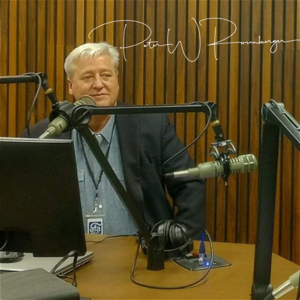
I'm Peter Rosenberger and after 40 years as a caregiver for my wife Gracie through a medical nightmare that has soared to 98 operations, both legs amputated, treatment by more than 100 doctors in 13 different hospitals and you can't imagine the medical bills.
Well I've learned some things. I learned every one of them the hard way. And in my new book, A Caregiver's Companion, it's a journal from that journey. It's filled with hard-won wisdom, practical help, and yes, an ample dose of humor. Because let's face it, if we don't laugh, we're going to blow a gasket.
And I've learned that I am no good to my wife if I'm fat, broke, and miserable. How does that help her? Healthy caregivers make better caregivers, and that's what this book is about: pointing my fellow caregivers to safety, to learn to live calmer, healthier, and dare I say it, even more joyful as a caregiver. It's one truth I've learned, punctuated by either a verse from scripture or a stanza from a hymn, and a space for you to share your own thoughts. While this is my journal from a 40-year journey, you can journal along with me in this book.
It's called A Caregiver's Companion, available August 20th from Fidelis Publishing, wherever books are sold. Learn more at peterrosenberger.com. Welcome to Hope for the Caregiver. This is Peter Rosenberger. This is the Program for you as a family caregiver.
More than 65 million Americans are serving as a caregiver right now. If you're one of them, you're in the right place. If you're not one of them, you're in the right place. Why? Because if you love somebody, chances are you're going to be a caregiver.
If you live long enough, you're going to need one. We all got a stake in this thing. How do you stay strong and healthy while taking care of someone who is not? And that's where I come in. I'm bringing you a lifetime of experience to offer a lifeline.
to you As a fellow caregiver, I've been doing this now for four decades. That's why I look the way I look. No, I'm just.
Well, yeah, that is why I look the way I look. My son was taking some pictures of me the other day for. the website. My web people said, you know, we need to have some more pictures, get some out there in Montana. And I looked at some of the pictures he was taking.
I said, Ugh, I look old and tired. And he said, Dad, you're going to hate what I'm about to tell you. But. Here we are.
So. Healthy caregivers make better caregivers. Let's get healthy together. You know, I've been watching a lot of this stuff going on with Charlie Kirk and how people are rushing to these events now and they want to start engaging with people. And I'm reminded of an event that happened when I was in Aurora, Colorado, earlier this year while Gracie had that long hospital stay, and I was staying across the street.
in the hotel and Would walk back and forth to the hospital. And it's not the safest neighborhood there where the hospitals are. Have you noticed that a lot of your major hospitals are not necessarily in the safest neighborhood? Areas of town. And Aurora is not exactly the safest city in America.
Let me just say that. And if you are listening to this right now in Aurora and that offends you, I'm sorry. I was there for five months. I could say this. It's not exactly the safest town in America.
I heard more gunfire there than I do in Montana, and that's saying something. But in this area of town, it's particularly bad and this street it's a it's a big busy street And the light's a little bit long, and my martial arts training kind of kicked in because I saw someone approaching me from behind and I don't like to have anybody behind me, particularly in Aurora, Colorado, in this part of town.
So um um I kind of moved to the side as as is my custom and my training. I didn't even really think about it as much as I just did it. And I noticed that there was this young woman, I think she was a Gen Zer. And I'm trying to figure out what all that means, but basically uh a lot younger than me. And She was heavily pierced and tattooed.
I mean so many piercings. She had like jewelry That was affixed to her body that was swaying as she moved her head. I mean, ears and nose and everything else. And I kind of winced because I'm thinking, how does this person get through the TSA? I mean, she looked pretty rough.
But she seemed, you know, Just standing there, just like I am, waiting across the street. And she was kind of quiet, and I saw an eagle. flying over the hospital. And I took a picture of it. I held my phone up and took a picture of it.
and she kind of whispered out, That's cool. That's cool. And I quoted John Denver from Rocky Mountain High, and I said, you know, John Denver said, I know he'd be a poor man if he never saw an eagle fly. I said this morning I don't think we're poor. Are we?
Mm-hmm. And she kind of smiled sadly. almost as if it was forced. And she said I needed that, given what I'm carrying. The light changed and we stepped into the crosswalk together.
And I asked the only question that mattered. I said, What are you carrying? She told me about her ex. He was abusive, threatening, and he's promising to show up at her house. And she's really, really scared.
As we got to the other side of the street, it by the way takes 21 seconds to cross that street. I know that because I did it a lot. And you could just tell she was Very afraid. And I asked her if she had an order of protection. She said she was in the process, but she didn't carry much confidence as that was going to help.
And then I asked her, I said, Well, do you have a firearm? And She was you know looking down cast a little bit, and you could tell she was a little bit embarrassed, she said, I I can't get one because of a past conviction. And on the other side of the intersection, I gave her some specific guidance of things that she could act on that very day. I mean, we talked for just a few moments. And I said, here's some things you can do today, right now.
And I could tell that that that wasn't the big issue with her. The logistics of what she could do. Even though she promised she would do these things and she saw the sense in it, but she. There was something else going on. And I looked at her and I said, Do you understand that your safety matters?
that you are worth protecting. And her eyes said she didn't believe it. She kinda looked down a little bit and So I told her again, and this time I didn't ask a question, and I said it slowly. are worth protecting. And you can just see the tears welling up in her eyes.
And I asked if I could pray with her. And she nodded, and and and right there on the sidewalk of a busy street in Aurora, I prayed with her. We bowed our heads and prayed.
Now let me tell you something, I can't count. how many people were praying for Gracie and me that day. Much less during this 40 year Plus Odyssey we've had. I can't count how many people were doing this. But I didn't count the ones who were praying for that woman on the street corner there at Aurora.
And it wasn't just me. You see We have a Saviour. According to Hebrews 7.25, we have a Saviour who always lives to make intercession for us. He prays for her. He prays for you.
He prays for me. That's a majority of one. And the question is, are we going to join with him in that prayer for one another? to intercede for one another, to be there for one another. That's all it took for me.
I didn't debate this woman. A lot of people are rushing off to get into apologetics and debate and they want to argue with people, and particularly with people who look kind of like this woman looked, man. I mean, you know, these these younger people today, they kind of go to great lengths to look a bit weird, some of them do. They dye their hair weird colors. They wear enormous amounts of piercings and they're heavily tattooed.
But They're still just people. But that generation is struggling. There's a new, several reports out. and talking about the level of angst and despair and depression and mental illness so many of them are reporting feeling. They're lost.
They're struggling. and they may look odd to us. And quite often they do. But Thoreau said, All men lead lives of quiet desperation.
Some of us just wear our wounds differently. Blood still red. Wounds still hurt. And scars still speak louder than arguments. You know, and I go back to this thing with Charlie Kirk, and I follow a lot of stuff on social media, and people are just rushing to the debate stage.
They want that verbal combat. There is a strong place for that in the public square. But not every meaningful moment requires a m a microphone, or a mastery of apologetics That morning in Aurora, I wasn't looking to change anyone's politics. I was just going to. see Gracie in the hospital.
I was just being a caregiver. Yet That brief exchange at a crosswalk became a chance to remind someone that her life mattered. I don't think this woman thought her life mattered, and I don't know how many people in her life were telling her this. And certainly her ex didn't think it mattered because he was threatening her. with extreme violence.
She never knew what I carried, by the way. And she didn't need to. What began as a caution moment for me to make sure nobody was coming up behind me. I mean, let's be honest, we live in a weird world right now. It became an opportunity to speak directly to another human being's heartache.
This generation is struggling. and those of us of a certain age may not know their world very well. But our scars can speak. It costs little and requires no training. to be kind, To a wounded soul.
And this is the natural progression according to According to Scripture, of our journey as believers. As caregivers, not to just Survive the day. I know that what you and I both carry is dire on any given day. It is.
Okay? It is.
But we are to comfort one another with the same comfort we have received from the God of all comforts. 2 Corinthians 1:4. And in an age of combat and argument, that may be the most radical engagement of all, is to see the scars of someone else and let your scars speak. Let your scars speak to them because that is what our Savior did for us. His scars speak with the loudest of voices.
And that is hope for this caregiver. This is Peter Rosenberg. We'll be right back. Welcome back to Hope for the Caregiver. This is Peter Rosenberg.
This is the program for you as a family caregiver, Hope for the Caregiver. Dot com Hopefortheregiver.com. A lot of stuff out there. I hope you'll check it out and see. I've been putting out quite a bit on my podcast and my substack page, which is caregiver.substack.com.
Bottom line, got a lot of resources for you as a caregiver. I struggled along for decades and nobody knew what to say to me, but that is not the case for you because I do know what to say and I've said it and I've recorded it and I've written it and I put it out there for you. Please take a look at it. HopefortheCaregiver.com is where everything is. Speaking of resources, I recently had the opportunity to sit down with Dr.
Barry Jacobs. He has a new book out called The Caregiver Answer Book. And he is a psychologist, also a fellow caregiver. And I thought you all might enjoy hearing some clips from this interview. Again, these are all things I put out in the long form on my podcast and my SubStack page.
Check it out. I enjoy those long-form interviews because it gives me an opportunity to kind of unpack a thought. And we had a lot to cover in this particular conversation.
So here's a portion of my interview with Dr. Barry Jacobs. Barry, welcome to the program and I'm very glad to have you here. Thank you so much, Peter. Really my pleasure to be here.
Tell us a little bit about your background in this. It's a rather dramatic one.
So when I was 14 years old, my dad developed brain cancer. And He was out of work as a consequence. He couldn't work any longer. He was quite ill. My mother went to work and actually worked two jobs to try to compensate for my father's loss of income.
But my family went through a a very, very tough time financially. There was a lot of conflict in my family between my father's mother and my mother over who was going to control my father's care. My father really wasn't in a position where he could make decisions for himself. And I learned at a really early early age that Illness like cancer, as well as many other illnesses, don't just affect individuals, they affect families. My dad died when I was 15, and then my family really had a hard time afterwards for a number of years.
And I didn't. Know at that point that I wanted to grow up to become a clinical psychologist focusing on the needs of families and illness. But it kind of the seed was planted, and later on in life, in my 20s, when I Was in the middle of graduate school for clinical psychology. I happened to work in a hospital working on a physical medicine rehab floor where I was working with people who had suffered strokes and traumatic brain injuries and brain cancer. And I immediately felt that it was something really familiar.
About what I was seeing, and I did a lot of work with the families there. And that was back in 1987. I recognized that this is the work I wanted to do with my life. And that's now almost 40 years later, 38 years later, and I'm still doing the work. You know, you touched on something that it is a, it's a, it affects the family.
It's a family. Event. And you don't just, one person doesn't just suffer something like this in isolation. I am struck by how this really evolved into your life work because you saw the pain and saw the trauma and you stepped into it. But that had to have been quite a process for you to grow into that.
Can you talk about that a little bit? Yeah, so I was uh a fifteen year old male who I was trying to be a tough guy and I was the oldest of myself and my brother, and had to be strong for my mom, so she was struggling.
So I had to keep it together emotionally and do everything I could. And I basically. Had this kind of tough guy stance that I wasn't going to. Keep my, you know, let my emotions out. I was, I was gonna keep everything inside.
And that went on. probably for almost another ten years. I I I really uh I really saw myself as somebody who could handle anything. I dealt with cancer, my father's cancer when I was a teenager. I could now handle it.
There was not much else in life that was gonna be thrown at me that was gonna be, that I couldn't handle. But then Somewhere in my mid-20s, I realized that by shutting off my emotions, I was shutting off my ability to really emotionally connect with other people. And it took me a while then to kind of grow out of that. Did anyone help you? Did anybody step up to offer you guidance or structure to help you as you cared for so many others, trying to hold it together for everybody else?
Was there anybody else like that for you?
Well, you know, I mean, we're going back a long ways. My dad got sick in 1972 and Um Back in nineteen seventy two, cancer was often a death sentence and w As it was for my father, but cancer was a death sentence for a lot of people. And so people didn't talk about cancer, they talked about the Big C. And And they in my family, I mean, literally nobody talked about my father's cancer while he had it. Nobody talked about his cancer, what had happened to him after he died.
There was a kind of shroud of silence over everything. And the message I got was, We don't talk about it, we just keep pushing forward. And that's what I did. And it really wasn't up until literally I was. going out with a woman for several years in my early twenties thinking I might marry her and we had a very bad break up and I went all to pieces that that I I suddenly realized that I wasn't I wasn't just feeling the the sadness of the break up, but I was feeling the sadness of of grief that I had Basically, stuffed down for a long time.
And that led to me in a whole other direction in my life.
So that, that. That breakup in my early 20s was an awful thing that turned out to be a very good thing, especially since I'm married to a wonderful woman now. My wife, who I've been married to for 35 years, is also someone who. is extremely understanding and has Has encouraged me to not be the tough guy, but to be a more feeling male who can relate to other people emotionally and deal with sadness and not have to run from sadness. And that brings me to a subject I've thought about a lot in my conversations with the caregivers and certainly myself.
We caregivers tend to defer grief, but I look at what many of us have as incremental grief, but we keep pushing it off.
Well, I think, as a certainly, as somebody who's been through this experientially and also as a psychologist. Would you concur that grief cannot be deferred? I mean, it's going to be what it's going to be. Is that a fair statement? I think it is a fair statement, but what I have seen caregivers do is To defer grief, they become very focused on the tasks at hand.
So they'll take care of dressing someone, they'll take care of feeding them, they'll take care of picking up the medicines, they'll take care of driving them around. They know every day they'll tick off things on their list of things to do. But by keeping their head down and focused on the tasks, they're really avoiding that grief. But it catches up with them. And I personally believe that caregivers that don't allow themselves to feel whatever they're going to feel, not just grief, but anger, oftentimes, that they may make themselves more prone to burning out.
I don't think you could just hunker down and be the resilient caregiver that most of us need to be when we're in the middle of caregiving. I concur. It's that reservoir of grief does not dissipate on its own. It's going to be there and it's going to accumulate and accumulate and accumulate. And we got to deal with it and the fear.
And the guilt, or the resentment, or whatever it is that we're feeling. And I'm grateful that you have. drawn from your own experience into this. When did you start making that transition to helping deal with aging parents? which has become such a big part of your your world now.
So When I started working in medical settings back in 1987, and then during my career, I I worked in first one physical medicine rehab unit, and then I worked in a physical medicine rehab hospital. Then I worked as a faculty member in a primary care office working in a family medicine residency program. But I spent most of my clinical career working in medical settings. A lot of the folks who have illness are are older people. It just so happens as we get older, we're more likely to develop complications with diabetes, we're more likely to get dementia, we're more likely to get cancer.
So A lot of the work that I was doing already was focused on older adults and really began understanding some of the family dynamics around that. Oftentimes, these are very proud people who had been very self-reliant all their lives, and now they. We were having one functional difficulty or another. They couldn't walk so well, they couldn't see so well, and sometimes they couldn't think so well. But they were very reluctant to letting their children step up and help them.
Sometimes adult children who were more than willing to help. And so I began to get a glimpse of that. uh and began working with those families and trying to help them uh do a better job dealing with old age and illness than my own f family had done with dealing with illness. And I I mean Then it kind of morphed into eventually dealing with my in-laws as they aged and dealing with my mother and later well, my stepfather. My mother did remarry, and my stepfather had Alzheimer's disease, and I was very involved in his care.
And then my mother had kidney disease and vascular dementia, and I was very involved in her care.
So I wound up doing a lot of work with aging parents. because of my own family, but also just because of the work, the nature of the work that I was doing for a long time. What surprised you in this journey? I mean, here you bring this wealth of information experientially, and then you bring this wealth of information as a clinical practitioner. And as you got into this more and more and engaged more and more with families, what surprised you maybe pleasantly, and what surprised you maybe on a heartbreaking level?
What surprised me pleasantly was Really, to see how devoted people were to one another. I mean, people sometimes they couldn't articulate. why family was important to them, but By and large, most of the folks I saw stepped up when asked. I mean, certainly not everyone. And certainly, we could look at our own families today and see that there are folks that step up and folks that don't.
But most people, most families stuck together. And I thought that was, I still to this day think that's. Marvelous. I mean, it really speaks to the cohesion and the strength of families. what is um what has unfortunately sometimes been unpleasant is to see some of the dissension that goes on in with families.
Over whether someone who needs care is going to accept the care. or whether they're going to resist it or How the care is going to be given. I mean, a lot of the work I do nowadays is working with adult siblings. who may or may want to take care of their parents, but Have very different ideas of what their parents need or how they should be taken care of, and could really get into some knock-down, drag-out fights about how that care is going to be provided. And it's not for lack of caring, it's for each sibling wants to be in control here.
And there's a lot of rivalry, a little bit of internal family power struggle.
So, that to me is very unfortunate. It's so much better if folks are pulling in the same direction than pulling apart. And I tell them as much. Do you find that people are receptive to hearing that from you? Not at first.
Well, I mean, so most people think they're right, you know, and they're not always so interested in hearing how the other person might have a legitimate point of view. I also think, frankly, and this goes back to what we were just talking about with grief, that. Especially if, let's say, a parent has dementia and everybody, you know, everyone in the family is sad about that. But maybe nobody really wants to express that sadness. Everybody wants to hang tough and just do what needs to be done.
Uh but what happens sometimes is people cover grief with anger. And so, if they're angry at their brother for not helping out enough, or they're angry at this one who maybe is being too bossy, or angry at that one for not. contributing enough money. That anger tends to take center stage when it's not that there aren't real. disagreements but what what should be taking center stage is the underlying sadness that everybody's feeling, but but no one really wants to acknowledge or express to one another.
And what I try to do with families is to help them not just acknowledge That they're all grieving that their parent is declining, but pull together around that, commiserate with one another. I mean, in my opinion, you know, sadness. It makes families stronger, it doesn't destroy families, and anger often tears families apart. You've been listening to my conversation with Dr. Barry Jacobs.
We're going to have more of this in the next block when we come back. Again, the whole interview is on the podcast. I'm on Substack page, caregiver.substack.com. The podcast, well, it can all be at hopeforththecaregiver.com. You can find everything there.
Please take a moment to go look at it. This is Peter Rosenberger. This is Hope for the Caregiver. We'll be right back. Welcome back to Hope for the Caregiver.
This is Peter Rosenberger, HopefortheCaregiver.com. We're continuing on our conversation that I had recently with Dr. Barry Jacobs. You can hear the entire interview Out on my Substack page or the podcast. Either way, you can go to both.
And it's all found at hopeforthecaregiver.com. You know, I'm out there. It's if I'm out there, yes, we all know I'm out there. Yeah. We're all here because I'm not all there.
But I'm out there. But please take advantage of listening to this. It was a marvelous conversation and just a wonderful man. Here's some more of that interview. Give me an example of one of the questions that people asked.
One of the things that people ask, unfortunately, is: how do I make my brother? Help me care for our parents, right? That's uh You know, that's a those are adult siblings who are fighting. I mean, it's often the daughters who become the primary caregivers, and then the sons they often get away scot-free. You know, they say, Well, I got a job, I gotta take care of my family.
I can't be. You know, spending time with mom, you can spend time with mom. And so, that is one of the most common questions I've heard in my work. Another is: I mean, people. People are really afraid they're going to just mess this up.
And so just the most basic question right early on is like, I don't know what to do, and I don't know. I'm afraid because I don't know what to do, I'm gonna make some terrible mistake and I'm gonna cause harm. And just helping people understand that. This is a learning process. At the beginning, they're going to be very green, but they're going to learn fast and There are things that they can do to learn.
Learn more and faster, and that they will become pretty good at this after a while and gain skills that they never thought they'd gain. even be in a position where they can narrow coach other caregivers, new caregivers who are green. You know, we talk about that process. Another question people ask is: after all this is over, presuming that they'll die before me, I mean, can I go back to my old life? The answer to that is That doesn't typically happen.
People are changed by caregiving. Most of the times, when they go try to go back to doing exactly the same things they did before, with hanging around with the same friends, maybe working the same job they did before, it doesn't satisfy them in the same way that they've now been in a caregiving position where the stakes were really high, where they felt like every day they were getting up and doing essential work. And if they go back to just a nine-to-five, you know, punch the clock kind of a job, it doesn't suffice. The answer is no, you're not going to bounce back to where you were before. Hopefully, you're going to bounce forward into something else where you are going to redefine yourself and redefine your purpose, given what you've been through with caregiving, taking the skills that you've learned and taking maybe even the sense of mastery that you gained through caregiving and apply it in different ways.
And so, I've seen many former, I still see a lot of former caregivers in my clinical practice who. After having gone through maybe a very hard caregiving, they felt guilty about this, but they really wanted to escape caregiving at some point. But when it's over, they feel lost, and then they have to figure this out. And I help them figure this out. And oftentimes, they go on to be caregivers for other people, or they volunteer for hospice, or they take up some other way of helping people.
that had never occurred to him prior to being a caregiver. You know, I've shared this with my audience many times: that we get lost in someone else's story. And it's very difficult as caregivers to. Maintain our sense of self in this because I can't count how many people over the years have asked me about Gracie, but I can count the ones who ask about me. And because of that.
It's very difficult if the caregiver outlives the patient, which is not necessarily the guaranteed. You can't guarantee that. We hope that'll be the case. But what are you going to do? What is your life going to look like?
And you know, I've thought about this for myself a lot. over the years and When I started doing a radio show for caregivers, It was interesting because my wife is the singer. I mean, she's got this amazing voice. I'm the piano player. But I had to find my voice.
I had to speak in first person singular. And become Peter Rosenberger, whatever that was going to be, it didn't come easy. it's it's a lot of work it's intentionality you don't just kind of haphazardly do it And that's the message I hope that a lot of caregivers are getting from this conversation with you right now: there is a path. It's not an accidental path, it's not one that you're just going to just fall into. You have to be intentional about.
claiming real estate emotionally for who you are. What is one of the questions that maybe dismayed you or that you didn't expect? One question is, I still to this day here is: why do I want to feel any of these feelings? I just got too much to do, right? Falls in line with our conversation earlier of where people were just trying to muscle through.
Emotion becomes an impediment to getting these done, and it's just this fear they'll break apart if they feel too much. That has to almost provide a little bit of education for folks about What emotion can do for them positively before they'll risk letting themselves feel anything.
So that's dismaying. You know, sometimes a question that I'll ask folks who are really immersed in caregiving is: I'll say to them, you know, what do you do for fun? And they'll like look at me like, What are you talking about? I don't, you know, I'm not allowed to have fun. They don't say I'm not allowed to have fun, but it's like they're looking at me like, Fun, that's not part of my life.
I mean, and then I say to them, Well, prior to being a caregiver, did you ever have fun? And well, yeah, I did this and that. And they'll say, Well, what happened to this and that? And they'll. They'll say, well, that just doesn't fit into my life anymore.
And we'll we'll have a conversation about how What was fun before, or may not be exactly fun now, but The need for fun doesn't end when you become a caregiver because fun is what replenishes you and enables you to continue being a caregiver. But I still see people who feel like they're not allowed to have fun if their loved one is suffering. Yeah, that's it's that shared misery, but it's and I've learned that firsthand with Gracie. I mean, I remember somebody asked me one time, how do you? How do you find the time to do the things that you do?
And I said, I don't find the time. I make the time. Right now, because I can't leave her very long, I'm having to do everything about 25 yards away from her. And that's okay. And I can slip down to run a quick errand, but I can't leave her for more than an hour or so because she can't transfer very easily until she heals up from these things.
But I had somebody come and stay with her. We live in Montana up in the Rockies. And I had a neighbor rancher put some cattle up here. And I got on a horse and moved some cows the other day. And I promise you, Barry, I wasn't thinking about caregiving at that point.
I was moving cows and hearing the theme to Lonesome Dove in my head while I was doing it. It's soul satisfying. And it makes me better as a human being to be able to go back to Gracie than and bring some of that to her. And be a part of that because if I don't do that, then I'm just going to end up becoming a husk of a person. And I came to this conclusion after one of her long hospital stays that I'm no good to my wife if I'm fat, broke, and miserable.
How does that help her? And I choose not to be any of those things. And I love what you've done here. This is a book, I would assume, and correct me if I'm wrong, that you don't have to read front to back in a linear fashion. You can pick it up in different places and go through it.
Is that a fair assessment? Yes, it is. I mean, you wouldn't you're not going to ever read this book. Front. To back because I mean, for instance, there are chapters on caring for parents, caring for a spouse, caring.
dealing with siblings. I mean, not everybody's situation Will warrant you reading a chapter, a specific chapter, but there are also chapters that are very general, like communicating with one another with dignity or dealing with healthcare professionals or dealing with financial issues. Those are cross-cutting issues that pretty much everybody has to deal with.
So, you've given a buffet of wisdom that people can access and go through and find things that are going to apply right there in their life, questions that they may be struggling with that very day. Where can people go to get this book?
So, this book is available through the usual book outlets, you know, Amazon and Barnes Noble Online, or Bookshop.com, which is a Independent bookseller book site, or I mean, just your, you know, the AARP website has this book listed. You could purchase it through ARP or through the publisher Guilford Press.
So it's readily available, and I hope people will check it out. Wherever books are sold. Exactly. I am um And if people want to find out more about you. How do they get a hold of you?
So, my wife and I do have a website for this book. Simple enough, it's you know, the book is called the caregiver answer book, and so The website is Caregiver Answerbrook and Caregiver Rancerbrook.com. And there are bios of my wife and I. There is a way of contacting us. There's information about our other books.
But folks contact. Contact me. I'm happy to reach back. You're on all social media and everything else, and you're out there. I appreciate you really taking the time to this.
Last word. You know, there are a lot of people listening to this who Are isolated. They're struggling. They feel all the things that we covered here today. What do you want to say to him?
I I want to say that um In my career, the most important thing I've tried to do. It is to help caregivers be kind to themselves, to reach up and pat themselves on the back and And because what I often see is is caregivers that are Really hard on themselves. They drive themselves hard. They're very critical of. of the mistakes that they make They don't take into account Well, enough, all the good things that they do, all the difference that they make.
And I'm just going to say there's no perfect caregivers in this world. They're just good enough caregivers. If you're a good enough caregiver, and I'm sure most of you are. Please be good to yourself and really. Pat yourself on the back and.
and feel like you've you have really done well. You know, you've done, you're right. As a caregiver, you've done something that few would and less could in many cases.
Sometimes you feel like you're not seen and not heard. But I hope that As you listen today, you realize that somebody like Barry, who brings an enormous wealth of wisdom and understanding, experiential and clinical. It does see and has Going to you with the best that he has to offer. And I hope you'll take advantage of it and read this book and check out all the things that he and his wife have put together. Friends don't let friends care give alone.
So if you know somebody who's struggling with something like this, Get him a copy of this. You know, if you don't know what to say, don't worry about it. Barry and I do.
So share this interview with them and get them a copy of Barry's book. Barry, I do appreciate you taking the time. This has been a treat for me because, you know, we've been passing through the night here and. And some of the things that we both have done with AARP, and I appreciate very much you taking the time with me today. It means a lot.
Peter, great conversation. We talked about some emotional things that mostly I don't talk about with other folks all that much, but really important things about sadness and avoiding muscling through and maintaining a sense of purpose. Really good stuff. You know, I've been doing this so long. I think I just know the terrain.
And so I know this is where so many caregivers live. And I appreciate you being willing to go into those places. And if you and I don't talk about this as caregivers, as husbands as as men then, you know, who's in line behind us to do it? I hope you enjoy these clips from my interview with Dr. Barry Jacobs.
You can hear the entire interview out at my podcast or my Substack page. Find everything at hopeforthearegiver.com. We'll be right back with. This week's hymn that every caregiver ought to know. Welcome back to Hope for the Caregiver.
This is Peter Rosenberger. This is the program for you as a family caregiver. Glad to be with you, HopefortheCaregiver.com. By the way, I just wanted to give you an update on some things with Standing with Hope. We're going into the end of the year and if you want to be a part of What we do at Standing With Oak, we have two program outreaches.
which is this program, the Family Caregiver Outreach. And the prosthetic limb outreach that Gracie founded when she gave up both of her legs. Our mission statement is very simple: for the wounded and those who care for them. And we just purchased a vacuum pump. I know that sounds really exciting, but it's a big deal for the clinic that we work with in Africa and Ghana.
We've been doing this for 20 years. This year is our 20th anniversary of prosthetic limb outreach. And we purchased a vacuum pump that helps make. prosthetic legs. It helps form the socket, and that's custom fit for that patient.
We're also sending over a bunch of liners and sleeves. These are gel liners and sleeves, they're very expensive. And the company that Gracie uses for hers generously donated a bunch of these. We're shipping these over there, and it costs money because it's kind of bulky and heavy and so forth. And if you want to get involved with any of this, we would welcome the help.
Standingwithhope.com/slash giving. And right now, if You get involved with this, I'll send you a copy of my new book. It's called A Caregiver's Companion: Scriptures, Hymns, and 40 Years of Insights for Life's Toughest Role. and I'll sign it and send it to you, As my gift to you, to thank you for any donation over $100 was what we're asking for, but you know. Whatever the Lord leads you to do, we would be very grateful.
We don't have fundraisers. I have no fundraising budget. I have no golf tournaments. I have no chicken dinners. I have nothing but just me taking care of Gracie, putting legs on people, and coming on a program and talking to caregivers and writing and all the things that I do.
And I figured that's the best thing I can do. And if you find value in it, then I'm asking for your help to help me do more of it. And speaking of hymns, we're going to go to the caregiver keyboard. For our hymn this week, it's a series I've been doing called Hymns That Every Caregiver Ought to Know. Technically, this is not per se an exact hymn.
You know, four-part harmony stanza. It can be written as such, and I've seen it as such, but and I could write it as a four-part harmony hymn, but. It's one that is so embedded into the church that I cannot imagine church without this hymn. I first heard it when I was eight years old. Mom and dad took me to some place, I don't even know where it was, mom would probably know.
And this lady that sang it, a beautiful African-American woman who had been burned horribly. And she had terrible scars, and she showed those scars on her arms. You know, it made a pretty big impression when you're eight, nine years old. And then she sang this hymn. I didn't know the story behind it till many, many, many years later.
And the lady who wrote it had some friends that lived in upstate New York she lived in, I think, in the city, and she went to go visit him, and this woman was bedridden, and her husband was taking care of her, and he had a terrible limp, some kind of mobility impairment going on with him. but he worked full-time and took care of her. And I related to the story immediately, even though I don't have a terrible limp.
Sometimes my left knee gives me a bit of a problem and I walk like Fred Sanford, but that's kind of a visual, isn't it? But she was talking with her friends and she was struck by how joyful they were. And she asked her, you're bedridden. I mean, how are you like this? I mean, how can you be.
so joyful, so happy. And the woman shared Why? And this lady was so captivated by that that she wrote it down. and she wrote it into a song. Her name was Syvilla Martin.
I don't know the name of the couple. I'm sure somebody knows it somewhere. And I don't know if Syvilla Martin ever gave her royalties for writing this. That's the Nashville in me. But you know this tune.
But I played again a little bit slower. Why should I feel? Discouraged. Why should the shadow? Shadows fall.
Why should my heart? Be lonely. And long for heaven and home and I love this bridge right here when Jesus is My poor son. My constant friend. Is he?
Now you've got to know this line. For his eyes. Is on the sparrow. Mm and I know. He watches.
Me his eye is on the sparrow and I know he watches me and as I sing that, I mean. I know that Many of you right now, your eyes are filled with tears. I'm the same way.
Some of you think, oh, that was my mother's favorite. That was my grandmother's favorite. That was Gracie's grandfather's favorite, by the way. And she sang it once in the studio, and I still can't find the recording of that. And I'm.
kicking myself for it. I will find it, but I've heard her sing it live. Many tabs. And this, to me, this is not a song that should bring audiences to their feet. You know, cheering with applause.
And I've seen people do it that way. They get out there and just do vocal acrobatics with it, and it's very effective. And I don't. I don't care for that. This is a song that is sung in the watches of the night.
This is a song that is sung in the hospital. This is a song that is sung while looking at your loved one's struggle. And you're wondering How we're going to get through the day. Everything that your senses are seeing is causing you to despair, but everything that your spirit knows is causing you to anchor yourself to say, his eyes on the sparrow. And I know he watches me.
And that's why when you get to the chorus, it's... I sing because Unhappy Now right there, that is a one chord over the three in the bass. That doesn't mean anything to those of you who don't understand music. But let me tell you why I did it. Because it's almost resolved.
It's almost it's not resolved. It's almost resolved.
So I sing because I'm happy. You feel that is kind of resolved. And then you sing it again. I see. Because I'm free.
And then I add these chords to it because there's a melancholy to where we are right now as caregivers. His eyes. Is all The sparrow, and I know he watches me.
Now, let me try that again here so you'll see it in context. I sing. We call I'm happy. I sing Because I'm free, his eye is on the sparrow, and I know he watches me. But then that's just the setup to do the.
course one more time I see you Because I'm happy I sing because I'm free is on the sparrow and I know he watches. Do you know that? Yes, I know. He watches me and Gracie and you. Oh, how he watches I love that song.
I'm sorry, I get a little bit. emotional with it as well because What better thing for us to remember as caregivers? That we have a Saviour who watches. I know he watches over me. I don't understand this.
And that's why I put some of those those melancholy chords in there because because I know what it's like right now, so do you. And so that's What goes on in my mind as a pianist and as a musician when I play these things because I'm not looking to impress people. with how acrobatic I can play it or or as a singer Gracie can sing it. She doesn't do that. She sings it from some place deep in her soul.
And I look forward to being able to share that with you one day when I find the recording or have her on here live. And we'll do that. In the meantime, you have to put up with me. But I want you to hang on to that song today. It was inspired by a woman who was bedridden and her caregiver husband.
That's got to resonate with you guys. It resonates with me. That's got to resonate with you all. His eyes on the sparrow. And I know he watches me.
Isn't that a great song that every caregiver ought to know? And Now you know why that song has lasted. Other songs come and go. A lot of the stuff that we have out there today is kind of 7-11, 7 words, 11 times, and it just doesn't really go anywhere. But this one.
This one will echo. for generations to come, should the Lord tarry. And I'm not so sure that we'll we won't see it in heaven. I look forward to meeting that couple. That inspired it and to meet Savilla Martin and to ask her if she gave royalties to that couple.
That's just. That's just me.
So, I hope you're enjoying this series I'm doing of hymns that every caregiver ought to know. They mean so much to me, and they anchor me, and I'm...
So privileged to be able to share them with you. We are out of time and I thank you so much for taking the time with me today. I enjoyed my time with you. And I look forward to every time that we get to do this together. You can hear all this and more at the website hopeforthecaregiver.com.
Thank you for being a part of what we do. Thank you for helping us grow and take this message to others. You can go out today at standingwithhope.com slash giving and be a part of what we're doing. This is Peter Rosenberg, and we'll see you next time. Gracie, when you envisioned doing a prosthetic limb outreach, did you ever think?
The inmates would help you do that. Not in a million years. What does it mean? I would have ever thought about that. When you go to the facility run by Core Civic and you see the faces of these inmates that are working on prosthetic limbs that you have helped collect from all over the country that you put out the plea for and they're disassembling, you see all these legs like what you have, your own prosthetic limbs.
And arms, too. And arms. When you see all this, what does that do to you? Makes me cry. 'Cause I see the smiles on their faces and I know.
I know what it is to be locked someplace where you can't get out without somebody else allowing you to get out. Course, being in the hospital so much and so long. When I go in there, and I always get the same thing every time, that these men are so glad that they get to be doing, as one man said, something good finally with my hands. Did you know before you became an amputee that? Parts of prosthetic limbs could be recycled?
No, I had no idea. I had, I had. I thought we were still in the 1800s and 1700s. I mean, you know, I thought of peg leg, I thought of wooden legs. I never thought of.
Titanium and carbon legs and flex feet and C legs and all that. I never thought about that. I had no idea.
Now that you've had an experience with it, what do you think of the faith-based programs that Core Civic offers? I think they're just absolutely Awesome. And I think every prison out there. should have faith-based programs like this because The Return rate. Of the men that are involved in this particular faith-based program.
and the other ones like it, but I know about this one. are it uh it's just an amazingly low rate. compared to those who don't have them. And I think that that says so much. But that says so much.
About Just, that doesn't have anything to do with me. It just has something to do with God using somebody broken. to help other broken people be Hold. If people want to donate a used prosthetic limbs, whether from a loved one who passed away. Yeah.
You know, somebody who outgrew them, you've donated some of your own. What's the best place for them to do? How do they do that? What do they find? Please go to standingwithhope.com/slash recycle, and that's all it takes.
It'll give you all the information on the What's that website again? DaningwithHope.com. slash recycle. Thanks, Chris. Take my hand.
Lean on me. We will.