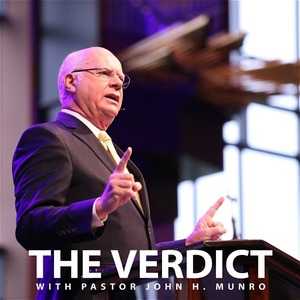
Today on the verdict with Pastor John Monroe. Today we're considering this very important question of meaning in life. Is there a Creator God who made you, yes, you personally, who made you for a purpose? Or is your existence on earth a mere quirk of fate? Or are we here on planet Earth Because we were created by God for a purpose.
Welcome to The Verdict with Pastor John Monroe. Have you wondered what's the purpose of life? Is there any purpose at all? Many people grapple with this basic question, trying to understand if their life has meaning. Or is it all just meaningless and random?
Today we're considering this fundamental question. Divine purpose or chance existence. As we continue our new series, What Would You Ask God?
Now, here's Pastor John Monroe. Does your life ever seem pointless? Do you get up in the morning, go to work, return home, get something to eat, spend time with your family, go to bed, get up the next day, only to go through the same routine again and again and again? Today we continue our series on God. We previously thought of God's existence.
And if there is a God, did He create everything? These are weighty questions, but well worth considering and discussing with others. Today and next time, our question is. Divine purpose or chance existence. All of us have to deal with this question of the purpose of life.
Even those who appear to have it all sometimes feel that their life is hopeless and meaningless.
So let's consider. Divine purpose? or chance existence. The Scottish Shortwork Catechism of 1648, part of the Westminster Confession. asks this question.
What is the chief end of man? That's an old fashioned way of saying what's the point of life. What is life? on a vote. Listen to the magnificent, powerful answer given in sixteen forty eight.
Okay. Man's chief end. is to glorify God. and to enjoy him forever. I think you'd be hard put to frame a more succinct and biblical and theologically accurate answer than that, that our chief end in life, our goal in life, is to glorify God.
And to enjoy him forever. That is, life is about knowing God, glorifying God, and enjoying God. If there is a God who created you, It follows that joy and fulfilment are not found in living a self-centred life. but rather in living a God-centred life, a life where God is, as it were, at the very centre of gravity of our very existence. Living in harmony with our Creator then is the most exhilarating, the most fulfilling.
the most rewarding life imaginable. Our question today, as we continue the series, questions we would ask God is divine purpose or chance existence. With this question, I'm asking what is the point of life? take that very personally. What is the purpose, if any, in your life?
Is life ultimately meaningful or meaningless? Are you the product of a cosmic accident? Or are you the creation of a purposeful act of divine intelligence? What is it? What do evolutionists believe as to life's meaning?
What do those who believe that there is no God, what do they say regarding life's meaning? Let's listen to the views of some evolutionists. From their own writings on the meaning of life. Stephen Jay Gould, the brilliant Professor at Harvard University, now deceased. wrote quote We are here because one odd group of fishes had a particular fin anatomy that could transform into legs for terrestrial creatures.
Because comets struck the earth and wiped out dinosaurs. thereby giving mammals a chance not otherwise available.
So he says thank you lucky stars in a literal sense. Because the earth never froze entirely during an ice age. Because a small and tenuous species arising in Africa a quarter of a million years ago has managed so far to survive by hook or by crook. He goes on to say we may yearn for a higher answer But none. exists.
William Profine, professor at Cornell University, writes The universe cares nothing for us. and we have no ultimate meaning in life. The controversial Richard Dawkins, who's about to His new book, which is an aggressive attack on belief on God, He's the Oxford Professor of Science. a strong, aggressive evolutionist strongly attacking Those of us who believe in God He believes, of course, that we human beings are nothing other than jumped-up apes. We feel like saying speak for yourself.
But here I quote Well, there is no purpose To ask what it is is a silly question.
Well, if you believe, as evolutionists do, that we are here by cosmic accident, I suppose questions about meaning in life are silly. Bertrand Russell, the British atheist, said, unless you assume a God, the question of life's purpose. is meaningless. And the British physicist Stephen Hawkins in his bestseller, Black Holes and Baby Universes, confesses, quote, although science may solve the problem of how the universe began, it cannot answer the question, why does the universe bother to exist? He concludes, I don't know.
The answer to that. I ask you, is there a divine purpose for your life? or Are you the result of a chance existence in Thomas Carlyle said, The man without a purpose is like a ship without a rudder, away from nothing, a no-man. Are we no men? the Beatles sang of That famous song.
The nowhere man. He's a real nowhere man sitting in his nowhere. Land making all his plans for nobody, doesn't have a point of view, knows not where he's going to, isn't he? A bit like you and me, nowhere man. Is that right?
We are nowhere men, nowhere women, nowhere boys and girls just going around life having really no point of an existence at all. Are we here by chance? or by divine. Purpose. Today, we're considering this very important question of meaning in life.
Is there a Creator God who made you yes, you personally who made you for a purpose? Or is your existence on earth a mere quirk of fate? An incidental blip in the great cosmic drama, as it were. Are you a creature, a creation of dignity? or a product of cosmic insignificance.
Are you the by product Of purposeless forces, a kind of piece of flatsom washed up on the beach of time with no meaning or purpose. Or are we here on planet Earth Because we were created by God for a purpose, divine purpose. Or chance. existence. I want us to learn, first of all, this morning and I am sure Most of us have come to this conclusion that meaning and purpose in life often seem very, very elusive.
A Scotsman was demonstrating the new game of golf as it was then. to President Ulysses Grant. The Scotsman carefully placed the ball on the tee and took a mighty. Swing. The club hit the turf.
scattered dirt all over the president's beard and some other people. The ball remained placidly on the T. The Scotsman swung again and again he missed. I sympathise with him. The President waited patiently through six futile tries and then quietly stated.
There seems to be a fair amount of exercise. in this game, but I fail to see the purpose of the ball. Yeah. Don't you agree with me that sometimes life is like that? We expend a lot of energy, a lot of activity.
A lot goes into it. But we then reflect and say, Well, But what? is the purpose. Will you turn with me in your Bibles to the book of Ecclesiastes to read the words of a man Who found that meaning and purpose in life were very elusive? He is Solomon, the wisest man who ever lived.
Ecclesiastes. Chapter one. Here is what. He says. This is the words of the preacher.
He's the son of David, Solomon. And he's the king in Jerusalem. Verse 2, vanity of vanity, says the preacher, vanity of vanities, all is vanity. The New International Version gives a good translation and says, Meaningless, meaningless, says the teacher, utterly meaningless. Everything is meaningless.
That's what he says at the very beginning of his book. Let's see what he says at the end in chapter 12. After he's written. These twelve chapters, Ecclesiastes twelve, Verse eight. Vanity of vanity, says the preacher.
All is vanity. Meaningless, meaningless, says the teacher. All is meaningless.
Solomon concludes after a very careful investigation that everything in life seems pointless. It seems without meaning, it seems without value, it seems without profit. Let's read that. In Verse three of chapter One. Back to chapter one.
and will read from verse Three. Not trying to follow this is not The most difficult Passage in Ecclesiastes, here it is. Ecclesiastes 1. Verse three. What advantage does man have in all of his work.
Which he does. Under the sun. A generation goes and a generation comes, but the earth remains forever.
Someone is born, but at the same day, someone dies. The earth remains forever, but we come and go. Also, verse 5: The sun rises, and the sun sets, and hastening to its place, it rises there again. Blowing towards the south and turning towards the north, the wind continues swirling along, and on its circular courses the wind returns. All the rivers flow into the sea, yet the sea isn't full.
to the place where the rivers flow, then they flow again. All things are wearisome. Man isn't able to tell it. The eye is not satisfied with seeing, nor the ear filled with hearing. That which has been is that which will be, and that which has been done is that which will be done.
So there is nothing new under the sun. Is there anything of which one might say, see this, it is new? Already it has existed for ages, which were before us. There is no remembrance of earlier things and also of the latter things which will occur, then we'll. There will be for them no remembrance among those who will come later still.
Do you get his basic point? He's saying as he examines life. He looks at the sun, he looks at the rivers, He thinks of his own tile. And after he investigates and tries everything under the sun, Solomon is still not sure of the point of it all. Life seems a dreary cycle of pointless activity.
It seems a waste of time. You'd agree with the wrong stones, I can't get no satisfaction. Whatever it is, The sun. Gets up in the morning. goes down.
Next stage this does exactly the same thing. The rivers keep flowing into the sea, but the sea is never full. The r rivers keep going. You get up in the morning, you go to work. You come home.
You go to bed.
Next day you get up, you go to work. And as you're going to work, you wonder, what's the point of all of this? I've done this before. I feel a bit like a hamster on one of these wheels. going round and round and round But what is it all about?
Doesn't your life sometimes seem like that? Of course it does. We work hard, we try to achieve something, but so often we experience frustration, a restlessness, a staleness, a boredom, an emptiness, an alienation, sometimes even a hopelessness. Carl Jung said, the central neurosis of our time is emptiness. Emptiness.
We wonder Certainly from time to time. What's the point of it all? Is there any meaning to life? We're not just robots, we're thinking people. And we think we've done this before.
Why we're doing it again and yet again? It never seems to end. There is this endl endless circle. There is really nothing new under the sun. Chapter two.
Verse one.
Solomon is a wise man, so I suppose he can speak to himself. He says here, I said to myself. Come now, I will test you with pleasure.
So enjoy yourself. And behold, it too was what? Meaningless, futile. Enjoy yourself. Seize the day.
Carfee DM. Eat, drink and be merry. Live life to the full. Seize it by the tail. I said of laughter, it is madness and of pleasure.
What does it accomplish? I explored with my mind how to stimulate my body with wine.
Well, my mind was guiding me wisely in how to take hold of folly until I could see what good there is for the sons of men to do under heaven, the few years of their lives. I enlarged my works, I built houses for myself, I planted vineyards for myself, I made gardens and parks for myself, and I planted in them all kinds of fruit trees. I made ponds of water for myself from which to irrigate a forest of growing trees. We just get tired reading this, don't we? He's hard working.
I bought male and female slaves, and I had homeborn slaves. I possessed flocks and herds larger than all who preceded me in Jerusalem. He's the richest man. Also, I collected for myself silver and gold and the treasure of kings and provinces. I provided for myself male and female singers, and the pleasures of men, many concubines.
Then I became great and increased more than all who preceded me in Jerusalem. My wisdom also stood by me. And all that my eyes desired, I didn't refuse them. I didn't withhold my heart from my pleasure, for my heart was pleased because of all of my labor, and this was my reward for all my labor. Thus I considered all my activities which my hands had done, and the labor which I had exerted, and behold, all was vanity and striving after wind, and there was no profit under.
The sun, do you get it? It great wealth. It brings no satisfaction, no peace, no purpose, no meaning in life. He tries pleasure. He had every pleasure you could imagine.
Tries wine, the best of food. We know Solomon had 700 wives and 300 concubines. A little excessive, I would have thought. But he tried that. We just read that everything that he wanted he got.
He goes to the mall, whatever he sees, he buys. The latest car, he just goes and says, I'll have that one. In fact, he'll have two of them. Any catalogue, anything he he sees. He can get.
He said that sounds pretty good.
Well, Solomon says not really. kind of left me empty, kind of pointless. everything seemed blowing in the wind. It's just like grasping the wind. Is there really any point for it?
Many people live for pleasure, Don. They're living for the weekend to go out and party, drink, have a good time. Billy Graham said it's like going to a theme park, standing in line for two or three hours to get on a roller coaster which only lasts a few minutes. And then it's over. That's it.
That's pleasure. That's the very best that the world can give you. These pleasures are short-lived and often leave us feeling empty, stale and used. Scotland's national poet Rabbi Burns. says pleasures are like poppies spread, you seize the flower.
Its bloom is shared. or like the snowflake, On the river. A moment white. Then gone. and melts.
Forever. says Robbie Burns is just like pleasures. And he's a man. who lived life to the full. And Solomon would agree with them.
Chapter 1, verse 13, he Pursues education. I set my mind to seek and explore by wisdom concerning all that has been done under heaven. It is a grievous task which God has given to the sons of men to be afflicted with. I've seen all of the works which have been done under the sun, and behold, all is vanity, all is meaningless, all is striving, all is blowing. In the wind.
He pursues education and he finds the answer is not there. He tries religion. He builds a beautiful temple. Many people turn to religion for meaning and purpose in life, don't they? They embrace some particular church, they go through the rituals of that particular church, seeking to fill the emptiness and longing of their soul.
But however well meaning and however sincere they may be, religious activity and ritualism do not provide meaning in life.
Solomon's conclusion is that meaning in life is not found in our possessions, it's not found in our pleasures, it's not found in our education, it's not found in our religious traditions. None of these things last. The pleasures we experience at their very best are short lived. The religious rituals, which once seemed significant, now seem trite, hypocritical, ritualistic, not satisfying our inner heart. And soul.
Our possessions, they don't last. We got the latest gadget, but. it became scratched, it broke. The bridegroom. Another one.
Just a bit better than the one that we paid so much for. And that nice smell. of the new car has now gone. Our possessions We say, well, we work hard for them.
Solomon later in Ecclesiastes talks about them. We work hard for them. But the problem is we leave them. Can't take them with you. Yeah.
Raw left.
Sometimes someone will spend them in a very different way from you. You worked hard, you saved. You thought a lot about your investments, but someone else just blows it all. That's life. It seems that nothing In this world, possesses the capacity to satisfy us.
Meaning and purpose in life. are often very elusive, aren't they? Turn to the New Testament, to John chapter 4. We thought of a of a man in the Old Testament seeking purpose. Here is a woman in the New Testament seeking purpose.
In John chapter four, the woman of Samaria, we've met her before. John chapter four And we'll read from verse five. Jesus came to a city of Samaria called Cycer. near the parcel of ground that Jacob gave to his son Joseph. And Jacob's well was there.
Jesus, therefore, being wearied from his journey, was sitting thus by the well. It was about the sixth hour. There came a woman of Samaria to draw water. Jesus said to her, Give me A drink. Verse fifteen.
The woman said to him, Sir, give me this water so I will not be thirsty nor come all of the way here to draw. He said to her, Go call your husband and come here. The woman answered and said, I have no husband. Jesus said to her, You have well said, I have no husband. For you have had five husbands, and the one whom you now have is not your husband.
This you have said. Truly. Here's a woman who had had five husbands, was now living with a man who was not her husband. constantly seeking meaning in human relationships. She was on a search for intimacy.
She thought that meaning and significance in life would be found in a relationship. But as Jesus says, your thirst. is still not satisfied. Many people think that if they just find their soulmate, as people talk about, have a perfect relationship, fall in love, experience true intimacy, the deep longings of their heart will be fulfilled. Purpose and meaning in their life, they think will then be achieved.
No. this woman's life was still without meaning. Her life was without purpose. There was an emptiness. within her.
crying out for fulfilment. and meaning. Because meeting and purpose in life often seem elusive. You know that and I know that. That's the first thing I want you to understand.
The second thing is this. That God created you. for a purpose. I want you to get that today. I want you to take this very personally.
God created. Me, put your name there. God created John Monroe for a purpose. John God created Jenny or Jim, or whatever your name is. Personalize it.
God created you. He created me for a purpose. This is the verdict, featuring the Bible teaching of Pastor John Monroe. There's still more to hear when John returns in just a moment, so stay with us. From matters of truth and identity, to the subjects of love and grace, our world seems more confused than ever.
but to find truth and certainty about who we are and find peace, we must turn our attention away from the world and look to the Word of God. To help you do that, John wrote a booklet titled Eternal Security, Finding Certainty in a Chaotic World. Through this special resource, John shares his personal testimony, along with a careful examination of Scripture, to offer us clarity on matters of eternity. Get your copy today by visiting our website at theverdict.org. While you're there, consider making an investment in this Bible teaching ministry.
Whether it's $5, $50, or more, your gift today helps cover the cost of sharing these gospel messages to listeners around the world. And if you haven't already, be sure to subscribe to the Verdict Podcast, featuring John's weekly podcast exclusive called Avizandam. It's available wherever you get your podcasts, or simply go to our website. Again, that's theverdict.org. The verdict is a ministry of Calvary Church in South Charlotte.
We're located on the corner of Highway 51 and Ray Road. If you've been looking for a church home or a community to help you grow in your walk with Christ, We invite you to join us for our Sunday services. For more details about Calvary and our service times, visit theverdict.org.
Now, here's Pastor John Monroe. Well, what's your verdict? Do you have a purpose in life, or do you find life rather pointless? If there is no creator and we're just a product of random evolution, I can understand why some people feel that life is meaningless. But there is a God.
A God who loves you. A God who created you, a God who sent his Son into this world to save us. Don't despair. Look to Jesus the Saviour, who came to give us abundant life. we will learn that God created you for a purpose.
Thanks for joining us today on The Verdict. I'm Michelle Davies. Today's program with Pastor John Monroe was produced and sponsored by Calvary Church in Charlotte, North Carolina.