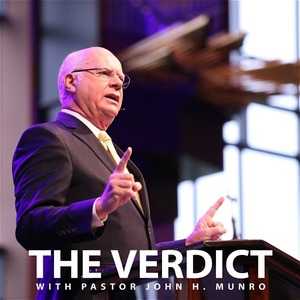
Today, on the verdict with Pastor John Monroe, those of us who have been converted to Christ, who have been saved by His grace, are to live a life of faith. Each day I'm to live by faith. And when the crisis comes, We are not to panic. But we're to look to the Lord and to the Lord Alone. And that is what Daniel does.
in the middle of a crisis. Trust God. Welcome to the verdict with Pastor John Monroe. Senior Pastor at Calvary Church in Charlotte, North Carolina. At some point, we all come face to face with a crisis.
But when these trials or tragedies come our way, how should we respond? And how does faith in God impact our perspective? Today on the verdict, we're learning how to handle a crisis God's way as we continue our study in the book of Daniel.
Now, here's Pastor John Monroe. Today we come to Daniel chapter 2. The background is that Daniel, who was Jewish, raised in Israel, is taken captive by the Babylonians under the leadership of King Nebuchadnezzar.
So Daniel finds himself in Babylon where he's going through a re-education. But although Daniel was in Babylon, Babylon was never in Daniel. Daniel took a stand for God. And God honored him. And we come now to chapter 2.
we're going to see the difference between two men facing a crisis. On the one hand, there is the mighty King Nebuchadnezzar, the leader of the superpower of the day, the Babylonians. On the other hand, There is this young man Daniel, who is a captive in Babylon. How are they going to respond to this crisis? How would you respond?
Let's listen. In Daniel 2, as we continue our study in Uh there's a wonderful book We find Two men In the middle of a huge crisis. One of them is Nebuchadnezzar, the king of Babylon. The other is a young Jewish captive. called Daniel.
And Daniel 2 is a fascinating chapter, one of the most fascinating in the Bible, I think. Because, as well as recounting the crisis that we'll think of this morning, which involved Nebuchadnezzar and Daniel. It also contains a panorama of prophecy. It gives us the big picture of future events. The So Daniel 2 is a very, very important chapter in our Bibles.
Helps us to understand, it gives us a framework for prophecy yet unfulfilled, some of it fulfilled, some yet to be fulfilled, and helps us to understand the last book in the Bible, the revelation of Jesus Christ.
Next week, And you won't want to miss it. We'll deal with these truths, we'll deal with the interpretation of the dream. and also see the great panorama of prophecy. In today's message, we want to look at the first part of Daniel two and deal with the background to Nebuchadnezzar's dreams. We will see these two men in a crisis.
and see how they responded. to a crisis in their lives. Let me ask you. How do you react? or act.
in the crisis of life. How do you cope when a crisis comes into your life? an illness, a loss of employment, the death of a loved one. Betrayal by a close friend, a traumatic event, a family situation, a business failure. the end of a dream, some situation where your world comes tumbling down.
How do you Deal. with these circ circumstances, when you find yourself in the middle of a crisis. Would you say at the moment our nation is in a crisis economically? A year ago we came very close to the brink of disaster. And they're still in a recession.
Politically, as a nation, we're very divided. Morally, we continue the downward slope. with increasing acceleration. Spiritually, more and more, we're buying into pluralism and tolerance of all beliefs other than the belief that this book, the Bible, is God's inspired word and is absolute truth. internationally We have many serious crises, don't we?
Afghanistan, the Middle East, Iraq, Iran, Iran with its nuclear ambitions, the rising of militant Islam were surrounded, it seems, by crisis. How are we as followers of Jesus Christ? to handle A crisis. when it is perhaps a personal crisis or a family crisis. A national crisis, a crisis in the church.
An international crisis. How are we to respond? Panic? Fear? Anger.
defeatism Retaliation, bury your head in the sand and pretend it doesn't exist. Studying this passage this morning. we will learn how to handle a crisis. God's way. Let's open our Bibles to Daniel chapter 2, first of all.
and read the first three verses. We are going to see, first of all, Nebuchadnezzar in the midst of a crisis. Nebuchadnezzar in the midst of a crisis in verses 1 through 12. First of all, Read with me the first three verses where we read of Nebuchadnezzar having dreams. In the second year of the reign of Nebuchadnezzar, Nebuchadnezzar had dreams.
His spirit was troubled and his sleep left him. Then the king commanded that the magicians, the enchanters, the sorcerers and the Chaldeans be summoned to tell the king his dreams.
So they came in and stood before the king. And the king said to them, I had a dream. And my spirit is troubled to know The dream. Nebuchadnezzar has these dreams, and these dreams, as we've read, make him very, very anxious. And so he calls in his wise men.
He has many wise men in the kingdom of Babylon. And they come in, he wants them to come in to tell him the dreams and to interpret the dreams. The Babylonians, as we know from history, were fascinated by dreams. They documented their dreams. They had an elaborate dream reading system.
They listened to the dreams, followed them, and then chartered how their lives went. in correspondence with the dreams. They would systematically compare their charts with the dreams.
So in Babylon culture, dream interpretation was very, very important. And Nebuchadnezzar has these dreams and he's very, very troubled about them. And as we Read these verses, and as we continue in the chapter, we see that Nebuchadnezzar, although he's a king of Babylon, he's the most powerful man in the world. He is a very restless man and a very insecure man. We read in verse 3 that he is troubled, his spirit is troubled.
He's very troubled about the future. He wonders, what does this mean for me and for my kingdom? From the outside, Nebuchadnezzar seems to have everything But have you learned that success in life often does not bring security and peace. We know from learning about the lives of Hollywood celebrities or national politicians, national figures, celebrities, that often, behind the scenes, their lives are out of control. They're often marked by anxiety.
They're rather restless people. They're often very insecure as we listen to them being interviewed. and they cannot cope. when a crisis comes. Let's read on in verse four.
We will see that his insecurity is evidenced by his hostility.
Now the vast majority of the Old Testament is written in Hebrew. In Daniel chapter two, verse four, it moves from Hebrew to Aramaic, and the Aramaic in the original text is going to continue to the end of chapter seven, Aramaic, the language of the nations, as the focus now on Daniel Right to the end of chapter 7. is on the Gentile nations. Then the Chaldeans said to the king in Aramaic, Okay, live. Forever.
Tell your servants the dream, and we will show the interpretation'. The king answered and said to the Chaldeans, The word from me is firm. If you do not make known to me the dream and its interpretation, you shall be torn limb from limb. and your houses shall be laid in ruins. Nice guy, right?
But if you show the dream and its interpretation, you will receive from me gifts and rewards and great honor. Therefore, show me the dream and its interpretation. very hostile attitude towards his advisers.
Now we're not sure whether he didn't remember the dreams, or perhaps he did remember, but wanted to test the wise men if they really were wise. He would then be able to find out whether these wise men, these astrologers, whether they really were authentic. And so He issues a death sentence. I want you to tell me the dreams. Number one, number two, I want you then to interpret the dreams.
Those who predict the future fortune tellers are known often to be phony. I remember As a young man being at one of these fairs and and uh a lady said she was going to tell my future by reading my hand. I was foolish enough to give her some money, and I forget what she said, but I'm sure it was a complete phony. And so now you can endure things. Are these wise men really true?
Can I depend on them? He's very, very sceptical. Of them. Verse 7, they answered a second time and said, Let the king tell his servants the dream, and we will show its interpretation. The king answered and said, I know with certainty that you're trying to gain time.
Because you see that the word from me is firm. If you do not make the dream known to me, there is but one sentence for you. You have agreed to speak lying and corrupt words before me until the times change. Therefore tell me the dream. And I will know that you can show me its interpretation.
Do you get the point? They are telling Nebuchadnezzar, listen. How can we give you the interpretation when you don't tell us the dream? We don't know what the dream is. And really, they're going to say there's no one alive that could do this.
And Nebuchadnezzar is a stall for time, understandably, wouldn't you? He sees this as an example of more lying. and corruption. They don't know the answer. You may have heard about the young doctor who just opened his practice.
And his first patient came To see him, and the doctor examined him and couldn't find what was wrong with the young man. And he didn't want to say to his first patient, You've got me sumped, I just don't know what's wrong with you.
So he looked at the patient and said to the patient, Well, Have you had this before? The patient said, Yes.
Well, said the doctor, you've got it again. It's difficult in life, isn't it, to admit that we don't know something, to admit. That someone else might have the answer, and this is happening. with these wise men. Where's Ten.
The Chaldeans answered the king and said, There is not a man on earth who can meet the king's demand, for no great and powerful king has asked such a thing of any magician or enchanter or Chaldean. The thing that the king asks is difficult, and no one can show it to the king except the gods whose dwelling is not with flesh. Because of this, the king was angry and very furious, and commanded that all the wise men of Babylon be destroyed. They say we don't know What is your dream, O king? And there is not one person in all of the world who can tell you.
There may be one of the gods, perhaps, but none of us can. And furthermore, Never in our history has a king asked us to tell him the dream. We might be able to interpret it, but we can't tell you what it was. And so the king Gives orders, verse 12, to destroy all of the wise men, which would have included, remember, Daniel, Hananiah, Mishael, and Azariak, Daniel, Shadrach, Meshach, and Abednego. In the middle of a crisis, what do we see from this great king?
insecurity Anxiety. Hostility. He is not at peace with himself. He's not at peace with others, and he's certainly not at peace with God. His future And his destiny is uncertain.
He realizes that this dream is very, very important.
Something is lying in my future. And these men won't tell me what it is. You know, if you don't know God. you won't be able to cope in a crisis. If you don't know in whose hand your future is.
You will be very insecure, very anxious, a very fearful person. And perhaps like Nebuchadnezzar, have you noticed when crisis comes, One of the reactions, a very human reaction, is to blame other people, is to point the finger at others. And you see Nebuchadnezzar's frustration. He doesn't know what to do. And so he threatens these men.
Unless you tell me the dream in its interpretation, you're going to be killed. But now consider the contrast with Daniel. Who finds himself also in a crisis, obviously, because he's one of the wise men. and there is a sentence of death over him. Here is crisis management, could we say, Daniel Stiles.
A time of crisis often reveals what we really are. And we are going to learn of four qualities which characterise Daniel. Four qualities because Daniel believes, as we've learned from chapter one, that God is in charge. Remember that. Brother.
sister in your crisis. Gods. is in charge. And secondly, that God always takes care of his people. And Daniel is rooted in these principles.
Now, first of all, let's read verses 13 through 16, where we will learn that Daniel. of faith. Verse thirteen.
So the decree went out, and the wise men were about to be killed, and they sought Daniel and his companions to kill them. Then Daniel replied with prudence and discretion to Ariok, the captain of the king's guard, who had gone out to kill the wise men of Babylon. He declared to Ariok, the king's captain, Why is the decree of the king so urgent? Then Ariac made the matter known to Daniel. And Daniel went in.
and requested the king to appoint him a time That he might show the interpretation. to the king.
Now think of this. There is a decree by Nebuchadnezzar that Daniel be killed. But although there is a warrant for Daniel's death, Daniel is characterised By calm Courage. After getting the details of what the situation is, He goes to the king. and asks for some time.
Is it not interesting That when the Babylonian wise men asked Nebuchadnezzar for more time, Nebuchadnezzar wouldn't give it to them. But Nebuchadnezzar agrees to give time To Daniel.
So that he can give him the interpretation. Why was that? I think Nebuchadnezzar From his dealings with Daniel and his friends in Daniel one knew that there was something very different. About Daniel. He meets Daniel.
He had interviewed Daniel, chapter one, we learned. And now Daniel is brought before him. O king Please give me more time. And I will then give you. the interpretation.
It was said of Thomas Hooker, the New England Puritan, that when he preached, He seemed to grow in size until someone said, You would have thought he could have picked up a king and put it in his pocket. Daniel's that kind of man. Daniel is the kind of person who Who, in a time of crisis, Is seen as a man of faith who grows in stature. The people who come into contact with this individual realize this person is different. The crisis is there, but this person is dealing with it in a very, very different way.
Nebuchadnezzar and these wise men are in a frenzy at the crisis, but Daniel. is the calmest person In all, of Babylon. How would you have reacted if you had had that death warrant on you? He's been told by the king. That there's a death warrant against them.
But he doesn't panic. Why? because his trust Is in God. God is in charge. He is a man.
of faith. And Daniel says in verse sixteen that if he's given time, he will be able to declare the interpretation. I mean, that was faith, isn't it? Later Daniel is going to say to Ariach That the king mustn't destroy the wise men, verse 24, as he's going to declare the interpretation. Daniel knows his God.
He has seen God at work before, chapter 1, in granting him favor with the commander of the officials. And at the end of chapter one, we read that God had granted Daniel and his three friends special knowledge, special intelligence and wisdom, and had given Daniel, chapter one, verse seventeen, understanding in all visions and dreams. And Daniel knows that. Daniel is in touch. with God.
God is revealing his purposes to Daniel. And here then is another opportunity for Daniel in the midst of a crisis. with a death sentence over his head To trust. God He is a man. of faith.
We often panic in crisis, don't we? Because our faith is very, very Weak. Why is it that young David didn't fear the great? Philistine giant Goliath. Saul, the king, was afraid to fight him.
David's brothers, more seasoned warriors, were afraid to do battle against Goliath. What was that about? This young boy, David, the youngest in his family. What was it about David that David could say, I will fight The Glythe, the giant David says First Samuel seventeen, verse thirty seven. The Lord who delivered me from the paw of the lion and from the paw of the bear will deliver me from the hands of the Philistine.
What was different about David? What was different about Daniel? They were men of faith. They were people who knew their God. When the crisis comes, they're not trusting God for the first time.
No. They are living by faith. They are God centred in their life. Their life is fixed on living for the glory of God and not for themselves, and so when the crisis comes, they do what they always do. And that is to ask God.
What God wants them. To do it. The Bible tells us that without faith It is impossible to please God. We know that we are converted to Christ by grace alone, through faith alone. In Christ alone, That faith is the empty hand receiving the full salvation which flows from the cross of Christ.
As the hymn says, Nothing in my hand I bring Simply, to thy cross I cling. Naked, come to thee for dress. Helpless, look to you for grace. Faulai. To the fountain fly, wash me, Saviour.
Or I die. We're going to break bread. It's a symbol, an illustration of this great truth. that because of what Christ has accomplished through His death, burial and resurrection, there is offered for each one of us salvation, forgiveness of sins and eternal life if we trust Christ, if we personally place our faith in Jesus Christ, not trusting in the church, not trusting in the ordinances, but trusting in Christ and Christ alone. Have you ever personally made that commitment to Jesus Christ?
Oh, you've come to church for some months, that's wonderful, but it never ever gets you into heaven. It is a personal relationship with Jesus Christ. And that comes through faith, trusting Jesus Christ. He's done it all, I now receive Christ. In the Gospel all of the amazing benefits of the Gospel come to me as a gift, as an act of Grace.
If you've never personally trusted Christ, will you do that? Will you believe in the Lord Jesus Christ? And you will be saved. But those of us who have been converted to Christ, who have been saved by His grace, are to live a life of faith. The just shall live by faith.
Each day I'm to live by faith. And when the crisis comes, We are not to panic. But we're to look. to the Lord and to the Lord. Alone.
And that is what Daniel does. in the middle of a crisis. Trust God. be a person. of faith.
This is the verdict, featuring the Bible teaching of Pastor John Monroe. There's still more to hear when John returns in just a moment, so stay with us. From matters of truth and identity, to the subjects of love and grace, our world seems more confused than ever. but to find truth and certainty about who we are and find peace, we must turn our attention away from the world and look to the Word of God. To help you do that, John wrote a booklet titled Eternal Security, Finding Certainty in a Chaotic World.
Through this special resource, John shares his personal testimony, along with a careful examination of Scripture, to offer us clarity on matters of eternity. Get your copy today by visiting our website at theverdict.org. While you're there, consider making an investment in this Bible teaching ministry. Whether it's $5, $50, or more, your gift today helps cover the cost of sharing these gospel messages to listeners around the world. And if you haven't already, be sure to subscribe to the Verdict Podcast, featuring John's weekly podcast exclusive called Avizandam.
It's available wherever you get your podcasts, or simply go to our website. Again, that's theverdict.org. The verdict is a ministry of Calvary Church in South Charlotte. We're located on the corner of Highway 51 and Ray Road. If you've been looking for a church home or a community to help you grow in your walk with Christ, We invite you to join us for our Sunday services.
For more details about Calvary and our service times, visit theverdict.org.
Now, here's Pastor John Monroe. Well, what's your verdict? Are you more like Nebuchadnezzar or more like Daniel? In a crisis, the foundation of our life is what matters. Make sure your life is built on the solid rock of Jesus Christ.
Who comes to save us, to forgive us, to give us eternal life? He is the solid rock. Is your life built on a strong foundation or Is your life based on some kind of uneasy compromise? Join me next time as we continue in Daniel 2 and see how Nebuchadnezzar and Daniel respond to this crisis. Thanks for joining us today on The Verdict.
I'm Michelle Davies. Today's program with Pastor John Monroe was produced and sponsored by Calvary Church in Charlotte, North Carolina.