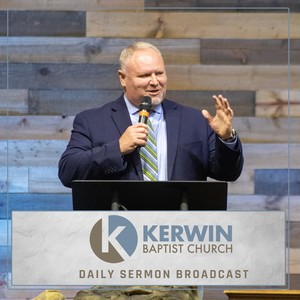
Welcome to the Kerwin Baptist Church broadcast today. Our desire is for the Word of God to be spread throughout the world so that all may know Christ. Join us now for a portion of one of our services here at Kerwin Baptist Church, located in Kernersville, North Carolina. Numbers chapter 11. Numbers chapter 11.
That's what you need to hear before you get up and preach to know that he will take you through the fire again. I just thought that was.
Okay, getting ready to head into the. Getting ready to head into the fire and Just pray God brings me out. That's okay. Numbers chapter 11. You saw what I did there, Nick.
You saw that. Numbers chapter 11. And that was a good special, wasn't it, by the way? Wouldn't it be nice just to lead a choir, sit down, play the piano, sing, have all that talent? And um Yeah, I really feel sorry for him.
Okay. And uh We have talented people here at this church. We're very, very blessed. Tonight, Lord willing tonight and at least next Sunday night, we want to speak on the burden of leadership, the burden of leadership. Let's just read a few verses, and we're going to deal with really a totally different aspect of what we talked about this morning from the subject and the perspective of leadership.
You say, Well, preacher, I'm not a pastor. That's fine. You don't have to be. And you can. Take my place anytime you want to.
But if you are a dad, if you are a mom, if you're a Sunday school teacher, if at work, if there's anybody that works under you whatsoever, just even in life, in your neighborhood, you young people, listen to me. There are some of you that will be natural leaders. It just kind of comes naturally. That's not something. Usually, if a person wants to try to be a leader and they have to try to be a leader, they might not naturally be one.
And so just listen to me. These principles are something that God, I think, really helped me this week with. Let's begin in verse 10, Numbers chapter 11. Then Moses heard the people weep throughout their families, every man in the door of his tent, and the anger of the Lord was kindled greatly. Moses also was displeased.
And Moses said unto the Lord, Wherefore hast thou afflicted thy servant? And wherefore have I not found favor in thy sight that thou layest the burden of all this people upon me? Have I conceived all this people? Have I begotten them, that thou shouldst say unto me, Carry them in thy bosom, as a nursing father beareth the sucking child unto the land which thou swearest unto their fathers? Whence should I have flesh to give unto all this people?
For they weep unto me, saying, Give us flesh that we may eat. I am not able to bear All this people alone. Because it is too heavy. For me. And if thou deal thus with me, Kill me.
I pray thee.
Now that's. That's kind of reaching bottom right there. That's when you know leader's a little tired, all right? God, if this is what you're going to do, then just kill me, I pray thee. Out of hand.
If I have found favor in thy sight, so Lord, if you love me at all, kill me, okay? And let me not see my Wretchedness. Uh the burden. of leadership. If you've ever led anything, You have to understand a little bit.
what Moses is feeling right here. Um Leadership is often, you know, in our day and time, it's pictured as privilege. Um Authority, influence. But you know what's interesting in Scripture? Leadership is usually pictured as a burden-bearing thing.
Anywhere in the Bible, Leadership besides the fact in the Old Testament where there were some kings that took advantage of their leadership. biblical based leadership. is a burden. It's not easy. It is difficult.
And if you've ever led anything. then you understand. In this chapter. Moses reaches emotional. spiritual And mental Exhaustion.
You know, in leadership, before there is a crown, there's a cross. Before there's authority, there's accountability. Before there's influence, there's always pressure. Here the people are complaining, the burden is overwhelming. The leader is breaking.
And if you and I are not careful, leaders can break. And But this passage, as negative as that might sound. This passage teaches us that God sees the burden of his servants. God does see it. It shows us that God never intended us to carry everything.
And God never intended us to carry everything alone. And this passage also teaches that God's hand is never too short. where he cannot provide help and power. for what you're going through. And so we're going to jump right into it tonight.
Let's pray and thank you for being faithful on a Sunday evening. I feel like summer kind of hit today. It's been beautiful weather, and today was a beautiful day, but it actually got. Um nice and hot today. And I can tell some of you are hot now.
And so summer is coming upon us. Let's pray. Lord, I love you. I thank you for all that you've done. And Lord, um leadership.
Leading is a privilege. But there is a burden to bear. And um Lord, there's a reason for that. And so, Lord, I pray as you help us maybe over these next. Two weeks tonight in this passage, next week in another.
As we just kind of talk about this thing of leadership. It's not something we talk a lot about in maybe a regular church service. It seems these are things we specifically teach to. specific leaders of many teachers and other things, but Lord, I believe that All of us can be leaders and should be leaders and Lord, I pray that we would learn something that we can take out of this building and use in our everyday lives. I pray that you would help us to see Um where Moses ended up here.
What he was going through, what caused it. And Lord, I pray you would help us to get some wisdom. In Jesus' name we pray. Amen. Number one, I want you to notice the weight that broke the leader.
The weight that broke the leader. Moses is crushed. beneath the pressure. of leading people.
Now, let me just say this. You know, when a person like me gets up and you have a pulpit to preach at. And when you say, listen, people are hard to lead. Um uh what I am saying by that is this, I am a people too.
So, I am not easy to lead, okay? And I have the privilege of leading people, but trust me, I know I'm not the easiest person to lead, and we are all human, we all have our faults.
So, please do not think it's a condescending thing. I'm just telling you: if you are in leadership, if God uses you to lead a group, to head up anything in your life, if God gives you children in your home, some of you grandparents have a great opportunity right now to lead your grandchildren.
Some of you get to watch them and take care of them, spend time with them. Anywhere in that role, there's some things that we need to understand biblically.
So, I want you to notice first the weight that broke the leader. First, we see the pressure of complaining people. The pressure Of complaining people. Look at verse 10. Notice this.
Then Moses heard the people weep throughout their families. every man in the door of his tent, And the anger of the Lord was kindled greatly, but notice this, Moses also. Was displeased.
Now, two things I want you to see out of this verse. Number one is this phrase: Moses heard. What did he hear?
Well, he heard the people, the verse says, weep throughout their families.
Well, they were weeping because they were upset, they were discontent, they were angry, they were complaining, they were miserable. They were unhappy. And Moses had to hear it. And when you're the leader and you hear it, you take it personal. And many times it's very easy to take it personal because they'll say it to you personally, okay?
This, and you have to understand, these people weeping in their tents, this was not sincere brokenness. This was fleshly dissatisfaction. This was people being difficult. This was people being selfish. This was people complaining because they didn't.
They weren't thankful, I should say, they didn't have gratitude for God's provision. And so they became a complaining people. Moses heard. And let me just say: one of the hardest things when you're a leader is when you hear those you are leading. criticize your leadership.
It's just hard. Let me put it in these terms. Dads, it's not easy when you find out, or through the grapevine, or somehow. whatever you hear your kids. saying something to somebody how they don't like what you do or they don't this or whatever the case might be.
Uh I regret. You know, times in my life when I was young and Played sports, and in high school, I'm sure there were times I said derogatory things about my dad. probably even about my mom, but probably more so dad, because dad was the leader of our home. And so when you're discontent with something in your life, by the way, when you're discontent with yourself, you'll often take it out on the leader. And I'm sure I said things and probably incorrectly described it.
Some of you have incorrectly and not truthfully.
Some of you young people have probably said things to your friends sometimes about your parents. And you said it out of ignorance and different things. And it is not easy for a parent to always sometimes hear negative comments. I think of an occasion, one of my boys, I won't say who, but I heard them talking to my wife about me. They didn't know I could hear it.
My wife didn't know that I could hear it. None of them know until now that I heard it. And all three of them are wondering, because I'm sure all three of them have complained at times, but they're all thinking, is it me? And yeah, it probably was. Whichever one of you you're thinking, it probably was you.
And um Let me just say it didn't make me angry. It hurt. It hurt. Leaders want to lead well. Deep down, many times good leaders didn't ask for that.
They didn't pursue that position. Um But Moses heard.
Now, I want to describe to you what this verse says. Moses heard the people weep throughout their families. Every man And notice the second thing you heard, every man, every man. It had gotten to the point Moses pretty much felt. that everybody was against him.
that everybody was discontent. And let me just say, it is easy to not be a leader. and criticize the leader. It's very easy. I mean, you got no sticks in the fire.
I mean, what is it going to matter? Nobody's going to criticize you.
So, you know, it's easy to kind of point at the person that's organizing this or does this. You know, Brother Jacob runs our upwards. I'm sure, you know, there's not been an upward season where I say, hey, Jake, how do things go? And he'll go, it went well, it went well. And I know exactly what that means.
You know, you have phone calls, you have people kind of a thing. And our staff, they lead different things.
Sometimes they'll come to me with things, and sometimes I'm sure they don't. They have, you know, they bear it and they go through it. And hopefully, they've learned from me that you treat people kind and respectful, even if they don't treat you that way, whatever the case might be. Listen, it is not easy to lead. And I want you to know: dads, it's not easy to be a dad.
Moms, it's not easy to be a mom. And if you're going to do anything and you're going to lead anybody, and by the way, that is a God-given privilege to have influence on somebody. But if you're going to do it, guess what? You're not going to make everybody happy. And you're going to hear some negative.
Can I have an amen right there? I just want you to know that about leadership. It doesn't mean that this should make you, I don't want to be a leader. No, no, listen to me. You ought to want what God wants for your life.
You ought to want God's will. And in God's will, somewhere is for you to be a leader. Listen, you need to take that role. You've often heard me joke. I used to say for years, I feel sorry for the person that's going to follow Joe Myers at Kerwin Baptist Church.
And boy, did I eat my words, all right? Listen, it is something I asked for, and you didn't pursue that. But when God puts you in a role, sometimes there is a pressure of complaining people. Notice every man, Moses heard it everywhere. Every tent had discontent, you know, literally.
Negativity spread through the camp. And by the way, a complaining spirit is very contagious. It just is. And that's the danger of social media right now. And listen, there's good things on social media.
That's not what I'm saying. I'm saying the danger is it's really easy behind a keyboard. You don't have a lot of accountability.
Well, so-and-so, well, I'm just going to jump in and give my 10 cents worth of whatever. And even if a leader is wrong, or even if a leader has made a mistake, you have no clue how you are hurting somebody. how you are wounding somebody. And some well they deserve it. Oh really?
Okay, well next time you become a leader. Let's see how you like it. Let's see how you feel about it. Because let's be honest, there's never real truth. There's their side, your side, and then the truth somewhere in the middle.
You don't ever hear the whole story of anything. And so Moses dealt here with the pressure. of complaining people.
Now listen to me. The very people that were complaining about him, he had to get up the next day, every day, and leave them. He had to get up and lead them and love them. And he had to treat them as if You know, nothing was wrong when he knew everything was wrong. It was just getting to him.
And there is the pressure of complaining people. Notice, secondly, here we see the pain of carrying people. You know, in leadership, sometimes you have to carry people. I want you to look at verse 11. And Moses said unto the Lord, Wherefore hast thou afflicted thy servant?
What did I do wrong to you, God? That you've put me in this situation. Notice what he says: And wherefore have I not found favor in thy sight? God, if you love me at all, you wouldn't be putting me through this. In this situation, that thou layest the burden of all this people.
Listen to what Moses says. upon me.
Now can I ask you something? Was he telling the truth? You don't, you're afraid to answer, aren't you? You don't know what to do. No, listen, God didn't lay on Moses.
the burden of all the people. God knew Moses couldn't handle that. Moses put on Moses. the burden of all the people. And can I challenge you leaders, by the way?
Parents. Sunday school teachers, ministry leaders, whatever the case might be. You have to understand they're God's people. Your children are God's children. They he owns them And you need to understand God never created you.
to carry everybody. God never created you. to be able to bear all the weight of everybody. And it is very easy to take it on, to feel like you're not doing a good job if you don't. But in its core, it's pride.
Because at its core, we want to say that we're carrying the burden for everybody. Because we don't want to have to admit that we couldn't or that we didn't. And so, what we have here is, he not only had the pressure of complaining to people, but now he had the pain of caring. Look at verse 12. He says, Have I conceived all this people?
Like, did I give birth to all these people? Notice this: Have I begotten them that thou shouldst say unto me, Carry them in my bosom? And as a nursing father beareth a second child, Moses is literally saying, God, I didn't birth them, I didn't raise them. I feel like I'm literally a parent having to feed them, to nurse them. They're a bunch of babies.
Do you hear what he's saying here? God, there are a bunch of babies, and I'm having to nurse them, and they just cry and scream, and all these different things. I didn't give birth to them. Why do I have the care of all these babies? Whew.
Notice here, Moses feels responsible for everyone. He feels accountable for everyone. He is emotionally drained. He even compares himself to a father nursing a child, and that does not happen naturally, okay. Leadership, listen to me, leadership many times is not merely directing people.
Sometimes it's feeling like you're carrying people. Real ministry involves bearing burdens, enduring criticism, absorbing pressure. Loving people that sometimes you feel don't love you. But notice what In verse 11, verse 12, you have it in front of you. I want you to hear in our vernacular what Moses is saying.
He's saying, God, why are you doing this to me? He said, Wherefore hast thou afflicted thy servant? God, why are you doing this to me? He says, God, are you mad at me? He's like, if I found favor in your sight, why is this?
What is he saying? God, are you mad at me? Notice third, he's saying, God, you've put too much on me. You've asked too much of me. And let me just say, I have felt all these things.
And I'm sure some of you At times. have felt these things too. Notice fourthly he says, God, you're making me fix something that I didn't break. I didn't give birth to these people. This wasn't my ideal to get him.
You asked me to come deliver your people out of. You can just see through this where Moses is at emotionally. God, you put too much on me. God, you're making me fix something I did not break. Notice next, God, this is not my responsibility.
They're not my babies. Notice last, God, you've created this problem. Notice what he says. Unto the land which thou swearest unto their father. God, you're the one that told them you were going to take them to the promised land.
You're the one that have them here. You're the one that brought me here. This is your problem. You created it. Anybody else feel sorry for Moses a little bit here?
I want you to notice, thirdly, we see the point of complete exhaustion. And I'm just going to give you some advice. I'm not saying it's right to feel this way. But if you do, don't go to prayer and God and pretend it's not. When you're going to go to God in prayer, listen to me.
You need to be respectful. It's that you are in holy ground talking to God, but you also need to be honest. Do not get down and pray. as if you're hiding, God knows exactly how you feel.
Okay? Listen to Moses. Look what he says. Whence should I have flesh? All these people keep saying they're tired of manna and they want meat.
But what does Moses say? How am I supposed to give meat to all these people? Look what he says. Weep unto me. Moses is like, God, that's your problem, but they're crying on me.
They're blaming me. They're taking this out on me. is what Moses is saying. Notice what he says. For they weep unto me, saying, Give us flesh that we may.
I am not able. To bear all this people alone. That's the first thing he said that's true. Because it is too Heavy. for me.
Let me tell you where Moses is at. I'm done. But he's not. Because he still has another step down. Verse 15.
And if thou deal thus with me, kill me. Moses is saying, you know what? I would rather be dead. than to have to put up with this junk another day. This is one of the lowest moments, by the way, in all scripture.
And he had some low moments. But this is one of the lowest moments in Moses' life. He reaches emotional collapse, mental fatigue, spiritual discouragement, all three at one time. And I want to, if I can, take these verses again to show you. Notice these phrases.
Notice what he says first, whence should I have to give? Moses is saying, I don't have enough to give. Notice what he says. He says, They weep unto me. They weep under me.
Notice literally he says, I am not able. And fourthly, he said, it's too heavy for me. too heavy for me. Great leaders still have breaking points. Faithful servants can become overwhelmed.
Listen to me, burnout is not always the result of rebellion.
Sometimes burnout is the result of trying to do right. But you just can't bear it anymore.
Sometimes it comes from prolonged burden. bearing. And let me just say that it is something that I have to watch. It's something that I have to watch in my own life. Um It is something that I have to kind of watch, and our staff, they probably don't know.
that I kind of look for things. And I can tell sometimes when they're teetering on that a little bit. And the good thing is. I'm here, I have a staff, if I see, I'll sometimes like, you know, hey, Uh you need to listen, why don't you take a couple days you know, go with family, whatever.
So I watch them, but there's nobody watching me. And so I have to kind of watch it myself. It's like nobody's going to come tell me, hey, listen, you need to. You know, You've had all you can take right now. You need a break.
You need whatever. I have to. Watch that. And every one of you, listen to me, dads. You need to watch that in you.
Because what you don't want is to be a dad at home that's taking out your anger and frustration, and because you're mentally exhausted, you take it out on your family.
Now, it's natural to know why, but they don't understand all that. They haven't been leaders yet. They haven't been dads of their families yet. They don't know the pressure of paying insurance and paying gas prices and paying insurance and paying bills and putting braces on everybody's teeth and all the doctors' visits and buying all the sports equipment when they go play sports and paying for this and paying. Listen, they don't know all that yet, but I will tell you this: you better know and you better watch.
Sunday school teachers, ministry leaders, whatever, upwards coaches, whatever the case might be. If you're leading, you need to watch. Because good people can still end up like this. And if you're not careful and you don't know it, you'll start taking it out. on everybody around you.
I want you to notice, second, the help that God provided. The help that God provided.
So obviously, we see the weight that broke the leader, but we see, secondly, the help that God provided. What I love about this, God does not rebuke Moses. He helps Moses.
Now, it doesn't mean that God never rebuked Moses. Look at me, when you're exhausted, when you're worn out, listen. We have a Savior that is compassionate to us. Where he got mad at Moses is when he disobeyed God. When he said, speak to the rock, and Moses took it on himself to do more.
That's when he rebuked him. Right now, Moses is hurting, he's down, he's worn out, and by the way, the people had been ridiculous. Notice God does not rebuke him, he helps him, and that is very powerful. I want you to notice first, God recognized the burden. Look at verse 16.
And the LORD said unto Moses, Gather unto me seventy men of the elders of Israel, whom thou knowest to be the elders of the people. And officers over them, and bring them unto the tabernacle of the congregation, that they may stand there with thee.
Now, notice. God jumps right into action. He says, gather unto me 70 men.
So What is God saying here without saying it? God is saying that the burden was real, that the pressure was heavy, and that help was necessary, and God jumped right into it.
Okay. Sometimes the most spiritual thing a leader can do is admit, I can't do this alone. And by the way, God never intended on you to do anything alone. And if you're saved, you're not alone. But I want to encourage you, listen.
If it makes you feel like you're doing more because you do it all on your own, you have a flaw in that. It is better for you to get help. to reach out for help, to do things with people, not just for people. And it is better for you not to just take everything alone so that you can say you did it all by yourself. Listen, I know people, they choose to do it that way, and everybody feels sorry for them because they did it all by themselves.
And yet, people wanted to help, but they didn't let them because they love to be the person that did it all by themselves. We have that martyr syndrome, and may I tell you something, people can only put up with a martyr syndrome for so long. And then they're tired of hearing it. All right? Hey, listen, I offered help.
You don't want it.
Okay. And so notice here, God recognizes the burden. All right, so God acknowledges this is a real thing. Notice secondly, God shared the load. Look at verse 17.
And I will come down.
So God says, listen, gather 70 men of elders, people that are leading and doing a good job. And I will come down and talk with thee there. And I will take of the spirit which is upon thee, God says, and I will put it upon them. And they shall bear the burden of the people with thee, that thou bear it not thyself. Alone.
Wow, listen to me. God never intended. one man to do everything alone. Healthy ministry, healthy leadership always requires shared labor. Godly delegation.
and spiritual partnership. It's always been that way. Listen, that is not weakness, that is wisdom. Delegation is not abandoning your responsibility. It is distributing responsibility.
Abandoning responsibility is when you delegate and you quit working. And we all know who that is. They're called bosses, okay? And so we all know that that doesn't work. My staff will laugh at that.
Okay. So, God recognized the burden, God shared the load.
So, what is God doing here? Notice third, God supplied the Spirit. And this is the key. Look at verse 17. He says, I will come down.
I'll talk with you there. I will take the spirit which is upon thee. And where did that come from? It came from God. God ordained Moses.
God literally called him to do this work, and God says, I'm going to take. That same spirit that's on you. And I'm going to put it on these men so that they can bear that load with you. Listen to me, the work of God. Has to be done through the Spirit of God.
Are you getting where I'm going with this? Good leadership, for good leadership to accomplish anything, it has to be spirit-led leadership. Dads, moms, you can't do it on your own. You were never meant to do it on your own. But I will tell you this: you'll go nowhere if it's not spirit-filled leadership.
It's not that, hey, you just go get some men to help. No, he needed spirit-filled men to help.
Well, that's two of us. Let me say that again. He didn't just need somebody to come help, he needed spirit-filled individuals to help. And when it comes to ministries in this church, we don't just need people, we need people that are spirit-filled. It takes the right kind of people.
to do that. Thank you for listening today. We hope you received a blessing from our broadcast. The Kerwin Baptist Church is located at 4520 Old Hollow Road in Kernersville, North Carolina. You may also contact us by phone at 336-993-5192 or via the web.
at Kerwin Baptist Church.com. Enjoy our services live and all our media on our website and church app. Thank you for listening to the Kerwin Broadcast today. God bless you.