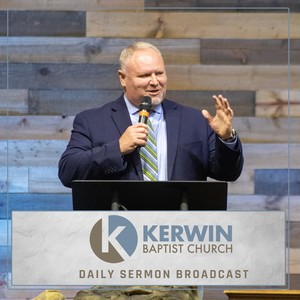
Welcome to the Kerwin Baptist Church broadcast today. Our desire is for the Word of God to be spread throughout the world so that all may know Christ. Join us now for a portion of one of our services here at Kerwin Baptist Church, located in Kernersville, North Carolina.
Well, that was fantastic. I want to issue an invitation to the choir here at Kerwin. to the ensemble and or to the trio. To come and sing in our prayer advances. We got a ladies' prayer advance coming up in two weeks, so your pastor will be there on Friday afternoon and Friday night speaking.
I put on my. Facebook page today that we were down here doing a praise challenge weekend, and one pastor emailed back and said, Dan can haul the mail. That's what he said, Dan can haul the mail. And that's a compliment. He's got the goods and knows how to give it.
We appreciate your ministry so much. Thank you to as a church for partnering with us in Christ-Life Ministry. He said, I'm serious about y'all coming up. It's only two hours. I came down.
You can come up too. Come on up. And a minister, we would appreciate it so much. How many did the. Have started the praise challenge book.
Lift your hand if you've started already. Put them up way high, way high. All right, all right, thank you so much. That's going to be great. This is not designed to be read only.
This is an exercise. You praise through it. You work through it. You get to the projects and you implement. And 21 days, so many, a pile of people committed to that this morning.
I would really encourage you to do it individually. And then if you're a family person, then do it together as a family as well. You know, there's benefits to praise.
Now, look, praise is for God. But it's really therapeutic. It's restorative. I asked one pastor how he stayed at the same church for 40 years and he pondered and he said, worship. Worship.
He's got a worship in church. He's got a praise in church. And I'll tell you what, this will help your heart and glorify God. That's the purpose of praise.
So, God bless you as you go through this. I'll be curious to hear from you how you make out with it. If you don't follow us on or follow my Facebook page, we try and have some encouraging quotes every day. We've got a few things with a little kick to it, but most of it is encouragement. And we would invite you to join in if you like.
All right, tonight, Matthew chapter 6 in your scripture, Matthew chapter 6. We all know this. It's the model prayer. It's what some people call the Lord's Prayer. But I like to call it the model prayer.
And I want to talk to you tonight about the bookends for prayer. Book ends for prayer. By the way, we should have had a picture of the grandbaby on the screen, Stephen. You dropped the ball on that point right there. But we've got a brand new grandbaby, 13 months old, and she is dynamite.
I'm just telling you, she is something just tremendous. And I would say this, we're so thankful for Stephen. He's the polished version, okay? He's the polished version, and we need a little polish. But anyhow, Matthew chapter 6, down to your feet if you would.
Let's see if we can say it from memory, the model prayer. Matthew chapter 6, verse 9. Let's just start with the model prayer. If you can say it without do it, but if you can't, read it, all right? Our Father, which art in heaven, how well, hallowed be thy name.
Thy kingdom come, thy will be done in earth as it is in heaven. Give us this day our daily bread. Our debts, as we forgive our debtors, and lead us not into temptation, but deliver us from evil. For thine is the kingdom, and the power, and the glory forever. Amen and amen.
Now, what I want you to notice tonight is that Jesus taught us to pray, He gave us instructions on prayer. And he taught us to open our prayers with praise. Our Father Hallowed be thy name. Hallowed means holy, sanctified, sacred. A separate and magnified, exalted be thy name.
He taught us to begin our prayer with praise, but not only to begin with praise, he taught us to end our prayer with praise. Because after the petitions come, for yours is the kingdom and the power and the glory forever. Amen.
So here's the pattern. Praise, prayer, praise. Say that out loud. Praise, prayer, praise. This is a pattern we're going to look at tonight.
Now, worship-based prayer is a pattern for prayer. And this prayer begins with praise. This prayer concludes with praise. This is God-centered prayer versus problem-centered prayer. This is God-focused prayer instead of man-focused prayer.
So I want to talk to you tonight about the bookends, the bookends for prayer, and praise are the bookends for prayer. Lord, would you give us something tonight? Would you teach us something tonight? God, would you bless this congregation as they undertake this 21-day praise challenge? And Lord, may you be honored and may your people be magnificently blessed.
We ask with anticipation in Christ's name. Amen and amen.
You can be seated.
Now praises are the bookends for prayer. You know, praising the Father is primary. It sets the course and it paves the way forward.
Now, the opening bookend is all about magnifying the name of God. The concluding bookend is all about glorifying God.
Now look, I fly a lot, and I'll tell you something, a good takeoff is needed to get airborne. And sometimes when the wind is blowing, man, it's a rocky takeoff. And without praise, prayer never gets airborne. You praise your way into the presence of God. And when you're praising, you connect with the mind and heart of God.
Now how can we intercede in the will of God without being controlled by the Spirit of God?
So praise aligns our souls, our hearts, our minds with the mind of God. It gets us airborne and we gain altitude when we open with praise.
Now, I like this quote. Prayer is launched on the runway of worship. and concludes on the landing strip of praise. Praise. Prayer is launched on the runway of worship.
Listen to this. And concludes on the landing strip of praise.
Now praise is how prayer takes off and it's how it stays on track. And sandwiched between these praises, these bookends, are two rounds of petitions.
Now the first set of requests... is a God focus, a God focus. How did Jesus teach us to pray? Our Father in heaven, hallowed be your name. And then what comes next?
Your kingdom come. Your kingship. Your governance, your rulership, Lord, your lordship. Lord, let your kingdom, let your kingdom come. Let your kingdom come to us.
Let your kingdom be expanded upon the earth. Lord, your kingdom come. And then what? Lord, your will be done on earth as it is in heaven. I just want to say that Jesus wouldn't have told us to pray for his will to be implemented if it was automatic.
And some things ain't going to happen apart from prayer and fasting, according to Jesus.
So we have to get the heart and mind of God and go to bat for the concerns of God, His kingdom and His will being done on earth.
Now, God's business has to be addressed before our own interest. And praise puts God first and keeps him there. This is very important. This is not a side note because we pray over God's concerns first.
Now, I believe that the purpose of prayer is to advance the kingdom of God, implement the will of God, and defeat the devices of the devil. That's the purpose of prayer. There's more to prayer than asking and receiving. That's part of it. Many times we're told to ask, and we should.
But, brethren, the real purpose of prayer is to implement the will of God upon the earth and to defeat the devices of the devil. That's the purpose of prayer. Your will be done. Lord, your kingdom come on earth.
Now, after we go to bed for God's concerns, then we bring our stuff up. Give us this day our daily bread. Now, that's anything that you need. Then he talks about forgiveness. Forgive us our debts.
As we forgive our debtors. And then he talks about deliver us from evil or deliver us from the evil one and to lead us.
So both sets of these requests are inserted in between the bookends, the bookends of praise.
Now, how many know that bookends are designed to keep books from collapsing on the shelf. That's the purpose. You get a thin... Metal bugged in. You get an odd inch stone bookend that's heavy.
It holds them up, it prevents the collapse, and using these scriptural bookends as guardrails will assist us from falling into the trap of man-centered prayer. God-focused prayer saves us from self-centered prayer, so we begin and end our prayer times with praise.
Now look, in the middle of this sandwich, you give yourself to devoted intercession. Hallowed be your name. Oh God, your name is great. Magnified. Glorified be your name.
Lord, your kingdom come. Lord, your will be done. And then what happens? We go into intercession. We talk about God's concerns.
I personally believe that prayer on earth is joining in with the prayer that's going on within the Trinity. You ever heard of Trinitarian prayer? You ever heard that phrase? I call it the cosmic prayer meeting. The Holy Spirit makes intercession.
Two. The father. Jesus ever lives to make what? Intercession. To whom?
The Father. The Trinity is a communicating Trinity. There's correspondence. There's communication going on. And if the Father is listening to the intercessions of his Son and the Spirit of God, I'm telling you, on earth, when we're in tune with God, we're joining in on the intercourse that's taking place in the throne room of God.
We're joining in on heaven. We're echoing what heaven is all about. And when you're walking with God, you get a sense of the heart of God, the mind of God, the desires of God, and the pain of God. And that's what intercession is. As we enter into the mind and heart of God to pray back to him the very things that he's put within our hearts.
Now, Richard Sibbs said this, we're never fitter to pray than after praise. We are never fitter to pray than after praise.
So prayer gets us into the spirit of prayer. Praise gets us into the spirit of prayer. It's God-centered prayer.
Now, who would deny that so much praying today is man-focused? Would anybody deny that? And so much of what we've been exposed to in our prayer gatherings. is man-centered prayer. One man said most people pray about Three things.
about three people, I, me, and I. But there's not an I, there's not a me, and there's not a my anywhere in the model prayer. It's our Father. It's give us. It's forgive us.
It's deliver us. This is a family prayer. And my brother and my sister, listen, Jesus' pattern for prayer calls for a paradigm shift. It doesn't start with petitions. And don't rush mindlessly into prayer repeating what you heard somebody else say.
Anybody ever do that? How about repeating what you say all the time? Don't do that. Think about who you're talking to before you start right here. And this kind of prayer starts with who God is: He's hallowed, He's holy, He's sanctified.
It ends with what God deserves, the power and the glory.
So, biblical prayer has a rhythm. There's a rhythm to this. And praise opens the door. Then the requests are presented and then praise seals the request. Thomas Watson, the old Puritan, said, he said, in prayer we act like men.
In prayer, we act like men, but in praise, we act like angels. And I'm telling you that God deserves and desires to be praised.
Now, adoration.
Now, that's a word that will sum up what praise really means. And adoration means to kiss the hand. To kiss the hand. That's showing reverence and respect to a dignitary. They still do this in European cultures, I think.
They still do this. And what is praise other than kissing the hand of God? It's adoring God. It's magnifying God. In Revelation 4, it says, Thou art worthy, O Lord, to receive glory and honor and power, for you have created all things and for your pleasure they are and were created.
So we're talking about a pattern here. There's praise, prayer. and praise. That's the biblical pattern.
Now, prayer is bookended with praise on both sides. And I want to give you a few biblical examples tonight to think about. What about David's prayer? What about David's prayer? And it's in 1 Chronicles chapter 29.
We see this pattern, praise. Prayer or request, and then more praise. It opens with praise. Notice how he opens it. Blessed be thou, O Lord God of Israel, our Father, forever and ever.
That's how he started. He didn't start out asking for stuff. He started out blessing the name of God, praising the name of God. And then he closed with praise in verse 20, where he said, all the congregation blessed the Lord God of their fathers and bowed down upon their knees and worshiped. They bowed their heads and worshiped the Lord.
So in between the opening and the closing of praise there's intercession There's intercession in the middle. But it starts with praise, it ends with praise, and David began praising God, the entire congregation ended by praising God.
So biblical prayer really travels on the rails of praise. It travels on the rails of praise.
Now praise is like the locomotive. Pulling out of the station, the box cars carry the request. and then the caboose. Brings up the rear with more praise.
So, prayer is the cargo, but it's transported on the rails of praise. I was in West Virginia one time. The guy in the church, he was an engineer on a train. or the whoever the guy that drives the train, whatever you call him. And we got on this train, he cranked that thing up.
He let me drive it. You're talking about powerful, man. You talk, you can just feel it, man. The earth shook, the thing was shaken. Those giant diesel motors, absolutely powerful.
And you know, praise, praise are like... Praise is powerful like the engine. It sets prayer in motion. It sets the prayer in motion. And praise prepares our hearts for prayer.
And then praise is the capstone of prayer.
So it's the engine and the caboose in the middle is the payload. David's prayer.
So here we have praise, petition, praise. Say that out loud. Praise, petition, and more praise.
Now what about Jehovah's national prayer? We see the same pattern over and over, praise, petition, and more praise.
Now this is a pattern that keeps us vertically oriented. It keeps us vertically oriented. Because I don't know about you, but buddy, I am sideways and get horizontally situated and horizontally looking and horizontally worrying and horizontally bothered and horizontally thinking. But, you know, praise will keep you vertically oriented. It will keep you fixed toward heaven.
It delivers us from selfishness.
Now, in 2 Chronicles. God's people are in trouble.
So King Jehoshaphat cries out to the Lord in 2 Chronicles 2018. Look at what it says right here. We talked, I think we quoted it this morning. Jehoshaphat bowed his head with his face to the ground. Here we have the movement, man.
Here he is. He's bowing before the Lord, acknowledging God. And all Judah and its inhabitants, the inhabitants of Jerusalem, fell before the Lord, worshiping the Lord.
So the prayer, the prayer began with praise, and then it closes with praise before the victory ever came. Because it says there in verse 21, praise the Lord, for his mercy endures. Forever.
So praise preceded the miracle. He was praising before the answer ever came. And praise ended the prayer. George Mueller, the great prayer man, he said, you get a promise from God, you get a promise from God, and then you praise from the promise. In other words, you praise before the answer comes.
One time they were without food in the orphanage. They had all the orphans sit down. George Mueller began to pray and praise. And while they were praying.
Somebody shows up at the door, man, with a truckload of milk and a truckload of food, and you praise God before the answer comes. Is anybody with me on this right here? Thanking God's the first step of faith. And that's why we've got to praise the Lord. And you know, God's greatness was emphasized in Jehovah's Prayer before and after the request.
Now look, praise reminds us of who God is before we ask. Praise reminds us of who God is before we ask. and who we are trusting when we finish. Jehoshaphat's prayer began in praise and it did not end in panic. I mean they were in trouble and the Bible says the Lord sent ambushments against Ammon and Moab in response to this praise-based prayer.
Now what about Hezekiah's prayer in crisis? You know King Hezekiah he was some character and Sennacherib had sent this threatening letter. In fact, you might just want to look over at this one, Isaiah chapter 37. Isaiah chapter 37, just look at this.
So Hezekiah Spread this threatening letter out. before the Lord. And Hezekiah calls on God.
Now notice how this thing went. Isaiah 37, verse 14. And Hezekiah received the letter from the hand of the messengers and read it. And Hezekiah went up to the house of the Lord and spread it before the Lord. And Hezekiah prayed unto the Lord.
Now, listen how he prayed. He's been threatened. There's a military conflict going on here. Oh, Lord God of hosts. O Lord God of Israel, thou that dwellest between the cherubims, thou art the Lord, even thou alone, of all the kingdoms of earth.
Thou hast made heaven and earth.
Now here he is praising God, magnifying God. Here's the prayer. Incline thine ear. Open thine eyes, O Lord, and see and hear all the words of Sennacherib, which he hath sent to reproach the living God. Of a truth, Lord, the kings of Assyria have laid waste all the nations and their countries and have cast their gods into the fire, for they were no gods, but the work of men's hands, wood and stone.
Therefore they have destroyed them.
Now look in verse 20.
Now therefore, O Lord our God, save us from his hand. and that all the kingdoms of the earth may know that thou art the Lord, even thou only. He started out with praise. He put the burden out before God. And then he closed the thing out.
Lord, do this, that all the kingdoms of men may know that you alone are God.
So Hezekiah's prayer. began and ended with the supremacy of God. And look, it was not a fear of the threat. Kind of like praise is like the arches on a bridge somewhere. You know, you got at either end of this expansion bridge, you got these arches.
And, you know, praise supports our cares and concerns. And intercession carries the weight of our needs to heaven. And wrapping your prayers in praise will keep your heart warm. Wrapping your Prayers with praise on both sides, it will instill confidence. It will inspire faith.
and will drive out despair. Because praying steadies the heart before the request is made and settles it afterwards. Here's the pattern. Praise. Prayer, praise.
Say it again. Praise, prayer, praise. Now what about Paul's prayer? Did he pray like this? He sure did.
Check it out. in more than one of his epistles. But in Ephesians, here's what he said. He opened up. He opened this up with thanksgiving and praise.
He said, I cease not, Ephesians 3, 14, I cease not to give thanks for you. I cease not to give thanks.
So he opens up. Not by asking, but he opens up by thanking, and then he closes with this exaltation of Christ. To him be glory in the church forever and ever.
So we see this pattern in Paul's prayer life. And he was praying that they would be filled with the love of God. and know the depth and the height and the breadth of the love of God. But he opened up with thanksgiving and praise. He brought his petitions for the Ephesian believers, and then he closed with praise as well.
Now, it's kind of like a traffic circle. Y'all got any traffic circles down here in Carolina? They're becoming more popular. Over in Ireland, they got them all over the place. And you got to get used to it.
But when you enter a traffic circle, You could drive all the way around. If you want them. and you can exit where you entered. You can leave where you came in. It's a circle.
And Paul entered his prayer with praise, and he exited his prayer with praise. It's kind of like a traffic circle, if you will. Because praise at the start honors God's greatness, and praise at the end affirms God's faithfulness.
So view your prayer time like a heavenly traffic circle. You enter with praise. And then you go around and you exit with praise, and in between, you're conducting business in heaven. Praise. Prayer.
Praise. It's a pattern. Got one more. The book of Psalms, you'll find this pattern over and over again. Because so many of the Psalms explicitly begin with praise, even the Psalms of lament.
And in Psalms chapter 8, it opens in verse 1, O Lord our God, how excellent, how majestic is thy name. That's the way he opened up. And then he closes in verse 9, O Lord, how excellent. Here's thy name.
So he started out praising. And then he prayed the prayer, and then he ended up with praising.
Now, if you will read the hallelujah Psalms. And there's 10 of them. They start out with, praise the Lord. They conclude with, praise the Lord. And if you'll read them, you'll find a pattern going on here.
In Psalm 146, it opens up with, praise ye the Lord. And the last verse, what is it? Praise ye the Lord. Psalm 147. How does it start?
Praise ye the Lord. How does it end? Praise ye the Lord. Psalm 148, Psalm 149, Psalm 150. We read it this morning.
Praise ye the Lord. and then whatever else is in between, and then they end up with, praise ye the Lord.
Now I was in high school and I took an art class. and we painted watercolor. Oil And we did all kinds of stuff. And one time I did this oil painting. And I painted some cypress trees, kind of like in the dismal swamp somewhere, solid black in the water with a sunset in the background.
And I had it on this canvas, but we put it in a very beautiful oak frame, a natural oak frame. And you know, the frame highlighted the picture and the painting, in the painting. It'd look better. with the frame, if I can put it to you like that. The frame made the painting more appealing.
And I want to say that praise is not filler. It's not filler, it's framing. It's framing, because a good frame makes the picture more attractive, and an unframed canvas can be overlooked, but listen up, the frame showcases the photo. And praise is the frame that highlights the request, that gives perspective, that helps us see more clearly into the mind and heart of God, and it frames our faith in the almightiness of God.
Now look. You don't rush into the throne room with demands. without first of all acknowledging the king and who he is. Let me say this one more time. You cannot exaggerate the greatness of God.
You cannot overdo it. You go to seed on some stuff, but you can't go to seed on Thanksgiving and praise. You cannot overdo it. But how many know you can underdo it? And I'm just here to tell you we ought to try to overdo it, but you can't overdo it.
So if we get into this habit, this mindset of praising God, I'm just telling you, listen, this is cheaper than medications. And I ain't trying to be trite here. Because I know people go into seasons of discouragement. And the br I I I know this. I had an evangelist friend one time, he was 73 years old, and a very good Bible teacher, I mean, like excellent.
He gave me one day in 73, he said, Harold, for the first time in my life. I'm battling depression. I said, you mean to tell me you've lived over seven decades? And this is the first time. You've encountered depression?
He said, yeah, no. I said, man, you ought to be cutting spiritual cartwheels if this is the first time you've had to entertain this unwelcome guest. And you know, depression is wintertime all the time, but no Christmas. That's what it is, man. But can I just say something to you?
That I know there's physiological reasons. I know there's reasons for depression. I know all of that. But can I just say something to you? That praise can chase away the blues.
Praise in time can reformat the mind. It can rewire our brains to see the goodness of God and stuff instead of all the bad. And there's plenty of bad stuff. Lady came up to me this morning and told me about A friend of mine over in Burlington, and lo and behold, she went and died in December, and I didn't even know it. She was sick, she had cancer, and...
Yeah. You know, that that bothers me. I got a friend in in New York or in No, he's in Pennsylvania currently. had prostate cancer the same time I did. His was worse than mine.
He's down to the wire. doing the radiation to relieve the pain, doing the chemo to relieve the pain. And can I just tell you something? When you see all the suffering and you see all the mess, And not only is it discouraging, it can become depressing. And what I'm telling you is, I pray for my friends.
I prayed for her. And she got ultimate healing. She didn't get healing here, but she got ultimate healing.
So when you think out about that, But what I'm telling you is this, that praising the Lord will help you to have a healthy attitude. My son Stephen told me one day, he said, Dad, you don't have healthy rhythms. I'm a project guy. If I can get on something, I'm on it. But if I ain't on something, I'm probably into something I ought not to be in.
He said, You don't have healthy rhythms. You know what I thought? That's exactly right. I'll take that. Thank you for listening today.
We hope you received a blessing from our broadcast. The Kerwin Baptist Church is located at 4520 Old Hollow Road in Kernersville, North Carolina. You may also contact us by phone at 336-993-5192 or via the web. at Kerwin Baptist Church.com. Enjoy our services live and all our media on our website and church app.
Thank you for listening to the Kerwin Broadcast today. God bless you.