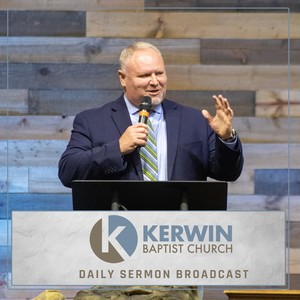
Welcome to the Kerwin Baptist Church broadcast today. Our desire is for the Word of God to be spread throughout the world so that all may know Christ. Join us now for a portion of one of our services here at Kerwin Baptist Church, located in Kernersville, North Carolina. And so Galatians chapter 2 tonight, just going to really share one verse as far as the text goes. And we'll talk about the Apostle Paul here a little bit tonight.
And I'll tell you how this came about. A preacher mentioned a little bit how we, in staff meeting, were talking about our theme this year. And for the gospel's sake, I really am excited about this theme this year. There's a whole lot you can do with this, a lot of different directions you can go. And so our conversation that day there in the teen room, we were sitting around the table and we were just talking about the gospel and It kind of turned into, you know, a lot of us kind of think sometimes that the gospel is just how you get saved, right?
Jesus, he died, he was buried, he rose again, and that's true, that's how we get saved. But the gospel is so much more than that. And so the preacher went around the table and he said, All right, he said, Let's do this. He said, I want you to tell me the first thing that comes to mind to you, other than salvation. What do you think of when you think of the gospel?
And he asked me first, and I was so glad he asked me first, because that's where the direction went for our messages. And so I said, you know, to me, the gospel means that's my identity, right? That's what makes me worth something. If I'm important in this life, it's not because I've accomplished anything. It's because of Jesus loving me.
And that's what the gospel means to me, other than salvation. It talks about. our identity. And so I'll start by asking you a question tonight. And I don't want you to answer me.
Don't raise your hand. Don't say it out loud. Don't tell the person next to you unless you want to. Um but how many of you have ever kind of thought Maybe just not even saying it out loud. You know, I love the Lord.
I love church. I love the things of God. I love the singing. I love serving. I love doing all that.
But there's that deep down feeling inside of you that you feel like I should be doing more. I feel like I should be further along. I feel like I shouldn't have to struggle with this anymore. I feel like I should be past this. And listen, if you've never felt that way, congratulations.
But for the majority of us in here tonight, I think we feel that way. That, you know, I'm saved and I love Jesus. I love the Lord. I love church. I love my church family.
I love what I do. But I just feel like sometimes that maybe I shouldn't still struggle with this, that I should be further along, that my faith should be greater, that I should enjoy God's word more than I do sometimes. And I'm here to tell you: if you've ever felt that way, it doesn't mean that you failed as a Christian. It doesn't mean that you're a bad Christian, and that's not a behavior issue. That's not rebellion.
That's not sin necessarily. I think a lot of times what that means is that we're trying to live the Christian life from the strength that we have and not the strength that Christ gives. We're trying to live the Christian life based on what we do and not what Christ has already done. And so I started thinking, you know, who's the example? Who do you go to in the Word of God that had this figured out better than anybody else, that explained this better than anybody else did, who talked about this more than anybody else did, outside of the Lord Jesus Christ, who understood the gospel better than anybody else that I find when I read God's Word?
And many of you would say the same thing. I had to think of the Apostle Paul. I had to think of Paul and all that he wrote about the gospel. And when Paul talked about his identity, What made him worth something? Why his letters mattered?
Why what he said to these churches mattered? Why what he was preaching mattered? He didn't go to his accomplishments. He didn't go to the churches that he had planted. He didn't talk about the persecution.
He didn't talk about the missions trip. He didn't talk about the mentoring of the pastors and all that. Paul went to the gospel, is why I matter. And so in Galatians chapter 2, verse number 20, Paul gives us his testimony. In story form.
Not in story form, excuse me. Not in story form, but in one sentence. He gives us his testimony here. What I found interesting about this verse is our theme for the gospel's sake. Right, and so I want to take you back to 1 Corinthians chapter number 15.
And I was scheduled to preach this. Do you guys remember the message that preacher preached on the gospel from this passage and did a phenomenal job explaining the gospel and just above and beyond explained how great the gospel was? I was supposed to preach that night on the gospel. And I was a little bit intimidated. I told some people, I was like, what they heard this morning was like Van Gogh painting a beautiful picture of the gospel.
And what you'll get from me tonight is like a kindergartner finger painting. Preacher does such a much better.
So I'm thankful for the few weeks that I got away from what he said because some of our message overlapped a little bit. And you can't help with that when you're preaching about the gospel. But in 1 Corinthians chapter number 15, Paul here says in verse 1, he says, Moreover, brethren, I declare unto you the gospel.
Now, for time's sake, tonight, I know we had a long service this morning, I'm gonna get you out of here as quick as I can. For time's sake, notice what he says in verse 1: I declare unto you the gospel.
Now, go down to verse number 3. He says, for I delivered unto you first of all that which I also received. How that, here it is, Christ died for our sins according to the scriptures, and that he was buried, and that he rose again the third day according to the scriptures.
So we understand that to be the gospel. That's the gospel that we believe, that's the gospel that saved us. But what I found interesting is the way that Paul starts out his testimony in Galatians chapter 2, verse number 20. Let's look at this text. He says, I am crucified with Christ.
Nevertheless, I live, yet not I, but Christ liveth in me. And the life which I now live in the flesh, I live by the faith of the Son of God who loved me. and gave himself For me. And so in 1 Corinthians chapter number 15, Paul says that Christ was crucified.
Now, notice what he says. In Galatians chapter 2 here, he says, I am crucified with Christ. Then he says in 1 Corinthians 15, Christ died and was buried. In Galatians chapter number 2, Paul says, The old version of me is gone. The old version of me is dead.
I am crucified with Christ. He says in 1 Corinthians 15, and Christ rose again. And then he says in Galatians chapter 2, he says, nevertheless, I live, yet not I, but Christ lives in me. I love how Paul takes the gospel and he basically incorporates his life into that. It's a living picture of what the gospel is.
Paul says, I am crucified with Christ, nevertheless, I live.
So here's what Paul is saying. He says, the same gospel that saved me is now the gospel that identifies who I am. That's what matters. Nothing else about me matters except for the fact that Jesus loved me and He died for me and He was buried for me and He rose again for me. That's what Paul is saying.
So here's the question tonight: right? The gospel didn't just help Paul, the gospel marked Paul. Right, and so here's the question that we have to ask ourselves tonight: is the gospel. Did the gospel just save us? Or has the gospel marked us?
Has it identified us? Because in our lives, You know what we find our identity in a lot of times? Right? who we are, what we've accomplished, what kind of car we drive, how much money we have in the bank. In terms of Christianity, our identity a lot of times is in what we've done.
It's in what we haven't done. It's in our behavior. It's in our background. It's in our passions. It's in our obedience.
It's in our past a lot of times. And so now, what we have to understand is my identity is not in any of those things. What matters is not any of those things. What matters is that Christ died and was buried and rose again for me. And so Paul's testimony forces us to ask this simple question: Has the gospel just forgiven me, or has it marked me?
Is that where my identity lies? Is that what matters most about me? And so, I want to give you some things here that Paul says in this verse: five things in this verse I believe that are marks of the gospel. And so, number one, I want you to see that Paul says the gospel marks us with number one death. Look at Galatians chapter 2, verse 20.
He says, starting off this verse, he says, I am. Crucified with Christ. And so if this is Paul's testimony, Paul starts off his testimony talking about death.
Now we have some testimonies this morning, and many of you stood up and you testified and you said a few things. You talked about maybe some struggles that you've had. You talked about some victories that you've had. You talked about how God's working in your life and doing things in your life. And so if I were to stand up and give my testimony, A lot of times I would start by saying, well, I was born in a Christian home, right?
I made a profession of faith when I was six years old, and I went to Christian school, and I struggled with my salvation. I got some reassurance of my salvation in my 20s. That's how I would start out my testimony. Many of us would start out our testimony talking about our lives, how we grew up. Paul starts out his testimony by saying, hey, let me tell you about the day that I died.
Let me tell you about my death in Christ. And he says, I am crucified with Christ. And so we look at that word, crucified. Like what was the purpose of crucifixion? Why did they crucify criminals?
When those Roman soldiers would take a criminal and they would put him on a cross, they didn't do that so that they would change their behavior. They didn't do that so that they would become a better citizen in society. They did that for one reason. And that one reason was that person was going to die. Annihilation, destruction, however you want to say it.
The purpose of crucifixion was a final thing, and crucifixion meant death. Paul is saying that the gospel didn't come along to make the old version of him better, it brought that old version to an end. He says, I am crucified with Christ. And I think a lot of times this is where a lot of, I say us. A lot of us Christians get frustrated and we get hung up because we're saved, we love the Lord, we love church, we love the things of God, we love coming to church, we love singing the songs, we love serving in all the ministries, but we keep trying to manage what God says is supposed to be dead.
I am crucified with Christ. And what we do a lot of times is we try to fix the old self. We try to motivate the flesh. We try to discipline the flesh. We try to keep it under control.
And Paul says that's not how the gospel works. That's why he said in 2 Corinthians 5:17, he says, If any man be in Christ, He is a new creature. Right, not a better version. Paul did not become a better version of himself once he accepted Christ as his savior. That down the Damascus road, Paul did not become Paul 2.0.
He became something brand new. That's why the language is so strong. It says, old things are passed away. Right, we use that kind of term talking about someone. Oh, they passed away.
They're dead. They're gone. Paul says, all things are passed away. Behold, all things are become new. We become something entirely new in Christ Jesus.
The gospel doesn't train the old self to behave, it takes the old self off the throne. You know, I think a lot of times we get so exhausted in our Christian life sometimes because we're trying to live the Christian life without dying to the flesh. We're trying to live in the old flesh, trying to do it in our own strength and in our own power. And I want you to notice something important here. Paul says, I'm crucified with Christ.
And listen, Christ, when he died, and you guys know this, you guys understand this, your Sunday night crowd. Christ, no one took Christ's life from him. Right? No one forced Christ to die. He gave it up what?
Willingly. He volunteered it. And so when Paul says, I am crucified with Christ, what he is saying is, I have surrendered. It's no longer about me. It's no longer about my flesh.
It's no longer about what I want. It's no longer about my desires or my opinions or my worldview. It's no longer about my past. I am surrendering that over to Christ. The same cross that paid for Paul's sin also marked the end of Paul being in charge.
He says, I'm crucified. And so, before Paul talks about any sort of life, before he talks about any sort of works, before he talks about any kind of power living in him, before he ever talks about dependence and faith and love and all of that in the rest of this verse. He says here that something had to die.
Something had to be buried. And until we settle that, the Christian life is always going to be frustrating to us because we keep asking the old version of us to do something it was never meant to do. He said, I'm crucified with Christ. Notice number two: the gospel marks us with not only death. But the gospel marks us with life.
Alright, notice what he says. He says, I'm crucified with Christ. Nevertheless, I live, yet not I, but Christ. Liveth in me. Paul doesn't end with death.
You know what? Salvation, Christianity doesn't end at the cross. It begins there. Starts there. And after Paul says, I'm crucified with Christ, he immediately says, Nevertheless, I live.
So he says, yes, something died. But something new has been made alive in me now. And he makes it very clear that whatever is happening in him, whatever is going on, whatever people are seeing of him, you know, when people see him and he's struggling and he's being persecuted and he's being stoned and he's witnessing and he's going on all these different trips and he's sharing the gospel and people are getting saved, whatever they're seeing. You know what Paul is saying here is that's not me. That's not me doing that.
That's not me performing all of those things. He says there is something else living inside of me. He says, yet not I. It's not me. It's not Paul.
Excuse me, go ahead, teenagers. You're gonna laugh at me now. I hope you get that on video. They have one on video where my voice cracks. They're gonna get that on video too.
He says, yet not I. It's not Paul. He says, Christ liveth in me. He's saying here that the life or the power that I am living from now doesn't come from me anymore. And that's such a big thing for us to get a hold of because I think some of the frustrations as Christians come from us trying to live a Christ-centered life in our own self-strength.
And he says it doesn't come from those things. And listen, the problems in our Christian life a lot of times, they don't come from our ignorance. They don't come because we don't know what to do. We know what's right. We know what we should do.
We know what God expects. We know what's right. We know what's wrong. The biggest problems in our Christian life sometimes come from us trying to live the Christian life in our own strength. And so, what do we do?
We know we struggle with something, we know we have an issue with this, we know we have a weakness here, and so what do we do? We try harder. We put forth more effort. We got to do better. We got to be more disciplined.
We try to do it in our own power. Listen, you and I are not the life source. We were never meant to be the life source. Paul says, I'm crucified with Christ, but I'm still alive. But it's not me that lives inside.
It's not the power of Paul anymore. It's not my self-strength. It's from Christ now. And so, this is a beautiful picture. He says, I'm crucified with Christ, nevertheless, I live.
yet not I. In other words, I'm alive, but I'm not the source. And I think once we get that. In our lives, once we figure that out, everything can start to change. You stop trying to produce life and you start learning to depend on the life that Christ brings.
Let me show you number three, because this is where it starts to get real practical. For us, I believe. The gospel marks us with death, number one. The gospel marks us with life, number two. And then, number three, the gospel marks us with reality.
All right, look at verse number 20. He says, I'm crucified with Christ, nevertheless I live, yet not I, but Christ liveth in me.
Now look at this next phrase. He says, And the life which I now live. in the flesh I still live this life in the flesh. Listen to me. Don't ever listen to anybody, and you guys are smart, you guys are mature Christians, you know this.
Don't ever listen to anybody that tells you just because you're a Christian doesn't mean you don't have any problems anymore. The gospel does not create a fairy tale existence for us.
Alright, Paul here says, I'm still human. I still struggle. I'm still the same Paul. I've still got the same body. I've still got the same pain.
I've still got the same responsibilities, the same temptations, the same pressures, the same struggles. Paul here says I'm still human. Right, this life that I now live, right, I live still in this flesh. And that's important for us to hear. That's important for us to see.
Because a lot of times I think, because we feel like, man, I'm saved and I've been saved for a long time. And so this really shouldn't be a problem for me anymore. I really shouldn't be beyond all this anymore. I really shouldn't have these doubts or I really shouldn't have these fears. I really shouldn't have these concerns.
I shouldn't trust more. I should have more faith. I should read my Bible more. I shouldn't do this or I shouldn't do that. And so we feel like, man, I should be further along.
I shouldn't deal with all this. But Paul says, this is the life that I now live in the flesh. The gospel didn't remove Paul from everyday life. In fact, We find a lot of times where Paul wrote about his struggles. Don't you love somebody who can be honest about their struggles?
I don't like to hear a preacher who gets up here and he talks about me, and I've got everything figured out, and I don't struggle with this, but I know you do. Listen, I struggle. Every day I struggle. Every day is hard. And Paul talks about his struggles.
Let me just show you in a couple of places. First, we see that Paul struggled internally. Look at Romans chapter number 7. Paul said, For I know that in me, that is in my flesh, dwelleth no good thing. Verse 19 says, For the good that I would, I do not, but the evil which I would not, that I do.
So Paul here, you see the tension that he has. He's wrestling with his flesh. He says, I looked inside, I searched inside, but you know what I found is that other than Jesus Christ, there's nothing good that lives in my flesh. And he says, the things that I want to do, I don't do. The things that I don't want to do, that's the things I end up doing.
Paul struggled, and can I say Paul struggled? Uh We struggle. He struggled internally. We see that fight that he had. Notice that he also struggled externally.
Look at 2 Corinthians chapter number 4. He says, We are troubled on every side. Is that not explained today? I mean, from the second you wake up a lot, we're troubled on every sign, he says we're perplexed. persecuted, cast down.
That's real life. That's the pressures that we all face. That's confusion. That's opposition. That's having hard days.
And it's a big deal that Paul admits this. And boy, doesn't it make you feel good? That, man, not that Paul struggled, but man, if Paul struggled, then. I feel okay about struggling some days. He says that life is difficult.
It's important for us to recognize that. We're not Superman. We're not super Christians. We're not above struggles. We're not above failures.
We're not above losing our temper. We're not above saying things we shouldn't. We're not above treating people the way that we shouldn't treat them. We all struggle. The gospel is not a quick fix that fixes all of our problems and just magically makes everything in our life just perfect.
We aren't perfect. We're messed up. We lose our patience. We lose our self-control. We have bad days.
And so here's the question. Paul says, I'm crucified with Christ. The old man is crucified, he's buried. Nevertheless, I live, but the Spirit of Christ lives inside of me, but this life that I'm now living, I live in the flesh. And so here's the question.
Where do we take these struggles? Where do we go? Where do we turn to? Do I turn to you? Do I turn to the pastor?
Do I turn to someone else? And I'm going to take a phrase that Pastor says a lot. Don't you love the Word of God? Paul tells us. Right here in this verse, he tells us where to take it.
I want you to see number four. Look at the verse here, Galatians chapter 2, verse 20. It says, I am crucified with Christ, nevertheless I live. Yet not I, but Christ liveth in me, and the life which I now live in the flesh, here's what he says. I live by the faith of the Son of God.
So number four, the gospel marks us with dependence. The gospel marks us with dependence. Not on other people. Not on our pastor. Not on our parents, not on our spouse.
not on other people in the congregation. The gospel marks us with dependence. Notice what he says. By the faith of the Son of God, Paul says, I live by faith.
Now, when life is hard and you realize that you struggle with something, you realize that you have a weakness with something. Our tendency, our natural instinct is to trust myself. Trust my strength. Trust what I can do when I'm aware of my struggles, when I'm aware of my weakness. Right?
We talked about this earlier. I gotta be stronger, I gotta be more disciplined, I gotta have more self-control. Paul would tell you that it doesn't work that way. And I want to be careful here because I don't want you to think that Paul is saying that we don't have to give any effort whatsoever. Because we do.
I think we should try to be more disciplined. I think we should try to have more self-control. I think we should try to be better in a lot of different areas. But because we weren't meant to be the source of our faith, that responsibility does not fully stand alone on us. And I love what Paul says.
Paul isn't saying that general faith is what keeps him going. He's very specific. He says, I live by the faith of the Son of God. That means Paul isn't trusting in his abilities. He's not trusting in his consistencies.
He's not trusting in his willpower. He isn't trusting in his track record. But can we be honest tonight? If there was anybody in Scripture that could have trusted in those things, He could have trusted in his patience. He could have trusted in his self-control.
He could have trusted in his work ethic. He could have trusted in his self-righteousness. You know, you go to the book of Philippians and Paul starts talking about all the things that he did. Philippians chapter number three. He starts talking about how he was a Hebrew of the Hebrews.
He was circumcised the eighth day. As far as the law goes, he says, nobody could touch me with anything. He said, I was blameless and all that. And so if anybody could have trusted in themselves, it was Paul. But Paul does not trust in himself.
He says right here, I'm trusting in a person. I'm trusting in the faith of the Lord Jesus Christ. And you know what that means? Paul saying, I live by the faith of the Son of God. What he's saying here is when I'm weak, when Paul is weak, he says, I lean on Christ.
When I fail, I don't throw in the towel. I take those failures to Jesus. When Paul doesn't know what to do next, he depends on Christ. When those old memories in the past of Paul started to haunt him, he took those and he placed those on Christ. That's what faith in the Son of God looks like.
I'm not going to be perfect. Paul says there's going to be days where I live in the flesh. There's going to be days where I struggle. There's going to be days where I mess up. I'm not going to be perfect.
But Paul says, I live now in the flesh by the faith of the Son of God. And the gospel doesn't create more pressure for us to perform. It doesn't cause more weight for us to carry. It gives us someone to rely on. Amen.
And so I think this will be up on the screen for you. Faith isn't trusting yourself to do better. It's trusting Christ to be enough for you. And so, when we struggle, when we fail, where do we take that? Paul says, I take it to Christ.
I depend on Christ.
Now I want you to notice the final phrase here when we'll be done. Look at the verse. I am crucified with Christ. Nevertheless, I live, yet not I, but Christ liveth in me, and the life which I now live in the flesh. I live by the faith of the Son of God, look at this, who loved me.
and gave himself for me. The gospel marks us with death, it marks us with life, it marks us with reality. We still live in the flesh every single day, we struggle. It marks us with dependence. We must depend on Christ every day.
When we struggle, we bring those things to Him. And next, the gospel marks as number five with love. You know, whether we say it out loud or not. Whether we ever mention it to anybody else or not, we're all looking for love. We're all looking to be accepted.
We all want to matter to somebody. We all want to be important. We all want to feel like we're enough. And because we feel that way, Right? We will take on and adopt activities and behaviors to make sure that we are loved.
If we want to be loved by a certain group of people, we want to be accepted by a certain group at work or at school or whatever, we will act like those people. We will do what they expect us to do in order for them to accept us. We'll do that in relationships. We'll do that at work. We'll do that at church.
And because we think we have to do that with people, we have to perform so that people will love me and accept me, we feel like we have to do that with God too. Right, I have to perform. I have to be good enough. I have to work enough. I have to give more effort.
I have to have the right kind of behavior. I have to be involved more. Whatever it is, fill in the blank. And Paul says that kind of thinking needs to be put away. Need to put away this idea that we have to earn Christ's love.
He said that Christ loved me and He gave Himself for me. He talks about living in the flesh. He talks about him struggling, right? I live every day. I live in the flesh now.
And what Paul is saying at the end of the day, no matter what happens. No matter what I've done today, no matter what I've fallen into. Doesn't mean that God loves it, doesn't mean that God accepts it, but it does mean that God still loves me. and that God still gave himself for me. And I want you to notice something really, really cool here.
I love this part. This is my favorite part of the entire study of this. Paul, when he says this, he did not say that Christ loved the world. He did not say that Christ loved sinners. He did not say that Christ loved mankind.
Does Christ love the world? Sure, for God so loved the world that he gave his only begotten Son. That whosoever believes Right? Does God love mankind? Sure, He does.
Does God love sinners? Of course He does. Paul didn't say that here. Notice what he said. He said he loved.
Me. gave himself for For me. That's personal love. Yeah. You know, general love.
A general, God loves everybody. General love doesn't mean a whole lot when you're dealing with personal failure. It doesn't mean a lot when you're dealing with personal regret. personal shame. For those personal things, I love this.
For those personal things that we deal with, God offers a personal love. You know, when you mess up, when I mess up. We don't start asking God, God, do you still love the world? Do you still love mankind? Do you still love sinners?
When I mess up When you mess up, When we've blown it, What do we start saying, God, do you still love me? You still care about me. And Paul here says, if you ever start to wonder that, If it ever starts to cross your mind, You know, I think of the brother that stood up this morning and was talking about You know, it crossed his mind, maybe God doesn't care about me anymore. Maybe God doesn't love me anymore. That thought has crossed all of our minds at some point.
And Paul here says that when you think those thoughts, when it crosses your mind, You look back at what he's already done. He says he loved me and he gave himself for me. Jesus said in John 15. Verse 13. Greater love hath no man than this.
Then a man lay down his life For his friends. And You know, I believe Jesus went a step further. Because Jesus didn't just die for his friends. He died for those people that hated him. He died for those people that would reject him.
He died for those people that put him on a cross. And then on the cross, From the cross. Forgive them. Yeah. That's love.
It says he loved me and he gave himself For me that ought to encourage every single one of us tonight. That no matter what I do, no matter where I go, no matter where I end up, God doesn't condone sin. God doesn't just sweep sin under the rug. But at the end of the day, He still loves me. He still gave himself Yeah.
Your past doesn't define who you are. Your failures don't define who you are. Your success doesn't define who you are. who you are. The gospel defines who you are.
That's the identity. At the end of the day, here, this is what Paul, I believe, is teaching: our identity is not found in our past, it's not found in our failures, it's not found in any of those things. is found in the fact that Jesus loves us. And he says, the old version of me was crucified. I'm crucified with Christ.
That's a surrender, that's a choice. Paul said, I died daily, right? He had to do it every single day. He said in Galatians chapter 5, to crucify the flesh. And so the old version of us was crucified, and now the power of Christ lives inside of us.
I know we don't fully understand that. But can we try to wrap our minds that the power of Christ lives? inside of you. It lives inside of me if you're a Christian. Thank you for listening today.
We hope you received a blessing from our broadcast. The Kerwin Baptist Church is located at 4520 Old Hollow Road in Kernersville, North Carolina. You may also contact us by phone at 336-993-5192. or via the web. At Kerwin Baptist Church.com.
Enjoy our services live and all our media on our website and church app. Thank you for listening to the Kerwin Broadcast today. God bless you.