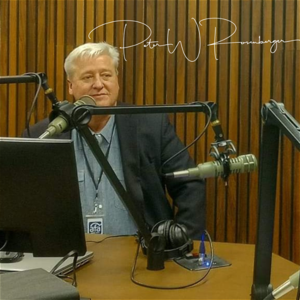
This is the Truth Network. Welcome back to Hope for the Caregiver. This is Peter Rosenberg, Hope for the Caregiver dot com. Glad to have you with us along this jaunt we have into all things caregiver related. This is the program for you.
As a family caregiver, healthy caregivers do indeed make better caregivers. We're continuing on our series. Have you considered the implications? Have you considered the implications? Last week we covered God's trying to get your attention.
That phrase that we've all heard a bunch of times, maybe even said it ourselves. And I want to take these phrases. I got about twenty-five of them so far. Maybe you've got another one that you want to throw out at me. But listen to the series first.
I may have already got it on the list that we say in our Christian community. We say to others, say to ourselves. We've had other people say them to us, and so I'm taking these phrases that carry a lot of stuff with them that maybe folks just don't think about. Really, what what are we actually saying here? We often fall on these things when people are going through tough times, and we put it on the person going through tough times.
And the goal of all of this is to point us to a better way of communicating. Again, in the first block, I talked about the guy that you know. I spoke some words in his language, and he immediately understands. Are we using words the way we think we're using them? Are we saying what we really think we're saying?
Have we considered the implications?
So today. Here's the one for today. God is still in control. I heard that profusely after the election. God's still in control.
Everybody's posted on social media. God's still in control. Well, God is. Psalm one fifteen three says, "Our God is in the heavens; He does all that He pleases." That's a declaration about who God is, and and. It's not an untrue statement to say God is still in control.
There's no question about it. He is sovereign over all. But what are we really saying there? We we have to think through this.
Okay, would you say God is still in control to someone who is burying their child? You go through the line at the at the funeral at the graveside, and you tell a young family God's still in control. Would you say that to them? If so, why? If not, why not?
You follow where I am going with this? It's it's not that he's not in control; he always has been, always will be. He is God, but when we wield that as some type of stamp that we put on a document, and the document is. Filled with grief and sorrow. Do we just stamp it and move on to the next document kind of thing, or do we do we wrestle with it?
Do we spend some time with it? Do we unpack it?
So if I came to your hospital room where you're you're taking care of your loved one, and I just bop in and say God's still in control, and I leave, it's almost insulting to hear that. But if I come to you and take both hands and say God is in control. You feel the difference, and after the election, I saw tons of posts on social media and everything else. And there's an article even somewhere, one of the Christian publications that basically has just become a cop out for so many people and Christians. God's still in control.
We we we use God's sovereignty as some kind of way to assuage that you know this is all going to work out because God's still in control.
Well, it is going to work out. May not work out in our lifetime. Let me tell you something. When Gracie slammed into that concrete abutment, God was in control. Make no mistake about it; He was sovereign then, as He is sovereign now, as He has always been sovereign.
It doesn't mean that there aren't real life painful things that go on. We talked about this earlier, about a month or so ago, with the doctrine of divine concurrence. That we have the ability to act with our own decisions, with our own nature, and yet God is acting on that as well. Remember what Joseph said to his brothers: "What you meant for evil, God meant for good." It doesn't absolve us of our stuff. Those people still crucified Jesus; they were not absolved of this.
Peter looked at them on the day of Pentecost, said, "This Jesus whom you crucified." Although it was foretold. From the beginning, back in the garden, and that this was coming, and yet they were not absolved of it. You, you, you follow. This is this is very difficult to to wrap our minds around. It it is.
It anybody that comes and tells you that they understand this sort of thing, well, you know, maybe give them some space because these are difficult things. It's like somebody say, "Well, they understand the Trinity." Well, do we? We accept it, but understanding it. A dear pastor friend of mine told me this. He's been a real great mentor to me.
Name's Larry, and he said, "We can know God truly, but we'll never know Him absolutely. We we truly can know Him, but we will never know Him absolutely." If you if you wanted to be clever with you could say we can absolutely know him but we can never know him absolutely, and and when we say God's still in control, what we're doing if we use that flippantly if we use that just offhand, then what we're doing is we're we're treating this carelessly, and we're also treating the heartache that we're faced with carelessly. And we we need to be careful with that. That's we we've all been there. We've all said it.
We've all done it. But the purpose of this series is for us as caregivers to grow a little bit in this. Let's let's push ourselves to to go deeper. And and I there's no better example of Christian ministry than that I've seen as far as the concept of what it looks like. Then the the paramedics who were trying to get Gracie out of the car, it first started with the truckers.
Now this was, by the way, forty three years ago.
Next week, and the truckers put the car the flames out with their fire extinguishers. About ten of them stopped, and and she's all just. I mean, she is. Her body's just broken, and she's in the car, and it's on fire, and her legs are pushed up over her shoulder so that her feet are over shoulder. I mean, she is broken.
And some of them, you know, were just some of the truckers got sick and everything else. I mean, it was it was pretty pretty grisly. And they put the fire out, and then they're trying they're calling for the paramedics, and they're talking to her now. I we've we've done some research on this. Grace and her family did a lot of research on on the conversations that went on and the people that were involved.
None of them said, "Hey, you know, God's in control. God's still in control." They didn't say that. The words that came out of the trucker's mouth were, "What's your name? Hang on, we're here. We're going to get you to safety.
Hang on, we're here. You're not alone." And then when the paramedics showed up, same kind of conversation.
Now they didn't have a script. That's just what came out because it was appropriate for the moment. They were not lecturing. You know, nobody asked her if she was baptized. Do you know that?
Nobody asked her if she understood the doctrine of justification. They just assured her that they were there. And they were going to be with her, and they're going to get her to safety. And I think when we're dealing with people with heartache and difficult things, we want them to be comforted by the fact that we serve a sovereign God. But how would you go about doing that?
You don't go through the receiving line at a funeral.
Well, all things work together for good to those who love God and call. You know, you know, you don't do that. What you do is you weep with those who weep, and you mourn with those who mourn, and you go in carefully, and we use our words carefully. Words really do matter. You know, my mother called me up after last week's show, and I mentioned that phrase, "Words matter," and she said the same thing.
You know, words matter. The words we say really do matter. That's how we communicate. You know, for example, when Iran has been chanting "Death to America" for forty-seven years, do we take them at their word? Do we believe them?
You know, when when. I saw a podcast host on the left, these two ladies, and then I saw a thing with Dave Chappelle. They both echoed the same thing. These two ladies said, "It's like we want to dig up Charlie Kirk's corpse and do it all over again." And then Dave Chappelle came out and said, "You know, when Charlie Kirk got killed, he felt better." Well, words matter, and you don't come back from something like that and say, "I'm sorry if anyone was offended." You don't come back and put it back on the person hearing it. You come back and own.
I have wronged you. I have done something that was terribly wrong, and I ask your forgiveness. You know words matter, and the same thing with wielding things about with scripture and truth. God is still in control, but I promise you this. If I ever am saying that to you in your distress, I promise you, I am going to be looking you in the eye, and we're probably going to have tears in both of our eyes.
And I am going to hold your hand, both with both of mine, and say, "Let me tell you that God is still, and let me tell you why that comforts me, and why. Let me tell you how that strengthens me, and I want you to hold on to that." In these dark moments, because that's what David said. Yea, though I walk through the valley of the shadow of death, I will not fear, because God is still in control. He is with me. David knew this, but it always comes with a place of deep understanding of who God is and what that means, and the implications of this, and if the implications.
Are important, and I believe that they are. Then, what are the implications of this?
So, when Gracie slammed into that concrete wall, God's still in control. That means He has not taken His eye off of this. That for whatever reason He has decreed that this will happen. But He's also decreed that He's never going to abandon her, and He's not going to abandon you, and that He does have purpose. We don't understand it.
We may never understand it in this lifetime. We may not see any of this until we get to glory. And so I'm going to ask you point blank: Can you live with that? Can you live with not seeing why all this is happening, even an iota of it, until we get into His presence? And if so, why?
And if not, Why not? And what would you like to see happen in your life to reconcile those things, so that you can live with this and trust Him in this, that you can recognize that His scarred hand is holding, indeed, your scarred hand, that He is in control, and He will not abandon you. But let us never say that flippantly. Let us say that with earnestness, and with a deeper understanding of what that means to us as caregivers. That this is not for naught.
That He is in it. He has purpose in it. He has purposed it. He has decreed, and He will see us through it, and He will get the glory through it, and that. Is hope for this caregiver because he is in control.
This is Peter Rosenberg. We'll be right back. It's hard to count how many times I brought Gracie home from the hospital.
Sometimes she still needed a level of care that would overwhelm plenty of people, but the medical staff believed I could take care of her. Once I brought her home with oxygen, three drains, a catheter, and yes, two prosthetic legs. That's a tall order for anybody. Trained professionals do this every day, but what about family members who suddenly find themselves responsible for all of it? How did I get here?
How am I supposed to do this? Who's going to help me?
Well, if you listen to this program or read my books, you know what I've learned, often the hard way. But how many caregivers haven't heard? How many are struggling alone? Will you help us reach them? Standing with Hope has two program areas: a prosthetic limb outreach for Gracie's fellow amputees, and a family caregiver outreach for my fellow caregivers.
It's for the wounded and those who care for them. We don't have a fundraising budget. We want every dollar possible going to the work.
So I'm asking you directly: if you find value in this program, please help us put it within reach of another caregiver. Give today at standingwithhope.com/giving. Standingwithhope.com/giving.