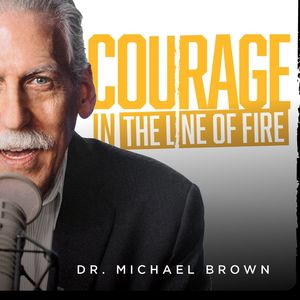
We've got some very special eye-opening interviews that'll get us all thinking today right here. It's time for The Line of Fire with your host, activist, author, international speaker, and theologian, Dr. Michael Brown, your voice of moral, cultural, and spiritual revolution. Michael Brown is the director of the Coalition of Conscience and President of Fire School of Ministry. Get into the line of fire now by calling 866-34-TRUTH.
That's 866-34-TRUTH. Here again is Dr. Michael Brown. We are going to spend the better part of one more day focused on. Racial reconciliation focused on different perspectives that we bring to the table here in America.
This is Michael Brown. You are listening to the line of five. Remember to call 866-348-787. 884. That's 866-34TRUTH.
A few minutes from now, I'll be joined by Janet Boynes, African-American woman. Powerful testimony coming out of lesbianism, broken home, a great ministry today reaching many people. We want to talk to her and get her perspective on what's happening in society today. A little later in the broadcast, we'll be speaking with Professor George Yancey, also African-American, with some very wise words to bring on how we can transcend racial barriers. In the second hour, I'll be speaking with Dan Fisher about his book, The Black Robed Regiment, a real eye-opening book about how American leaders, pastors, clergy.
Paved the way or played a major role, I should say, in the American Revolution in the 1700s. And then in the last half hour, I'll be speaking with Reverend Jesse Lee Peterson, also an African-American, a man who said that Black Lives Matter is worse than Ku Klux Klan.
So we're going to get a bunch of perspectives today. We've been blessed by hearing from so many of you, our dear listeners, Friday, Monday, yesterday, and today we'll be having these special interviews.
So I may be taking some calls at some point, but for the most part, sit back. Enjoy the broadcast. And if you miss any part of it, remember you can listen online, on your tablet, on your cell phone, wherever you are, anywhere in the world, on the website, askdrbrown.org, a-s-k-d-r-brown.org. And you can also catch the broadcast later at that very same place.
So I expanded on my thoughts about why Christians should lead the way in racial reconciliation. And I put together a list of 10 items. You can read this by going to my website. Brown.org, but here they are in brief. Number one.
We are called to be salt and and light. Number two. We have a unique unity. Having the same father. and being saved By the same blood.
Number three. We're called to be peacemakers. and ambassadors of reconciliation. Number four. as those who have been forgiven, we can forgive others.
Number five. In Jesus, there is neither black or white, yellow or red. Number six. We know the life-changing power of the gospel, and with God all things are possible. Number seven.
We have a common enemy. Number eight. We understand spiritual warfare and the power of prayer. Number nine. We understand the power of the tongue, Number 10.
We know how the gospel has changed America in the past. I just noticed a note on one website from a perpetual critic. In other words, whatever I post to criticize and attack, and saying, Oh, yeah, oh, that's all fine and dandy, what you wrote, but we've got to address the systemic issues throughout the society. I guess what he's completely missing. And this is what happens when you just have it in for someone, whoever it is, be it a politician, be it a pastor, whoever it is, that whatever they say you're going to differ with, is that you miss the point of what they're actually saying.
And in this case, What I'm saying is Where there is systemic injustice or racism or inequality, that these principles are what will address it. Of course, it is by living these things out in every sector of society that we bring about positive and constructive change. By the way. Another note, but just to comment. I'm shocked by the comments of Ruth Bader Ginsburg attacking Donald Trump.
Completely out of line for a Supreme Court justice. Completely out of line, regardless of which sides we have taken. Bizarre. It's fire we want for fire we want. It's the line of fire with your host, Dr.
Michael Brown. Get into the line of fire now by calling 866-342. Here again is Dr. Michael Brown. Welcome back friends to the line of fire.
866-34 Truth, the number to call if I do take calls. I want to get straight to my guest, Janet Boynes. Janet's got a powerful book that will be coming out soon. I wrote the forward to that, and I want her to share that with you briefly. But she comes from a very broken home, suffered abuse growing up, ended up in lesbian lifestyle, by which I mean in lesbian relationships, also drugs and bound for 14 years.
Jesus wonderfully delivered her, and she's got a great ministry to the hurting, to the broken, and to others who want to grow in God. You can find out more by going to Janet Boynes. Boynesministries.com. That's B-O-Y-N-E-S, Janet Boynesministry.com. And Janet and I off the air have discussed the current racial tensions in America and the different perspectives through which different people see the world.
So I wanted to bring her on to discuss these things with us. Janet, welcome to the line of fire. Thanks for joining us today. Dr. Brown, it's an honor to be a part of anything that you're doing.
You have become a mentor and a friend. And I'm so grateful to be a part of whatever you're doing.
So, thank you for having me.
Well, my joy to have you. Before we get into the race issues and your perspective, tell us the title of your new book. And again, I wrote the forward to it. I'm quite familiar with the contents. But tell us about your new book, when it's going to be coming out, and why you wrote it.
You know, Harrison Publishing is going to publish this book, and it's coming out actually, the first hundred copies is going to be. arriving at my conference that's going to be in New Jersey in August. But the release date, I'm not sure. But it's a quest for truth. And the reason why we decided to do this book is so many Families and parents have contacted my ministry and said, When are you going to do something for parents?
So we want to answer the tough questions. My kid is decided to have a civil union. Do I go or do I not go? My child is becoming transgender. How do we respond as parents?
We want to answer some of these real crucial. questions That's going to help a parent not reject their child, but at the same time, love them. I believe in compassion without compromise. Let's have compassion with those who are going through difficult times. but let's not compromise the gospel.
So, I'm really excited to get this book out and get it into parents' hands, and a lot of people are. Are asking us about this book.
So it's going to be exciting to get it out. I think it's really going to do some help for parents and to help them have a better understanding of how to work with their child. and the reason why they could be going through what they're dealing with today. And you know, Janet, the thing that struck me most in the book, and I mention it in the foreword. The way you grew up, such a broken home, an abusive background, both from your your mother and from a stepfather and then living in the world Being caught up in sinful relationships for years, being on drugs, and now knowing the Lord and walking with the Lord these years since, I was struck by the degree of wisdom that you had, as if you.
You had been raised in the Lord in a godly home all the days of your life as if you had been in a solid marriage for decades, as if you had raised your own kids and so on. I thought, obviously, God's really done something deep in your life, and you've been around some great godly examples because. With the upbringing you had to be able to write a book like this, it's really a testimony to God's transforming power. You know, God works from the inside out. You know, being raised in a family of seven kids, four different fathers.
watching my mother get abused. By my stepfather. My mother abused us, and I became the abuser. I was raped by my mother's husband and then by an altar boy. But what was my demise is now my voice.
I wasn't going to allow my past to predict my future.
However, me coming from from point A to Z was a process. Yes, I was raped. Yes, I went into homosexuality. I struggle with drugs. I put myself in treatment.
I got away from all that, and that's because of the power of God and the body of Christ and the church. But it was the church that helped me to get to where I'm at today. The church is the change agent on the earth today. that is going to be there to assist and help. Men and women.
Come out of what they're dealing with. It's going to take all of us to be a part of that change. And if it wasn't for the church that I was at in Maple Grove, Minnesota, I wouldn't be where I'm at today. I moved in with a Christian family at the age of 40. I walked away from that lifestyle, and this family took me in, and that's where I was able to have a better understanding Of what it was like to have a family.
And you know what? It wasn't a black family. It was a white family that took me in. But it all started back when my eighth-grade English teacher took me under her wing. When teachers told her, why are you gonna work with a girl that gets D's and Fs?
She's going to wind up dead at the age of twenty one. But my eighth grade English teacher said, it doesn't matter. I'm going to take this girl under my wing because I see potential. And she spent time with me, working with me on my English and my writing. And I am to what I am today is because somebody took interest in me, somebody believed in me.
Even though I went through a lot of pain because of watching my mom get abused, and then I was abused and raped. I was determined once I gave my heart to the Lord not to look back, but look. at what was in front of me. and all the Christian mentors that came into my life, I took everything that they said with heart, and I wasn't going to let what my past looked like or how people are trying to label me. To stick with me, I knew I could do better, and I kept going at it, and I kept going at it, and I didn't give up.
And now today I get an opportunity to speak around the country and share what God has done in my life. That's pretty powerful. And I that's why I wanted to come on your show today because I realize we're in a spiritual battle. We are in a spiritual battle. But a lot of these young kids that are getting involved in some of these fights.
They're not bad kids. A lot of people thought I was a bad kid because I got kicked out of school all the time. Bad things happened to them. And so we're acting out of our pain. A lot of times we have to be rehabilitated.
A lot of people look at us as second-class citizens. I know I'm black. But 98% of my friends are white, and we can go into a restaurant and they can even tell I get treated differently. than they do. Hmm.
So racism is still here. But let me tell you what I really think is important. What was hidden in the dark is now. in the light. I remember doctor Brown when I was living a homosexual life.
We stand on a corner. And I have the utmost respect for police officers. I have friends. that are police officers. But I have a healthy fear of them too because I know what they're capable of doing if they're in a bad mood.
I was thrown hooked up against a cop car and I bounced off of it. and o and chipmatu. because I was standing on the corner because maybe they were having a bad day. But again, not all police officers are bad. But our young kids are getting shot.
They're getting killed. And matter of fact, I'm trembling because I'm afraid I'm going to say the wrong thing, but I shouldn't have to be afraid of how I feel. These are my feelings. and they are legitimate. And what we're going to have to do is come together as a body of Christ, white.
Black is Hispanic. we're all going to have to sit at a table and talk about what we can do to continue to help these generations that are coming behind us. Because I'm gonna tell you. This world is in a mess, and we are in a spiritual battle. And I believe that we're in a warfare against good and evil, light and dark.
But what do we do, Church? We fight back. We don't have to fight back with guns, we don't have to fight back with our fists, but we can fight back in the spiritual realm where the supernatural is going to bring birth to the natural. We have to get on our knees and pray. We're going to have to pray for our city.
We're going to have to pray for our kids. But oftentimes, we're so quick to judge these kids or these adults on how they dress or how they look or what they're doing. And we're so big on behavior modification But I'm telling you what they need is the soul transformation in the behavior take care of itself. Mm-hmm. Yeah, Janet, again, when we discussed you coming on the air, it was so that you could bring this perspective, which we've also heard from a good number of listeners.
I've had a good number of black listeners totally respectful of the program, in fact, enjoying the program, honoring me. God-fearing citizens, hardworking men, women, younger people, and they've talked to me about what they faced. And that's helped to round out my perspective because I didn't grow up in this way. I didn't grow up being racially profiled. I didn't grow up, you know, like when I was on drugs and I was carrying drugs, I had a certain fear of the police, but that was quite justified because I was breaking the law.
But it wasn't because of the color of my skin. And the thing is, though, you're not saying this to attack or accuse. You're saying this to say that we have the answer, but we need to understand. The depth of the issue.
So, when we come back, Janet, I want to talk about what we can do together as the body of Christ. to address the challenges of families in the inner city. to address the challenges faced by black Americans. and again, working together as the body of Christ. And then to just give you, okay, well.
Here's a perspective where whites react about Black Lives Matter because what they feel is an exaggeration or dangerous rhetoric or something.
So we'll continue this conversation. All we can do is get started today. We'll be right back. Oh God of burning, cleansing flame. Say It's the line of fire with your host, Dr.
Michael Brown, your voice of moral, cultural, and spiritual revolution. Here again is Dr. Michael Brown. Thanks so much for joining us on the line of fire. Your voice of moral sanity and spiritual clarity in the midst of a society and compromise in a church.
Excuse me, society in chaos in the church, all too often in compromise. I'm joined by Janet Boynes. Her new book will be out shortly: A Quest for Truth that will greatly help parents. Leaders dealing with questions about homosexuality and transgenderism, compassion without compromise, the way Janet puts it. And I wrote the foreword to that book.
Janet's last name spelled Boynes, B-O-Y-N-E-S. Janet, I'm going to throw out a couple of things for you, and then you can respond at length because you've got a lot to say, and it's important that we hear this. And everything you're saying is redemptive and constructive, which is, again, a key. Why we want to hear it.
So, to give you a white perspective, which is not going to be news to you, but your average white Christian is not aware. of systemic racism. in America. They're thinking, hey, we're one body, we're one family in the church, and we've got a black president, and you know, what's the big deal? And then they'll see, okay, say the the the black man that was shot.
In Alabama, out in Sterling. They'll say, look, the guy has an arrest record. He's got 20 arrests. He's a registered sex offender. He, illegal possession, resisted arrest in the past.
Don't make the guy into a saint. And now look at the shooting of the policeman. And this is spurred on by Black Lives Matter rhetoric. And these, you know, the African-American communities just being used by people like Jesse Jackson and Al Sharpton. And, you know, it's divisive and there are bigger problems to address and things like that.
So that's how many white Americans would see things and be quite oblivious. To what black Americans have experienced as a people over the years.
So just give me your honest response. When you hear those things, which have validity on the one hand, but then are missing other points. First, what's your perspective? And then second... What do we do together as the church to try to bring help to a difficult situation.
In my personal opinion, all African American people aren't good people, just like white people. The one thing people got to realize we're not second class citizens. we are not in slavery anymore. And any white person cannot ever say to me they understand what it's like being black. because we were the ones that were in slavery, and it feels like sometimes they're trying to keep us there.
However, Jesse Jackson, L. Sharpton. Only time you see them when something happens. I don't see them out there doing anything else. They're just getting political gain.
They're just like the media, always looking for a way to get their name out so they can feel like they're the big dog. They are ridiculous. They're not listening to the kids. They're not listening to those who are out there speaking. when we sit down and listen.
To what these kids are saying to us, I believe we're going to start making change. Not based on our desires and our thoughts and what we think is best for them. They will tell you what they need. That's why Donald Trump. Or that's why Jeb Bush, who I like, or crews, that's why they're probably not the front runners.
Is because you get there and we put these folks in office and they don't listen to the people.
So now everybody's sick and tired of it, and now they want change. And because people are making changes, now they're telling people they're stupid and they don't make sense. No, they're doing what they think is going to be right for them and their families. And when you're pinned up against the wall and when you can't take it no more, there's a backlash. Doesn't make it right.
It doesn't make it right to go kill anybody. We have to find another solution or when people are in pain. And I believe that inside of that pain, they're sort of acting out. And that's what's happening with most people. They're acting out.
Does it make it right that they kill these police officers? No. What the police officers are doing, I believe there's so many bad cops out there, and I believe there's bad. But what the cops are going to have to do is start telling on their own. And from what I know from friends that are police officers says if you tell on your own, That's right.
really killing somebody. one of your brothers or one of your sisters, they're going to have to start standing up and saying, no more. No more venom here in the police department. We're going to start calling you guys out, and you need to get off the course because you're making things bad for us. That's the first thing.
That's where change is going to have to start in their own houses. parents, you have to understand, African Americans, I was born out of wedlock. Many of us don't have fathers.
Some of us don't even have mothers. People are trying to survive. We have come from a different culture. Try to understand. Our culture.
and where we've come from and why we feel the way we feel. As a person, Dr. Brown, who's come out of homosexuality. And travel the country, do you know how I feel left out sometimes? I think about all these big speakers out there.
And yes, I'm going to some churches. But sometimes I feel like because people know where I've come out of, they don't want to align themselves with me. That breaks my heart. It makes me feel like I am a second-class citizen, or you don't fit into a certain group of people. I sit and I watch and I'm a very good watcher.
And I watched some of the conferences all over the country, and I watched the speakers that they have. I watched Donald Trump. I was in Washington in New York. At the Trump, 900 pastors and leaders were there. Me and a guy by the name of Greg Coinland, we were there.
And The speakers that came out, or the ones to get to ask questions, they were all white. No Hispanics. They were all white. And that should not happen. You're going to have to mix it up so other voices can be heard.
The other thing is that we're an African-American female. Trump has a faith advisory board. If you're going to bring people together, you're going to have to start having them on your team. Not less of them, but more of them. Where is the African American woman on your faith based team?
We're going to have to come together. And that's where the racial divide is going to stop.
Somebody like me who's come out of homosexuality, who's been abused, who's been raped, who's had an eating disorder, and God is now using my voice. These are the kind of people that you want to use because you want to get the information from us to find out what worked for us. Maybe they'll work for somebody else, maybe not the same way. But it just might. Help.
some of these other young girls. or some of these other young boys. We got to find a way to start using our voices, but using it in a correct way. And not a bad way. I just feel like we're all just getting pushed back, and we get the big one.
I love TDJ. I love Jensen Franklin. These are big names. But a lot of times, people go there and they think, yeah, What, you want another penny for how much you want this? I hear young kids talking.
They might not say it in front of them, and I'm not saying that about them because I love them, I listen to them all the time. But this is what they're saying. Is it really about money? Is it really about a I think there's a lot of confusion going on in the body of Christ. If we want kids.
And we want them in our churches, and let's start going to where they are and meet their needs where they're at, not. Bring them to church if they're saying, hey, I'm hungry, need some food. Let's clothe them, let's dress them, let's meet their needs, and then in the end, they're going to see that you really care. Then I believe they're going to start coming to church. Janet, in a few short minutes, you said a whole lot.
And the challenges are there. And the question is how we respond. Janet, we just got started today. We're going to continue this conversation. I'm very glad you're part of my family.
To be continued. It's the line of fire with your host, activist, author, international speaker, and theologian Dr. Michael Brown. Your voice of moral, cultural, and spiritual revolution. Get into the line of fire now by calling 866-34TRUTH.
Here again is Dr. Michael Brown. You know, I I don't mind I don't mind at all. when things make me uncomfortable. Oh, I don't always like being made uncomfortable.
But I don't mind. When things are said that challenge me That makes me feel uncomfortable because I know ultimately, if I'm pursuing the Lord, if my heart's open to Him. If I love his truth, if I love his ways, then whatever. Perspective: I need change, whatever mindset I need change, whatever adjusting I need. No problem, it's for the good.
It's just like if Maybe you're an athlete and you're seeking to get to the top of your sport. And you bring in a new trainer because you feel you've gone as far as you can. And the trainer says, you know, you've got some fundamental issues. You're going to have to relearn how you do this and this and this to get where you need to be.
Well, no one likes to hear that. But if you know that it's constructive rather than destructive, you embrace these things.
So, a lot of the conversations we're having over these days. They're making some listeners uncomfortable. making some listeners angry. discouraging other listeners. And others are saying, amen, absolutely.
I'm so glad someone's saying it. The whole purpose of having live talk radio is to be able to interact together as a family. to be able to interact together as a body, to be able to learn from each other, to be able to challenge each other. To be able to grow together, why, so we can make the maximum impact for the Lord.
so that we can bear the most lasting fruit, so our lives can touch the most people in the deepest, most powerful ways, so that Jesus can be glorified while we have breath. In the next few minutes, I'm going to bring on another guest. And I'll introduce him at that point. But Professor George Yancey. is coming at these issues As an African American man, but also as an academic, as a professor.
Who has examined issues of racial tension and racial barriers, written some important books on these issues.
So we're going to be talking together. And again, everything we do is to be constructive. I've looked at something, and I'm going to pose it to Professor Yancey in a moment. But I've looked at the issue of other minorities in American history, And be it Jewish minority, so the one that I come from. be it more recently Asian minority.
Hispanic minorities, others, other ethnic groups, when they came to America and were in the minority. and there were often obstacles to overcome. There are often challenges to overcome. but in every case they have been overcome. And when we look at Africans coming over from Africa to America in recent years, many of them well educated, many of them quickly rising to the top of their profession or doing well in the particular universities where they're studying.
And yet, historically, African Americans here, those who have been with us through the generations, Uh they're still struggling. I don't look at that as their fault primarily. I look at that as there's something larger going on. that we need to address together As the body of Christ. It's all too easy just to point at someone and to say, well, you should do better.
But as Jonath Boynes just said She was raised without a father, as are many African Americans. Many don't even know their mother. And there are obstacles that need to be overcome.
So, how do we overcome these together as the body of Christ? My guest will be joining me shortly, Professor George Ansey. has called for the very thing I've called for. Honest communication, which means listening to each other, learning from each other. committing to make each other uncomfortable if need be.
so that we can come to constructive solutions. America needs us to do that right now. The church. should lead the way. We'll be right back with Professor George Yancey.
It's the line of fire with your host, Dr. Michael Brown. Get into the line of fire now by calling 866-34TRUTH. Here again is Dr. Michael Brown.
This is our fourth straight day of focusing in particular on the racial divides in America, the pain that's being experienced throughout the country, the question of addressing injustices. in an individual and systemic way. We've heard from quite a few different voices. We've had so many great calls from your listening audience. I'm so pleased to bring on the air for the first time Professor George Yancey.
He is Professor of Sociology at the University of North Texas. He's written popular Christian books for publishers like InterVarsity Press, One Spirit. Principles of successful multiracial churches, beyond racial gridlock, Embracing mutual responsibility. His recent book, together with Michael Emerson, published by Oxford University Press, Transcending Racial Barriers.
So Professor Yancey is looking at things as an academic, As a Christian, as an African American, he's looking at massive research, he's looking at anecdotal. responses and then he's saying what can we do now As the body of Christ to bring about positive change.
So, Professor Yanci, great to have you with us on the line of fire today. Thank you, Dr. Brown, for having me. I really appreciate this.
Well, my joy, sir, this has been a major academic focus of you for years and a major practical focus. Obviously, these are issues we all intersect with, but what got your attention? Why did you feel you needed to be a voice on this?
Well, you know, it's interesting because going to graduate school when I first started, I wasn't really wanting to study racial issues. But then I had some things happen in my life personally that affected me as an African American. And it just reinforced that if you're black in the United States, it's hard for you to escape thinking about racial issues. Whereas for white, it's not quite that har I mean, it's not quite as hard. And so that's got me into studying, among other things, racism and racial issues, especially in the church.
And when you say things that happen to you, give me a for instance.
Well, what was happening at the time was I was dating a young lady who was white and her mother didn't like it 'cause I was black. And so that was the initial thing that really got me interested. It wasn't the only time I faced this sort of racial bias, but it had a profound impact on me at that time. Yeah. And what I've seen and heard from so many callers just reminds me of the fact.
That I can have empathy as much as possible, but I can't fully relate to your experience because I'm a white American. It doesn't mean I'm a bad person or that I'm a white supremacist. It just means that my perspective on life growing up, how I'm treated, how I'm looked at, is going to be different than that of many African Americans. Yeah, and what I think is really missing, and I say this, You know, I don't come in here as a supporter of one side or the other, even though I am an African American and things of that nature. But what I see is a really a breakdown of communication.
that we we argue with each other, we argue past each other, but we don't talk to each other and we don't listen to each other. And as long as that happens, then we'll have moments like yesterday where people come together for a funeral and temporarily we have a detente. But we won't really get the root of these issues until we're willing to talk to and listen to people we disagree with. Yeah, so so perhaps in caricatured form, explain how we might talk past each other or argue past each other. You know, we've each got our talking points and maybe in a caricatured way, how are we missing each other?
Well, let's put it this way. I I think all of us have been in a conversation where we had a disagreement. And if we're not careful, we catch ourselves instead of listening to that person that we're in a disagreement with. forming our own counter argument while they're while they're talking. And so as soon as you're finished talking, we just go right back with our counter argument.
I see a lot of our I mean, watch MSNBC or Fox or go on Facebook and look at these conversations we're having. You know, people are arguing And they're arguing to win rather than arguing to to understand or discussing to understand. Because until we understand how other people come from, then we're not going to find solutions that everyone can buy into. And what we're going to do is we're going to try to impose our solutions on other people. Right, exactly so.
And sometimes to really listen is painful because it's going to expose a blind spot on our side or a wrong perspective or a wrong attitude. And you're right, we're often coming up with our counter argument or we've got our ways set before we even start, in which case we're never going to make forward progress.
Now, you've looked at things, again, on a practical level in churches, multiracial churches, things like that. But academically, you've done research.
So in terms of inequities, in terms of injustices in terms of quote systemic racism. That's a word a phrase some people find offensive and others find to be an apt description. What what does your research, your academic research, tell you about the state of things in America today?
Well, you know, the way racism manifests itself today is quite different from the way it used to. And here's the example I like to give when I teach my classes. Consider the fact that I own a home. A lot of my students come from people that own homes. How did we get the land that owned that home?
to own that home on.
Well, at some point in the United States, most of that land was controlled by Native Americans.
Now if we know our history, we know that we didn't go there and negotiate in good faith with the Native Americans and buy their land. Uh there's a history, there there's an institution that took that land from them. generally in an unfair manner.
So in that sense, I, as an African American, have benefited from from the historical institutional discrimination that Native Americans have faced. There are other examples, but I think that's one of the clearest ones because you can clearly see that Even though uh we don't have the clan going around thank goodness, and and doing this stuff. We don't have a lot of that over type of racial hatred. but we do have the lasting effects. of what has happened in our country.
And uh and it's just like if you're in a relationship. you know, what's happened in the past in that relationship is going to affect where you're at today. And until we confront that and until we recognize that, then we're going to continue to have these sort of problems and issues and alienation as I like to call it. All right, so a white listener might say, look, we've had our reconciliation meetings. We've asked for forgiveness for the past.
The Civil War cost us dearly. You know, Abraham Lincoln even saying the blood that was being shed in the Civil War was repayment for the blood that we had shed. And segregation, that's in the past. We have an African-American president. And why, and here, I'm going to say it in a caricatured way.
Why can't you guys just move on? What's missing in that sentiment? Yeah. First, let me just say that as an African American, I just sit down and listen to that white person, and I have, listened to white people voice their frustrations as to all that's happened and I'm not personally racist and so forth and so on. This current situation, I am not just blaming whites.
On this. I just want to make that very clear. This is not just, well, the whites are wrong and people of color, you know, they're the saints, because we are all fallen creatures, we all sin. Uh But what I would what I what I would argue for that white person to do is to find a person of color. and to engage in what I would call and I would argue that people in close should do this as well.
but engage in active listening. to see why people of color still feel the way that they do. And it's not that you have to agree with them. But By understanding where they come from, then maybe you're in a position to say, okay, I see that you feel this way. Maybe we can do this in order to try to help all of us out.
and then we can find solutions that we can all agree upon.
So at this point, I am not in you know, I've been humbled enough to know that I'm not going to just throw out a solution, hey, we do this and it's all solved. I think the solution is within us, but we can't get it out until we're willing to listen to each other about it. Yeah, exactly. Very deeply, that's been my heart, and that's why I've echoed what you've written. By the way, friends, you can read Professor Yancey's writings at the stream, stream.org, where I frequently write as well.
I've so appreciated many of his writings. We've intersected a little here and there in the homosexual issue. You've written some on that, but not as a major focus.
So let me approach it from this angle then. Again, Professor Yancey's most recent book, together with Michael Emerson, Transcending Racial. barriers. Oh. I had a caller.
The first caller I got when I started discussing these issues on Friday. and in every way respectful and honoring and appreciative. in no way mean spirited or angry or reactionary. And he said to me, Listen, as an African American The first thing we want is some empathy. We want to know.
That when our community is hurting, when we see what to us is another example of police brutality, that you're hurting with us, that you understand our pain. And then I think my last caller yesterday said that he's been mainly in large white churches as a black man, and that he's never once heard a word from the pulpit when there's been great trauma and pain in the African-American community.
So it was that same call for saying, Could you at least understand our pain?
So you're saying that's that's a starting point. Yeah, that is a starting point. And I've gone to a lot of white churches that I really respect the people, they talk about moral values. And yet racism never comes up. And and as an African American, as one who ha you know, is interracially married and has a lot of white friends, that sort of pains me that you know The problem I see, y'all don't even think of as a moral issue.
And so, yeah, uh I that's why I think sometimes just talking and listening to one another can help us be more sensitive to where other people are coming from. Absolutely.
Alright, I've got a more... major large philosophical question I'm going to pose to Professor George Ansey when we come back right here on the line of fire. Hey friends, this is Michael Brown. I want to encourage you to join our support team today. Become a torchbearer, one of our regular monthly supporters that enables us to broadcast the line of fire around America and around the world.
And oh, every month we sell back into you in many, many different ways. Join our team, become a torchbearer. Go to ask Dr. Brown, A-S-K-D-R-Brown.org, and click on donate. Give us strength to always do what's right.
It's the line of fire with your host, Dr. Michael Brown, your voice of moral, cultural, and spiritual revolution. Here again is Dr. Michael Brown. I am joined today by Professor George Yancey, his most recent book with Michael Emerson, Transcending Racial Barriers.
And Professor Yancey writes frequently on the stream, stream.org, very relevant columns to what's happening in our world today.
So, Professor, a little bit larger issue. I got a call the other day from a gentleman from Tanzania and Kenya who now lives in the States.
So, he calls himself AAA, African-American. And he's echoed what quite a few other callers have said that have come over from Africa, Nigeria, other countries. And he said, you know, we have a very different demographic. We haven't experienced some of the same problems that others, historic African-American communities, have experienced here in the States. We're better educated, we have more opportunities in the universities, in the workplace, and things like that.
And it made me think further: okay, I'm Jewish background, and Jews, small minority in America, have a very prominent role. Other minorities, say Asian Americans, have done quite well academically, succeeded in other ways in business, etc. If you look at, say, a tiny demographic of the population, those who identify as gay and lesbian, under 3%, and yet having tremendous influence and clout in America, in many ways I feel are negative, but undeniable influence and clout. And yet you have the breakdown of the African-American family. You have this minority still struggling.
And uh It The only thing I look at is, okay, have government policies, well for other things, even if they're well-intended, have they contributed to the demise? There's got to be one reason that this demographic in our society seems uniquely kept down, that seems uniquely held back. It's troubled me for years. I don't know that I have answers and solutions, but I'm sure it's something you've spoken, studied, thought about as well. Any insight on that?
Yeah, you are touching on a multifaceted issue, and it's hard in sort of time frame we have to really go into it. Let me let me say that uh There's multiple factors to try to explain the situation of African Americans. And bringing in Africans illustrates something. It's not just about black skin. It's also about a history that's there that has impacted African Americans.
Because Africans have come in come here recently. don't have that history here in the United States. And as you are correct, they tend to do better economically and educationally than African Americans. they tend to have attitudes that are more in keeping with majority group than African Americans do.
So when you look at our history, then you get more of an understanding as to why African Americans struggle. Is government policy part of that history? Yes. In some ways that you might suspect, but in other ways that you may not suspect as much. There was a policy.
once, I'm trying to remember the exact name of it. Uh, it had to do with housing. And basically what it was u it was the purpose of it was to make housing cheaper. for people to buy homes. The practical reality was it was used against African Americans to keep them out of white neighborhoods and it helped to perpetuate residential segregation.
The Federal Housing Authority Act. That's the basic name of the policy.
So the government policies have had a But it's not the only thing. There's many different dynamics that have impacted African Americans. To create the sort of situation that we're in, and some of the attitudes we have, some of the mistrust we have of police and the medical field and things of this nature have come from that multifaceted from this multifaceted history and explanation. And as we think, say, to the beginnings of the civil rights movement, illegitimacy in the African-American community is a fraction of what it is today. And again, that's troubled me.
That's raised the questions of government policies. Of course, there's the one narrative that this is just another way that white Americans keep black Americans down. The other narrative is well-intended, but harmful. And again, there are multiple factors involved. But I personally feel that this is our problem as Americans.
In other words, the breakdown of the African-American home, which is at the root of so many other problems, quite naturally and understandably. To me, this is an American problem. This is our problem. And I honestly feel we got there together. But I'm troubled in terms of lack of viable solutions.
So if you're just saying, okay, we're going to listen to each other, we're going to understand each other, if we're going to start to take steps to rebuild. Not just trust, but to help rebuild the African-American family in America. What are even first steps that we can think about taking? Uh yeah, I I s yeah, that's a big question as far as how we rebuild the African American family. Uh Yeah.
It's really an area I've not studied that strongly in as far as I mean, of course I know the data behind the falling of the African Arctic family. all the theories behind it. Uh I'm not as familiar with them. I do think that is there is it part of our racist history that's impacted it? Yes, I think that it has.
Is it part of what's happened culturally, things that I've seen in our African American culture? that we need to challenge, there's that too. And so I think whatever solution we come up with, and and I'm not trying to dodge you, I just you know, I don't have I can't just roll out a solution, but whatever solution is, I think we can include many things. Does that include African Americans having to look our at ourselves At what we're doing to damage our families, but it's also going to have to include European Americans looking at some of the ways. are social structures.
make it harder for an African American man to make the money so that he can raise his family.
So, you know, I'm not one of these people I don't enjoy simplistic solutions to complicated problems. I think they usually people do that because they have a political ideology they're trying to push. I think the real solution is going to be multifaceted. And this is why, you know, I'm talking about communicating with each other so we can figure out, okay, this is what's happening here, here's what's happening here. Maybe we can figure out some things we can pull together instead of just arguing with each other and pushing our one magic boat solution on everyone else.
Yeah. And of course, I didn't expect you to give a cheap answer, and I know these are challenging questions, especially someone thoughtful as you. We've just got about 30 seconds, but multiracial churches coming together. Can the church really make a difference in this situation? I think the church can, and here's why.
I think we in the church understand something that's not well understood among the more highly educated, and that's we understand human depravity. And I think that we understand that All people have a propensity towards human depravity. Res in In academia or or in larger society, there's this notion that we can perfect humans, that humans can be perfected by better education and such. Education's great, but but it doesn't make a person more moral. And I think that understanding can give us the the humility to say, look, I don't know all the answers.
Maybe I can dialogue with others and maybe we can figure things out. And that's something I don't see as much outside the church. N you know, and it's not uh as easy as saying in the church we f feel this way and outside the church it's different. There are people in the church that think they know all the answers to and some outside the church who realize they don't. But I think we have more of a chance to figure that out uh if we can bring our Christian principles to this problem.
Absolutely right. And that's a great point to end that. Hey, we've got to run, but thanks so much for joining us today. Thanks for having me. God bless.
God bless. Alright friends, my bottom line. Today. We must humble ourselves before God. We must listen to him.
Listen to one another and then say, here I am. Use me. We've got some very special eye-opening interviews that'll get us all thinking today, right here. It's time for the line of fire with your host, activist, author, international speaker, and theologian, Dr. Michael Brown, your voice of moral, cultural, and spiritual revolution.
Michael Brown is the director of the Coalition of Conscience and President of Fire School of Ministry. Get into the line of fire now by calling 866-34-TRUTH. That's 866-34-TRUTH. Here again is Dr. Michael Brown.
Many times as a leader in the body of Christ, I have made this statement publicly. America. It's messed up. Because the church is Messed up. And The church is messed up.
because the leaders are messed up. Oh, thank God. for godly Christian leaders all over America, and thank God for millions of godly believers all over America.
However, we must also mourn the lack of strong leadership, the lack of strong voices, and the lack of strong commitment through the body. And we're going to address the role of what Leaders can do, what impact Christian leaders can have today on the line of fire. And then in the second. part of this hour we're going to return to the issues of Racism in America does exist, but from a perspective I think that will surprise many listeners. 866-342 is the number to call, but I won't be taking many calls today.
December 4th. Charles Finney. made this comment. Brethren our preaching will bear its legitimate fruits. If immorality prevails in the land, the fault is ours in a great degree.
If there is a decay of conscience, the pulpit is responsible for it. If the public press lacks moral discrimination, The pulpit is responsible for it. If the church is degenerate and worldly, The pulpit is responsible for it. If the world loses its interest in religion, The pulpit is responsible for it. Have Satan rules in our halls of legislation?
The pulp. is responsible for it. If our politics become so corrupt that the very foundations of our government are ready to fall away, The pulpit is responsible for it. Let us not ignore this fact, my dear brethren, that but let us lay it to heart and be thoroughly awake to our responsibility in respect to the morals of this nation.
Now I recognize 1873 is different than 2016. Eighteen seventy three, there was much more of a Christian presence in our schools. The media Which would have been primarily newspapers and books and things like that, was not as distant from the gospel as much of it is today. There were not as many forms of entertainment, forms of education. For sources of information for people, so the pulpit in that respect played a larger role.
Nonetheless, With Tens of millions of believers in America today with hundreds and hundreds of thousands of preachers and pastors and Christian leaders. with New York Times best-selling Christian books, with 24-hour, 24-7 gospel radio T V programs, where roughly one-third of Americans attending church on a regular basis I I agree with Fenney. that the pulpit is largely responsible. And I said for many years That if we had been sounding the alarm from the pulpit, if we had been preaching against sin from the pulpit, if we had been. glorifying God in His holiness and purity as well as in His love and mercy from the pulpit.
If we had been calling people to take up their cross and follow Jesus, that America would look very different because the Christians would be living very differently. And it would also mean that we would have been preaching against sin in our own camp. And I've said many a time that no fault heterosexual divorce in the church. Has done more to undermine marriage than all gay activists combined.
So against that backdrop, We're going to come back and speak with a special guest. who has written about the black robed regiment. He has written about the role of American clergy in the American Revolution. We'll be right back. It's the line of fire with your host, Dr.
Michael Brown, your voice of moral, cultural, and spiritual revolution. Here again is Dr. Michael Brown. Revolution. That's been an operative burning word in my life for 17 years now.
And before that word itself burned in me, the concept had been burned in my heart for decades as a follower of Jesus. The American Revolution burst our country. We need a gospel-based moral and cultural revolution today. Can it be fueled by the same people who helped fuel the American Revolution in the late 1700s, the people who were called the Black Robed Regiment? My guest, Dan Fisher, senior pastor of Liberty Church in Yukon, Oklahoma.
He is a national leader in the Black Robe Regiment today, and he is a state representative in Oklahoma District 60. His recent book, Bringing Back the Black Robe Regiment, and he's given a presentation, which you can watch on DVD, Bringing Back the Black Robe Measurement Regiment. He's given it all over America, giving the history of American pastors during the Revolutionary War. Dan, it is great to have you on the line of fire. Thanks for joining us.
Dr. Brad, it's an honor. Thank you for having me.
Well, my joy, some of your friends some weeks back sent me as a gift the book and the DVD of your presentation. And oh, probably about three years ago, I wrote an article on the Black Robe Regiment, having read some things about this and some comments from David Barton, but I was unaware of all the work that you had done on this. Was this something that you'd been aware of always, or did you kind of stumble upon or learn the role of American clergy in the Revolution at some point in your life, and then it had a transformative effect? Sure. I I began preaching when I was sixteen.
And oh, I would say, Dr. Brown, about eight to nine years ago, I first heard about the Black Regiment. And when I first heard about the Black Robed Regiment, I I thought they were talking about judges. I had no idea. That they were talking about the preachers of the 18th century.
And so once I found out about that, since I've been a pastor most of my life. Obviously, I dove in And I just found this amazing history that has been literally kept from us either intentionally or unintentionally, I don't know, but it's been kept from us.
So I just dove in and one thing has led to the next. And now I'm going all over the country doing a presentation. I actually do it in period costume and bring to life some of these men. And as you said, I've written on it and we've done the video.
So it's a growing passion of mine. All right, well take us back in time. Tell us about the Black Robe Regiment. And first, let's ask the larger question. What kind of role did pastors have in early American history?
How might it be the same? How might it be different from today?
Well, first of all, we have to remember that the eighteenth century colonies were very Christian based and oriented.
Now, certainly not everyone would have claimed to have been a born-again believer, but even those who didn't. Had a basic general respect for the God of the Bible and the church.
So the church played a major role. In fact, I would say that the church was pretty much the hub of society, and everything pretty much revolved around the church. even in the secular world, the church still had huge impact.
Now these pastors Oh, I would say ten to fifteen years before the actual fighting began in seventeen seventy five seventy six. had been preaching the principles of just and righteous government. Because they believe that The institution of government was one of the three institutions that God had created to begin with, so we could have a civil society. The other two, of course, being the home and the church.
So, they believe that you should preach on what we would call politics, they would call it government. They believe you should preach on that just as readily and as often as you would preach on the other two institutions.
So they've been hammering these issues for years. And then as the growing strangle grip of the British Crown tightened around the necks of the colonies. Of course, they intensified their preaching up until the point that finally, of course, fighting began and they were intimately involved. But that's kind of the role that the church was playing up until. what we would call the the opening salvo, which occurred at Lexington and Concord.
So if you think back that this is before the time of Uh Thomas Jefferson writing a letter. To Baptists in Danbury, Connecticut, about the wall of separation, basically keep the state out from the church, of course, been turned completely upside down. But the concept of separation of church and state didn't even exist at that time. Is that an overstatement? No, that's not an overstatement.
In fact, a a very famous historian named John Wingate Thornton. In 1860. wrote that um Fathers of the Republic did not divorce politics and religion. And then I quote. They denounce the separation as ungodly.
So our founding generation believe the exact opposite of the malarkey that we're being fed today. And of course, there was not the issue of tax exemption. Maybe that would have happened just by default, but there was not a formal tax exemption, let alone restrictions or threats where you could lose your tax exemption. Again, concepts they would have been unfamiliar with.
Well, right. But we have to understand that the founders viewed the church as a sovereign entity. Just like today, we view the states as sovereign entities, so we don't try the federal government doesn't try to tax the state. They would have never dreamed of taxing the church. In fact, you know, George Washington, as I'm sure you're well aware, in his farewell address.
said that morality and religion were the two pillars that held up the republic. And you couldn't have morality without religion.
So it would have been unthinkable to them. to try to tax the church because later on Chief Justice Marshall even he said that the power to tax is the power to control and ultimately to destroy. And they they just felt like they had no sovereignty over the church. It was a sovereign entity in and of itself. All right, so let's just wade into this a little bit more deeply.
there is obviously the fear which is a justified fear. that the church could become political meaning We're for Trump, we're for Hillary, we're for this candidate, we're for that candidate, we're for this party, we're for that party. And obviously, the gospel transcends parties, and you might have. For example, the Republican Party platform to me is going to be a hundred times more righteous a platform than the Democratic platform. And yet we know that there's corruption in both settings, the Republican establishment, the Democratic establishment.
Politics in itself can have its corruption and lifetime politicians, etc.
So there's a concern that we can degenerate into. partisan politics on the one hand, but is there a way to address political issues in a way that is transcendent? We could call out the President, we could call out a candidate, we could address specific issues, but can we do it in a way that is transcendent without getting bogged down in partisan politics?
Well, I think we must. You know, I'm a Republican representative here in Oklahoma. But I'll tell you right now, Dr. Brown, I blame I blame the Republican as much as I blame the Democrats for what's going on. And of course, I believe that those parties are nothing more than a reflection of the church.
My basic belief is that.
Society reflects the health or the unhealth or disease of the church.
So the reason why the culture is melting down around us is because of the church. And so I I believe That parties are immaterial, really. I mean, granted, you're right. When you look at the party platform, I don't How a Christian in good faith could embrace at least the planks of the Democratic Party platform, not because it's Democrat, but just what they stand for. But in the end, that's not what we're about.
We're not about parties, we're about principles. And we have to remember that the founders again, political parties would have been foreign to them as well. Madison and and Washington both warned against allowing political parties to form in America because they warned that what would happen is people would be more concerned about their party winning than they were the principles winning. And if you look at where we are today, That prophecy has unfortunately been fulfilled in front of our very eyes.
So, I think what we have to do is we have to understand what the principles are. What does God's word say? Because you're right, ultimately, the gospel. Is the most important thing, but I like to stress. We must preach the whole counsel of God.
And when we say the gospel, we don't just mean the plan of salvation. We mean not only saving men and women here, making them fit for heaven, But we also believe in bringing heaven here to our lives, living out the principles of God on this earth while we're here. And if if we understand what those principles are, then it doesn't matter. What the parties are saying, or who's running for president, that would be pretty easy to sift out. You don't have to.
You don't have to be a a a major in political science. to know who you ought to vote for if you know what the principles are. And see, that's why the black regiment is so critical because those men we're so committed to certain principles that by the time the fighting began at Lexington and Concord, the pastors led the men of their congregation literally directly onto battlefields and many times fought themselves. They understood what was at stake. Yeah.
Alright, we come back. I want to accomplish two things in the eight minutes we have and then you'll need to get the book by Dan Fisher Bringing Back the Black Robed Regiment. I got two things I want to accomplish when we come back here on the line of fire. It's the line of fire with your host, Dr. Michael Brown.
Get into the line of fire now by calling 866-34TRUTH. Here again is Dr. Michael Brown. Uh Thanks so much for joining us. I'm speaking with Pastor Jan Fisher, who is also an Oklahoma State Representative, the author of Bringing Back the Black Robed Regiment, speaking of the role of pastors and Christian leaders, addressing the urgent moral, cultural, social, political issues of the day and leading the way with a solution.
So, Dan, two questions. First, Just give us an example. All this will be is just the tiny, tiny tip of the iceberg. But what kind of messages were pastors preaching that helped fuel the fires of the American Revolution? What kind of things were they saying from the pulpit?
Well, one of the things would be Dr. Samuel West out of Massachusetts in his seventeen seventy six election sermon in the for the state of Massachusetts before their legislature, he preached out of Romans thirteen that though we are to submit to authority, God did not intend unlimited submission. That You know, when someone acts outside of God's rules, the laws that man has written and constitutions. we have an obligation to stand up and speak out. And so that's exactly what they did.
That's why Jonas Clark, the pastor in Lexington, Was training the men of his church and the community how to fight together as soldiers. And when the Lexington Battle took place, the Lexington Minutemen were led and trained by their pastor and a deacon named John Parker. These things are preaching about our responsibility before God, our responsibility before men. And then they apply that to their situation right then and there. All right, so they were again not having the concept of separation of church and state.
They were not thinking, well, we're getting political here. They were dealing with moral, cultural, real-life issues that the Bible addressed.
So, my second question, and the one that's obviously the most relevant. What should we be doing today as Christian leaders? Every day on the radio, I'm introduced as quote, your voice of moral, cultural, and spiritual revolution. This burns in my heart every day of the week. I'm constantly trying to write articles and talk about things on the radio and put out videos that address the issues of the day from a biblical perspective and agree with you wholeheartedly that the state of America reflects the state of the church.
and that the primary reason America is morally and spiritually and culturally confused now is because the church has not primarily been salt and light. What should we be doing? Obviously, you're not saying everybody get a Trump bumper sticker or a Clinton bumper sticker and put it on your car. And pastors, you should get everyone to register as Republican or Democrat. It's quite the opposite of what you're saying.
What can pastors, leaders be doing? What should they be doing to shake America today?
Well, the first thing we have to do, Dr. Brown, is we have to stop self-censoring. Pastors have started to censor themselves. George Barna did a study in twenty fourteen, interviewed pastors all over the country, asking why pastors are not speaking out on the moral ills of our culture. And he found the top two reasons were they're afraid they're afraid it'll hurt their attendants.
And number two, they're afraid it will hurt the offering. We've got to put those things aside. We have to begin to preach the biblical perspective on all of the moral issues. I hear Christians now hedging on things like the definition of marriage.
Well, that's that's very clear in Scripture. I hear Christians hedging on sexual preference.
Well, that's extremely clear in Scripture. But somewhere along the way, Those two just two examples, we've not preached. We've certainly not preached the biblical role of government. But we've also not preached the responsibility of Christians to stand up for justice. And even If it means standing against the government, if the government becomes unjust and immoral, we don't have a biblical obligation to knuckle under that, especially here in a representative republic.
Leave the people. are Caesar and Jesus said render to Caesar the things that are Caesar's Okay. Masters and leaders like yourself must do what your program says. Get on the firing line and stop censoring the message. Stop preaching the uncomfortable truth.
or the people will never know. What God says about these things, and they'll crumple. Yeah, and crumple they have. And as a result, if the salt loses its saltiness, what good is it? It's just going to be trampled underfoot of men.
That's what's happened. The trampling underfoot of the church, the mocking of our views and convictions. And remarkably, even on some level, uh growing persecution, obviously not compared to other countries, but now the government and society actively coming against us. And again, I believe it's it's because of our failure to be salt and light. In your heart of hearts, Do you believe that through the powerful preaching of the gospel in all of its and all of its connections affecting every year of society, led by Christian leaders in America, do you believe that the tide can still turn in our country?
I do. If pastors will Come awake. In the eighteenth century, our revolution was led by a very small minority. The tape prevailed because they had truth on their side and they were bold. If pastors today would buck up and and whatever the call.
preach the truth and take the right stand. I do believe there's hope, but that's our only hope. If the pastors do not speak up. The churches will not. They will follow their leaders as they are doing now.
and they'll compromise just like their leaders do. But if their leaders stop compromising, the people will follow bold leadership. And that's our only hope, I believe. Yeah, and from what I remember from a recent Barner survey, the pastors agreed that the Bible contained the answers for every area of life. They agreed with that.
And the congregants overwhelmingly wanted to hear the pastors address every year of life, and yet the pastors were not doing it.
So, when you say people follow bold leadership, wherever I go, I'm overwhelmed with people, lines of people. Thank you, thank you, thank you for standing up, thank you for speaking. They want to hear because this is the world everybody's living in. Dr. Brown, what I have happen to me everywhere I go, the crowds come up to me and say, How can we get our pastor to talk about what you're talking about?
You know the people who get up and walk out on me at conferences? It's not the congregants. It's the leaders. They're the ones who get up and walk out, not the people. The people come up to me weeping because their pastors will not take a stand.
and do what what you're doing. Yeah, and thank God for those that are, but it's sadly, it's the minority when people thank me. Thank you so much for being our voice. I'm thinking. There should be millions of me.
This would not be so unusual. But what you bring to bear, though, sir, is not just the theology, but the history. Because it's just something that most of us don't know, haven't learned, and still, because of the way that we've grown up with the separation of church and state mentality, sometimes still having a hard time bridging that gap.
So we've got to just it's got to evaporate in our mind. That whole thing has to completely disappear. And we go back to God, his word, get his burden, and then say, okay, how can we be God's prophetic voice in the society? I'd love to interact further with you in the future about these issues, and I appreciate very much what you're doing. Dan Fisher, his book, Bringing Back the Black Robed Regiment, eye-opener, chock full of primary sources, quotes.
out of the horse's mouth. Let us believe together. My brother, for a gospel-based moral and cultural revolution in our day. Amen. Amen.
Alright. We'll be right back. Much more to come today on the line of fire. It's the line of fire with your host, activist, author, international speaker, and theologian Dr. Michael Brown.
Your voice of moral, cultural, and spiritual revolution. Get into the line of fire now by calling 866-34TRUTH. Here again is Dr. Michael Brown. Welcome, welcome to the line of fire.
We have devoted the better part of our broadcast. Friday, Monday, Tuesday, 10. Today, to discussing the race divide in America, to discussing the growing tension, to discuss the growing pain, to discuss the question: is there systemic racism in America? Are there things that white Americans are missing? Are there things that black Americans are missing?
Are there elephants in the room that we're unwilling to talk about?
So, we've committed to make each other uncomfortable. And we've had some tremendous, very, very helpful, very edifying, very eye-opening discussions. Black Lives Matter, we played a clip yesterday for you from one of the guests on the Kelly file who said things that got many on the panel very upset. Speaking of Reverend Jesse Lee Peterson, he has been called the most courageous, outspoken critic of the civil rights establishment in America today. Raised without his father on a plantation near Tuskegee, Alabama during the Jim Crow era.
Peterson's lived a part of America's history few have experienced. I had him on the air a few months back to discuss his latest book, The Antidote. Healing America from the poison of hate, blame, and victimhood. I had not been able to read as much of the book as I wanted before the interview. After the interview, I went back and started to read the book and found it incredibly insightful and very, very challenging.
Jesse Lee Peterson made the comment on the Kelly file that Black Lives Matter is worse than the Ku Klux Klan.
So we are going to devote this next half hour to discussing these issues with Reverend Jesse Lee Peterson. If you'd like to interact, the number to call 866-34TRUT-866-348-7-884. Jesse, welcome back to the line of fire. Not to Dr. Brown, it's good to be with you.
My mic is not a good idea. Yeah, we can hear you. We've got a studio-to-studio connection here. Yeah, so I think we're loud and clear in one another's ears. Thank you, thank you for having me.
Yep, my joy, sir. And again, I got into your book, The Antidote, primarily after the broadcast. And boy, you've got a lot of stirring, eye-opening stuff in there. But you made a statement, let's start here and just put it out there. That Black Lives Matter is worse than the Ku Klux Klan, and you're saying that as an African-American minister.
Talk to our listeners.
Well, Black Lives Matter is an evil, radical, agitative. group of people and they are of their father the devil. And what they do, and the reason I say that they are worse than the KKK, the only thing that the KKK managed to do with some black people was to hurt them in a physical way, kill them, whatever they did, it was physical. But Black Lives Matter is still in the soul of black Americans by causing them to hate their fellow man. They're causing them to hate white people.
They're causing them to hate white police officers rather than looking at themselves and overcoming their anger that starts in their home with their failing parents. And so when you cause another person to hate their fellow man, you cause them to. die from God. And Satan became their father. You kill their soul.
And according to the scriptures, What d good does it does does it do a man does it do a man to um Preserve his physical body and lose his soul. And so Black Lives Matter, Barack Obama. the uh most of the black preachers And the so-called black politicians are killing the soul of black Americans. And to me, that's worse than anything that the KKK could have ever done to them. All right, friends, we're going to give you the opportunity to interact with Rare Peterson.
He speaks with an authority based on his background as someone who's been there, done that, and as someone who serves as a mentor to young black American men and raises up other mentors to try to rebuild families.
So if he speaks things that are offensive, and we've had folks from every perspective on. If he speaks books that are offens things that are offensive, You can interact, but hear him out. Because this is not a white racist speaking. We'll be right back with Reverend Jesse Lee Peterson, his book, The Antidote. It's a must-read.
Hey friends, this is Michael Brown. I want to encourage you to join our support team today. Become a torchbearer, one of our regular monthly supporters that enables us to broadcast the line of fire around America and around the world. And oh, every month we sell back into you in many, many different ways. Join our team, become a torchbearer.
Go to ask Dr. Brown, A-S-K-D-R-Brown.org, and click on donate. It's fire we want, for fire we please. Yes. It's the line of fire with your host, Dr.
Michael Brown. Get into the line of fire now by calling 866-34TRUTH. Here again is Dr. Michael Brown. Well, I just looked at my Twitter feed during the break, and there are voices, black voices, protesting me having Reverend Peterson on the air.
Phone lines are quickly getting jammed with folks wanting to weigh in. No surprise, what Reverend Peterson says is going to be very controversial. I've had a number of guests, and I've really done my best to let them speak their mind, and then we've interacted.
So, Reverend Peterson, when you make these statements and you talk about black politicians, black preachers, Jesse Jackson, Al Sharpton types you'd always have as the top of your list is, in your mind, abusing and misusing black Americans. Are you saying that there's no inequality, that there's no injustice, that there's no mistreatment, that blacks have it just as easy as whites in America? Is that your viewpoint?
Well It is.
Well, what I'm saying is that in life, we all have to deal with situations because our battle is a spiritual battle, it's a warfare between good and evil. And so you're going to always have situations in your life. And At one point, black Americans knew how to deal with issues of life. They didn't blame it on racism, they didn't blame white people because they had. fathers and mothers, they had grandparents who set the example of how to deal with things.
But when the civil rights movement started, And the government came in, the family was broken, the fathers left the home, the government became the daddy of the family, and the corrupt so-called black leaders became the head of the people. And so, in that fallen state that black people are in, these black people. are using them to gain power. How and well. Because when you're angry, You can't see the right way to go.
The friend looked like the enemy, and the enemy looked like the friend. That's why God told us to forgive and not to hate.
So Barack Obama and Jesse Jackson and others are taking advantage of black people. They're controlling them. If you notice that, Dr. Brown, that you don't see Barack Obama family out there shooting cops and screaming and yelling and going to jail and carry on, carrying on. You don't see Jesse Jackson family out there.
You don't see any of these high-profile black preachers out there, nor do you see their families. They're sending these men and women who have not had fathers to guide them, who are really empty and looking for the love of a father. And they are sending those people out there to kill themselves. While they use that to say racism is the problem, everybody have to deal with situations of life. White folks are dealing with issues as well, but they know how to deal with it.
And for the most part, they're not blaming others for their problem. And I said, doctor, that there is no such thing as racism. Racism is a lie. It's been made up by the children of the lie, the liberals, the Democrats. They have told black people that racism is this, that people are discriminated against you because of your color.
When the scripture says that our battle is a spiritual battle, a warfare between good and evil. We wrestle not against flesh and blood, but against spirits and principalities and wickedness in high places.
So when black people were attacked by the KKK, it wasn't because they were black. It was because the KKK judged them in a negative way and hated them and went after them. As a matter of fact, The reason that the original reason the KKK went after black people was because the black folks were setting up the Republican Party. They helped to start the Republican Party because the Democratic Party didn't like and accept black people, so they formed the Republican Party and they were gaining a lot of power. They were congressmen and senators and things like that.
And the KKK didn't like the fact that they were. they were gaining all this power, so they went after them to destroy the Republican Party, not because they were black. This black thing only came in later as we move forward in life. And so there is no such thing as racism. It has never existed and is used by the liars to intimidate white folks and keep black people angry so that they can act out and they can be used for whatever purpose.
So, you're saying that the skin color is the subterfuge, the sense color is the excuse. for other things that are more demonic, diabolical, corrupt. What about the argument? All right, so what about the argument that when you think back to the early days of the civil rights movement, the black American family was much stronger than it is today. Illegitimacy was much lower than it is today.
The role of the father was much more prominent than it is today. Crime rates were much lower than they are today. And some would say that the whole welfare system was another way of white society keeping black Americans down.
So, two questions here. Number one: is there any truth to that in your mind? And number two, If that's not the case, what has contributed to this deterioration of the black American family now that there have been more civil rights?
Well, very true. But it was whites and blacks who encouraged. black folks to rely on the government. It was the white Democrats And the black Democrats, the so-called civil rights leaders, along with Lyndon B. Johnson.
They said to black people that white folks are against you. They're trying to hold you back. And we're going to help you by giving you government. programs like welfare and other stuff, but you can't have a man in the home. Jesse Jackson and even at the time, unfortunately, Martin Luther King Jr.
was for that too. And I was a little surprised by it. But he was for that. As a matter of fact, Martin Luther King Jr. was a Republican.
Prior to agreeing with Lyndon B. Johnson about these social programs and the way that they agreed to, if okay, if we give you these programs, you're going to have to be with the Democrats. And so that's when Dr. King switched over from Republican to Democrat. And they took the fathers out and even understand if you could remove that father from the wife and the children, you can do whatever you want with the women and children because they need somebody to take care of them.
So they took the man out, and when they took him out, they took the spiritual head of the wife and children away. They took the provider away. They took the one who brings love into the family because there's a spiritual order to life, and that order is God in Christ, Christ in man. man and woman and woman over children.
So that love come down from God. through Christ, through the man, to the wife, to the children. When they took that man out, love left as well. The mothers became very angry and took it out on their children, causing them to hate, causing the children to resent them. And as you know, you become like what you hate.
and instead of forgiving, they blame it on the white man.
Well, how was anybody able to, quote, take the black man out of the home? How was that actually done? By telling them that they're going to get this free money, they're going to get free food stamps, they're going to get this, but we're not going to give it to you if you have a husband. And in some cases, the husbands were still around, but when the social worker, at that time they called it the welfare worker, come around, the husband would leave the house and pretend that the wife would pretend she didn't even have a husband, but they did it for the money. which also allowed the leadership to gain power over black people.
Got it. All right, listen, let's grab some calls. And folks, you can agree with every word. Reverend Peterson said you can disagree with every word. We're having a discussion and putting the issues out on the table.
Obviously, plenty of people look at someone that's different. White man looks at a black man, says you're different. Your skin color is different. Your background is different. They judge them.
Black man looks at a white man, same thing can happen. Minorities in a culture can easily get judged. But Reverend Peterson is talking about something deeper when he talks about the issues of racism. All right, let's go to Dallas, Texas. James, welcome to the line of fire.
Hello, how are you doing? Hey, James. Doing well, thank you. Go ahead. Dr.
Brown, I listen to you constantly while I'm at work. And uh Uh I really respect your your opinion on different Yeah. These you bring about very good conversation. I respect the opinion of your guest But I don't agree. With everything that he says.
I'm a black man. I'm a black man born in the United States. Almost 60 years. Yeah. And if we're talking about Racism, which it does exist.
Agree. I disagree with what you're calling. But we can, like you say. we can amicably disagree. I have experienced racism every time.
since I've been in the United States born here. the inception of the United States Was um was a battery. Yeah. Mm-hmm. The enemy.
Satan. in that slavery was very unjust. That came from the white population. Ever since then, the white population has ruled legislation Justice, injustice. and the atmosphere of America.
And that what the what your caller has mentioned They incited all of those programs for a reason. Because they wanted to divide The black Power. of the black culture. And that's what they did. Tell you what, James.
James, please stay right there. Finish your thought on the other side of the break, and then Reverend Peterson will respond. But, sir, thank you for being a regular faithful listener. Thank you for the kind words, and thank you for raising these issues. Much appreciated.
Oh God of burning, cleansing flame. Send the fire. It's the line of fire with your host, Dr. Michael Brown, your voice of moral, cultural, and spiritual revolution. Here again is Dr.
Michael Brown. Sure. Let me make this one point before we bring back on James from Dallas and my guest, Reverend Desily Peterson. I do hope if you've been listening, you've been able to catch a lot of the discussion we've had. We've had many different perspectives shared, and I think it's been tremendously helpful for a listening audience.
Reverend Peterson's book, The Antidote, You will find to be just that. It speaks of the solution. It speaks of the very real problems, and it speaks of solutions in a practical, biblical way. Just want to mention that.
So, James and Dallas, thanks again for your kind words and for being so respectful in your differences, because these are hot-button, difficult issues.
So, if you could just finish your comment to Reverend Peterson, then he can respond. That would be terrific. Yes, sir. Yes, sir. Um So As I was saying, and I'll be brief, white people have had the control in America.
They've gotten everything sewn up, they've gotten land sewn up, the Walmarts that are on the grounds that they claimed. are theirs, billions of dollars, trillions, millions of dollars.
So the black man has always been behind the scene as far as economic is concerned or trying to catch up. You still don't have equality In the United States, other countries see that the United States does not have equality. And the black man, the black man is rooted out within the black culture, in our culture. from the family. They instituted that for a reason.
It's not fair. But like the brothers said. God said in his word, if you don't repent, if the white folks that brought us over here America don't repent of what they did years ago. this society will be left to its own Vices. And that's what you're seeing in today's culture.
We just have to pray. and ask God to cover and to bless the United States and it changed the heart of the people that are in control. of America. And I love your show, brother. May I ask him a question?
What's his name, James? James, yes, sir.
Well, James, were you raised by your father and mother? No, sir, I was raised just by my father. And see, Doctor, that's the problem. Did not have the love of his father and mother. And so he can't see what's really going on because when you don't have that, you become angry and you don't realize that you're blind and can't see.
First of all, it was the Africans, black Africans. Ups you know, rich. Popular black Africans who sold other black people to the Arabs. And it was the Arabs who sold black Americans to other folks around the world. And secondly, black people are not the only ones who've been enslaved.
Most cultures have been enslaved by somebody at some point. And thirdly, if We are children of God. We're supposed to forgive and love our enemies. And love means just don't hate them. Because when you don't hate them, then God will open up doors for you.
You would see that it has nothing to do with color. Every opportunity you need, He will provide for you. They will come. I personally grew up on a plantation in Alabama. I'm barely educated.
But because I love what's right with all my heart, soul, and might. And I love God along with nothing else. And I didn't grow up with a lot of money, but I've done very well because my grandparents taught me to work. They were a good example of that. They showed me how to save money along the way.
So when opportunities come to invest, you can invest. They encourage us to buy the land, make sure you buy a house. And when I was growing up, long story short, there were black friends of mine whose parents. uh own land and they still own the land and they pass it on to their children. I have an uncle and aunt well my she is my aunt and she married a guy and they have something like thirteen or fourteen kids.
Growing up at the same time I was, and none of their kids had to go to the cotton field. They all went to college. They graduated from college, every one of them. And that was back during the Jim Crow time. And it was because black Americans had character.
They believed in God, they believed in family, they didn't hate their fellow man, and that kept them going. But today, most black people hate white folks, and when you hate somebody, you're angry, and you blame someone else for your problems, you feel like a victim, and that's what James is all like right now. No, sir. No, sir. James, you can go ahead and respond.
Go ahead. Yes, sir. I'll be brief. No, sir, I'm not bitter. I make almost $70,000.
I've I've pulled myself up. I believe in God and I believe that God has. Then why are you blaming the white man? Why not teach other blacks to do the same thing? Excuse me.
Excuse me, please. And I love my white brothers. I love people Excuse me, brother. I love all people as God says to love all people. But forgiving them does not mean that you ignore or that you ignore what's going on in the culture.
That's the conversation. We're not talking about forgiveness. We're talking about that's what we should be talking about. Because if black people forgive, Reverend Peterson, let me just jump in. When James is saying we're not talking about forgiveness, I think what he means is, of course, we have to forgive.
But if there's still an ongoing injustice in the society or an ongoing inequality that has to be addressed, in other words, you can forgive history. Doctor, that's real. It's not real. It's an illusion. It's a lie.
Yes, sir. I heard that. White people are not doing this. Yes, sir. I heard your point on that, and that's your point, and I respectfully.
Disagree with your point, but what I'm saying, Racism still exists in the world. A few of us, or a few of the blacks, have come up, a few of us have. Have managed to hold on to our faith. aim God and believe in the scriptures. Because God never intended us.
to be abundantly down here on this earth. He didn't It's it's in the afterlife. We're supposed to be helping others. We're supposed to be helping others. For salvation.
What do you think about Black Lives Matter? Isn't that an evil group? No, sir. I believe Nightlife Matter is not evil. Sir, please, you ask me the question, please let me answer the question.
Go ahead. I believe that Black Lives Matter. is an institution That came about because of the evil of what's happening. Evil begets evil, the word of God. The word of God says easily.
I'm sorry, Dr. Brown. Because we run out of time, I want to ask him something. When the Black Lives Matter shouting, what do we want, dead cops? When do we want them now?
What do we want? Pets and a blanket? When Black Lives Matter go over to Dallas, Texas, and kill five police officers and wounded seven others. And when asked why, he said that he hate white people and especially white cop. How is that good?
No, sir, I did not say that that was good. I said evil begets evil. J Dr. Brown knows He knows better than I am. you have had so many white on black killings in the last ten years all across all Excuse me, sir.
Joshua, that is absolutely not true. There have been more black and white killers. Tell you what, I've just got to jump in here. All right, here's what we're going to do. Reverend Peterson, if you're willing, because my phone lines are totally jammed.
Let's bring you back on for an entire hour. We'll open up the phones and we can continue conversations with our with our listeners. Is that fair? That's fair. May I give out my website for the folks?
Yeah, please go ahead. Go ahead. Rebuildingtheman.com. Rebuildingtheman.com.