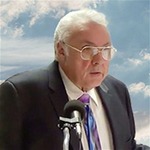
What do you make of those who claim to have briefly died and visited heaven? Are their stories at odds with what the Bible teaches? Today on Turning Point, Doctor David Jeremiah explains what really happens when a believer dies, as he continues his series, Angels: Who They Are and How They Help. Yes, angels do play a role in your heavenly arrival. Here's David to introduce today's message: Angels and Death.
Well, this story is really special to me because it is a reminder of an experience I had as a pastor, with the death of someone who had been very special in our church, and a discovery that I made as I preached that day, and we'll talk about that in just a moment. We are teaching on angels because the Bible has much to say about them, and we've already covered a lot of subjects. And we have a few left to talk about in this month. I hope you have been with us every day, and I hope you have a copy of the book on angels that we have written to help you understand what angels are all about. This book called Angels is.
Available to you this month for a gift of any size to Turning Point, to help us in the cost of making sure that radio stays green and keeps coming your way every day. I've just come back from some speaking engagements where I met a bunch of people who told me they listen to Turning Point every day. One man said, "I've been listening for 35 years, every day." And it reminded me that this is not just a one day and gone program, but this happens every day, the same time on this station where you live, and it's all because you are faithful in your support of this ministry, making it possible for us to be there for you every day. Thank you for your gift, and when you send your gift, be sure to ask for your copy of this book.
Well, let's get into this exciting discovery. It's called Angels in Death, and it begins right now. I grew up in a family of four kids. Before the days of the super highways that went everywhere in the Midwest, we used to take our vacations. And would travel along the highways from one city to the next.
And when you have four kids in one car and two frazzled parents, sooner or later you learn how to take care of yourself and make the time pass. And I developed an incredible affinity for the Burma Shave signs. Do you remember those? I had a notebook and I used to write them all down and take real careful note of the message on each one. In fact.
My oldest daughter Jan, the most creative gift giver in our family, found a book that had all of the Burmesege signs that have ever been created since day one, and she gave me that book for Christmas. It's one of my cherished possessions. But among the Burmesege signs were many that dealt with death in a very strange way. There were epitaphs, like the one that I remember that said, "Here lies the body of Archibald Rummy." He tackled the coach instead of the dummy. Burmese shave.
You remember that? Just sort of a reminder. And I wrote those down. And as I got a little more sophisticated, I began to just keep epitaphs by themselves. It's amazing to me some of the things that have been written on the tombstones of people across this land and around the world.
Some of them are oh, they're profound. One of my favorites. It goes like this: Here lies the body of old man Peas, buried neath the flowers and trees. But Peas ain't here; just the pod. Peas shelled out and went to God.
Isn't that great? That's a great one, isn't it?
Now you see, we're all laughing, and what are we laughing at? We're laughing at epitaphs because some folks have gone out of their way. To make sure that something which is very serious is also capable of bringing laughter and smiles to our face, you know, one of the most controversial books that hit the secular bookstores is the book written by Betty Eady entitled "Embraced by the Light." This book, published by Gold Leaf in 1992, began a rise to the top of the New York Times bestseller list, and believe it or not, it stayed there for over a year and a half. In her book, Betty Eady gives an elaborate account of her near-death experience, which had taken place some 20 years before she actually wrote the book. Among other things, the book tells about her experience of a benevolent being of light, which surrounded her in such a way that she could not tell where her light ended and his began.
Edie wrote in her book, "Embraced by the Light," that Jesus would do nothing to offend her, so she should stop regretting all of her past deeds. That humans are not sinful by nature. That human spirit beings, assisted by the heavenly Father, created the world. That despite appearances, the world is not filled with tragedy. That she knew that she was worthy to be with Jesus.
Now, the interesting thing about that book, men and women, is that the dedication of the book could have been found in any of the evangelical writings which you and I read regularly. Here's the dedication in the book. To the light, my Lord and Savior Jesus Christ, to whom I owe all that I have, He is the staff that I lean on. Without Him, I would fall. But I need to tell you, the book is patently New Age.
It is not scriptural, and yet, because of her references to Jesus Christ in her book, many Christians have been deceived into believing that the book is okay. Christian booksellers have told me that they are constantly bombarded from evangelicals to run the book in their bookstores, so they can be bought in the evangelical bookstores. Right after I finished writing the book, The Invasion of Other Gods, and it was published. I did some radio talk shows from my office here in San Diego, which is quite an interesting thing to do. You're hooked up by telephone, and you can talk to people all over the world who call in, no matter where the program is.
And one day, a woman called in on a talk show from back east, and she confessed to me that she was a pastor's wife of an evangelical pastor. That she had been teaching Betty Edie's book, Embraced by the Light, to a women's Bible study in her church, until one of the women in the church came up and told her that the book was patently New Age and was not supported by the Scripture. And she called to warn everybody who was listening to the program that it was very, very important that they knew what they were reading. It is amazing to me. How this whole culture in which we live has been fascinated by what some have termed NDEs, near-death experiences.
It goes back to the publication of a book by Raymond Moody entitled Life After Life, a book in which he chronicled 50 survivors of clinical death who claim to have experienced another world. It was followed in 1980 by a book by Kenneth Ring, published under the title Life at Death, which was followed by cardiologist Michael Sabin's recollections of death. Melvin Morse, a pediatrician in Seattle, captured national attention with his research into children's experiences with NDE. Morse's book is entitled Closer to the Light. A major entry into this whole discussion is a book called "Saved by the Light" by Danyan Brinkley, published by Random House.
These and other books on death and near-death experiences have stirred up such an interest that a whole new term has been coined to describe their findings. It's called the religion of the resuscitated. It is a whole substrata of discussion among people around this country. Man's fascination with death has filled volumes in both secular and religious books. Whole philosophies and religions have been born out of the ideas man has conjured up concerning the appointment that we all have with the grim reaper.
But I want to tell you that the Bible alone stands as the one source of information. For anyone who really cares about the truth concerning the end of this life, it is a book that is filled with such unique truth that anyone who reads it will be transformed by its teachings. It is so different than what the world has to say about this. Literally, it casts this experience in a positive light, and when you look at all the information together, it has an overwhelming impact upon you. In essence, what it says for all who will listen carefully is that which has caused bondage in the hearts of many, which is the fear of death.
Need never be a matter of fear. It is as simple as going to sleep in one place and waking up someplace else in the presence of God. I went through the Scripture, the New Testament, and I just wrote down the various things that the New Testament says about this experience, which cut against the grain of much that we are reading today in the books that are published in the secular arena. For instance, the Bible tells us. That death for the believer is precious.
Now that's a strange thought, isn't it? Psalm one hundred and sixteen, verse fifteen says, "Precious in the sight of the Lord is the death of His saints." The Bible describes death for the believer as falling asleep. But I do not want you to be ignorant," says First Thessalonians, "concerning those who have fallen asleep, lest you sorrow as others who have no hope." The Bible describes death for the believer as absent from the body and present with the Lord. Second Corinthians five eight. The Bible describes death for the believer as the valley of the shadow.
Please listen to that carefully. It isn't the valley of death. It is the valley of the shadow of death, according to Psalm twenty three. And there is something to fear from reality, but there is nothing to fear from a shadow. And in essence, the psalmist is captured for us the enigmatic nature of death for the believer.
While it appears to be something to be afraid of, it is not. It is just the shadow of death. The Bible tells us that death for the believer is blessed, not only precious but blessed. Revelation fourteen thirteen says. Then I heard a voice from heaven saying to me, "Write, blessed are the dead who die in the Lord from now on." Yes, says the Spirit, that they may rest from their labors and their works follow them.
Here is one that I never thought of in this term before. The Bible says that for the believer, death is actually gain. Paul said this when he was writing to the Philippian church. He said, "For me to live is Christ, but to die is even better. It's gain." He said, "It's a step forward in my relationship with God." The Bible describes death for the believer as without sting.
I love this. It says in one Corinthians fifteen fifty five, "O death, where is thy sting?" O Hades, where is your victory? You know, Jesus Christ has taken the stinger out of death through what He did on the cross at Calvary, and then the Bible describes death for the believer simply as being with Christ. Paul said, "I am hard pressed between the two, having a desire to depart and be with Christ, which is far better." Yes, you see, the New Testament sets this whole subject in a whole different setting—not something to be afraid of, not something to dread, not something to look at with absolute total fear—but in essence, God's wonderful way of allowing us to move from this arena where we live and breathe into the presence of God Almighty, where we will be forever and ever.
Now, having said that, with all this discussion about near-death experiences, it's amazing to me how very little is known about the biblical content that goes around this subject. What is death anyway? I know the discussions about clinical death, but what does the Bible say about it? The word for death in the New Testament is the word thanatos, which has to do with the concept of separation. And from all we can learn in the Scripture.
Death is simply that moment in time when your soul and spirit is separated from your body. Look at James two twenty six for as the body without the spirit is dead. That's what death is. It's the body without the spirit. Or here's a verse.
It's in Ecclesiastes. But Ecclesiastes says a very interesting thing. It says, "Also, they are afraid of height and of terrors in the way. When the almond tree blossoms, the grasshopper is a burden, and desires fails. For man goes to his eternal home, and the mourners go about the streets.
Now, watch this. Then the dust will return to the earth as it was, and the spirit will return to God who gave it. That's what it is. That's the best biblical statement." I can give you concerning the nature of death for a believer. Your body goes in the grave, and your spirit goes to be with God.
And sometimes, when we come to a time of mourning for somebody we love, especially young ones, we have all kinds of questions because we hear people talking about how our loved one went to be with the Lord, but then we go to a service. And we see the casket, and we find out that the casket's going to be laid in the ground, and it doesn't make any sense. I mean, if they want to be with Jesus, but you see, that's the thing we don't often understand about death. Death is the separation of the soul and spirit from the body. The body is what goes in the ground, dust to dust, but the spirit goes to be with God.
Class, who is the real you? Is the real you the tenement house in which you live? No, the real you is the soul and spirit which lives within that house, and it's the real you that goes to be with God. That's the nature of death, according to the New Testament. When a person dies, their body goes in the grave, and their spirit and soul goes to be with God.
Now, in the Old Testament, and I want to be a little bit theological here for a moment. In the Old Testament, there was a place called Paradise, and there's a lot of discussion about this. And so, I'm just going to tell you what I believe, and you can look it up and decide for yourself what you want to think. But Paradise was a place much like heaven.
Now, please note, it wasn't purgatory, but it was a place much like heaven, and it was separated from Tartarus or Sheol, which was a horrible place of suffering. The top half of paradise is referred to as Abraham's bosom, was separated by a great gulf, and then the lower part of that was Sheol or Tartarus. In the Old Testament, when a person died and they believed in God, they went to paradise, Abraham's bosom. If they were not a believer, they went to the same place everybody goes to now, waiting for the time when they will be cast forever into hell. They went to the lowest part of Sheol, sometimes referred to as Hades.
Now, the interesting thing is that in the New Testament, in Ephesians four eight, it says that when Jesus died on the cross, he went and took captivity captive. And many believe that at that moment, what happened was he went to the upper level, to paradise, and all the Old Testament saints who were there waiting the crucifixion, were set free from their captivity and taken to heaven to be with the Lord forever.
So that today, when a believer dies, they don't go to paradise; they go to be with God in heaven. We are living on the other side of the cross, so it is true to say what Paul said. Listen to me: absent from the body, which is what death is, and present with the Lord immediately in heaven. When Jesus ascended on to His home, taking with Him the spirits of just men made perfect, He took paradise out of commission. And made heaven the final place where all believers will ultimately go.
Now, having said all of that, I want you to turn with me to a passage in Luke 16, which will help us understand what this has to do with angels. I want you to look with me at Luke chapter 16, verses 19 and following. We have a story here which Jesus told that will help us understand how this all fits together in our theme on what does the Bible say about angels. Like many other stories in the Bible, this is the record of two people who were in contrast to each other. I'm enamored with that particular thought because, as I study the New Testament, I find it over and over and over again.
One of the greatest teaching tools that Jesus used in his stories, and that is found in New Testament scripture, is taking one person over here and another person over here, and showing how their conduct, their lifestyle, their destiny, their philosophy is different from this person over here. If you keep that in your mind when you read the New Testament, you will find it almost without question every time you open the Bible. For instance, let me give you some illustrations of that. Two men went up to the temple to pray. One was a Pharisee; the other was a publican.
You remember that story? Two men hung on the cross next to Jesus. One man received Jesus Christ, and the other one rejected him. Two brothers grew up in the same family. One took his inheritance and ran away from home.
He later repented and returned. The other kept his inheritance, stayed at home, and we don't know that he ever repented. Isn't that interesting? Two men owed money they could not pay. One man was forgiven a great amount.
Then he turned around and would not forgive one who owed a much lesser amount. Two women lived in the same house. One was devoted to Jesus in her personal life, and the other was busy about many things. In the Gospel of John, we read about the woman who took all that she had and gave it to Jesus. And in the very same context is the story of Judas, who was the treasurer for the disciples.
And I love the language of the New Testament. It says he took the bag and he bore it away, which is a New Testament euphemism. For the fact that he stole the money, in the same context, in all of these stories, there is something to be learned from the contrast and the comparison of the two people. Do you see it?
Now, the story to which we have opened in Luke chapter sixteen. I believe has the greatest diversity between two people that you will find any place in the Bible. Here are two men as different as they can possibly be. Read with me verses nineteen and twenty. There was a certain rich man who was clothed in purple and fine linen and fared sumptuously every day.
But there was a certain beggar named Lazarus, full of sores, who was laid at his gate.
Now the rich man, as some of you know, is sometimes called by the name Diavese. You'll not find that in the Bible, but the word Diavese is the Latin Vulgate for being rich, and so we kind of associated that name with this wealthy man. Lazarus is the only person in any of Jesus' stories who's ever given a name.
Sometimes people say this is not a real story, but I think it's a true story. Lazarus was somebody Jesus knew, and Jesus could see through to the end of all that would happen.
Now the Bible tells us that Divie's the rich man is clothed in purple and fine linen, and it says he fared sumptuously every day. Verse twenty-five tells us that he enjoyed his good things. He lived a lavish life, and he paraded his wealth for everybody to see. He was a flamboyant wealthy person. The poor man called Lazarus was a beggar.
And the Bible says he was laid down daily at the gate of the rich man. The language of the New Testament literally says he was thrown down daily. It gives you the picture of them driving the cart next to the rich man's house and just pushing him off the edge until he rolled over by the gate. He was hoping somehow to get just a few crumbs that had fallen from the table of this very wealthy man. And the Bible tells us that Lazarus was covered with sores.
The Bible says the dogs came and licked his sores. Verse twenty-five tells us that Lazarus received evil things throughout his life.
Now watch carefully, class. Only a gate separated these two men. Lazarus lying outside the gate in misery, and Davy's inside the gate. In luxury, and comfort.
Someone has described the differences between these two men in this paragraph. Listen, Diavies is covered with purple and fine linen. Lazarus is covered only with sores. Diavies fares sumptuously. Lazarus desires to be fed with the crumbs.
Diavies has numerous attendants to wait on his every need. Lazarus has only the dogs to lick his sores.
Now. Before you make any false assumptions about this story, let me tell you, this is not about being rich and poor. The fact is, this is about being with God or outside of God. Here is a story of a poor man who knew God. And a rich man who did not, and I can prove to you that this is not a message about being wealthy.
Because remember, when Lazarus died, where did he go? He went to whose bosom? Abraham's. And who was Abraham? Only the wealthiest person who had lived on the earth up until that time.
This is about whether you know God or whether you don't know God. And Jesus told this story so that we could understand that wealth and away with God do not come together. That poverty and not knowing God are not necessarily synonyms, but it's what our relationship with God is that really counts. No matter what we have in this world, that's a message that's important to hear. Because you know that message has gotten, it's gotten muffled.
It's gotten mixed up in a lot of teaching. I listen to a lot of preaching. And especially when I have been ill, I haven't been able to go to church, so I listen to others. A lot of good preachers out there, a lot of good ministers, but there are some who still. Want to make the Bible acceptable to the culture, and part of that is so discouraging because some of these men I have known, and they didn't used to be that way.
Something happened along the way. I don't understand it. Listen to me, friends. The Bible doesn't change. God doesn't change His mind.
And what we're talking about here, relative to angels, is historic eternal truth. The Bible says it's forever. And what a joy it is to share it with you because it's so helpful to you and to me. Be sure and join us tomorrow as we continue our discussions on angel and death. And be sure and get your copy of the book on angels.
Just send a gift to Turning Point and ask for the book on angels, and it'll be on its way. And we'll see you next time. This is David Jeremiah. For more information on Dr. Jeremiah's series "Angels: Who They Are and How They Help," visit our website, where we also offer two free ways to help you stay connected: our monthly magazine Turning Points and our daily email devotional.
Sign up today at davidjeremiah.org/radio. That's davidjeremiah.org/radio, or call us at eight hundred nine four seven nineteen ninety three. Ask for your copy of David's book, "Angels: Who They Are and How They Help." What the Bible Reveals. It's yours for a gift of any amount. You can also purchase the Jeremiah Study Bible in the New International and New King James versions, available in several handsome and durable cover options.
Get all the details when you visit our website, DavidJeremiah.org/radio. This is David Michael Jeremiah. Join us tomorrow as we continue the series "Angels: Who They Are and How They Help" here on Turning Point.