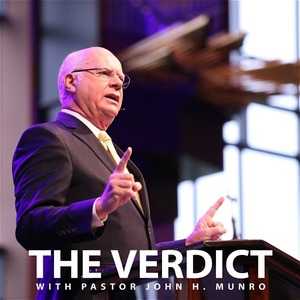
Today on the verdict with Pastor John Monroe.
So what do we have? We have Jesus who died on the cross. We have Jesus. He was buried in the tomb. But third, of course, and central to the Christian faith, absolutely essential, one of the great fundamentals, the essential fundamental of the Christian faith is that Jesus rose from the grave.
Welcome to the verdict, featuring the Bible teaching of Pastor John Monroe. The very heart of the Christian faith is to believe that our Lord Jesus Christ died for our sins on the cross, was buried, and rose from the grave on the third day according to the scriptures. This week, we're pausing our series in Esther to prepare our hearts for Easter. And today we're examining the evidence of the resurrection. Let's join Pastor John Monroe for today's message.
This week we're taking a break from the book of Esther and beginning to think of Easter. when we celebrate the resurrection of our Lord Jesus Christ. The Apostle Paul said, That if Christ has not been raised, then our preaching is in vain. And your faith is in vain.
So, if Jesus did not actually rise from the dead, if Jesus is not alive, the whole of authentic Christianity falls. You can have a religion of doing good, of being kind, of being a good neighbor. But without an empty tomb and a risen Christ, there is no biblical Christianity.
So today we want to look at the evidence for the resurrection of Jesus Christ. Then next time we'll think of its relevance.
Well, two thousand years ago, a man named Jesus. died on a Roman cross. He was buried in the tomb. And on that first Easter Sunday, he literally and bodily rose from the dead. that the cross is empty.
The tomb is empty. the stone is rolled away and that Christ is risen. Christ is risen. He's risen indeed. You know, we were singing that him up from the grave.
He arose. And it reminded me that when I was baptized, it was before my 17th birthday, That was the song, the hymn, and the little church where I was baptized. And I understood in a fresh way then, and increasingly so. the importance of the resurrection of Jesus Christ. that when I was being baptized, it wasn't just going through a formality.
It was as a young man, as a young teenager. That I had confessed my faith in Jesus Christ. And that was being symbolized in my baptism as I was dying with Christ, being buried with Christ, and being raised to Christ to walk in units of life. And this is why the resurrection is so central to the Christian faith. And among world religions, the resurrection of Jesus Christ stands unique.
The tomb of Abraham in Hebron in Israel, which I visited, is occupied. The tomb of Buddha is occupied. The tomb of Muhammad is occupied and is visited by millions every year, but the tomb of Jesus is empty. We believe in an empty tomb and a risen Christ. And Paul said, as he wrote to the Thessalonians in 1 Thessalonians 4, verse 14: We believe.
That Jesus died and rose again. Two essential facts of the Christian faith. That Jesus Christ died on the cross for our sins, that he was buried, and that he rose again from the dead. I believe that, and I trust each one of you believe that, not just as some theory, not just as some theological dogma, but because you, in the very depth of your heart and soul, have had an encounter with the living Christ.
So I want to consider Very simply, this Easter Sunday, two things. I want us to think a little of the evidence of the resurrection because I am by nature a skeptic and I think some of you may be. And particularly if you're not a follower of Jesus Christ, you may say, well, it's all very well to get excited and have this wonderful music and all of this and to whip people up into some kind of emotional frenzy, but I'm not really sure that Jesus is alive.
So, I want to think of that. And then, secondly, I want to think of the relevance that it has for you and for me. First of all, the evidence for the resurrection of Jesus.
Well, first of all. It is historically true. that Jesus died on a cross. There was this man who lived some two thousand years ago. Born in Bethlehem.
Growing up in Israel, And then in his early 30s, being taken and being crucified and died on a cross. He was crucified by Roman soldiers, professional executioners. Who took long nails about five to seven inches, we're told, about three-eighths of an inch square. And they took his hands and his feet and they nailed them to a cross. A nasty way to die, I think we would agree.
And just to make sure that he died, one of the soldiers took his spear and pierced the side. of Jesus. After the death of Jesus, The chief executioner. the Roman centurion and the Romans knew how to kill people. We had done it before.
And the chief executioner, the centurion, he then made his report to Pilate. Pilate was a Roman governor. Pilate was the judge who had delivered Jesus up. To his crucifixion, even although Pilate was very ambivalent about it, but eventually, because of the political pressure and the social pressure on him, he did a very cowardly thing and he delivered up Jesus to be crucified. And after the crucifixion, the Roman centurion then reports to the governor.
To the head, appointed by the Roman Empire, and said to the pilot, Sir, the prisoner has been killed. He certifies that Jesus had actually died. There is no doubt. That Jesus died. On the cross.
You say, well, many people were crucified. That's true. The Romans specialized in crucifixion. And so they crucified thousands of people. But it's certainly true of this man, Jesus, that he actually died on the cross.
Secondly, Jesus was buried in the tomb. The Romans normally were quite happy To leave the corpse on the cross to rot. It was a warning to people to behave. They were the superpower. They were in control.
And any acts of rebellion had to be stamped down. And a dead person on a cross was a way to get people's attention.
So they didn't quickly bring the Deceased from the cross, they just left them there for days, weeks, possibly even months. on these crosses, which were just two rough pieces of wood. put together. But the evidence is clear that in this case, in the death of Jesus, he did not stay on the cross. uh two of his followers.
A man called Joseph from the little town of Arimathea in Israel, and Nicodemus. Nicodemus, one of the religious rulers, And uh who it appears that during the The Lord was on earth, I became a follower, perhaps a secret follower, but they come when they hear that Jesus has died and they ask permission if they can take him down from the cross, and the permission is given. And I'm sure with great love. And with great tenderness they take Jesus from the cross. They take out his Nails.
From his hands and his feet, and take him down. And then the Jewish custom, they wrap him in a cloth, in a linen cloth with spices. And then one of them, Joseph, a man of some means, had a tomb. It was a new tomb. Nobody had ever been in it before, a tomb, a kind of cave.
And so they take the body of Jesus. And they lay it. In the tomb, in a garden, a garden tomb. And then, to ensure that the body is kept safe, a great stone is rolled in the front. of the cave.
So Jesus dies. He's taken down from the cross, put in this tomb.
Now the Jews Remembered that during the life of Jesus there was talk about his resurrection. Not that they really believed it. Um but In order to be sure, they thought, well, during his lifetime, He did say that he was going to rise from the dead. And so perhaps some of his followers will come secretly and steal the body from the tomb and then say he was resurrected.
So let's prevent that.
So there's this big stone in front of the tomb. And then, secondly, and very importantly, they put a guard. Again, these are professional soldiers. These are tough men. They're on security at the garden tomb, standing in front of the tomb, to guard that no one comes to steal the body of Jesus.
So what do we have? We have Jesus who died on the cross. We have Jesus. He was buried in the tomb. But third, of course, and central to the Christian faith, absolutely essential, one of the great fundamentals, the essential fundamental of the Christian faith is that Jesus rose from the grave.
And you say, well, I can believe that he died. I can believe he's putting that term. Bye. you know, dead people. Are not resurrected.
I really struggle to think that this person who had been died for a few days actually rose from the dead.
Well, We have in the Gospels We have wonderful evidence, evidence that we'd hold up in any court of law. In fact, the first witnesses of the empty tomb We're women. Because what happened?
Well A supernatural thing happened. The angels came and rolled away the stone. And these soldiers, who were meant to be standing guard, were, in a sense, put to sleep. They were unable. To oppose the mighty power of God in raising his Son from the dead.
And so the tomb is empty. And that first Easter Sunday, very early in the morning, some women come They deeply love Jesus. You remember the disciples, the men, are devastated. They think this is the end of life. That their leader.
Uh Jesus The Christ is Crucified. And so these dear women come. And to their utter amazement, they realize that the tomb is Empty. Isn't it interesting that the first witnesses To the empty tomb and to the resurrected Jesus were not men, but were women. You say, Well, why is that significant?
It's significant for a number of reasons, but one is this: that in that first century culture, women were not regarded as competent witnesses. If you wanted to build a case, That was A male-dominated culture, could you say? And so women's testimony were disregarded.
So, if the writers of the gospel were trying to fabricate a case, trying to lie, trying to spin, as it were, we would say. Uh they wouldn't have woman as your witnesses, they would have men, they would have reputable men. Why woman? Because that's the fact. Woman actually saw...
The empty tomb and the risen Christ. And they told some of the disciples, and particularly two of them, two of their leaders, Peter. Simon Peter and John. A John who really loved Jesus. Perhaps more than the other disciples.
And these two men come and they hear the report and they run to see if it's true. And to their utter amazement, the tomb is empty. And they testify. Their record is written in scripture. They testify that the tomb is empty and they see the risen Christ because on that first Easter Sunday evening.
The disciples are together. And no doubt Peter and John are saying, we saw Christ. And then, to their utter amazement, And how they must have got down on their knees because right in front of them appear the resurrected Jesus. You see, we believe in the bodily resurrection of Jesus. Not just that his spirit somehow is out there floating around.
No, he literally, bodily rose from the dead and he appeared to the disciples. And knowing their scepticism and their fear, In order to Reinforce the position that it was Christ, the one who had died on a cross, the one who was buried in the tomb. He says to them, He shows them. His hands And decide. There it is, there's the very evidence for the crucifixion.
And they realize That this is Christ, as he says to them, peace be. with you. They saw Jesus from the dead.
Now Christianity would have been stamped out in a moment In what way?
Well, if you could produce the body. If you are saying that this individual, Jesus of Nazareth, This teacher, this miracle worker, whoever he claimed he was, if you're saying that Jesus actually rose from the dead, The quickest way to stamp out such nonsense If you were one of the Jewish leaders or one of the Roman leaders, it would have been to produce the body of Jesus. But isn't it wonderful to think that for over two thousand years With all of the scepticism. With all of the examination, with all of the archaeology, with all that's going on, no one has ever produced the body of Jesus, and no one ever will. Why?
Because he rose from the dead. And we read What Paul is saying, writing some years after the resurrection, saying that hundreds of people saw the risen Christ. The disciples did. Paul said, I'm the last one. I saw the risen Christ.
Imagine the case. where you're trying to establish the resurrection. And you have one witness after another witness after another witness saying, we saw him. We were there in the upper room when he appeared to us. Here are 500 others say, Yes, we were on this occasion, and the risen Christ appeared.
To us. Strong evidence, isn't it? And also, think of this. When Jesus was crucified, The disciples were devastated. They were afraid.
They thought they possibly themselves would be killed. Their hopes are dashed. They had Misunderstood an important aspect of the teaching of Jesus because they thought that he was going to set up his kingdom there and then, overthrow the Romans. He would be a literal king in Israel and they would be right there with him. And when Jesus is killed, Their hopes are dashed.
And they're afraid.
Now what transformed them? Because only a few days later, after the crucifixion of Jesus, they are in downtown Jerusalem, in the very center of Jerusalem, opposing the very people who killed him and saying, You put Jesus on the cross. What gave them such boldness? What gave them such power?
So that the world was turned upside down and this. little faith, as it were, in this tiny little Country of Israel was going to, this message was going to penetrate the known world just in a matter of a few years. What caused that? What changed them? The change was this.
They had seen the resurrected Christ. Wouldn't that absolutely change your whole view of life? That you saw a person who's nailed to a cross, and now he is alive. They're going to be persecuted. They're going to be thrown out of their homes.
They're going to lose their jobs, they're like Christians. They're going to be stoned, persecuted.
Some of their number even killed. That didn't stamp out the Christian faith. Pastor Nevy in his prayer referred to the blood of the martyrs being the seed of the church. And this has happened in the first century. that the more the church was persecuted, The more people ridiculed them, the greater and the more effective the message of the gospel was.
They were transformed. What are we saying about the evidence? Jesus died. On a cross. Secondly, he was buried in a tomb.
Third, He rose from the dead. The evidence is clear. You may reject it, but the evidence is clear. That Jesus is alive.
Now you say, well. John, that was 2,000 years ago. Yes, but think of the relevance. of this. The relevance of the resurrection of Jesus is crucially important.
for your past. You say you won't wait.
Well, in the chapter we read from 1 Corinthians 15. the great chapter on the resurrection, which I commend you to read. Paul argues very logically and very powerfully. that if Jesus Christ did not rise from the dead, the whole of Christianity crumbles. And in particular, There is no forgiveness of our sins.
He says if Christ 1 Corinthians 15, verse 17. If Christ has not been raised, your faith is futile. and you are still in your sense. You say Woo, woo, woo, how is that? Where's the logic in that?
That I'm still in my sins if Jesus isn't raised from the dead.
Well, think of this. Why did Jesus die? The Christian faith is not just that Jesus died. Not just that he died on a cross. Many people have died on a cross.
Not just that he was a martyr. Many people have been martyred. What's the basic truth? Did you notice it as we read? 1 Corinthians 15, as Paul says, this is of first importance.
These are the critical truths, the fundamental truths of the Christian faith. that Christ died What? For our Sense. Ah, that's it. That's it.
That he died for our sins. Christ who is sinless. Takes the sin of the world. The Lamb of God who takes away the sin. of the world.
And because Jesus Christ not only died for our sins, But was raised from the dead, this means there is for you and for me the possibility of our sins being forgiven. They say, well, I'm not sure if I've sinned. I don't know if I like that word. It sounds rather negative. It sounds rather old-fashioned.
Well What is it? Sin is failure. It's more than a regret. It's more than a mistake. Sin.
is acknowledging That before God, we have come short, we have messed up. And because of that, Because I've messed up in God's eyes, possibly in yours as well, but certainly in God's eyes, I need to be forgiven. Will you acknowledge that today? You may be a very kind person. You may be even the most generous, kind person on all of the 10 million people who live here.
You may be one of the best. But I can say And I don't think you can really contradict me. is that you're not perfect. You've messed up. Even the best of people, the nicest of people, sometimes do and say nasty things.
that we're all characterized by failure. And you know in your life That there are things that you have said. And things that you've done, and things that you've thought, and attitudes that you've had, that as you look back, you say, I can't believe I did that. I can't believe I said that. I can't believe I had that evil thought in my mind.
That's a dilemma. that all of us are in. The Bible says that all of us have sinned and come short of the glory of God. Life is full of regrets, life is full of failures. This is the universal human condition.
We look at politicians and with their cover-up and their spin and all of the rest of it, and we say, oh, you know. How terrible. We're exactly the same. And into a world of sin and of darkness. God, in His great love, sends His Son, our Savior, to come and to die on the cross for our sins.
This is the verdict, featuring the Bible teaching of Pastor John Monroe. There's still more to hear when John returns in just a moment, so stay with us. From matters of truth and identity, to the subjects of love and grace, our world seems more confused than ever. but to find truth and certainty about who we are and find peace, we must turn our attention away from the world and look to the Word of God. To help you do that, John wrote a booklet titled Eternal Security, Finding Certainty in a Chaotic World.
Through this special resource, John shares his personal testimony, along with a careful examination of Scripture, to offer us clarity on matters of eternity. Get your copy today by visiting our website at theverdict.org. While you're there, consider making an investment in this Bible teaching ministry. Whether it's $5, $50, or more, your gift today helps cover the cost of sharing these gospel messages to listeners around the world. And if you haven't already, be sure to subscribe to the Verdict Podcast, featuring John's weekly podcast exclusive called Avizandam.
It's available wherever you get your podcasts, or simply go to our website. Again, that's theverdict.org. The verdict is a ministry of Calvary Church in South Charlotte. We're located on the corner of Highway 51 and Ray Road. If you've been looking for a church home or a community to help you grow in your walk with Christ, We invite you to join us for our Sunday services.
For more details about Calvary and our service times, visit theverdict.org.
Now, here's Pastor John Monroe.
Well, what's your verdict? Do you believe that Jesus died on the cross for your sins? Do you believe that he was buried? Do you believe that he was bodily raised from the dead on the third day? Of course, it's not just enough to believe in these essential facts.
Authentic Christianity is believing in the person of the Lord Jesus and experiencing a personal relationship with Him.
So today, Believe in the Lord Jesus Christ and you'll be saved.
Next time, we're thinking of the resurrection's implications for us today. Thanks for joining us today on The Verdict. I'm Michelle Davies. Today's program with Pastor John Monroe was produced and sponsored by Calvary Church in Charlotte, North Carolina.