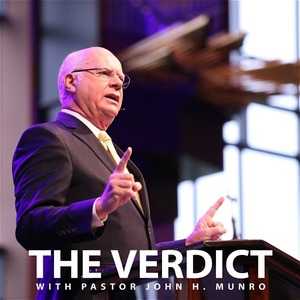
Today, on the verdict with Pastor John Monroe. Let me ask you, is there anyone here? Running. From God. Perhaps you're running from your own home, your own family, you're turning your back on God.
Anyone here ever done that? And you know that what you are going to do or what you're not going to do is contrary to the word of God, but you feel like Jonah, you're going to run. from God. Welcome to The Verdict, the daily radio program featuring the Bible teaching of Pastor John Monroe. Most of us know the story of Jonah being swallowed by a big fish.
But there's much more to learn. Today, we're beginning a new study on the book of Jonah, and we're going to find that there's much we have in common with this runaway prophet.
Now, to kick off our brand new series, here's Pastor John Monroe with a message titled, Running from God. Today, I'm excited as we begin a short series on one of the Old Testament books of the Bible. the fascinating book of Jonah. I first learned about Jonah and the big fish.
Nowhere does the Bible say it was a whale. from my parents when they taught me the stories of the Bible. As a wee boy, I was fascinated and intrigued by a man being swallowed by a huge sea creature and living to tell the story. But the book of Jonah is not just the story of a man being swallowed by a sea monster. We will learn that this book presents important truths about God.
about ourselves. About our enemies. Are you ready to start this intriguing journey? Let's begin our study of Jonah. A fisherman was surrounded by a large group.
and uh was bragging about the five large, beautiful salmon that he had poached from a private river. What he didn't know was that a conservation officer, a game warden, was hearing this conversation, and so the game warden came up. To the fisherman and said, You obviously don't know who I am. The man said, No, I don't. He said, I am the conservation officer, and what you have done.
is illegal and I'm going to report you. to the authorities. We simply can't have people going to private rivers and poaching Five Large salmon. The man looked at the game warden, the conservation officer, and said to him, You obviously don't know who I am. I'm the biggest liar in this state.
We've all heard fishing stories that are difficult to believe. But the story of Jonah is not about a man catching a fish, but about a fish, a very large fish, catching Amen. And we will learn in this little study that our focus should not be on the size of the fish, but on the size of our great God who made the fish. Today Uh we commence a study of this little book, this Old Testament book. of Jonah.
I suppose that no book in the Bible has been so ridiculed as the book of Jonah. And as I say that, I think there are four, at least four major views. of the book of Jonah. First of all, some regard it as a legend, a myth. It's a whale of a tale.
Not at all true. Interesting story, but in the realms of Goldilocks and the three bo bears, Humpty Dumpty, Little Bo Peep, that kind of thing.
Something you tell your children. Others regard it as a spiritual allegory. That is, Jonah represents Israel on a mission. The great fish represents the Babylonian captivity which swallows Israel. Third, some regard it as a parable, a legend with a message, a story that didn't really happen, but a story which communicates in a rather novel, interesting way.
a spiritual message. The fourth view I would say the cracked view is to regard this as A historical record of what actually happened. Jonah. was a historical figure who actually lived in history. Nineveh was a historical city.
And the book of Jonah Is not a whale of a tail, but it's the tail of a whale. And it's true. I ask you to open your Bibles, first of all, not to the book of Jonah, but to the first book of the New Testament, the book of Matthew, the Gospel according to Matthew. And I want to read a few verses By our Lord. Here in Matthew Chapter twelve and verse thirty eight.
Some of the scribes and Pharisees answered him, saying, Teacher, We want to see a sign from you. And he answered and said to them, An evil and adulterous generation craves for a sign. and yet no sign shall be given to it But the sign of Jonah the prophet. For just as Jonah was three days and three nights in the belly of the sea monster, so shall the Son of Man be three days and three nights in the heart of the earth. The men of Nineveh will stand up with the generation with this generation at the judgment and shall condemn it Because they repented at the preaching of Jonah.
And behold.
Something. or someone Something, someone greater than Jonah. is here referring Two himself.
So, the reference by Jesus to Jonah indicates that Jesus accepted the story of Jonah as historically true and used it to illustrate his own ministry, particularly his death, his burial, and his resurrection. And so, Jonah. is part of inspired scripture. It is a book of immense profit, having many valuable and important and relevant lessons. For us.
Let me ask you, is there anyone here? running From God. Anyone here turning their back ungodly influences. Anyone here trying to close your ears to the word of God and to the will of God. And as people speak to you and as they confront you with spiritual truth, perhaps a parent or a spouse or a school teacher or a pastor or a preacher, you really don't want to hear it because you are on the run.
Perhaps you're running from your own home, your own family, you're turning your back on God. Anyone here ever done that? Anyone here doing that? Anyone here considering doing it? You are faced with a choice.
And you know that what you are going to do or what you're not going to do is contrary to the word of God, but you feel like Jonah, you're going to run. From God. Before we read the opening three verses of the book of Jonah, I ask you to open your Bible to the very beginning, in fact, before the book of Genesis, to the table of contents, as it were. Can you do that with me? This will make it much easier for some of you to find the book of Jonah.
To look at the names and order of the books. of the Bible. Jonah is one of the minor prophets. There are twelve minor prophets in the Old Testament, minor, not because they're unimportant, but because they're books. Are smaller than the major prophets.
There are four major prophets in the Old Testament and twelve minor.
Now, if you've got. the table of contents there in front of you. You will see that there is the Old Testament and the New Testament. I realize I've met some of you that are very new to the Bible and you don't really know much about the Bible. The Bible has two basic books: the Old Testament and the New Testament.
The Old Testament written before Christ, the New Testament written after Christ. If you look at the order of books in the Old Testament, you'll see that the last one is Malachi. I'm going to read backwards. Malachi, Zechariah, Haggai, Zephaniah, Habakkuk, Nahum, Micah, Jonah, that's the one we're considering. Obadiah, Amos, Joel and Hosea.
Hosea through Malachi are what we call the minor prophets. Then going back. After Hosea, there is Daniel, Ezekiel, Jeremiah, and Isaiah. Isaiah, Jeremiah, Ezekiel and Daniel are the four major prophets. They are much larger.
Their books are much longer. And then we have the minor prophets. Prophets. I would encourage you to read them. If you're going to get to heaven, it's kind of embarrassing if you were to meet Habakkuk or Nahum and they ask you what they thought of.
You thought of their book and you said you never even read it. Generally These minor prophets are in the unused part of our Bible. The pages may be sticking together. But look at Jonah. In my one, it's page 1376.
Now, I already know where Jonah is. It's very embarrassing if the preacher can't find his own text, so I've made sure I can find it. But Let me ask you to turn now to the book of Jonah. One of the twelve minor prophets, and we're going to read the first. three verses of Jonah.
Chapter One. The word of the Lord came to Jonah. The son of Amittai saying, Arise. Go to Nineveh, the great city, and cry against it. for their wickedness has come up before me.
But Jonah rose up to flee to Tarshis from the presence of the LORD.
So he went down to Joppa, found a ship which was going to Tarshis, paid the fare, and went down into it to go with them to Tarshis from the presence. of the Lord. Jonah Is a prophet living in Israel in the northern kingdom in the 8th century BC. As I say, one of the twelve minor prophets. He's a contemporary of Amos the prophet and a prophet in the northern kingdom, the kingdom.
of Israel. No. Keep the reference to Jonah, put a finger there, but go back in the Old Testament to 2 Kings. We're going to read a verse from 2 Kings. an interesting verse about Jonah.
We read one in the New Testament about Jonah. We're going to read another one in the Old Testament. 2 Kings. Chapter Fourteen. I encourage you to come with your Bible.
Open your Bible, you say, why don't you do what these other cool preachers do and put the texts on the screens? That's fine, but I want you to get to know your Bible. And the best way to do that is having your Bible, opening it. getting familiar with it. and learning from it and seeing it yourself.
Second, kings Chapter fourteen verse Twenty five. King Jeroboam is the king of Israel in the northern kingdom. We read In verse 25 of 2 Kings 14, he restored the border of Israel from the entrance of Hamas. As far as the Sea of Araba. Hamath is northern, probably in present-day Lebanon, or possibly up there in Syria to the north.
As far as the Sea of Arabah, that's another name for the Dead Sea. Notice this: according to the word of the Lord, the God of Israel, which he spoke. Through his servant Jonah, the son of Amittai, the prophet who was of Gath Hefer. That is Just north of present-day Nazareth. Again, To the north.
So here is Jonah, a prophet, during the reign of King Jeroboam in the northern kingdom, and he makes this prophecy. The word of God comes to Jonah and he makes this prophecy, which meant that the borders of Israel, evidently then under dispute as they are today, They were restored in the north and right down to the Dead Sea. Where again, there must have been some clarification needed. He is speaking. The voice of God.
He is a prophet in Israel. When God wants to communicate His truth, it comes not to the king. Not even to the priest, but it comes to the prophet. He hears the word of God, and then he communicates the word of God in this particular case in 2 Corinthians 4 and 2 Kings 14 regarding the borders of Israel. He is the conscience of the nation.
He speaks the voice of God. Amos says in his prophecy in Amos 3, verse 7: Surely the Lord does nothing. Unless he reveals his secret counsel to his servants, the prophets.
So, in Old Testament Israel, God raises up prophets who not only prophesy, telling what's coming in the future. God tells them about the state The spiritual state and the state of the nation in the present tense, and asks them to communicate it to the people.
So the prophet is the word. Of God.
Now, here, back to Jonah chapter 1, verse 1. We're not surprised then that Jonah, who is the prophet, receives the word of God. The word of the Lord comes to Jonah, the son of Amittai, saying, Arise. Go to Nineveh, the great city, and cry against it. For their wickedness has come up.
Before Me. God is giving Jonah a clear command to preach against Nineveh. The command is clear, it's unambiguous, it's easily understood. In the past, Jonah must have Experienced a great blessing as he had given the word of God regarding the restoration of the boundaries, but this command is very different. And Jonah While he understands it, He doesn't at all.
like it. He does not want to go. to Nineveh, their enemy. Nineveh, the capital of Assyria, their enemy. He doesn't want to go there and preach against the wickedness of that mighty empire.
Who would want? to do that. Nedava The capital of Assyria. located on the banks of the Tigris River. It's part of modern Iraq, so much in the news.
about two hundred and twenty five miles from Baghdad. Nineveh. The capital was the symbol of the Assyrian Empire. It was Israel's enemy. It was a very wicked city.
God says this. Their wickedness has come up. Before me, a wicked city infamous for its immorality, for its torture, for its child sacrifices. for its cruelty. against prisoners of war.
Sound familiar? The Assyrians pulled out the tongues of some prisoners, we read. Cut off the heads of others. Fasten the arms and feet of others to stakes. stretched them out and literally skinned them alive.
Not a very nice people. King Asher Nasser Paul II said, and we have this recorded in history: he said, I flayed, that is, I skinned, all the chief men who had revolted. And I covered the pillar with their skins.
Some I walled up within the pillar, some I impaled upon pillar on stakes, others I bound to stakes around about. The pillar. This was a wicked People. Cruel. But notice.
That God Takes notice. of such wickedness. and such violence in this world. Jonah, I want you to go to Nineveh. and preach against it.
for their wickedness has come up before me. I know about their wickedness. God Takes No this. Of wickedness. God takes notice of violence.
God takes notice of all sin. Isn't it strange that in our society more and more Those who speak against evil, those who speak against wickedness, those who speak against violence are regarded as intolerant and judgmental, so that many preachers are strangely silent. I heard one. the mother of one of America's most famous preachers, one of the bestsellers. Saying openly When she was asked about the philosophy of her son's ministry, she said, In this church, which is attended by thousands, we don't talk about sin.
That really turns off people, doesn't it? That's got a negative impact on offerings, doesn't it? I mean, people don't like being talked about. Sin. We want to be told we're wonderful people.
and we're happy all the time. And it's who loves Jesus. It's just a wonderful thing, being a Christian, isn't it? It's all smiles. Who wants to be confronted with sin?
Carl Henry. In his book, The Christian Mindset in a Secular Society says, Who any longer dares to suggest that the big apple may be rotten to the core. The monstrous demons may inhabit the city of angels. That the windy city may as justly be targeted by the last whirlwind as was ancient Rome. Almost no one speaks of these metropolises as Jesus spoke of Tyre and Sidon.
Almost no one weeps over them as Jesus wept over Jerusalem. Almost no one seems aware that they may be hurried stops on God's judgment trail. Who today trumpets the theme that God is sovereign in the city? that the great universities and fearless media are answerable to him. Who declares that the judge of all the earth requires just judges, impartial law enforcement officers, fair news reporters and editors?
Who speaks? For God. Consider the violence in our own cities. violence against the unborn. Think of the rampant immorality, think of the perversity and the wickedness in our major cities.
And people often say, well, why doesn't God do something about it? God does do something about it. One of the things that God does. is to call his servants, like Jonah, to preach Against it. Such preaching will never be popular, but God calls.
His preachers to preach against it. Yet, the insidious culture of tolerance which permeates our society and which is impacting our churches, yes, our evangelical churches, where any mention of sin is regarded as being judgmental. Who are you to tell me what is wrong?
Someone says. Who are you? To say I can't do this. George will. The news Newsweek commentator and columnist has said that there is no bizarre perversity going on in America about which some PhD professor from some university can't be produced in some talk show to say not only is the behaviour acceptable, the behaviour is good.
Isn't that true? But God Calls Jonah to go. and preach. against the Ninevites' sin. You see, pagan, idolatrous, wicked, violent Nineveh was not at all interested in God.
They didn't believe in a God. They had their false gods, they were pagans. Ah, but God. was very interested. in Nineveh.
And God is very interested in Beirut. and Jerusalem. and New York. in Chicago and Los Angeles. in Charlotte.
You see lost people do matter. Yeah. And God In his amazing love, had compassion. toward wicked Nineveh.
Sound unbelievable, but it's true. You see, God's hatred of sin. And his holiness, and his uncompromising holiness, that God is light, and in him there is no darkness of. At all. God's hatred of sin and God's love of the sinner are not incompatible.
In fact, the book of Jonah. is the Old Testament version of John 3:16. Because the book of Jonah, as we're going to learn, is telling us. that gods so loved the world. That God So loved Nineveh.
Then he puts his hand on one of his prophets. Up there in his in the northern kingdom of Israel, and says Jonah. You're the very fellow I want to go. And I want you to go to Nineveh. Yes, that great city.
And I want you to preach against it because their wickedness has come up before me. You see, God's interest in us and God's love for us is universal. That God is very interested in Nineveh, and God is very interested in you. And God is very interested. In me.
and loves us. And so we see in verses one and two that God's will is, first of all, revealed to Jonah, but secondly, God's will is disobeyed. by Jonah. His will is revealed, verses one and two. His will is disobeyed by Jonah in verse three.
Jonah becomes A prophet. on the run. Too convicting to stay in Israel.
So Jonah gets up. He's told to arise and go to Nineveh, he gets off all right. But he gets up. To fleet. Verse two, arise.
Go to Nineveh. Verse Three, but Jonah. Rose, same word. He rose up. to flee.
to Tartars from the presence of the Lord. This is the verdict, featuring the Bible teaching of Pastor John Monroe. There's still more to hear when John returns in just a moment, so stay with us. From matters of truth and identity, to the subjects of love and grace, our world seems more confused than ever. but to find truth and certainty about who we are and find peace, we must turn our attention away from the world and look to the Word of God.
To help you do that, John wrote a booklet titled Eternal Security, Finding Certainty in a Chaotic World. Through this special resource, John shares his personal testimony, along with a careful examination of Scripture, to offer us clarity on matters of eternity. Get your copy today by visiting our website at theverdict.org. While you're there, consider making an investment in this Bible teaching ministry. Whether it's $5, $50, or more, your gift today helps cover the cost of sharing these gospel messages to listeners around the world.
And if you haven't already, be sure to subscribe to the Verdict Podcast, featuring John's weekly podcast exclusive called Avizandam. It's available wherever you get your podcasts, or simply go to our website. Again, that's theverdict.org. The verdict is a ministry of Calvary Church in South Charlotte. We're located on the corner of Highway 51 and Ray Road.
If you've been looking for a church home or a community to help you grow in your walk with Christ, We invite you to join us for our Sunday services. For more details about Calvary and our service times, visit theverdict.org.
Now, here's Pastor John Monroe.
Well, what's your verdict? Isn't this a fascinating story? Does it surprise you that Jonah, one of the prophets of the Lord, is disobedient and runs away from God? Or at least he tries to? Perhaps you are running away from God.
Perhaps you're pursuing some relationship, some situation which you know is wrong. The Lord wants you. To stop. The Lord wants you to serve Him, perhaps, in a particular way, and you simply don't want it. Stop running.
Next time we'll continue and learn four important lessons on doing the will of God. Thanks for joining us today on The Verdict. I'm Michelle Davies. Today's program with Pastor John Monroe was produced and sponsored by Calvary Church in Charlotte, North Carolina.