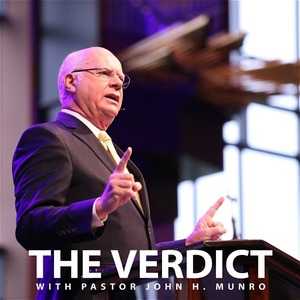
Today on the verdict with Pastor John Monroe. We continue our study. through the Gospel of Matthew and today come to Matthew chapter 12. And we're going to see in the first eight verses that Jesus has authority over the Sabbath. that he is Lord of The saber.
Welcome to the Verdict, featuring the Bible teaching of Pastor John Monroe. The fourth commandment tells us to remember the Sabbath day and keep it holy. But what does that mean for us today? Today, on the verdict, we're continuing our study in the book of Matthew and learning an important lesson about the mission and authority of Jesus. To get us started, here's Pastor John Monroe with his new message, Lord of the Sabbath.
Today, we're thinking of an interesting and controversial question, which is this. How should followers of Jesus Christ regard the Sabbath? One of the Ten Commandments is: remember the Sabbath day to keep it holy.
So, Here we have a clear command from God to the people of Israel. But the question is, does this apply to followers of Christ? And if it does apply, How does it apply? Today we're looking at the first 14 verses of Matthew chapter 12. Where Jesus is in conflict with the Pharisees over this question of keeping the Sabbath.
So, Let's look at the background to the story. Let's see how the Lord responds to the Pharisees and how we should respond. as followers of Jesus. Matthew twelve, first of all, the first two verses. At that time, Jesus went through the grain fields on the Sabbath.
His disciples were hungry, and they began to pluck heads of grain. and to eat. But when the Pharisees saw it, they said to him, Luke, Your disciples are doing what is not lawful to do. On the Sabbath. The Pharisees are criticizing the disciples of Jesus for picking grain on.
The Sabbath.
Now, you may think this is very, very trivial. But I want you to understand that work of any kind was not permitted on the Sabbath. Will you turn with me if you have your Bible there to the second book? In the Old Testament, the book of Exodus, and I want to read to you some of the teaching. Of the Lord under the Mosaic law on the Sabbath.
Exodus chapter 18. Thirty-one. Exodus chapter thirty-one.
Now, here is some of the provisions. Under the Mosaic law relating to the Sabbath. Exodus thirty-one Verse twelve. And the Lord said to Moses, So this teaching is coming from the Lord. It's not just Moses' idea, it's coming from the Lord.
And the Lord said to Moses, You are to speak to the people of Israel and say, Above all, you shall keep my Sabbaths. For this is a sign between me and you throughout your generations, that you may know that I the Lord sanctify you. You shall keep the Sabbath. Because it is holy for you. Everyone who profanes it shall be put to death.
Whoever does any work on it, that soul shall be cut off from among his people. You can see how serious this is. Verse fifteen. Six days shall work be done. But the seventh day is a Sabbath of solemn rest.
Holy to the Lord. Whoever does any work on the Sabbath shall be put to death. Therefore, The people of Israel shall keep the Sabbath. Observing the Sabbath throughout their generations as a covenant forever. It is a sign forever between me and the people of Israel.
that in six days the Lord made heaven and earth And on the seventh day he rested and was refreshed. And he gave to Moses When he had finished speaking with him on Mount Sinai, The two tablets of the testimony. Tablets of stone written With the finger of God. Isn't that amazing? The Ten Commandments are given to Moses on Mount Sinai, and the Ten Commandments are written with the finger of the Lord.
Yeah.
Now did you notice as I read that the Sabbath was a sign? Verse 17, it is a sign forever between me and the people of Israel. This is a sign of the Mosaic covenant. With a covenant comes a sign. What's the sign of the covenant with Noah?
The rainbow. We look at the rainbow, it's a sign of that covenant. The sign of the Abrahamic covenant. was Circumcision. The sign of the Mosaic covenant is the Sabbath.
And as we read then, work was not permitted on the Sabbath.
Now what was the Sabbath? The Sabbath was From sunset on Friday to the sunset on Saturday. That was the Sabbath when I was a teenager. My family and I, we lived in Gibraltar, right on the southern tip of Spain, for three years. And uh with a number of Jewish boys in the school we attended, boys only school.
And my brothers and I on Saturday evenings, went to a certain place, really in the center of Gibraltar, it's a very small place, and we would watch some of our friends and some of the the Jewish community, and they were standing And we used to smile, because they were looking west. They were looking for the sun to set. That was like us as boys. We sometimes wondered, okay, when is Sunday over? These boys were wondering, when is the Sabbath over?
So we can get on with life. But the point is, it was from sunset. to sunset.
Now, the Pharisees, these are the religious rulers, these are the experts in the law. Uh they are the ones who go around with the ropes. uh rather hypocritical people, but they know the law. They have studied the law in a meticulous way, memorized large parts of it, certainly the Ten Commandments, certainly their regulations that we just read from Exodus chapter 31, they know. And they love the Sabbath because it is the pinnacle of their self-righteous legalism.
We've seen before that the Pharisees, among other things, were legalists. They love the meticulous interpretation of things.
Now here are Jesus and his disciples. and they're walking through the grain fields.
Now there's no Starbucks. There's no McDonald's. There's no baj angles. In ancient Israel, and as they're walking through the fields, what are they doing? Doesn't say Jesus did this, but the disciples, they did what you have done.
They take some of the grain. They're hungry. And they eat. The Grand and the Pharisees. Can you just see them?
are looking and say, ah ha ha ha. We've got him this time. This is a breach. of the Sabbath. There is, as it were, a fine legal point.
Does plucking the grain constitute work. Under the Mosaic law. Is this a breach of the Sabbath regulations? Not surprisingly, the Pharisees responded in the. Positive.
These are merciless legalists, and they're very happy to find fault with the disciples of Jesus. There they are, they're violating. the Sabbath regulations.
Now, under the law, It was permitted. to take some of the grant. Good dealing. With a largely agricultural economy.
So you go for a walk, you're hungry. You're with her family, and the law said in Deuteronomy: it's quite permissible to take. The grain. And eat it.
So that was not the point of the Pharisees. The point of the Pharisees was: aha, you've done it on the Sabbath, and we've caught you. Do you get the point? Jesus is going to respond. He's going to Respond to the criticism of the Pharisees by asking questions.
And then he's going to state a conclusion. First of all, he says, In actual fact, Mr. Pharisee, there is Old Testament. precedent for breaking the law in similar circumstances. Verses three and four.
Are you following me? Matthew 12, verse 3. He said to them, Have you not read? That must have been like a sword through them because they did read. They knew their Bibles, as it were.
But he's saying to them, You don't know your Bibles as well as you think you do. Have you not read? What David, as King David, did when he was hungry, and those who were with him. How he entered the house of God. and ate the bread of the presents.
Which it was not lawful for him to eat, nor for those who were with him, but only For the priests. Don't you remember he's saying to them? Uh King David. Israel's greatest king. violated the Sabbath.
Violated the law by eating the bread of the presents, the bread that was in the tabernacle. Jesus saying, remember that? There was a precedent. Uh for people eating. in violation.
of the Sabbath. And furthermore, there is no record in scripture of David being condemned for that action. Have you not read that?
Now if David Israel's greatest king. Had authority over the ceremonial law so that the physical needs of his men and himself could be met. How much more can the disciples of King Jesus, David's greater son? Ignore the Pharisees' legalistic interpretation of the law. There you are.
Think of David. That's his first answer in verses 3 and 4. Here's the second answer, verses 5 and 6. Or have you not read, again, you don't know your Bibles, you should know this. Have you not read in the law How on the Sabbath The priests in the temple profane the Sabbath and they're guiltless.
I tell you.
Something greater than the temple is here. Old Testament precedent for breaking the law, yes, but secondly, Jesus is saying. Don't you know that in the temple, the priests, they work on the Sabbath? What are they doing on the Sabbath? They're working, they're killing animals, they're presenting sacrifices, they're praying on the Sabbath, and all of that is instructed under the Mosaic law in Numbers chapter 28.
What they're doing is permissible.
So you're getting excited about my men taking a little piece of grain as they walk. But think of the priests. in the temple what they do and they are guiltless. And furthermore, I tell you, verse 6.
Something greater than the temple is here. What is greater than the temple? the kingdom of God, Jesus himself. He's there. Yes.
The priests Could break. The normal Sabbath regulations because they were permitted to do so in their worship, and therefore, surely, someone who is greater than the temple. can interpret the law. What was the Sabbath? Jesus is reminding the Sabbath.
was designed by God For man's rest. for His joy, for His renewal, for His blessing and His worship. What were the Pharisees doing? They were turning a Blessing into a burden. They were turning something which was a delight given by God into something which is oppressive.
Mercy and compassion. Are gone. In their place are guilt. and condemnation. If you were here last week, we heard the words of Jesus.
At the end of Matthew 11. For my yoke is easy and my burden is light. The burden of Jesus is not oppressive. His commandments are not grievous. Ah, but the burden, the yoke of the Pharisees was heavy.
It was joyless. It was oppressive. These were legalists, these were hypocrites, they were Making life difficult. for the oppressed, such as the widows and the orphans. When we were in Israel, We've stayed in this hotel several times, beautiful hotel in Jerusalem.
And We were there on the Sabbath, on Shabbat. as it's called. And in the elevators, There was a number of elevators in the hotel. And on the Sabbath A notice was put up. Which read Shabbat elevators.
For your convenience, Elevator number six. is a Shabbat elevator stopping on each floor. Yeah.
Why would you have on the Sabbath One elevator. which is designed to stop on every floor. Because the Orthodox Jew interprets pressing the button as work. You say that's ridiculous. That's what they believe.
That's a meticulous interpretation, we would say a wrong interpretation of the law. But Jesus says, Mark records The Sabbath was made for the good of man. not man for the Sabbath.
Something which was given by God to his people for their blessing. has become something oppressive. And notice what Jesus says in his brilliant conclusion in verses 7 and 8. And if you had known what this means, he's going to quote from the Old Testament scriptures, Hosea 6. If you had known what this means, I desire mercy.
Uh that's it. God wants mercy and not sacrifice, you would have not condemned the guiltless. For the Son of Man His Lord. of the Sabbath. No wonder they said, never man spoke like this man.
Here is the master. Teacher. What is he saying to the Pharisees? That Jesus is Lord over the Sabbath, therefore, he can override the Sabbath regulations. He is the Christ.
He is the Son of God. He is the Son of David. Jesus is not only greater than the temple, He's Lord. Lord of the Sabbath. That is, he has sovereign.
He has sovereign authority to override and to determine the laws of the Sabbath. After all, He wrote the Sabbath. These gods. And if David, if King David could override the Sabbath regulations, surely David's greater son, our Lord Jesus Christ, the Messiah, certainly can. And the spirit of the law is what?
Is it for oppression? Is it to point a finger at someone? Is it to be the legalist? Is it to embrace a lifeless ritualism?
Some kind of mechanical religion? Absolutely not. No, the spirit of the law. Is worship. It's worship of God.
The spirit of the law is to be merciful, is to be compassionate. And the spirit of the law is much more important than the letter of the law. The Pharisees are concerned with the meticulous letter and the dissection of it and they took the law and they expanded the law.
So it became an absolute burden on people. Paul's going to say for the letter kills. But the Spirit, that's the Holy Spirit. gives life. And if Jesus is the Son of Man, notice in verse 6, Jesus describes himself as the Son of Man.
Really, his favorite self-designation: the Son of Man, God's perfect man. He's God, but he comes. into time and space. As God's perfect man, as the Son of Man, in fulfillment of Daniel's prophecy, he's the perfect man, and as the perfect man, he is Lord of the Sabbath. He's greater than King David, greater than the temple.
It's not for the Pharisees to say how the Sabbath should be interpreted. We learned as we went through the Sermon on the Mount that Jesus is the fulfillment of the law. In the person of our Lord Jesus Christ, He is a total fulfillment of the law, and He's also the interpreter of the law. And mercy. and compassion are much more important.
Than the meticulous observance of ceremonial law. Notice again. Verse 6. I desire mercy and not sacrifice. That's in the Old Testament.
Hosea six. It's in the New Testament, it's in the teaching of the Lord. God desires. Mercy. and compassion.
Rather than some mere ritualism. which leads to hypocrisy. And deadness.
So Jesus, verses one through eight, has authority over the Sabbath. Secondly, Jesus does good on the Sabbath, verses 9 through 12. Fourteen. The controversy with the Sabbath continues. Verse nine: He that is our Lord.
went on from there. and entered their synagogue. And the man was there with a withered hand. And they asked him. Here's the Pharisees again.
Is it lawful to heal on the Sabbath?
So that they might accuse him. He said to them. Which one of you has a sheep? If it falls into the pit on the Sabbath, will not take hold of it and lift it out. Or how much more value is a man than a sheep.
It's an irrefutable argument, isn't it? If you did that for a sheep. Surely you can do much more for a man.
So it is lawful. Here's the point. It is lawful. to do good on the Sabbath. Then he said to the man, Stretch out your hand.
And the man stretched it out, and it was restored, healthy like the other. What did the Pharisees do? The Pharisees went out. That is, they leave the synagogue and conspired against him, how to destroy him. Can you imagine it?
The Lord Jesus is in the synagogue. There's a man with a withered hand. May well have been born that way. And the Pharisees are there. And what are they doing?
They're criticizing Jesus. Not for healing the man. They're criticizing Jesus for healing the man on the Sabbath. Incredible, isn't it? The Pharisees said That a sick person could only receive medical help on the Sabbath if he or she was in a life-threatening situation.
So if you're about to die Someone has a heart attack here. And it's the Sabbath, we're allowed to help that person, but if you've got some other condition, that can wait for the next day. Clearly, a man with a withered hand, that's not a life-threatening situation. Therefore, Mr. Pharisee would say, why are you healing him on the Sabbath?
This is a Sabbath. Are you going to have left it to the next day? I mean, after all, he's still going to have the withered hand then. Why are you doing this on the Sabbath? Notice what the Pharisees are doing right in the synagogue.
The Pharisees are looking to accuse Jesus. Verse 10. And they asked him Is it lawful to heal on the Sabbath so that they might accuse him? They come to a place of worship. They're there not to worship, not to learn, not to glorify God.
They're there to criticize Jesus. The Pharisees are so focused On the legalistic interpretations of the law as devised by themselves. With all of their bizarre interpretations of the law, they so focus on that that they've lost sight of people. They don't see, they don't really care. But a man is there with a withered hand.
They don't celebrate. The power of God in their midst. As this man, Jesus, says to the withered man, stretch out. Your hand. And right before them, They see themselves a miracle.
They see the power of God in action through our Lord Jesus Christ so that this man's hand, which was withered, is just as healthy as these other one. And it happens before their eyes, and they criticize Jesus. In fact, they leave the synagogue in order to conspire to kill Jesus. This is the verdict, featuring the Bible teaching of Pastor John Monroe. There's still more to hear when John returns in just a moment, so stay with us.
From matters of truth and identity, to the subjects of love and grace, our world seems more confused than ever. but to find truth and certainty about who we are and find peace, we must turn our attention away from the world and look to the Word of God. To help you do that, John wrote a booklet titled Eternal Security, Finding Certainty in a Chaotic World. Through this special resource, John shares his personal testimony, along with a careful examination of Scripture, to offer us clarity on matters of eternity. Get your copy today by visiting our website at theverdict.org.
While you're there, consider making an investment in this Bible teaching ministry. Whether it's $5, $50, or more, your gift today helps cover the cost of sharing these gospel messages to listeners around the world. And if you haven't already, be sure to subscribe to the Verdict Podcast, featuring John's weekly podcast exclusive called Avizandam. It's available wherever you get your podcasts, or simply go to our website. Again, that's theverdict.org.
The verdict is a ministry of Calvary Church in South Charlotte. We're located on the corner of Highway 51 and Ray Road. If you've been looking for a church home or a community to help you grow in your walk with Christ, We invite you to join us for our Sunday services. For more details about Calvary and our service times, visit theverdict.org.
Now, here's Pastor John Monroe.
Well, what's your verdict? Don't you marvel at the Lord's interaction with the Pharisees? No wonder that people marveled at the gracious words which proceeded from his lips. We also marvel at the Pharisees and their legalistic interpretation of the Old Testament law. Here was the Messiah.
The Lord of glory in their midst, who is in fact the fulfillment of the Sabbath. In him There is perfect and eternal rest. But as we'll see they missed a point.
Next time, we'll continue thinking of what this means for followers of Jesus Christ. Thanks for joining us today on The Verdict. I'm Michelle Davies. Today's program with Pastor John Monroe was produced and sponsored by Calvary Church in Charlotte, North Carolina.