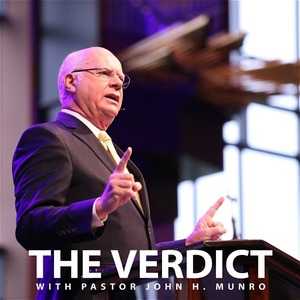
Today on the verdict with Pastor John Monroe. Many a person has sung Psalm 23. Many a person has memorized Psalm 23. But Can you say? As David says, The Lord is.
My Shepherd. Can you say he's my shepherd? But he died for me. that you rose for me. and that I am eternally united with him for all of life.
Welcome to the verdict, featuring the Bible teaching of Pastor John Monroe. Senior Pastor of Calvary Church in Charlotte, North Carolina. Today, we're nearing the end of our study on the life of David. by turning to one of the most famous and well-loved psalms written by David. We'll learn from the rich life lessons and the great spiritual truths shared.
as we revisit Psalm 23 today. as we join Pastor John Monroe for his message. David looks back. As we come to the close of our series on David, Today and next time, I thought we should consider the most famous words that David ever penned. I want us to think.
of the six verses of Psalm 23. I tend to think David is writing the Psalm towards the end of his life. Early in life, he worked as an actual shepherd. But then for many years as king of Israel, He also served as a shepherd, a spiritual shepherd. That is, a shepherd for the people of God.
No. You may have memorized this Sam, or it's possible that you're hearing it for the very first time. But this is a wonderful psalm. and always seems appropriate irrespective of our circumstances in life. Here is David looking back then and reflecting on the Lord.
as his shepherd. Psalm twenty three, it's the shepherd's psalm. And it's written by The shepherd king came. David. You will recall, we covered this earlier in the series, that when Samuel was sent by the Lord, to anoint the new king.
You remember he asked Jesse if all of the sons were present as From the oldest to the youngest, they're brought before Samuel, and the Lord is saying to Samuel, No, this is not the one, remember. Uh God looks Differently from man. Man looks on the outward appearance, but God searches the heart. And then To a question, Jesse, David's father, says there remains yet the youngest. But behold, he is keeping The shape.
So in our introduction to David, We're told right away that he is a shepherd. He would then be in his teens, no doubt. When Saul, King Saul, tells David, that he's too young. uh to fight the giant Goliath, remember as David volunteers to fight. Uh David says to King Saul, Your servant used to keep sheep for his Father.
So David saw himself. as a shepherd. As a king, He shepherded not sheep, but he shepherded the nation of Israel. Psalm 78 verses 70 to 72. He chose David his servant.
and took him from the sheepfolds. From following the nursing news, He brought him to shepherd Jacob, his people, Israel, his inheritance. With upright hand, he shepherded them and guided them with his skillful hand. David knew a lot about sheep. He knew a lot about shepherding sheep.
He'd spent many years taking care of shape. But he also knew What it was to be a shepherd, a spiritual shepherd, a spiritual leader. to the nation. of Israel.
So it's perhaps not surprising Well, when David begins to write Psalm 23, He begins with a wonderful description of the Lord. The Lord is. My Shepherd. And in six short verses, only six verses in Psalm twenty-three, David presents.
some basic spiritual truths. Rich promises of God, which have sustained the people of God now. for over 3,000 years. Psalm 23 was in Israel's hymn book. All of the Psalms, that was what they sang.
And so the Hebrew people read it and sung it. and meditated on it and memorized it. And from the time of our Lord Jesus now, for 2,000 years, this has been one of the Psalms, this has been one of the scriptures. That the people of God have turned to over and over again. If you grew up in a Christian home, If you went to a Bible-believing church or Sunday school, I'm sure that you, like me, uh were told to memorize some twenty three.
So this is I think rightly so. The best loved of all. of the Sams.
So I want us to think of three. of the rich truths of this psalm. and to think of them in the context of David. It is. As the superscription says, It is a Psalm of David.
So if you have your Bibles, open it there to the Psalms. And we're going to read from Psalm Twenty Three. Not Psalms 23, as sometimes people see, say, not that I would judge them or despise them for that. Uh but just a word of admonition, it is Psalm. Singular.
twenty three Assam of David. I'm reading it from the English Standard Version. I learned it in the old King James. And um Maybe it shows I'm getting old. I I I'd still like it in the old King James, but I'm going to read it in the ESV because this is the Bible we use here.
Psalm 23.
Now As I read it, I know that many of you like me know the sum. You you could stand up and and memorize it. But I want you to listen to it with fresh ears. This is the living word of God. I know it's 3,000 years old.
But we believe that this is God's eternal word. Listen. to the word of God. David writes, The Lord is my shepherd. I shall not want.
He makes me lie down in green pastures. He leads me beside still waters. He restores my soul. He leads me in paths of righteousness. For his name's sake, Even though I walk through the valley of the shadow of death, I will fear no evil.
for you are with me. Your rod and your staff, They comfort me. You prepare a table before me in the presence of my enemies. You anoint my head with oil, my cup. Overflows.
Surely. goodness and mercy shall follow me all the days of my life. And I shall dwell in the house of the Lord. Forever. Versus and think of the rich, rich truths in these six Verses.
I want to think, first of all, of the shepherd's provision. Notice how David begins the Psalm by saying, The Lord is my shepherd. Shepherd. David, in his life, his varied life, a very full life, as we have discovered in this series on the life of David, he'd proved the reality of the Lord in many circumstances, and so he describes the Lord in many, many ways. He is A poet.
He's a man who spent most of his time outdoors, and so he describes the Lord in many interesting ways as. My rock has God is a fortress, God is a deliverer, God is a shield. And many, many other ways, as you know, as you read the Psalms. But now, I believe he uses a very personal and a very intimate term when he says the Lord is my God. of Shepherd.
Oh, David had shepherded, we don't know how many sheep. He had shepherded the nation of thousands and thousands, but he says. The Lord is My Shepherd. Jo uh Jacob, when he blessed Joseph, at the end of his life, said, Genesis 48, verse 15, the God who has been my shepherd. all my life long to this day.
So this term uh As the Lord is my shepherd, wasn't it original to David? It's certainly used by Jacob there in Genesis 48, verse 15. Ah, but David. is not just articulating some cliché. Uh Hebrew Statement that was well known.
He's writing, I think, very, very personally because David knew. The Lord is My Shepherd. He uses the word Lord. The Hebrew word Yahweh, God's personal name. Remember when Moses is called by God to be the deliverer of the people from Israel, and he says, Well, what's your name?
And God gives him what we think is a very strange reply in giving his name. He says, do you remember what it was? I am who I am. The Lord is outside of time. Outside of space.
He is the eternal I am. I am who I am. God describing himself exclusively in terms of himself. He is the all-sufficient, all-powerful one. He's the one who is not dependent on the on any other being or cause.
No human being could say, I am who I am. We are dependent on others. We can't describe ourselves purely in terms of ourselves. But God is the eternal God who is everything and has everything. He is a great I am.
So David uses not just the word God, Elohim, he uses the word Yahweh. The Lord. The great, all-sufficient, self-existent, omnipotent God, this God, this Lord, is my. Shepherd. Think of a little girl proudly saying, She points to her dad, this is my daddy.
Think of a a young bride. Introducing her new husband and saying this is My husbands with pride and and with a smile and and glowing. David could have said, the Lord is a shepherd. That's true. The Lord is the shepherd, that's true.
The Lord is our shepherd. That's true. But he says the Lord is my Shepherd. That personal pronoun makes all of the difference to our lives, doesn't it? I wonder if all of us here can truthfully say Not just that the Lord is a shepherd.
But I wonder if you could truthfully say The Lord is My. Shepherd. Can you say that? Do you know God is your shepherd? The Lord is my Shepherd.
Now because the Lord is our shepherd, Because the great God, the I am who I am, the God who is and was and ever shall be. The God who is sufficient for all things is all sufficient, who doesn't need anything. Who speaks and it's done, who commands and it stands fast. The psychus says. Because the Lord is my shepherd, Therefore, I shall not want.
The Lord is my shepherd. I shall not want. The New International Version says, I lack. Nothing. I like Nothing.
David experienced the Lord's provision throughout his life, didn't he? In the series, we've considered the ways in which the Lord provided for David. in many, many ways. And here the shepherd's provision is a promise guaranteed by God himself. The Lord is My shepherd.
Our Lord is going to describe himself in John chapter 10 as the good. Shepherd. The writer of Hebrews in the last chapter, Hebrews 13. Refers to our Lord as the great shepherd of the sheep. Peter, as he's writing to exhort elders, under shepherds, reminds us that the Lord Jesus is the chief shepherd.
He's the good shepherd. He's the great shepherd. He's the chief. Shepherd. And As the good shepherd, as the great shepherd, as the chief shepherd.
He knows His sheep. He says that in John chapter 10. Adverse 3, I know my own and my own know. Me. The shepherd A good shepherd knows his sheep.
When you and I look at sheep, They all look the same, don't they? I mean if you had a hundred sheep would you be able to to point out the differences of it all look the same Abhinato the shepherd Not your good shepherd.
Some of the old Scottish shepherds gave the sheep names. You think that's strange? You give your dog a name, don't you? Maybe your hamster or your goldfish, why not a sheep? You say, does he know them?
Yes, the good shepherd. Nose. His ship. Isn't it wonderful to know that as you and I go through life, As followers of Jesus, That he knows your name. There is not one person in the sanctuary today who could come up here and identify every single person in the sanctuary by name.
You couldn't do it. I think I could get quite a good number. But look at some of you and I would think, okay, I think I know this person, who is that again? Oh, yeah, that's my wife, Goodney. I mean, um.
We forget.
Furthermore, I've not spoken with all of you. Face to face, and some of you perhaps are here for the first time, but never met you, I don't know your name. But you just think they're wonderful. That the good shepherd knows you By name, The sheep hear his voice, John 10. And he calls his own sheep.
by name and leads them out. That's the good shepherd. He calls his sheep. calling us By name. Come And to Me.
He knows us by name. And the good shepherd knows the needs of the shape. Just as A good father, a good mother knows the needs of their children. Many of your fathers, many of your mothers. You know your children.
Certainly you know their name. Even if you've got many of them. And you know their needs. And therefore, in a human perspective, you're the best person. to take care of your own children.
I may look on and say, well, You know, why did they go to that college? Why do they go to that school? Why are they doing this one? Why do they don't Do this and do that and all the rest of it. But I don't know your children.
You, as a father, you as a mother, you know the needs of your children. Here is God. The all-knowing, the all-powerful God, He is our shepherd. Doesn't it make sense then? That he can say You Shall not want.
Because this good shepherd Lays down his life for the sheep. In fact, the shepherd is the lamb who dies for us. What care? What love? Just think as you go through life, what provision.
Isn't that Paul's argument in Romans chapter 8, at the end of Romans chapter 8, that we studied some time ago? His argument is: if God didn't spare his Son and gave the very best for you, He's certainly going to graciously give you all that you need. If he's done the difficult things in sending his son and giving his son and not sparing his son, but delivering him up for you, if he's done that for your salvation, If he guarantees your salvation, Isn't he going to do the easy thing and provide for you? The answer is Yeah. This is a promise.
The Lord is my shepherd. I shall not want. Under the care of the good shepherd, you shall not want. You will lack. Nothing.
His provision is all the best, is always the best. Verse 2. He makes me lie down in green pastures. He leads me beside still. waters.
That's what a shepherd does. He makes sure the sheep are properly fed. He leads them to the green pastures. And as I follow my good shepherd, the Lord Jesus Christ, I'm not going to want. He's going to lead me.
Now I've got to keep my eyes on him. Am I flash? I want to go my own way. I'm going to do my own feeding. But when I follow him He's going to lead me in the green pastures and beside the still.
quarters. That wonderful to know. that you and I For followers of Jesus, have a good shepherd who's taking care of all of our needs, all of our cares, and all of our anxieties. Because David is saying the Lord is present tense. Not that he was, that's true.
But he's living in the present. Tonight. Tomorrow. You're listening to this?
Next week. A month from now. The Lord is your shepherd. And you shall not want No need to worry. No need to fret.
Do you think any sheep die of stress? I don't think so. Majors Follow the shepherd, he takes care of them. No need to worry, no need to fret. Notice David says as well.
He leads me beside still waters. The footnote on the on the ESB that I have says He leaves me beside The waters of rest. What did Jesus say? Come unto me, and I will give you. Rest.
As I follow, as you follow the Good Shepherd, He'll make sure that we're provided for, and He'll lead us by the still, by the quiet waters, by the waters of rest. You get anxious? You're worried? What's the answer to that? Work it out yourselves, no.
Follow. The good shepherd. All that you need, he supplies. There's five. Our cup.
Overflows. All that you need and much more. Isn't that the promise of the gospel? Seek ye first the kingdom of God and His righteousness, and all of these things will be added to you. Put God first.
Follow me. Follow the good shepherd, and you don't need to worry about anything. God will take care of you. That is the promise. of the scripture.
Philippians 4.19, Paul says, my God. Notice the little pronight my. My God. Will supply every need of yours according to his riches and glory in Christ Jesus. This is the promise.
of the shepherd's provision to you. He will supply your every need according to his riches and glory in Christ Jesus. Here is the shepherd's provision.
Now, the shepherd's provision. And I certainly didn't understand this as a wee boy singing this many years ago. But I have discovered what David is writing. that the shepherd's provision is often unexpected. Notice verse 5.
You prepare a table for me in the presence of my enemies. That's a strange place. to have a table. in the middle of your enemies. Uh You're in hostile territory and you've prepared a table.
Yes. You think back if you've been following Jesus for some time. Can you think of times I'm sure you can. When God has surprised you with His grace? That in a situation which could have been overwhelming, Which it can mean very very difficult for you.
God Grace comes to you and it comes in a surprising way, in an unexpected way. preparing a table for me in the presence of my enemies. In hostile situations, in difficult situations of life, in perplexing circumstances. Yes, at the time of your greatest need, God often surprises us with His grace. I hope you f you have experienced that, brother, sister.
So in the midst today of your pain, Your disappointment, your illness, your tragedy. Your fears, your uncertainty about the future. Will you listen to Psalm 23? Will you listen to the Good Shepherd? The Good Shepherd has promised this.
He will provide for you. You say, I don't know how he's going to provide for you. Listen, he's going to provide for you. You shall not want. He's going to guide you by the still waters.
And even in the toughest situations of life, in the middle of your enemies, he's going to prepare a table. David knew about enemies. David had lived many years with the king trying to kill him. He knew about hostile territory and yet God over and over and over again had protected David. and given him that table.
In the midst of of his enemies and his cup. Overflows. You see, every one of us is individually loved. and cared for by the good shepherd. Here is the shepherd's provision.
The Lord is My Shepherd. Rejoice in that. Be thankful for that. that the Lord is. Your shepherd.
This is the verdict with Pastor John Monroe and the start of a message titled. David looks back. And before we get to John's closing remarks, we want to make sure that you've gotten your copy of the special listening guide we've been offering for our current series. In this insightful printable workbook that John put together, you'll be able to explore the biblical themes, key takeaways, and real life applications of every lesson we've covered on the life of David. Reviewing scripture and practical guidance to help you make the most of this fascinating study.
So request your free copy of the Life of David Listening Guide today. by visiting us online at the verdict.org. And while you're there, Be sure to sign up for our monthly email list to get the latest ministry updates from John. And if these lessons and resources have helped you, would you consider helping other listeners by supporting the Verdict's gospel outreach with a donation of any amount? By helping us cover the cost to produce and distribute these biblical messages, you'll be playing an important part in sharing the gospel with new listeners and communities across the globe.
You can give your tax-deductible gift today. by going online to theverdict.org. And then don't forget to subscribe to the Verdict podcast. In addition to these programs, John presents a weekly podcast called Avizandam, where he shares his personal thoughts on relevant topics like church and politics, the power of hope. and how to engage the culture for Christ.
You can hear it all by subscribing to the Verdict Podcast.
Now, here's Pastor Jean Monroe with closing remarks.
Well, what's your verdict? How well do you know Psalm 23? More importantly, how well do you know the Good Shepherd? Because it's all too possible to know the Psalm but not to have a personal knowledge of the shepherd. My prayer is that everyone listening will know the Lord as their shepherd.
Jesus is the good shepherd who gives his life for the sheep. He did this by dying for our sins. Come to the Good Shepherd. He will forgive you. He will restore you.
He will lead you in the paths of righteousness. Thanks for joining us today on The Verdict. I'm Michelle Davies. Today's program with Pastor John Monroe was produced and sponsored by Calvary Church in Charlotte, North Carolina.