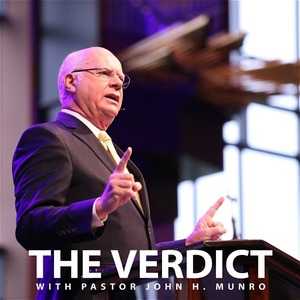
Today on the verdict with Pastor John Monroe. Worship can never be passive, it is dynamic. It involves our whole being, irrespective of our musical ability. And this God seeks worshipers. He wants your worship to be costly.
He wants you to give thanks. And he wants you to bless and praise his holy name. David was an outstanding. Worshipper. Welcome to the verdict, featuring the Bible teaching of Pastor John Monroe.
David served God faithfully throughout his life as a warrior, poet, musician, and king. and is one of the most well-known figures in the Bible. And today on the verdict, we're learning from the inspiring example of David on how to be a worshiper of God in spirit and in truth. And to get us started, here's Pastor John Monroe with today's message titled, David the Worshipper. Throughout our series on the life of David, I've stressed that David was a man after God's own heart.
This does not mean he was perfect, as we saw him fall into serious sin. But that does mean that David is a man who communed with God. He had a heart. for God. We will never have a heart for God or be people after God's own heart unless the worship of God is central.
in our lives. This is a high and holy privilege as we'll see today and next time. as we consider David. as a worshipper. From the magnificent Psalms David wrote, We know that David poured out his heart to the Lord.
and we'll learn much today about our worship. as we think of the example of David the worshiper. You may recall that when Jesus was talking to the woman. Of Samaria, in John chapter 4, he said this to her. But the hour is coming and is now here when the true worshipers will worship the Father in spirit.
and truth. For the Father is seeking such people to worship him. God is spirit. And those who worship him must worship In spirit. and truth.
That's an amazing truth, isn't it? That God, our Heavenly Father, is seeking. worshipers. We love the fact that our Lord Jesus came to this world to seek and to save the lost. As Luke records in Luke chapter 19.
But think of this: that God. is seeking worshipers. And Jesus tells that woman, who knew so little from our background, but as he began to expound this great truth, He began to teach her. That in worship it's not The Jews and the Samaritans had a debate whether worship Had to be centered in Jerusalem or in Mount Gerizim. And the Lord is saying, no, that's not the issue.
The issue is. to worship in spirit. And in truths.
So in this series on the life of David, I want to think for a few moments on David as an outstanding worshiper. I think that is largely why he's called a man after God's own heart. We saw previously that he was not a perfect man. He failed and he failed very, very badly. But this was true of him.
that he had a heart For God. He was a true. worshipers. He was a musician, he was a poet. He was a writer of many of the Psalms, Psalms that we love and that we turn to.
in all of the varying circumstances of life. And no doubt that David, as a young man, as he was looking after Uh his father's sheep. on the hills around Bethlehem. would take his harp, would meditate on on the law of the Lord as a young man, without being taught. Uh by his father.
And the reading of the law, and there in the hillsides round Bethlehem, that little town. I'm sure he began to worship. The Lord. And worship is central to who we are as a people of God. and it's certainly a church worship Is so important that we want to be.
a worshiping community of believers. And so we're going to think this evening of what is worship. It's not mere emotion. It's not Just shouting, having a good time as it were, because the Lord reminds us That this worship that the Father is seeking must be in spirit and in truth.
So let's learn. From David the worshipper. I want to base my remarks largely from 1 Chronicles 29.
So let me ask you to open your Bibles there. In 1 Chronicles 29, the last chapter of 1 Chronicles, David is coming to the end of his life. He previously had expressed a great desire To build a temple for the Lord. After all, he's living in this wonderful palace, and the Ark of the Covenant is in a tent called the Tabernacle. And David thinks there's something wrong with that.
But the privilege of building a temple A house of God. It's not given to David, it's going to be given. to his son Solomon, but David is given the privilege. of preparing the people to worship And preparing the building materials for the temple.
Now David as a worshipper was very very organized You could read. from 1 Chronicles 22 through 1 Chronicles 28, he talks about the Levites. uh the order of the musicians, the gatekeepers, and so on. And so David was a great organizer and delegated many of the tasks in worship. Uh to others.
So I want to take time and read the whole chapter, 1 Chronicles. This is one of these outstanding chapters in our Bibles and has so much Uh to teach us. First Chronicles then Twenty-nine read I'm reading from the English Standard Version. And David the king said to all the assembly, Solomon, my son, whom alone God has chosen, is young and inexperienced. And the work is great.
For the palace will not be for man, but for the Lord God.
So I have provided for the house of my God, so far as I'm able, The gold for the things of gold, the silver for the things of silver, and the bronze for the things of bronze, the iron for the things of iron, and wood for the things of wood. besides great quantities of onyx and stone for setting. antimony, coloured stones, all sorts of precious stones and marble. Moreover, in addition to all that, I provided for the holy house. I have a treasure of my own, of gold and silver, and because of my devotion to the house of my God, I give it to the house of my God.
You following this? Three thousand talents of gold, of the gold of Afir. Seven thousand talents of refined silver for overlaying the walls of the house. And for all the work to be done by craftsmen, gold for the things of gold, silver for the things of silver, who then will offer willingly? consecrating himself today to the Lord.
There's a question. Then the leaders of father's houses made their Free will offerings, notice that. Free will offerings. As did also the leaders of the tribes. the commanders of thousands and of hundreds and the officers over the king's work.
They gave for the service of the house of God. 5,000 talents and 10,000 darks of gold. 10,000 talents of silver, 18,000 talents of bronze, and 100,000 talents of iron. And whoever had precious stones gave them to the treasury of the house of the Lord in the care of. Jehiel the Gashonite.
Then the people rejoiced. Because they had given willingly for with a whole heart, They had offered willingly to the Lord. David the King also rejoiced greatly.
Now we think of this prayer. Talk about worship. What a great example is going to follow now. David blessed the Lord in the presence of all the assembly. And David said, Blessed are you, O Lord, the God of Israel, our Father, forever and ever.
Yours, O Lord, is the greatness and the power and the glory and the victory and the majesty. For all that is in the heavens and the earth is yours. Yours is the kingdom, O Lord, and you are exalted as head above all. Both riches and honor come from you, and you rule over all. In your hand are power and might.
And in your hand it is to make great and to give strength to all. And now we thank you, our God. and praise your glorious name. Isn't this magnificent? And who am I?
And what is my people? that we should be able thus to offer willingly. For all things come from you and of your own have we given you. For we are strangers before you and sojourners, as all our fathers were. Our days on the earth are like a shadow.
And there is no abiding. O Lord our God, all this abundance that we have provided for building you a house for your holy name comes from your hand, and it is all your own. I know, my God, that you test the heart. and have pleasure in uprightness. In the uprightness of my heart, I have freely offered all these things, and now I have seen your people who are present here offering freely and joyously to you.
O Lord, the God of Abraham, Isaac, and Israel, our fathers, keep forever such purposes and thoughts in the hearts of your people and direct their hearts towards you. Grant to Solomon my son a whole heart that he may keep your commandments, your testimonies, and your statutes, performing all. and that he may build a palace for which I have made provision. Then David said to all the assembly, Bless the Lord your God. And all the assembly blessed the LORD, the God of their fathers, and bowed their heads and paid homage to the Lord and to the King.
And they offered sacrifices to the Lord, and on the next day offered burnt offerings to the Lord, a thousand bulls, a thousand rams, a thousand lambs, with the drink offerings, and sacrifices in abundance for all Israel. And they ate and drank before the Lord on that day with great gladness. And they made Solomon, the son of David, king the second time. And they anointed them as prince for the Lord and Zadok as priest. Then Solomon sat on the throne of the Lord as king in place of David his father.
And he prospered, and all Israel obeyed him. All the leaders and the mighty men, and also the sons of King David, pledged their allegiance to King Solomon. And the Lord Notice this. And the Lord made Solomon very great in the sight of all Israel, and bestowed on him such royal majesty as had not been seen on any king before him in Israel. Thus David, the son of Jesse, reigned over all Israel.
The time that he reigned over Israel was 40 years. He reigned seven years in Hebron. and thirty-three years in Jerusalem. Then he died at a good old age, full of days, riches and honor. And Solomon his son reigned in his place.
Now the acts of King David from first to last. are written in the Chronicles of Samuel this year. And in the chronicles of Nathan the prophet, and in the chronicles of Gad the seer, with accounts of all of his rule and his might and of the circumstances that came upon him. and upon Israel and upon all the kings. of the countries.
First Chronicles twenty nine. Don't neglect your reading. Of 1 Samuel, 2 Samuel, 1st Kings, 2 Kings, 1 Chronicles, and 2. Chronicles. Three men Things I want to say today about worship.
Obviously, worship is a huge subject. But I want to take three, I think, that we find here in 1 Chronicles 29. That was true of David and the Israelites, and I trust is true of us. At church. Worship God first.
Give generously and joyfully. Think of the example of David. Worship to God is costly. and must never be done in a casual, laxadaisical, routine way. You remember when David wanted to buy the threshing floor.
from Morona, the Jebuside, which was going to be the place of the temple. Arana offered it to him free. No, David, you don't need to pay for it. Here it is. 2 Samuel 24, verse 24.
David said, No, but I will buy it from you for a price. I will not offer burnt offerings to the Lord my God that cost me Nothing. David knew that in worship, God wants his very Best. If you're familiar With the Old Testament law, you know that when you came with an offering, an animal, It had to be the very best, there had to be no blemish. In it.
a diseased animal or a deformed animal. Or a bird. uh with a broken wing or anything like that could not be offered. You may recall in the last book of the Old Testament, the book of Malachi. The Lord rebukes Israel.
Because they were given to the Lord. The diseased and the deformed. In fact, he says in Malachi 1: I wish you would shut the doors of the temple. In other words, This is blasphemous. I want your very best.
And remember, he says in Malachi, you're robbing God. And they say, How can we rob God? You're robbing God. because their worship was not from the heart. Here The worship in 1 Chronicles 29 came from the heart.
It was given with generosity. It was given with joy. God wants your very best. Building this magnificent temple was very, very costly. And so the materials had to be contributed.
As we saw in verse nine, the people rejoiced. because they had given willingly. With a whole heart, they'd offered freely to the Lord. David the king also rejoiced greatly. And David himself gives from his treasure, he gives an example to the people that he's the king, and he's giving riches and precious stones and gold and silver for the building of the house of.
of the Lord. Not only did they give generously, Not only did they give that which cost them, They offered joyfully. We know In the Old Testament, there were certain offerings that you had to bring in certain circumstances. But these were free will offerings. The one in commands.
you to give from your heart. This was not your tithe. This was a free will offering. And David, did you notice it said a couple of times that David realized this? That in a sense, we can't give God anything.
Because anything that you offer to God God has first given to you. David said, of thy own have we received and of your own have we given you? A recognition that God had blessed the people. And now they are giving back to the Lord. That was similar with the construction of the tabernacle.
Do you remember when Moses challenged the people? And Exodus thirty-five and thirty-six. Um The text says that the people gave willingly. A free will offering. The woman brought their precious jewels and they gave it.
And different people contributed different things for the construction of the tabernacle. In fact, Exodus 36, verses 6 and 7 says, That the people of God were restrained from bringing, for the material they had was sufficient to do all of the work and war. In fact, Moses had to say: wait a minute, stop, stop, stop, stop. We've got enough. We've got enough.
Isn't that amazing? The generosity Of the people of God. One of our themes this year is give. Generously. Do you realize that giving is part Of your worship?
We are to worship God. not only with generosity, But joyfully and willingly. You don't want to receive a gift, do you, from someone who's giving you that gift grudgingly. or because someone has told them to give. You that gift?
No. When someone gives you a gift, you want to know this comes from Their heart. that this is something they want to give. It's willingly. And certainly God.
Wants that. God doesn't need. And the thing that you can give, he wants it all. He wants you to give it. Costly.
and joyfully. This was the principle. in the Old Testament of the first fruits. The farmer brought the very best to the Lord as an offering. The farmer Uh with perhaps Twenty lambs.
Slacks Not the one that's lame, not the one that's diseased, not the one that's about to die. He selects the very best one. And he offers that.
So the Lord I say, how could you do anything else? You say, well, that was the Old Testament. We don't bring animals and we don't bring jewels to the Lord. No. But in the New Testament the principle is the same.
It's very easy to sing about loving Jesus. But it's much better, isn't it? When what we say and what we sing is reflected as to how we handle our resources. Inner generosity. Listen to Paul.
In second. Corinthians chapter 9 verse 6. He says, the point is this: whoever sows sparingly will also reap sparingly. And whoever sows bountifully will also reap bountifully. If you're a farmer, you understand that.
The more you plant, the more you get. You can't expect to have a good crop if you don't sow the seed. Each one Says Paul, must give as he's made up in his mind, not reluctantly or under compulsion, for God loves a cheerful giver. And God is able to make all grace abound to you.
so that having sufficiency in all things at all times you may abound in every good work. That's the principle, isn't it? That part of our worship. is in our giving. Paul says in 1 Corinthians 16, verse 2, that on the first day of the week, put something aside.
And store it. Jesus said it's more blessed to give Than to receive. And I'm very glad that we take, what do we call it? We call it an offering. You say, I don't need to give.
No, you don't need to give. If you don't want to give, don't give. Don't give it grudgingly. God doesn't need your money. No, this is something that we want to do, isn't it?
That if we love someone, we give. That's one of the. Characteristics of love is that it gives and gives, and this is central to our worship. And David understood that worship involves. Generosity.
and joyful Giving.
Now, I've said this before, I don't make it a rule for others, but My wife and I try to practice this, and they're giving a church every Saturday evening, as I did. I put it in that little envelope. You say, why did you do that? Did you do that in a legalistic way? No.
I do that as a reminder. And my wife, that's a reminder that everything we have comes from God. And that we want to give our first To God. The first act Of the first day of the week, the day of resurrection, when our Savior rose from the dead, that is an act of worship because. The flesh is greedy.
The flesh, my flesh and yours, is self-centered, self-indulgent, wants to hold on rather than to give. And one of the transformation of the Gospels is that where once we held things like this, our hands are now open. This isn't this accepting the challenge of total commitment. that everything we have Belongs to the Lord. And so they're gonna build this temple.
And they're worshiping God and that worship is sin. in their giving generously and joyfully. Second, Worshiping God is giving thanks. with humility. It's giving generously and joyfully.
Secondly, it's giving thanks. with humility. Again the example of David. Look at verses 10. Through twelve of 1 Chronicles.
29. David, what did he do? He blessed the Lord. In the presence of all the assembly, and David said, Blessed are you, O Lord, the God of Israel, our fathers, forever and ever. And then he has this magnificent word.
worship, which concludes in verse 12 by saying And now we what? We thank you. Our God. David focuses on the greatness and the power and the glory and the Victory and the majesty of our great God. He knows that God is supreme and rules over all.
He's just a sojourner. He's tiny. God is a ruler. God is the king. David understands where he came from.
He's got no claim.
Now but God gives strength. And what's to be our response?
Now we thank you. O God, and praise your glorious. name. Thanks. We're very quick to ask for things, aren't we, in our prayers?
But perhaps not so quick to give Thanks. This is the verdict with Pastor John Monroe. and a message titled, David the Worshipper. It comes from our ongoing study on the life of David. And as a special addition to this series, we'd like to send you a helpful resource.
It's a custom listening guide specifically written to complement each of these daily lessons. With details on key points, questions for review, and practical ideas for daily application. This printable workbook is a great resource for your own personal study or for hosting a group discussion with family and friends.
So get your free copy of this unique resource today by visiting us online at the verdict.org. and downloading your copy of the Life of David listing guide. While you're there, you'll also have the chance to help reach new listeners with the gospel by supporting the work of this radio ministry. We're so grateful for fellow believers like you who help us continue sharing God's word across the globe with your financial gifts. And you can give a special one-time gift today with just a few clicks of a button by going online to theverdict.org.
And before we close today's program, remember that you can always find these messages and catch up at another time by subscribing to the Verdict Podcast, available on all major podcast platforms. In addition to these lessons, John has a weekly podcast exclusive called Avizandam. Where he offers an insightful and biblical take on relevant topics, giving them the careful consideration Scottish law calls avizandum. You'll discover more when you subscribe to the Verdict Podcast.
Now, here's Pastor John Monroe.
Well, what's your verdict? Would you describe yourself as a worshipper? If you are a follower of Jesus Christ, God is seeking you to worship Him. That worship must be in spirit and in truth. To say the obvious, this is a spiritual exercise, and therefore our attitude must always be humble.
As we focus not on ourselves, but on the greatness and the grace of God. Worship involves all of our life, including outgiving. We'll learn more about David as a worshipper next time. Join me then. Thanks for joining us today on The Verdict.
I'm Michelle Davies. Today's program with Pastor John Monroe was produced and sponsored by Calvary Church in Charlotte, North Carolina.