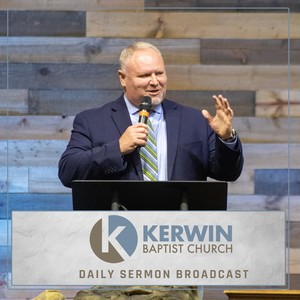
Welcome to the Kerwin Baptist Church broadcast today. Our desire is for the Word of God to be spread throughout the world so that all may know Christ. Join us now for a portion of one of our services here at Kerwin Baptist Church, located in Kernersville, North Carolina. And thank many of you for being sensitive to this. Holy Spirit of God, don't ever feel in a hurry here.
Because the song's getting ready to end. If you're on the altar and you're doing business with God, as long as it takes, you do that. You have that freedom here. We have that freedom here, right? We have that freedom here.
And it doesn't matter what part of the service, where we're at in the service, God. Touches your heart about something, you get to an altar. And I'm a person that believes in altars. A lot of people are making fun and criticizing altars nowadays. And um Yeah, I have not had any bad experiences at an altar.
In fact, that's where I've humbled myself. And I encourage you to do so. And thank you for being here today. Psalm 42. We're going to continue obviously in our series Uh on hope and um I hope this has been a help to you, and I hope it will be a help to you.
Psalm 42 was a challenge. I knew God wanted me to preach on this particular passage, but I got to be honest, there's so much, there's so many angles.
so many different ways to present this. It was just exhausting.
So you just kind of have to pick a road and stick on that one. Because there's just too much to do. You almost could make Psalm 42 a series within a series. There's just so much there. Our title today comes straight from this passage, O My Soul.
Oh my God. Psalm 42 begins the second major division of the book of Psalms. It's often called Book II. Psalms. And it starts with chapter 42.
and goes all the way to Psalm 72, and then starts, obviously, book three. This particular psalm, as Brother Frank read, is labeled a maskel. That literally means it's a musical. arrangement. And Psalm 32, Psalm 52, Psalm 89 are among other Psalms that are literally written with a musical arrangement.
This particular chapter has two choruses. And the choruses are very, very similar. Verse 5 and verse 11, but they're slightly different. And the difference in them, I want to really point out to you today at the end.
Now, obviously, you know, in the beginning of this chapter, it says the sons of Korah. And many of you know the story of Korah in the Old Testament. I won't get into all that, but the sons of Korah, it's believed that later on in Bible times in David's day, became many of the worship leaders. in the temple. And so this particular psalm, it says, written for the sons of Korah.
It literally means that this might have been a musical arrangement that was literally made for them to sing, to use, and worship. Um In other words, it's a personal experience, but written the way it was so it could be sung.
Some people believe that maybe even some of the sons of Korah at times wrote parts of the Psalm. I don't know. We believe David is the author of this psalm. But that's why it says the sons of Kor, this was used in music and in worship. And there is constant dialogue in this chapter.
Um of David. from talking to himself to talking to God. Yeah. One moment he's talking to self. The next minute he's talking to the Savior.
And I don't know, have you ever found that in your life? Like I said, when I'm doing laps or walking or going to Krispy Kreme, I find myself. That part of it is that that's where I do a lot of talking to the Lord and different things. Part of the time I'm talking to me. and about things and then I kind of Get A little bit come to myself, like you shouldn't have that kind of attitude.
And then I start talking to God. About what I just said. I complain about something. I'm talking to myself about how bad things are.
Well, then I got to talk to God. But, God, I know you're faithful, and God, I know you'll take care of it. And then, somehow, you know, a little bit later, I'm right back to where I was, talking about circumstances and things going on. And through this whole chapter, there's constant dialogue between David talking to his soul and David talking to God, and David talking about what's going on, David talking to God about what's going on, David talking to himself about what's going on. It is just this constant.
Inner anguish, inner turmoil. And by the way, many of the great, great men of God in the Bible face this exact thing. And some of you, and some of us, I should say. Face this. You know, I think of the New Testament passage where Paul literally describes this spiritual schizophrenia that he has.
He says the things that I don't want to do, I do, and the things I want to do, I don't, and that I don't want to do, and then I do want that. You know, it's a constant back and forth between fighting the flesh, feeding the spirit, all these different things. I want to give you a little bit of context for this particular chapter that begins book two in Psalms and. What David was going through. There's an interesting story in the Bible, and actually, one of my favorite messages ever by a preacher.
was a sermon by a man, Dr. John Phillips. who I had the privilege of preaching with. on two occasions in my life, which was very embarrassing. But he is one of the smartest, has written commentaries on every book of the Bible.
And I'm sure he's not standing up anywhere saying that about me. Like I got to pray. Anyway, he's in heaven. But it was embarrassing. I just asked the pastors: please let me go before him, not after him.
That would be a great blessing. And but he preaches a sermon on this man in the Old Testament named Bar-Zalai. And the context of Psalm 42 is that David, his son Absalom, Has turned against him, and Absalom is chasing after his dad. to kill him. When David fled the city of Jerusalem because of Absalom's rebellion, There's a whole lot of David's inner circle that forsook him.
Included in them was, number one, his own son, Absalom. had betrayed David. He had a trusted servant named Shimei, and Shimei turned his back on David when all this happened. Many of you have heard the story. Many of you heard the songs about Mephibosheth, you know, the crippled boy that, you know, Jonathan was connected to Jonathan and David took him into the house.
And beautiful story.
Well, Meshibbofeth, Meshibboth. Oh Mishi, he um Mephibosheth, he turned his back on David too during that. David took him in, showed kindness, put him at his table. And he kinda discarded David when this happened. David had a very close advisor named Ahithophel.
And Hithophel not only stabbed David in the back and turned his back on David, but he tried to counsel. The enemy against David. This is all going on, so David's running for his life, probably hiding in a cave. Everybody had kind of turned their backs on him, but 80-year-old Barzili. Who had been one of David's mighty men.
Brought a whole bunch of supplies, brought goods, brought things, brought nourishment, brought. Drink brought Supplies that David needed, but more than that, really, he brought himself. After having everybody turn their back on them. How comforting it must have been. To have somebody in his life that seemed to still care.
About David. As David receives this stuff from Barzali and is encouraged by this, he pins the words of Psalm 42. This was used by Jews for years would sing this at times to remind that God can restore, that God can encourage. And God can bring Hope. Even hope when people have turned their backs on you.
Now it's one thing to find hope in the midst of circumstances. It's one thing to find hope when your own personal failures. We've talked about a lot of things, what hope and faith is, and all these different things. I have personally found the hardest time of my life to find hope is when people. have hurt me.
It It sucks out the joy. The contentment. the motivation, the enjoyment. And it just ruins hope. Because you begin to think, I thought they, if they've done this, What hope do I have?
If so-called my friend did this. then what hope do I have?
So, David writes this psalm, and I want us to look at some things here today. Oh my God. Oh my soul. This constant inner Dialogue. Let's pray.
Lord, I love you. Lord, this series is on hope, and we need hope, and Lord. If ever there's a time we need hope, it's now. Lord, this gets personal. This this teaches us about finding hope when hope isn't there.
Teaches us a lot of lessons in this chapter. I pray you'd help us today, Lord, in Jesus' name. Amen. Number one, I want to kind of show you the verses. And then we're going to kind of deal with the choruses.
But David, in the verses, talks about the difficulties he's going through, but in the choruses, He says You know, hope thou in God. I want you to notice, number one, David talks about deep wounds. Look at verse 3. You have a piece of paper and a pen, you can write these things down in verse 3. He says, my tears have been my meat day and night, while they continually say unto me, Where is thy God?
David said that the circumstances have so overwhelmed me that it's almost starting to make me think that God doesn't care, that God's not even aware of what I'm going through, or that God has somehow abandoned me.
Now, notice what he says: my tears have been my meat day and night.
Now, there's two possible ways that this is interpreted. And what's interesting, he compares what he's going through to bread and to meat. What are we saying here? He is saying this might mean that somebody that literally they cry daily and regularly. As somebody would eat a meal in the morning and eat a meal in the afternoon and meet a meal in the evening, and if you're like me, there's a few more after that, you know, kind of a thing.
But he said literally that my tears have been my meat That, as regularly as somebody eats food, that's how often I'm crying and weeping over this. The other possibility is that the psalmist is upset to the point. that he doesn't eat. That literally, that now instead of food for breakfast and instead of food for lunch and instead of food for supper, it's just weeping and weeping and weeping. These wounds have run deep.
It's become a part of my life. Notice, secondly, he brings up in verse 4 that he was deserted by friends. Look at verse 4. He says, when I remember these things.
Now, may I say that sometimes it's good to remember some things, and sometimes it's not good. To remember other things, and if you're like me, when I'm down and discouraged, I think of all the wrong things. Anybody else like that? Can you raise your hand? All right, you breast of your hypocrites, and don't you worry about it.
Yeah. I'm gonna tell you when things are bad, what goes on in my mind. Notice what David says here. When I remember these things, I pour out my soul in me. For I had gone with the multitude.
Listen to what he's saying. I went with them to the house of God with the voice of joy and praise, with a multitude that kept holy day. David here is talking about going to church, he's talking about going to the temple. He said, I went with these people to worship. Even led them in worship.
Notice this with a voice of joy and praise. He said, with a multitude that kept the holy day. He said, literally, these people I went to church with, I was friends with, I was close to, and I thought I bonded with them over worship. Deserted by friends. He is recalling literally leading worship with these people.
Seems to have been a group that was connected by worship and music and worshiping in the temple. These friends have deserted him, Shimmei and. Ahithophel. Even my own son, Absalom. Notice number three, we see he was depressed.
By circumstances. Look at verse 5. Why art thou cast down, O my soul?
Now, these two words, cast down, is a Hebrew word shachak, and it literally means this: to sink or depress. To crouch down, to be low, to stoop. It's literally talking specifically about depression. David here is going through depression that has come upon his life because of the circumstances. And I can understand it.
He's had to leave home. He's had to leave family. He's left kingdom.
Now his own son's trying to kill him. People that he trusted have turned their backs on him.
Now he's living in a cave, hiding in hiding, running for his life. He is depressed by circumstances. By the way, can I say this? In the middle of all this, When you end up in a cave hiding and away from all this, you really begin to think. In the middle of all this, David also had to fight with the fact that some of this is a result of my own actions.
Do you know why Absalom hated his dad so much? Because of David's adultery. Because of what David had done. Not only that, Absalom had watched His half-sister Tamar was raped by Absalom's stepbrother. He'd watch so much go on behind closed doors.
And Absalom had a spirit of rebellion. David knew that some of that, while rebellion is wrong, David had to face his own failure, depressed by circumstances. Has he ever been depressed? My circumstances. Notice number four, he talks about being desperate for answers.
Look at verse 5. Why art thou cast down, O my soul, and why art thou disquieted in me? It is not out of question for believers like psalmists to experience inner turmoil. Even Jesus Jesus Faced inner turmoil. Remember, as he's in the garden and he's getting ready to have to be crucified, he said, Father, if it be possible.
Even Jesus was facing this inner turmoil. Not that he wasn't willing. But knowing the sin he was going to have to bear. That literally, David here is saying, Why art thou disquieted? I can't rest.
I have answers. I have questions that need answers. And it's driving me crazy that I don't have answers. Have you ever been at a point in your life where you need some answers? You want answers.
You don't know why this is that. You don't know why those people did that. You don't know why they said that. You don't know why this has happened. And you need answers, and you're never going to get them.
You ever tried to deal with it? You go to a source, they'll never admit to it. They say this, change the story. Oh, it was for this. Oh, it was for that.
They never, you can't ever get them pinned down. You're fighting a ghost. When you fight people sometimes. He was desperate for answers. Why art thou disquieted in Me.
Notice number five, David talks about drowning under the burden.
Now, I love his metaphor here. Listen to this. Deep calleth unto deep. At the noise of thy water spouts, all thy waves and thy billows are gone over me.
Now, listen to this. Even faithful people can be tempted to quit. The writer here, David, turns to expressing a sense of overwhelming grief.
Now, listen to me, notice this. He compares it to a brutal chain of oncoming waves. Notice what he says, all thy waves and thy billows are gone over me. If you've ever been out in the ocean and you've ever been further out than you probably should be, and you end up in some adverse circumstance trying to get back in, I've done that many times, is that literally you get one wave and then another one comes. And it's just like wave after wave after wave.
It means problem after problem after problem. Notice what he says: he says, deep calleth unto deep. He is saying that one bad problem comes right after another. Deep calleth unto deep. And then he says this.
by water spouts. He's talking about a waterfall. It's like standing under a waterfall.
So he gives this metaphor of deep ocean, of the waves of an ocean, and now of a waterfall, you stand under a waterfall, what happens? The water just pounds you and pounds you and pounds you and pounds you, and you're not going to be free of it unless you get out of it. And the problem when you're going through things like this, you can't get out of it. David said, literally, here that I'm drowning under the burden. That as soon as I get past one wave, another one hits me.
I find out something else that this person did. I find out something else that another person said. I'm under this waterfall, and it's just drowning me, and I can't get out of it. I can't get away from it. Whatever I do, it's there.
He says, literally, as low as I can go, the deep. Calls unto the deep. I don't know if you're here. this morning for encouragement, but so far has not happened. Notice number six.
He talks about the daggers of criticism. And I use that word daggers not just because it's alliterated, but because of the verse. Look at verse 10. as with a sword in my bones. Mine enemies reproach me.
Notice this. Wow. They say daily unto me. Where is thy God? You know, someday you and I are going to join the host in heaven praising the Lamb who was slain.
Amen? But until then, we're on a pilgrimage, not a picnic. And you are going to face The daggers. of criticism. They say you ever heard sticks and stones may break my bones But words won't that's it's a bunch of junk.
I've been through it. I would rather be hit with a stick or a stone. Or at the least hit them with a stick or a stone. But words do hurt. And words hurt in places that outward physical Attacks can't hurt you.
Words cut deep. He said, It's like daggers in my bones. While they say unto me daily, Where is thy God? Wow. Not a lot of hope here.
in this chapter. What's amazing, verses 1 through 4, David talks about all this, then he reminds himself, sings the chorus in verse 5.
Well, then he. Talks about all the other stuff, and then he comes back. And here's what's great about the Psalms: if you've ever noticed, David questioned God constantly. David struggled, and David just happens to be the guy that God put all the verses there that we see the struggle. And sometimes we think, well, David should know better.
I mean, looking back at chapter whatever, God really helped. David should know better. Guess what? We should know better, too. We should know better too.
Circumstances should not attack our hope. But it does. People hurting you should not affect your hope. But it does. We're no better.
So, I want you to notice as David gives us some instruction about finding hope. In the middle of something like this. I want you to notice, number one, we make a change here and I want you to notice, number one, as we start off the chapter, We must be desperate for God, not people. It's good. It's immense.
We must be dead. How did David end up finding hope in the middle of this during this chapter? Look at verse 1 and 2. As the heart, the dear, Panteth after the water books, so panteth my soul after Thee, O God. My soul thirsteth for God, for the living God.
When shall I come and appear? before God. I saw this quote, and I don't know who the author is. Maybe you can find it, but he said this. The soul seeking restoration.
doesn't simply prefer God. It urgently needs him. I believe our churches are full of people that prefer God, but they don't need Him. Let me tell you what will get hope back in your life when you get desperate for God. We live in a generation where people are desperate for people.
We live in such a social generation, and we put everything out there on social, everything else that when we get criticized, somebody has something to say, and we get in arguments about that. And it just seems to the point that we want to be accepted by people. We want them to accept our life. We want them to like everything about us. And can I tell you something?
If you put that in people, you are asking for trouble. It is going to kill your hope. if you put your hope in people. You've got to get to the point that you get desperate for God. Not people.
David said, I'm desperate for God. Look at the phraseology of this. When a deer is panting for water, what does that mean? When a deer is panting for water, that is his only focus. This is different than just being thirsty.
He's panting for water. That means this is desperate. This isn't just about, hey, I'd like something cold to drink. This is about, I've got to get something to drink. That deer will pass possible food, possible places to sleep, because he is focused on one thing.
He's got to find water. And a lot of times you and I lose our hope because our hope is in people. And our hope is in how people will react and what people will say and what people will do. And in the middle of that, you and I have got to be so focused and desperate for God that it doesn't matter what this person says. It doesn't matter what this person does.
It doesn't matter what this person has done in my life. I'm not desperate for them. I'm desperate for God. And hope. We'll start.
Once you notice number two, David gives us a principle here in verse 5, the first chorus. We must remember that hope is a choice of faith. Look at verse 5. In the middle of all this bad, David says, Why art thou cast down, O my soul? And why art thou disquieted in me?
Why am I depressed? Why am I desperate for answers? Look what he says. Hope thou in God. For I shall yet Praise him for the help of his countenance.
Shall yet, these are faith words. Not might shall. Not won't yet. Praising God now for what I believe He will do later. Look at me.
In the middle of your depression, in the middle of your discouragement, in the middle of everything that people have done to you, there must be a choice that you and I make that we are going to hope in God. Yes, sir. It's a choice. I don't care how many sermons I preach about this, you need to know hope is a choice. You're going to have to choose to hope.
by your faith now. I choose to hope. That's why the first message we had to teach you the difference between faith and hope. Because I must choose to hope for later because of my faith now. It's a choice by faith.
Notice what David says: the depression's still there. The discouragement's still there. He's still in a cave. Nothing has changed. The only thing that's changed is his decision making.
Amen. And he now decides, hope thou in God, because by faith I believe I shall yet praise him. Because I believe he's going to take care of this. It's a choice. By faith.
Philip Brooks said this: Hope can see heaven. Through the thickest clouds. John Bunyan said this, hope is never ill. when faith is well. Richard Sibbs said this, the nature of hope.
is to expect that which faith believes. to expect that which faith believes. One of my favorite stories my dad would always tell. Not a long one, a short one, but he would be preaching on faith or anything like that. He'd always tell this story about this guy drove up on a little league game and.
He thought, I'm just, you know, I played Little League, I just want to watch this a little bit. He was out there at the outs. outfield fence just standing there watching little league and Here they're playing and he watched this team that was at bat. They scored eight The greatest news that anyone can receive is the news of the free gift of salvation found in Jesus Christ. It is our desire for you to know him personally.
Would you take a moment to hear this to-day? Every man is born with a sin nature. Romans 3:23 says, For all have sinned and come short of the glory of God. No matter how hard we try, We're not good enough to obtain God's glory. or to get to heaven.
Because of that sin carries the penalty of death. Romans 6.23 says, For the wages of sin is death. But the gift of God is eternal life for the through Jesus Christ our Lord. The wages of our sin, or the payment of our sin, only equals death and separation from God. But it's only through God's gift salvation through Jesus Christ that we can accept Him as our Savior.
Jesus Christ paid for your sin debt. The Bible says in Romans 5:8, But God commendeth his love toward us, in that while we were yet sinners, Christ died for us. All you have to do is receive Christ. by faith as your Saviour. Romans 10.9 says That if thou shalt confess with thy mouth the Lord Jesus, and shalt believe in thine heart that God hath raised him from the dead, thou shalt be saved.
Verse 13 continues, For whosoever shall call upon the name of the Lord shall be saved. It's as simple as admitting that you're a sinner believing that Jesus is the only way. and calling upon his name. Bible says whosoever that's anyone can call upon the name of the Lord to be saved. Have you accepted Christ as your personal Savior?
There is no greater day than today to take care of this. Would you accept Christ as your Saviour? If you have any questions, please give us a call at 336-993-5192 or visit our website at Crowin Baptist Church. Dot com. or visits that person at one of our three service times.
We hope you have a great rest of your day. God bless you. Mm-hmm.