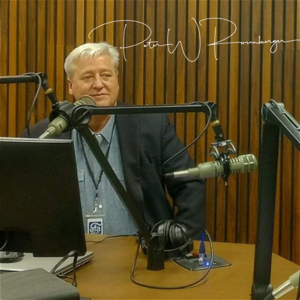
This is the Truth Network. Nobody taught me how to be a caregiver. I've spent 40 years. Learning the hard way. And that's why I created caregiver.substack.com.
No scrolling and hoping to find a nugget. Just articles, audio, video, and practical insights I've learned over four decades as a family caregiver. When I post something new, it goes straight to your phone. or your inbox. And by the way, every bit of it is in Fluent Caregiver.
Caregiver. Substack. com Welcome to Hope for the Caregiver. This is Peter Rosenberger. Glad to be with you.
HopefortheCaregiver.com. HopefortheCaregiver.com. This is the program that is for Family caregivers.
Now, if you're not a caregiver, you're going to get something out of what I'm talking about, but I'm not here for you. I'm here specifically for those who are waking up every day and taking care of somebody. Who has some type of chronic impairment?
Now, it could be a disease, it could be trauma, it could be addiction, it could be mental illness, it could be all kinds of different things, but it's not going to necessarily get better. In fact, it More than likely, we'll probably get more difficult. And that person who is standing between that chronically impaired loved one, an even worse disaster, that's who this program is for. HopefortheCaregiver.com. I'm bringing you a lifetime of experience.
To offer a lifeline to my fellow caregivers. I'm glad you are with me today. Two weeks ago, I started a new series that I want to spend a lot of time with, if that's okay with you. If it's not okay with you.
Well, I don't know what to do about that because I'm going to do it anyway.
So if it's all right with you, that's what I'm going to do.
Now, I started talking about theology. And before you change that dial, just hear me out, okay? Why is this important to us? What are we doing here? What's going on with this?
And I started with Three questions that every caregiver will eventually ask of some form.
Now they may not ask them at the same time. and they may not use the exact words. They may not even realize they're asking theological questions, but eventually, in some form, The questions come, where is God? And we talked about this two weeks ago. what kind of good and loving God would allow this?
That's question number two. And the third one is How long, O Lord? And that third one, by the way, is biblical. Because they're praying that right now. You know, how long, oh, Lord, you see that in the book of Revelation.
How long will this continue? How long? Will my loved one suffer? How long can I keep doing this? You see this throughout the Psalms.
David expressed this a lot. How long, O Lord? You know, he was anointed king and chased all over Israel. For 20 years, roughly.
Well, he was anointed king. He knew he was going to be king, and yet he was dealing with this reality for a lifetime. How long can I keep doing this? How long before something changes? How long before somebody helps?
How long, O Lord? We sometimes hear variations of that second question. You know, what kind of good and loving God would allow this with the familiar, you've heard this a long time ago. I forget the guy that came up with this, but if God is all good, then he cannot be all-powerful. And if he's all powerful, then he cannot be all good.
Okay, you've heard that before. They even had Lex Luther do that in the Superman movie, you know.
So it's been around the public discourse. There was some guy, I think it was a German guy or something, that came up with this in the late. 1800s, early 1900s, or something. But anyway, it still distills down to the same question: what kind of good and loving God would allow this? You see where I'm going with this.
Now these are not caregiver questions. I mean, caregivers certainly asked them. And we may ask them. More urgently than others because of what we witness and carry. But these questions transcend care giving.
They transcend sickness, disability. Tragedy, war, loss? and they step into the realm of theology.
Now, I realize that the word theology may cause some people to tense up.
So I just want to start off with saying Chill out. Don't don't get tense on me. Don't don't get all worked up about this. Theology. It sounds academic.
Sounds like it's something reserved for seminary professors, pastors, and people who enjoy using words that nobody else understands. And Sometimes that is conveyed. But don't let that word intimidate you. Theology simply means the study of God. The word comes from two Greek words, theos, meaning God.
and logos, meaning word, reason, or study. We get the word Bio study biology for bio life. Ology study of life anthropology. You know, that kind of thing. Theology asks who is God?
What's he like? What's he done? What's he revealed about himself? What does he require of us? And how are we to live in the light of who He is?
That is theology. And theology does not belong only in a classroom. And I suggest to you. that it belongs at the bedside. The waiting room.
Intensive care unit. Post op. Pray up. The kitchen. At two in the morning.
The bathroom. When you have a mop in your hand.
Now, religion, there's a difference between religion and theology. Religion studies people and how they behave toward what they consider sacred.
Okay, what do they believe? How do they worship? What rituals do they practise? Then how do those beliefs shape their families and cultures. And those are important questions.
But they're questions about human beings. Religion studies man. and what man does concerning God, theology studies God. Theology subject is the nature and character of God Himself, And that distinction matters for us as caregivers because when suffering comes, we are not. merely asking why people behave the way they do.
I don't care about other people's religion. When I'm dealing with chronic suffering. which I deal with every day. I'm asking questions about God. Where is He?
Is He good? Is he powerful? Does he see this? Does he care? Can he be trusted?
How long will he allow this to continue? My son asked me this when he was nine years old. He said, why should I believe that God cares about my suffering when I see what he allows mom to go through?
Now think about that question he's asking as a nine-year-old. A nine-year-old, that's a heavy theological question. The Scripture tells us that knowing God is the highest pursuit Available to us in Jeremiah chapter 9. The Lord says, Let not the wise man boast in his wisdom, let not the mighty man boast in his might, let not the rich man boast in his riches. Wisdom, strength, and money.
Those are the things we usually depend upon to solve our problems. If we had enough this, we could get this done. Or if we knew why this was happening, we could do this, or whatever. If we had the strength. Those are the things that we lean on.
If I can understand it, I can manage it. If I'm strong enough, I can carry it. If I have enough money, I can fix it. But God. continues In Jeremiah, let him who boasts boast in this, that he understands and knows.
Me.
Now think about that for just a moment. God does not tell us that the highest human pursuit is accumulating information. displaying strength or acquiring wealth. We have more information available to us now. on our phones.
than the entire wealth of human knowledge has had up until this point. We could access all of that on our phones. It's not enough, is it? God says the highest pursuit is knowing Him. That's theology.
And now, for centuries, theology was called the queen of sciences.
Now, that sounds kind of strange to us, doesn't it? When we hear the word science, we think of laboratories and microscopes and all that kind of stuff, experiments and people wearing white coats and sometimes I do, I wear a white coat. No, I don't wear white coat. But the word science originally had a broader meaning. It comes from the Latin word scientia or scientia.
meaning knowledge. That's it, just knowledge. A science was simply an organized and disciplined body. of knowledge. Theology was called the queen of sciences because it dealt with the highest possible subject, God Himself.
Every other science studies some part of what exists. Physics studied matter and energy. Biology studies living things, medicine studies the human body, psychology. Studies you know, people's thought and behavior. But theology asks why anything exists at all.
Who made it? What's it for? What is a human being? What does being mean? Why does human life possess value?
What makes something good or evil? What does suffering mean and to whom are we ultimately accountable? You follow where I'm going with this. This is the world we live in as caregivers. And when we come back, we're going to delve even deeper into this.
This is Peter Rosenberger. This is Hope for the Caregiver. Don't go away. We've got more to go. We'll be right back.
Welcome back to Hope for the Caregiver. This is Peter Rosenberger. Glad to be with you. HopefortheCaregiver.com. Hopeforthearegiver.com.
We're continuing on our conversation about theology.
Now, two weeks ago I started this, but if you want to go back to last week's program, I had my interview with Johnny Erickson Tata on there, and that is a crash course in theology, just to have a conversation with her. I've maintained for years that the moment Johnny Erickson Tata enters the room, people are having a theological question in their mind. I used to see that with Gracie all the time. The moment she walked out on stage and she would wear a skirt and you'd see her prosthetic legs and she would get up there and sing and just, I mean, nail it, just wail on it. Gracie's such a good singer.
And the moment that happened, people are having a theological question in their mind. How how is this possible? What kind of Good and loving God. allows this and how can she sing to him? What's going on here?
And that's a theology question. And so that's why I'm going into this right now, spending the time talking about this. What is this about? Because this is where we live as caregivers. You know Medicine can tell us what's happening.
inside someone's body. That's what medical science can do. It can describe the disease. It can recommend the treatment. It may be able to even ease the pain.
And we're grateful for the medicine. We're grateful for these things. But medicine Does it tell us what a human life is worth? Medicine doesn't tell us why we should remain faithful when recovery is no longer expected. In my conversation with Johnny, she talks about medically assisted suicide and how it's becoming more and more popular, certainly in Europe and Canada.
California and other states in this country, it's becoming more and more the thing here. And medicine can't tell us whether suffering has meaning. And since our culture seems to think that suffering should be avoided at all cost, Therefore, we need to eliminate it at all costs, even if that means eliminating the sufferer. And so now We're in a much deeper pond, if you will. Actually it's not a pond, it's an ocean.
And and the water is very deep here And so, this is why it's important for us as caregivers to understand what's going on. What do we believe? Why do we believe this? And medicine today can't tell us. Where God is in the midst of this, it doesn't answer that, it doesn't deal with that.
And for those questions, we've already left. The Quote-unquote laboratory, if you will. We've entered into a much bigger laboratory. We've entered into the realm of theology. And the Apostle Paul explains why theology stands over every other field of knowledge.
In Romans 11, he writes: For from him and through him, and to him are all things, to him be glory forever. Amen. Everything is from him. What is being? You know, you think go back to the Big Bang theory, and everybody says, well, you know, that's what it all exploded, and these gases and everything.
Okay, well, where did the gas come from? Are you saying that gas has being in and of itself? Are you saying that matter has being in of itself? It is eternal? Is that what you're saying?
You see how these questions start. forcing very uncomfortable things into the the topic here that people want to they say, well, you know, it just happened over a lot of time. We we throw fourteen billion years at it and think that makes it more palatable. But we still got to ask the ask the question, well, where did this come from? What was it always here?
Was gas and matter always here? Does it have being a seity, being within itself, a seity? S C E I T I T Y I mean A S C E I T Y E S being in of itself. Does that what is that what matter has?
Now, do you see the questions that we're asking? And these are important questions to ask. Everything is from him. Everything is sustained in him because God has being in of himself. And Studying this helps us understand these things, and everything ultimately returns to him and exists for his glory.
And that is why theology was called the queen of sciences. If all things are from God, through God, and to God, that every other subject we study eventually leads us back to him. Do you believe that? Philosophy was sometimes called theology's handmaiden. And that's another term that might Frighten people.
You know, but it shouldn't. And I don't want you to be frightened about it. I want you to go down this pathway. We're both caregivers. We look at suffering and disability and chronic impairments and age and all kinds of impairments of all kinds every day.
That's what we do as caregivers. That's why you're listening to this program. That's why I'm doing this program. And we don't need to be frightened of these things. We need to push ourselves to think through this.
Philosophy simply means the love of wisdom. It helps us think carefully. It teaches us whether an argument makes sense. Or whether a conclusion follows from its premises, or we're contradicting ourselves. For example, do you think that God is all-knowing?
I think, can we agree on that as believers? Can we agree with that? That scripture teaches God is all-knowing? Omniscient. And yet there are people out there in pulpits to day.
Who are saying God looks down the corridor of time and sees who's going to pick him.
So they're saying that God is all-knowing, and yet he's learning something. Do you see how the argument breaks down? They're not thinking through this clearly. God learned something? He's all-knowing, but he learned something.
He learned who's going to pick him. And that's how predestination works, or you know, but that's how they get around Romans 9 or whatever. I don't know. I hadn't figured out the particular pretzel of that logic, but. You know, that's another conversation.
But but philosophy gives us tool to reason with. And theology tells us about the God who gave us reason. Theology tells us about the God who is the source of truth, wisdom. goodness, life, and everything else there is to know. And I I remain convinced that theology and philosophy represent the highest forms of thought available to the human mind and specifically available to the caregiver mind.
And I'll tell you why.
Now let me let me explain. Or, as Ricky Ricardo would say, let me explain. When life hits And it does. And you know this. Otherwise, you wouldn't be even listening to this program.
This is where our minds go. When the diagnosis comes from the diagnosis, we do not merely ask, well, what does the scan show? We ask why is this happening? When the surgeon walks into the room with that look on his face. We don't merely Express a curiosity.
Well, how did the surgery go? Did you do that? No, we want to know where's God. When suffering continues month after month, year after year. And in some cases, like ours, decade after decade, We don't merely ask, what's the treatment plan?
What's the plan of care? We ask how long, O Lord? And sometimes people ask these questions out of rage. See, there is no God, look at this tragedy. Yeah, you've heard that.
Maybe you've asked it. I have. To my shame, well, I never said there was no God. I just got very angry with God and I would say, See, do you see this? Are you paying attention to this?
Now I say that out of great shame. But I'm saying it because full disclosure. There is nothing you're going to fail at as a caregiver that I haven't trumped you at.
Okay. I am the wily coyote of caregivers. By the way, there's a new movie out called Coyote vs. Acme, and I can't wait to see it. But I am the wily coyote of caregivers.
If you could fail at it, I failed at it. I have jumped off the cliff holding an anvil and fallen and plummeted while chasing the roadrunner. I've done it.
So, I say these things because I want you to understand: I have plowed this ground. I have field tested these, I have spent the nights. contemplating these things. and working these things out.
Some people ask this stuff out of betrayal. Why would God do this to me? And sometimes people ask them out of confusion, I thought God loved me. I thought I was obeying him. I thought things were supposed to get better.
I had a lady came into Gracie when she was in traction after her wreck, 17 years old. What did you do that God would do this to you? That's a theological question. It's just a really bad theological question. And some can no longer form the words at all.
Some of us just sit in the wreckage and groan. You ever been there? I bet some of you have. But whether the question comes through clenched teeth or tears or. Stun silence.
They are theological questions. The book of Job is filled with theological questions. They're bad theological questions. They got it all wrong. The moment those guys started talking, they got it wrong.
The only question, really, is whether or not. We will become Thoughtful theologians. or careless ones. You and I are both theologians. We don't necessarily think of ourselves that way, but we are.
Are we careless ones or are we thoughtful ones? Will we build our understanding of God?
Okay. On what he's revealed about himself? Are we going to? Get it from some bumper sticker somewhere, or some Instagram post that somebody posted that says, you know. God doesn't allow more than you can bear.
He doesn't give you more than you can handle. Show me that in Scripture.
Now, I let me let me let me Take it out of the caregiver world. We're approaching the 25th anniversary of September 11th.
Now, you think back to that. What happened there?
Some of you remember that pretty well.
Now The moment that happened, after that happened, we're all in stunned silence. We're all watching this thing, was just shocked. We don't even know how to even process this. But then you watch nearly every talk show. Ministers were invited on to news programs.
Where's God? What kind of God would allow this? What kind of God permits such evil? The president all the way down were talking about this. I saw members of Congress gathered on the steps of the Capitol singing, God bless America.
And there was, I mean, you know, I remember that. I'll never forget. Hillary Clinton was right there as a senator singing God Bless America. And I was, first off, the question I ask is: which God are they praying to? Do they know what they're saying?
Do they know what they believe and why they believe it? But they're saying it, is it out of sentiment? Is it out of understanding? Why would God allow this kind of thing? And for a brief time, God returned to the national discourse.
God was everywhere, as far as the topic, the conversation topic. Tragedy forced the conversation. But as it always seems to happen, The suffering kind of backed down a little bit. The immediate suffering kind of dissipated. We started playing baseball again.
The stock market reopened. People went back to work. The smoke cleared. and God was eventually returned to the shelf, because in the human mind Manageable suffering does not seem to require God. If we could medicate it, finance it, schedule it.
Regulate it, insure it, or distract ourselves from it, we can convince ourselves that we have everything under control. But what happens when the suffering does not become manageable. What happens? when there is no return to normal. What happens when the wheelchair is still beside the bed 25 years later, when the disease doesn't go into remission, when the cognitive decline continues, when the addiction remains, when the prodigal does not come home?
when the bills keep arriving but the sleep doesn't. When pain doesn't go away, that's where we live as caregivers. And the cry that comes from our heart is not a medical one, it is a theological one. And we're going to talk more when we come back. This is Peter Rosenberger.
This is Hope for the Caregiver. We'll be right back. Welcome back to Hope for the Caregiver. This is Peter Rosberger. Glad to be with you.
Last week, I told you about a shipment that we are sending over to Ghana, it left this week. of prosthetic supplies through The work we do at Standing With Hope.
Now, Standing With Hope is the presenting sponsor of this program. It's the ministry Gracie and I founded years and years and decades ago. And we have two programs. For the wounded and those who care for them, a prosthetic limb outreach. and the family caregiver outreach.
And the prosthetic limb outreach, we've been working in the West African country of Ghana for more than 20 years, and we partnered with them to provide prosthetic supplies, training, equipment, all kinds of things. And then we'll take teams over when we can. We haven't done it since COVID because of. A lot of different factors, and also Gracie has not been very well, and so my time has been somewhat constrained. We're trying to change that and go back over there.
But in the meantime, the work continues because we're equipping them and sponsoring limbs and sending all kinds of things that are very, very needed right now. And this left this week. But another thing that has happened just in the last week and a half, our church here in Montana ordered new Bibles and new hymnals. We replaced the ones we had, they were very old. We wanted to update it and go with a little different translation of the Bible and also a different kind of hymnal.
There's nothing wrong with these hymnals, and certainly nothing wrong with the scriptures. Our pastor didn't know what necessarily to do with them. He was thinking about, I said, we'll take them. We'll take them and we're boxing them up. I'm going to have them shipped over as well.
It'll be a separate ship, and I couldn't get it on the one with the prosthetic. Materials and the prosthetic feet, which would have been really cool because the Bibles are so heavy and they would have been perfectly rectangular and put those on the bottom of the palate and then all the prosthetic feet on top of that, and so they could have been standing on the promises. And I, you know, that's just the way my mind works, however. I I couldn't get it. Time-wise, logistics-wise, and I didn't want to hold up the prosthetic supplies.
Because they are really needing some of these things.
So we're gonna do a separate shipment. This was not part of our budget, but you know what? I'm just asking. Do you guys Want to help me with this? You want to help be a part of this?
We're going to put a Bible in every Amputee that we treat. Bible in their hands. We've sent over Bibles over the years in the past. We've kept an inventory there. But also, these hymnals, the clinic director we work with, his name is Moses.
And he has uh assured me that he will put these at a church. Locally, there in Accragana, so that they will, the congregation will be able to have a hymnal. If one of the patients wants a hymnal, too, we'll be glad to give them that as well.
So, if you want to be a part of both of these shipments, you can go to standingwithhope.com/slash giving today. Standingwithhope.com/slash giving. It's going to be roughly about $5,000. And we could use the help with this. Again, we're just a small mom-and-pop ministry, okay?
And mostly pop right now.
So, if you want to be a part of this, if you're finding that this show is blessing you and you want to have a way to give back to this and say, you know what, I want to be a part of this ministry, this is a perfect way because you can put it all towards the prosthetic limb outreach and go towards shipping those supplies. When Gracie started this ministry, the whole purpose of this was: I'm going to put a leg on people. And I'm going to tell em about Jesus. And we've been doing that. for more than 20 years.
And we would invite you to be a part of that. StannywithHope.com/slash giving. Today, whatever you have in your heart to do, if you want to do the whole thing, underwrite the whole thing, I'd be grateful. If you want to tell some other people about it, if you want to get your Sunday school involved with it, your church involved. We could use the help.
And I'm inviting you to be a part of this today. Standingwithhope.com/slash giving. All right, we're going to continue back to our conversation we're having about theology: on why are we even talking about theology as caregivers? What's this all about? Why should we?
Why should a caregiver already overwhelmed by medication and appointments and bills and Exhaustion and cleaning and laundry. Lots of laundry is a caregiver. Spend why why why should we spend time with this? talking about the nature and character of God. Because what we believe about God determines what we believe about ourselves.
And what we believe about ourselves. determines what we attempt To carry.
Now every one of you are carrying something. You wouldn't be listening to this program if you weren't. How you carry that. How you try to carry Things that aren't yours. How you try to Manage this.
Is a direct reflection? of what you believe about God. Christian, what do you believe? John Calvin opened his institutes. I don't get nervous when I say John Calvin.
John Calvin opened his institutes of Christian religion. With this sentence. nearly all the wisdom we possess, that is to say. True and sound wisdom Consist of two parts. The knowledge of God?
and of ourselves. The knowledge of God and the knowledge of ourselves Those two things belong together. I can't understand who I am. Until I better understand who God is. And I can't understand what belongs to me until I understand what belongs to him.
He's the creator. I'm the creature. He is infinite. I am finite. He is all knowing.
I am not. He is sovereign. I am not. And as you've heard me say, many times. My wife has a Saviour.
I'm not that Savior. He's the Saviour. I'm not. And as a caregiver, that That is the Penultimate. Conversation: I want to have with my fellow caregivers to understand what belongs to us and what doesn't.
We have responsibilities. We have difficult decisions to make. We do it every day. We're going to do it today. You may be the one that's giving the medicine.
paying the bills, speaking with the doctors. You're Probably the one that's dealing with the insurance company or changing the bandages or doing the laundry, sitting by the bed, cooking the meals, and all all those kinds of things. But you're still not the Saviour. The knowledge of God teaches me who He is. the knowledge of myself teaches me who I am not.
And there's tremendous freedom in learning the difference. Part of sound theology is learning to live with that distinction. Deuteronomy 29:29. says the secret things belong to the Lord our God. but the things that are revealed belong to us and to our children for ever.
There are secret things. There are things that God has not explained. There are questions whose answers he's not given us. That's why I heard one teaching on this, that's why God despises. Fortune tellers and mediums and all that kind of stuff.
Because they're trying to go into the secret things, those are God's things. And they're doing this under false pretenses, under demonic influence, under evil influence. Those things don't belong to us, those are secret things that belong to God. There are questions Whose answers? He just hadn't given it.
and he feels no compulsion to do so. Why this illness? Why this accident? Why this family? Why this long?
Why this much pain? Why did that treatment fail? Why did that person recover while my loved one didn't? Why did the people who promised to stand with us disappear? Those questions are real.
They're painful. And Scripture doesn't scold us for asking them, but But Deuteronomy. tells us that some things remain secret. They belong to God. That doesn't mean that God has revealed nothing.
The same verse also says the things that are revealed belong to us. God hasn't told us everything. But he's told us what we need to know in order to trust him, in order to obey him. He's revealed his character. He's revealed his law, he's revealed his promises, but ultimately.
He revealed himself in Christ. And we often become fixated upon what God has kept secret while neglecting what He's plainly revealed.
So, our response changes when we see these things come at us. I can say, I don't know why this has happened. I'm okay with saying I don't know why. Because here's what I do know. God's holy.
I don't know how long this is going to continue. But here's what I do know. God is faithful. I don't know what to morrow's phone call's going to bring. But I know that God does not change.
Let's go to Malachi 3:6, or as my brother Tom calls it, Malachi, the only Italian book in the Bible, Malachi. That's it. I'm sorry, that's just funny. Malachi 3:6 says, For I, the Lord, do not change. There it is.
Not I don't change unless the diagnosis changes. Not, I don't change unless the surgery fails. I, the Lord, do not change. That's what it says right there in the text. The medical chart changes.
The treatment plan changes. Your insurance coverage changes. People's promises changes. Politicians change. My ability to do this changes, my emotions change, my ability to cope with it changes, but God doesn't.
Thou changest not. Thy compassions they fail not That's not an abstract theological point. That's Something solid. Bedrock to put your weight on, that you can stand there. That's what sound theology does for us as caregivers.
It gives us someplace to stand while everything around us is moving. We don't deny what's happening. We don't pretend the news is better than it is. We do not call evil good. We don't call suffering painless.
we do not paste a Bible verse over a gaping wound and pretend that we no longer hurt. We don't misappropriate scripture and say stupid things. Remember, I told you about that lady a couple of weeks ago, you know, during the ice storm, and she said, No weapon formed against me shall prosper. And I'm thinking, What does that have to do with an ice storm? It's not a weapon formed against you.
We don't have to do stupid stuff like that because we know he changes not. Charles Spurgeon once preached of God's compassion. Towards suffering people, he said that God is not only full of pity, but very full of pity. Not only of mercy, but of tender mercy. This Is the God that Scripture reveals.
We bring the wound to God whose character does not change. He's not a distant force. He's not indifferent. He's not caught unaware. He doesn't play defense.
He's not a deity we invent to make ourselves feel better. He is the God and Father of our Lord Jesus Christ. the God who entered human suffering, the God who wept at the tomb of Lazarus. Who took on flesh, who was acquainted with grief, who bore our sins upon the cross. Christianity doesn't answer suffering by giving us a theory, it gives us Christ Our questions are not going to disappear.
And that's okay. But our questions are brought into the presence of someone who is greater than our questions. And sometimes That's where our faith must rest. Not in knowing why. Not in knowing when, but Not in knowing how everything's going to turn out, but in knowing whom we have believed.
At the end of his ministry Paul is writing in Second Timothy 1.12 Now listen to what Paul says. For I know Whom I have believed. and I am convinced that he is able to guard until that day what has been entrusted to me. The King James says, For I know whom I have believed and am persuaded. that he is able.
Convinced. That he is able to guard until that day what has been entrusted to me. In other words, Paul is committing everything that is in his responsibility to the one. He knows. who he has believed.
That's why we study theology. Dead. is hope for the caregiver. This is Peter Rosenberger. We'll be right back.
Welcome back to Hope for the Caregiver. This is Peter Rosenberger. Glad to be with you. HopefortheCaregiver.com. HopeforthTheCaregiver.com.
If this is the first time you've ever listened to this program and you've thought, gosh, a show for caregivers, he's talked about theology and all kinds of things. I was thinking we're going to talk about insurance companies or medical stuff or whatever.
Well, you know, I've done that.
Okay. I've been doing the show for 14 years. I've covered dealing with doctors and all kinds of things like that. And you can see that on my podcast. You can read about it in my book.
But this issue of dealing with the things of God. That is something that's going to Weigh heavy on our hearts every single day because as long as we look at things that are unsettling, unpleasant, uncomfortable, painful, heartbreaking. And as caregivers, we do that. every day. I mean, it's part of the journey.
It's that's the nature of it. It's a chronic impairment that we are addressing in someone that we love. And so every day we're going to be asking these questions, and that's where the battle is.
Okay, so that's why I'm covering it. And then I've been doing a series on hymns that every caregiver ought to know. And if you think my conversation on theology today was abrupt. To the caregiving conversation, wait till you hear what I'm about to do here. All right, I'm gonna deviate just a hair and not do a hymn.
Okay, this is not a hymn. But it's a song that I played. In a church setting. that we're going to talk about today. When I first moved to Montana, One of the first things I ended up doing was playing at a funeral for.
Some friends of ours, the father died. He was a rancher here a long time in this community, and I played at the funeral and was happy to do stuff. I really, really am very fond of this family. And um at the end of it, they wanted a A country western I can't even remember the name of the tune. I think it was Gene Autry or something, and they wanted that kind of at the end.
And I played it, and then at the very end, I threw in, you know, just as I rolled up the chords and ended on the tonic, I threw in a da da da da da da happy trails to you because I thought, when am I going to get a chance to do that? I mean, I'm in Montana, they had his saddle up there, uh, his cowboy hat, his Lariat, the whole thing. You know, it's a Montana funeral.
So I wanted to do that and play Happy Trails, so I did that.
Okay. Play 'em. The family told me that they wanted me to do this for the mother, who was dealing with a long-term illness. Uh and they knew it was Yeah. The direction it was going.
And I told him, I said, when the time comes, you just let me know. And again, I'm very, very fond of this family. And I've played many funerals. In my journey as a pianist. I've been a pianist longer than I've been a caregiver.
And I'm always very honored when families ask me to play for them. And I try to accommodate that to the best of my abilities. I can't always do it. I won't do weddings unless you have an enormous amount of money, or I love you so much that I just can't help myself because weddings are just too much drama. But funerals, I try to do if I possibly can.
And so Sure enough, this woman passed away. And I got a text from her son, my friend. And he said, We'd love for you to play. And we've been organizing the service. It was going to be a memorial service a couple weeks after the fact.
And then he put in the text. Do you know Zippity-Doo-Duh?
Well, I looked down at the text and I And my I was glad it was the text because I don't know how I would handle if I was in it person to person. And I. Wrote back, yes, yes, I do. Why do you ask? You know, I felt like Bob Newhart.
Why do you ask? But I do. And he said, well, it was mom's favorite song, and she used to sing it all the time. And I said, I'm happy to do it. Happy to do it.
And so I thought about this a lot, and I did get a chuckle at it. My father had just passed away. My father's name was Burl. And I. I just, and I was talking to my mother, and I was talking to my sister, and I said, you know.
I could imagine that dad would really Enjoy this. In fact, I'm thinking that he was probably having a conversation with the Lord. He said, Lord, I'm a little concerned about Peter. He's writing a lot and he's getting well known. His show is getting well known.
Do you have something in mind just to keep him in check? And I'm thinking the Lord said, Watch this, Burl. Watch this. That's probably still laughing about this.
So, zippity-doo.
Now, I have. You know, I've I've had some extensive training as a pianist and I've been doing this for a long time and played in front of a lot of folks and some very complex pieces and things such as that over my years and in my career. And I thought zippity do duh at a funeral. And I didn't really quite know how to process this at first. And I thought, well, I truly love this family, and I don't want to phone this in.
I mean, you could go two ways with this. You could just perfunctorily do it. And then you can really bring. Everything you have to this to To really spend some time with this and let the family know how much they mean to you and how much it means to them. And this moment is sacred.
This is a precious moment for this family. And I learned the context of she would sing this, you know, my, oh my, what a wonderful day. And she felt this way. She really did. And so I worked up the piece, and it was going to be set to a slideshow of this woman's life that her family put together.
And I talked to one of the daughters and I said, they give me the exact time that you have.
So I timed this out so I'd have it right. And I'm playing it live while they're showing the pictures.
So this was not synced up. And nobody knew what to expect. And I played it for Gracie a couple nights beforehand to say, what do you think? And she teared up and she said, You you I've never heard it like this. And you did what you needed to do.
And again, we just truly love this family. And so I got up there to play. And I'm doing the service. And there's a pastor there that was a he was not the pastor of this church, but he had been pastoring her at the at the nursing home. And so he got up and was officiating the service.
And he said, and now we're going to have a slideshow that the families put together. For her life, and it's set to one of her favorite songs, Zippity Doo Da, played by Peter Rosenberger. I've never had an intro like that before. And the whole audience was that you could hear the laughter throughout the entire sanctuary. And I started right on the downbeat with the pictures.
And I've played it. And afterwards There were a lot of tears. You could hear the sniffling because I knew that I needed to do something. And communicate and bring the best of what I had for this family. And this is a theological moment for us.
Because it's saying everything is satisfactory, everything is going to be okay, it's a beautiful day. And as Christians, that is our I mean, we believe this. And she certainly did. And this kind of describes The reason I do everything on this show and everything else, I recognize the trauma that people are living with. My father was a big proponent of the ceremony.
And nobody did a funeral quite like he did. Nobody did these things because he understood the ceremony, he gave the moment what it needed. And he brought the best of what he had, and I wanted to give this family the best of what I had. And so when I played it, I played my heart out. And I looked at the faces of the family and knew that I had Achieved the mark because I could tell that they were genuinely touched.
They were surprised because normally when you think of this song, you think of just kind of zip bitty doodad, you know, that kind of thing. And I thought, no, this is going to reflect this woman's life. It's going to have the pictures of her life. This is going to be in Emblazoned on this big screen, and the whole community there that came out. The church was packed.
And I want them to be able to. Feel the preciousness of her life and bring the best that I have. And so I thought I'd play this for you all today. And this is just a snippet of the recording, but I thought you get a. Feel for what I did.
And I'd never played Zippity Dood at a funeral before. I'm not so sure it'll be the last time after I did this arrangement, but you be the judge on that. This is just a snippet of what I played for this, but this is zippity doo-da.
So that is my Arrangement of zippity-doo-ha. I did for this. My father had just passed away. When I started working on this. And I was still dealing with my own grief.
And I think that's the message I want to leave at the end of this segment for myself and for fellow caregivers: that even in our own pain, we can offer the best of what we have to someone in their own agony as well. We're all beggars just showing others where the bread is. And In doing so we find out that indeed everything is. Satisfactual. This is Peter Rosenberger.
Thanks so much for spending the time with me today. Don't forget to go out to stannywithhope.com/slash giving and help us give the gift that keeps on walking through the gift of prosthetic limbs. StannyWithHope.com. We'll see you next time.
Okay.