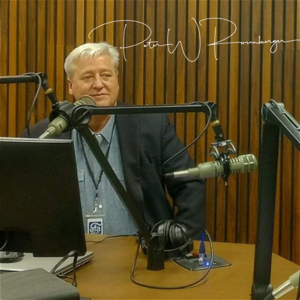
This is the Truth Network. Welcome to Hope for the Caregiver. This is Peter Rosenberger. Glad to be with you. This is the program for you as a family caregiver.
For those of you who are putting yourself between a chronically impaired loved one, an even worse disaster, how are you doing? How are you holding up? What's going on with you? You're the reason we Do the program. Hope for the caregiver.
What is hope for the caregiver? What is the conviction? that we as family caregivers can live a calmer healthier, and dare I say it. a more joyful life while serving as a caregiver. not in spite of serving as a caregiver.
Not after we serve as a caregiver, while we're doing it, because we're doing it. And we can become greater because we're doing it. We can become better people through this process. That's the whole point of this. It's not that we've got to get through this and then we can get on with our lives.
This is our life. It's not a bad life. And we can become better through it. And we can, more importantly, see things more clearly about the things of God. Hopeforthecaregiver.com.
Hopeforth the Caregiver dot com. Over the years, I have had the opportunity to speak with thousands of family caregivers. And in doing so I've learned to identify a few common denominators. You want to hear him?
Okay. Since you asked. For example. Every caregiver I've met struggles with what I call the three eyes. We lose our identity.
We become isolated and we lose our independence. The three I's. I've talked about this extensively, and I've covered that in my book, particularly Hope for the Caregiver, which is available, which I wrote many years ago. And I would highly recommend getting a copy of that book. It will lay it all out for you very easily.
There's an audio version, and the print, and the e-version.
So I would recommend that. But there are other common denominators among caregivers.
Now, the circumstances we all deal with are very different. I deal with somebody who endured extreme trauma.
Okay, you may not be dealing with that. You may be dealing with somebody who has a a disease such as Alzheimer's or so forth.
Some of you may be dealing with a a special needs child.
Some of you are dealing with aging parents.
Some of you are dealing with somebody who has mental illness or somebody who has an addiction. There are all kinds of different scenarios. But there are common denominators. That Transcend all of those things. They intersect all of those things that people are dealing with.
that go beyond the three I's. of identity, isolation and independence issues. I have come to believe and understand and experience that when caregivers face brutal challenges, particularly challenges that stretch on beyond the horizon, three core questions eventually emerge. Three core questions. The first one is.
Where's God? The second one is Why would a good and loving God allow this? And the third comes directly from Scripture. How long, O Lord?
Now, sometimes the questions may come in various You know, versions of that. But those are the three distilled questions that I see so many caregivers. Ask. In addition to a lot of times the person that they're caring for, if they're lucid. but certainly the caregivers.
will ask these questions. Maybe very timidly, maybe not very, very forcefully at all. They may be too embarrassed to ask, ashamed, feel guilty, or feel like they're being irreverent towards God, or all kinds of things. But whatever, the question's still there. It's still lurking.
It comes from the basement of our hearts and it hangs out there. and every so often, if the pain is enough, if the heartache is enough, It'll go beyond being whispered in a hospital chapel. or behind the closed door of a bathroom, and it'll erupt. It will come out.
Now, we all have lots of different types of questions as we're caregivers. I mean, you know, Some of us have to learn how to give injections.
Some of us have to learn how to change a urine back.
Some of us have to learn how to take out drains.
Some of us have to do wound care.
Some of us have to deal with lots of meds.
Some of us have to deal with learning disabilities.
Some of us have to deal with. The effects of alcoholism and addiction and so forth and memory care. There's so many different things. And every unique situation comes with its own set of unique questions, but those questions can be answered. relatively quickly.
For example, wound care. I remember the first time I had to change a very complex dressing. I'm not talking about band-aid, I'm talking about complex dressings. And yeah, it was a little nerve-wracking, but I did it and I learned how to do it, and I don't freak out about it anymore. I don't ask that question every day.
I don't wake up thinking, how am I going to learn how to change this dressing? How am I gonna learn how to give this injection? How do I deal with this insurance company? How do I deal with this doctor? I don't wake up every day and think about it.
In fact, I don't even think about it once a week, once a month. I rarely think about it once a year. I mean, it's one and done. I've learned it. Chances are so have you.
But that's not what I'm talking about. What I'm talking about are theological questions.
Now the word theology. can intimidate people. It sounds like it's something reserved for seminaries and professors and pastors and people surrounded by a lot of big books. But theology simply concerns what we know and believe about God. When we ask where's God, we are doing theology.
You know, there used to be a time when we studied theology and it was considered the queen of sciences and philosophy its handmaiden.
Now, what does that mean? Theology was the queen of sciences, and its handmaiden was philosophy. Think about that. was founded. for the theological studies.
That's why Harvard was founded, and Princeton, for that matter. They've deviated from that founding, wouldn't you say, quite a bit. But there was no higher. Nobler pursuit of knowledge than the study of theology. And philosophy was right there with it to ask those questions: why are we here?
Who are we? What are the implications of what we're learning in theology? Theology was the queen of sciences.
Now we don't teach theology in a lot of our higher education. Or should I say higher indoctrination institutions? And we have religion department, where religion and theology are not the same. Theology in a nutshell, is the study of God. more specifically the study of the nature and character of God.
Religion, on the other hand, is something different. Religion is the study of human behavior regarding worship, rituals, and religious practices. Religion is fundamentally man centred as an academic subject. Theology is God centered. Religion studies human behavior, what people believe, how they worship, and the practices they observe.
Theology has as its object the nature and the character of God. Religion begins with man, theology begins with God.
Okay? Can we can we all kind of Not along that we understand those basic differences because it's really important where we go from here and why I'm even doing this. Again, you may be tuning in for the first time. You said, I thought this was a show for caregivers, not a study of theology. It is a show for caregivers.
And I'm telling you, I have been doing this for a very, very long time. forty years now. In fact, tomorrow's our fortieth anniversary. We've been married forty years. I've been doing this.
for a long time. And in that journey, I've learned some Profound Principles. about life, love, faith, and the character of God. And I've learned that So Figuring out how to give an injection or dealing with an insurance company is not my major battle. I am my major battle.
And my beliefs about God. and how my life is governed by those beliefs. is the major battle. What I do as a caregiver reflects what I believe about God. And I had to be.
deconstructed and then reconstructed. With understanding, in order to gain what I've learned through this journey. And so, I want to share this with you, fellow caregivers, that. We are not merely asking. how we should behave religiously.
while we're suffering. What is the best way to go to church service while you're suffering? That's not what we're asking. What kind of music should we listen to while we're suffering? No.
We're asking questions about the nature and the character of God Himself. Where is He? Is He good? Can He be trusted? These are theological questions.
You are not going to tune into this show and listen to me say, You need to pray more, you need to go to church more, you need to quote this verse. No. We're going to learn together. more about the character of God. and what that means to us while we take care of somebody who is suffering.
That's what we're going to learn together, you and me. Because that is hope for the caregiver. We'll be right back. If you're feeling overwhelmed, exhausted, or carrying more than you could put into words, I've created something just for moments like that. Go to hopeforthecaregiver.com.
Right at the top of the page, click the blinking caregiver 911 light. That page will take you to a short guided audio I made to give caregivers a quiet place to pause, breathe, and set the load down. You don't have to fix anything. You're allowed to rest here. Hopeforthecaregiver.com.
Click on Caregiver 911. Two. Welcome back to Hope for the Caregiver. This is Peter Rosenberger. Glad to be with you.
HopefortheCaregiver.com. Hopeforthgiver.com. For centuries, Theology was called the queen of sciences And philosophy, the queen's handmaiden. I'll talk about this in the last block.
Now, those phrases may sound real weird to you, particularly on the show for caregivers, but stay with me for just a moment, okay? Just hang tight, just hang in there like a hare in a biscuit, and just hold on. How can theology be a science? When we hear the word science, we usually think of biology or chemistry or physics, laboratories, microscopes, that kind of thing. Biology studies living organism, chemistry studies matter, physics studies the behavior of matter and energy.
What does theology study?
Well, the word theology comes from two Greek words Okay? Theos meaning God and Logos meaning word, reason, or study. Theology is the discipline study. of God. His nature?
His character. His works? And what he has revealed. The older word science Did not refer only to laboratory experiments. It meant an organized and disciplined body of knowledge.
Theology is not a science because we place God under a microscope, conduct experiments on Him, or things like that. God is not an object within creation that we could examine alongside. Rocks and cells and chemicals, that kind of thing. Theology is a science because we carefully and systematically study what God has revealed about Himself. And theology was called the queen of sciences because every other field of knowledge ultimately exists within the world.
God created and governs. Biology studies the life God created. created. You look at Katanji Brown, Supreme Court justice, when Marsha Blackburn asked her, you know, what is a woman? She says, Well, I'm not a biologist.
Well, she's not a theologian either, because if she was a theologian, she would have known. What a woman was. And she would have known what biology was too, for that matter. Physics studies the order God established. History examines events unfolding under his providence.
Ethics ask how creatures made in his image ought to live. Theology sits above all of those disciplines, not because theologians are always smarter. Than everyone else? But because theology Concerns where everything else comes from. The one from where everything derives.
Then there's philosophy. What they used to call theology's handmaiden.
Well, what does philosophy have to do with any of this thing?
Well, philosophy helps us think clearly. It helps us define our terms. We examine our assumptions, we follow an argument, we recognize contradictions. And we distinguish between what we feel and what is logically true.
Now, philosophy can't reveal God to us, scripture does that. Philosophy does not sit in judgment over God's word. It serves us as we seek to understand God's Word accurately and consistently. The handmaiden, if you will, To stay with that, doesn't rule the house. The queen does.
The handmaiden serves the queen. Philosophy doesn't rule here, it serves.
Now what does any of this. Have to do. with a tired family caregiver.
Well, I'm glad you asked. because suffering creates theological questions. Not just for the sufferer, not just for the caregiver, but also for the people. that are observing. I maintained for years That the moment my wife walked out on stage on her two prosthetic legs to sing.
She created a theological discussion. In fact, you could go all the way back to her birth. She was born with an eye defect. Her eyes were crossed horribly behind her head and and when she was born, and the first words they said about her when she was born was, There's something wrong with her eyes. just by showing up.
She caused people around her to question the goodness of God. Why would God allow this for a little baby? She had nothing to do with it. She just showed up. and people started asking theological questions.
I just did an interview with Johnny Erickson Totti. You'll be able to hear it at my Substack and I'll have it posted out if you want to go out and. It's sign up for it. You can sign up for free, and it'll send you a little email when it comes out. It's a wonderful interview.
Go to caregiver.substack.com, but when Johnny wheels out on stage in her wheelchair. There's a theological question that floods the entire room that she's in, or stadium, or auditorium, wherever she is. Suffering prompts these things. Pain tells us that God has abandoned us. Fear tells us that nothing good could come from this.
Suffering can make our clear thinking. A bit compromised, wouldn't you say? How many of you all think clearly when you're in anguish? Exhaustion tells us this is never going to end. And these are real feelings.
I mean, they really are. We all, if you're a caregiver of any timeframe, you've felt this. And they're powerful feelings, and they they deserve to be acknowledged. But are they true? And that's where theology and philosophy serve us.
Are they true? Is it never going to end? Did God abandon you? Can anything good come from this? Theology asks, What has God revealed about Himself?
Philosophy helps us ask Does my conclusion necessarily follow from what has happened. If I cannot feel God's presence, does that mean He's absent? If I cannot understand his purposes, does that mean he has no purpose in this? If something terrible has occurred, Does that Mean that God has ceased to be good? These are not academic exercises for us as caregivers, are they?
Let me give you another example here. Years ago, I was in Ghana with our prosthetic limb outreach. When Gracie gave up her legs, she had a vision to put legs on her fellow amputees. We've been doing that for over twenty years, standing with hope. And you can see more about it.
We send supplies regularly. In fact, I've got a shipment I need your help with right now. If you don't mind me putting in a plug, I really need the help on this. It's expensive to send this stuff over. And I need to put a team together, but I'd have to have somebody stay with Gracie while I do it.
And it's. Fairly involved, and some of you. May have a bunch of money sitting around you don't know what to do with.
Well, you know what? I have, if I may be so bold, I have an opportunity, and we'd like to send over a bunch of supplies. I've got it ready to go, and also I'd like to start playing for a team.
So, anyway, standingwithhope.com if you want to get involved with that. But, anyway, so I'm over in Ghana. And This has many years ago and I had one of our team members, great guy, And there was a little boy that came in. Four years old, his name was Benjamin. And he was hurt in a uh a vehicle hit him.
I don't know if it was a motorcycle or a car, I can't remember, but a vehicle hit him when his mother and he were crossing the street or he was crossing the street and tore his leg off. Four years old. And he comes in there and we're going to put a pediatric prosthetic limb on him. And this one team member was really taken with this boy. He just loved seeing him.
The little boy's attitude was just so great. And as team members, we were building the leg and there was a lot of people there. I mean, there were so many amputees there. And I was managing the whole team and I was running around like an idiot, you know, as I often do. And this guy asked me, he said, you know, where was God?
when Benjamin got hurt. And I was so tired, and I didn't have time to really. sit down and unpack all this, whatever. And I said he was there watching the whole time. He was there.
He was waiting for him there. It was very matter of fact that I said it. I said, just like you was with Gracie when she slammed in that concrete abutment.
Now to be fair to this man, This was a new concept to him, not a new concept to me. At the time, I had wrestled with this for decades by this point. and I had searched the Scriptures and came to a place where I could say such a statement. and not be freaking out about it. But he freaked.
And he told me later, he said, When you said that to me, it wrecked me. He said, You're absolutely right, but it wrecked me. And I've never forgotten that. I thought, you know, because he had not thought of this. He thought that somehow this, you know, God heard about this through the grapevine that Benjamin got hurt and God sent a team to help out there.
But I had already made peace with the fact that God doesn't play defense. God Gracie's car wreck didn't catch God by surprise. You've heard people say about predestination in the church and so forth, and they say, They try to come up with how this worked, and everybody gets all mad about it. And one group said out there said, Well, God looks down the corridor of time and sees who's going to pick him. That's what that means.
And my question then and response is: well, so you're telling me God learned something? I mean, think that through for a minute. Aren't you saying God learned something? Is that what you're telling me? Uh, the all-knowing, omniscient, all-powerful God that we serve, the great I am, learned something.
He looked down and see who's going to pick him. Oh, okay, he's going to pick.
Okay, I learned that. You know, we don't think about it. That's again, that's where philosophy comes in. Am I drawing the correct conclusion here? Is that what Scripture says about God?
And This guy had to struggle with that. What I said, you know, in the fly at a prosthetic limb clinic in West Africa. But Was God there? When that vehicle struck Benjamin? Let's start with it.
Was God there? Did it catch God by surprise? Was God there when Gracie's car crashed into that concrete abutment? Was God there? when Johnny dove off that dock in the Chesapeake Bay?
Well, let's go to the text. Don't take listen my opinion is irrelevant.
Okay. Let me just again make that disclaimer. My opinion is worthless. I have nothing to offer you. From my own opinion.
As Bill Gaither said it beautifully, all I have to offer him is brokenness and strife. He made something beautiful in my life. I got nothing, y'all. But now here's where the authority is. Psalm one thirty nine.
Where shall I go? From your spirit? Or where shall I flee from your presence? If I ascend to heaven, you are there. If I make my bed in Sheol, you are there.
If I take the wings of the morning and dwell in the uttermost parts of the sea, even there your hand shall lead me, and your right hand shall hold me. Where was God? When Benjamin was hurt. Where was God? when Gracie was hurt.
Where was God? When Johnny dove off that duck, Where was God when your loved one? got the diagnosis. Where was God? Where was God?
Where was God? This is a question a lot of caregivers ask. We're having a theological discussion right now. People say, I don't want theology. Just give me Jesus.
Well, who is Jesus?
Now we're having a theological discussion.
Okay? You see how this works here? Where was God? Heaven? God's there.
The grave? God's there. The furthest reaches of the sea? God's there. If I say, Surely the darkness shall cover me, And the light about me be night, even the darkness is not dark to you.
This is what David is saying in scripture. That includes the darkness of a hospital room. of an accident scene. Of a diagnosis, of a little boy losing his leg, of a woman slamming into a concrete wall. There is no corner of creation that is hidden from God.
There is no accident that takes place outside his knowledge or beyond his presence. Yes, God was there. But my answer that day to that friend of mine was incomplete. We're going to talk about that when I come back. This is Peter Rosenberger.
This is Hope for the Caregiver. There's more to go. Nobody taught me how to be a caregiver. I've spent 40 years learning the hard way, and that's why I created caregiver.substack.com. No scrolling and hoping to find a nugget.
Just articles, audio, video, and practical insights I've learned over four decades as a family caregiver. When I post something new, it goes straight to your phone. or your inbox. And by the way, every bit of it is in Fluent Caregiver. Caregiver.
Substack. com Welcome back to Hope for the Caregiver. This is Peter Rosenberger. Glad to be with you. HopefortheCaregiver.com.
I'm tackling something that. Quite frankly, I probably should have done it a long time ago. But after spending forty years as a caregiver, And spending an awful lot of time with caregivers, writing hundreds and hundreds and hundreds of columns about this, four books. I thought, you know what? Let's educate ourselves a little bit, theologically speaking.
We as caregivers deal with hard realities. and it forces uncomfortable questions for us. But do we deal with the questions? Do people around us know how to deal with them? Do we know even how to ask them?
Do we feel okay asking them? And one of those questions is where's God? That's one of the questions that... I've heard so many times from caregivers. Have you asked that question?
Have you watched this thing unfold that you're dealing with and just say, where's God in all this? Where is he? That's why I wanted to tackle this today and spend some time with because, as caregivers, there's a point. I got to this point. I don't know if you're there yet.
Maybe you are, but I got tired of just being. you know, all over the map. I got tired of just living in confusion and frustration. I got tired of people telling me. Just Horse hockey of stuff.
Remember, I talked about that last week on that lady that, you know, no weapon formed against me when the power went out because of an ice storm. I got tired of people with bad hermeneutics, I got tired of people with bad doctrine. I I I got tired of it. I just got tired of being tired of it. And it seems like people were free to just.
spout all this nonsense to me. and Gracie, while we're going through these things, and none of it held up. None of it held up. And I have field tested this for four decades. And here's what I've learned.
Now there's not a lot of precedent for somebody like me. I don't know of anybody else on the air that has a radio programme for caregivers that's done it for four decades. Particularly in the kind of intense day-by-day crisis of the day moments that Gracie and I have. And if there were I'd listen to their show, and I'd read their book, but they ain't done it yet. I'm it.
I'm the guy. And so I'm going to take the time to unpack what I have learned through this. Because I was buffeted By people giving me all kinds of bad stuff. My own doctrines and my own beliefs were pitifully shallow and weak. And it was time for me to grow up.
and have grown up doctrine. where I was no longer just walking around stupid and clueless. And at the mercy of people, including pastors, who had no clue what to say to me. And so you know what? I went straight to the source.
Well, what does God have to say? And that's where I went. And I said, by the way, I made a miscalculation. I was incomplete. I said, God watched it happen with that little boy.
I told him God watched it happen. And that technically, I guess that's true. But that is not really the best word for it. Nothing escapes his notice. That made it sound like he was a passive spectator.
I maintain, and I said this to Gracie before she went down to this really big surgery. And she was so nervous, I said, Gracie, he's already there waiting for you. and he's going to shepherd you all the way down to that surgery. That's more in alignment with what scripture says. Yea, though I walk through the valley of the shadow of death, I will fear no evil, for thou art with me.
But he's already waiting for me too. And so there's not a, it's not passive with God. He's not like he's camped out.
Okay, it's about time for Gracie to come around the corner or Peter to come around. You know, that's not the way it works. He is ever present. Always working in our lives. All things work together.
for good to those who love the Lord and are the called according to His purposes. All things, what what part of all is tripping you up?
some things, all things. And in order for all things to be working for good, that means he has to be Lord of all. All things. If he is Lord at all, he is Lord of all. You see how philosophy starts.
helping us better understand what's happening here. We ask better questions.
Well, how can all things work together if He's not Lord of all? But he is Lord of all. And that's why I know that he was there all the time. And he's there every moment. God is not.
Watching history unfold. He's not reacting to events as they surprise him and wringing his hands alongside us, wishing he could do something. You know, you'd be amazed. It sounds simple.
Well, of course not, Peter. And yet, we act. and function and carry on as if That is the case. This doesn't make what happened to that little boy easier. It doesn't make what happened to Gracie easier.
Or Johnny. In some ways, it makes the question harder. If he were absent, perhaps he didn't know. And then, okay, well, we can understand that. If he were powerless, you know, he he couldn't intervene.
But if he was present, if he knew, and if he possessed the power to prevent it, Then that takes us into the second question. Why would a good and loving God allow this?
So you see, this is where caregivers live.
So, I'm not trying to take us down the road so we can get our master's of divinity. That's not it at all. I'm telling you that To endure something like this for a week is one thing. To do it for a month is one thing. It's to do it for a year.
maybe even a couple of years. But when you start getting into decades, and in my case a lifetime. You have to come to grips with certain things. You have to wrestle with them. You have to deal with these questions.
Where? is God. You got to deal with it. You don't get to just Casually Think about that. Because I've watched Suffering Now every single day.
For forty years. Gracie has lived it for more. Several months ago, I did a program, and you can see the article if you want out of my Substack. And it's Daddy's Here. And it's a chapter from Gracie's book.
And when she woke up from her wreck, she didn't she all she knew is she was waking up to pain. The last thought she had was being trapped in her car. Three weeks later she wakes up. And she starts to moan. She'd had and she's waking up to pain that would never leave her again since this is back in 1983.
And the first word she heard was Daddy's here, Gracie. Daddy's here. It was f it was her father. And she didn't even know where he was. Daddy's here.
And she, that kind of set the tone for how she would process this. and still is processing it. whatever she is facing is made Bearable. Because daddy's here. and not just her earthly father.
that she came to understand that her heavenly father, was there with her. And I've had to walk through the same thing. Spurgeon Had to go through the same thing. Listen to Spurgeon said: He trusts him where he cannot trace him. looks up to him in the darkest hour, and believes that all is well.
He trusts him. where he cannot trace it. And this is our life as caregivers. There are times you and I both Are not able to trace very well what's going on with us and with our loved one in the dark hours of the night. We are struggling.
We are feeling not just alone, we feel abandoned. There's a difference between feeling solitude, isolation, and then abandonment. And we feel this way. And our feelings are not to be dismissed. They are real.
They are. choking us.
So we have to speak to our feelings. and we have to calm them down. We have to do what is necessary from our spirit to tell our flesh settle down. But how are we going to do that if we haven't wrestled with this? If we haven't spent the time to think about these things, if we don't have the scriptures at our.
Fingertips to be able to say to ourselves, go back to David at Ziklag, his own men picked up stones to kill him. They were so angry with him that their wives and their children, their family, everybody was just taking all their possessions, everything was taken away while they were out following David around, and they were just bereft of everything. And they were so distraught that they were going to kill him. And he said David encouraged himself in the Lord. And I'm going to tell you something.
Caregiver to caregiver. There are times When there ain't nobody around you that's going to be able to speak to you. They don't know what to say. They don't have the words. And it's in that moment.
Wherever you are, whether you're in the middle of a hospital parking lot and you're just sitting in your car by yourself. Or you go into the bathroom and you just close the door. Or you go for a walk. Or you're sitting there at night looking at somebody labored, and their breathing is labored. Or you're watching somebody you love passed out drunk.
Or you're watching your child. I struggled to breathe. And nobody's going to know what to say to you. It's in that moment. that you could speak to yourself.
You can encourage yourself in the Lord, but you're not going to be able to do it unless you've wrestled with these questions, unless you have decided I am going to study theology so that I know what to say and what to what to how to write the ship. when all the waves are are just crashing over me.
So that I know how to speak. to my fears. There was a moment with Gracie, and I looked at her, and she was really struggling. And I said, Thou wilt keep him in perfect And then she finished it, Peace, whose mind is stayed on thee. And then I said God has not given us a spirit of and she said fear.
And I said, but if and she finished it with power and love in a sound mind. Thy word have I hid in my heart that I may not sin against thee. But the question I have to ask you is: Do you believe that? Do you believe this? And are you prepared to preach to the most needy congregate?
that you know, which is your own heart. Think about pastors for a moment. You've heard a lot of great sermons, I'm sure you have, and you've seen a lot of wonderful pastors who are very skilled at what they do and so forth. But I have always found, and I've heard, a lot of preachers. known a lot of them.
And I've often found that the most effective preachers I've ever heard are the ones who are not trying to convince themselves or convince you. They're not reading from a script, per se. They're preaching to their own heart. They're preaching to themselves. And that's sometimes what we have to do as caregivers.
because of the isolation that we are struggling with. you may not have anybody showing up at the hospital in those dark watches of the night.
So what are you going to do? And I want you to listen to this today, this program, and I want you to remember what I'm saying here.
So that you can say to yourself, I don't have to ask where God is, I know where He is. He was waiting for me in this moment, and he is shepherding me all the way to this moment, and he will see me through this moment. Where can I go? Where can I go that he's not there? Anchor yourself in this.
Go back to the scriptures. We can't always trace God's hands, but theology teaches us whose hand it is. Paul said it so perfectly. 2 Timothy 4, 16 through 17. And by the way, when I say perfectly, I mean it.
At My first defense, no one came to stand by me, but all deserted me. But the Lord stood by me. and strengthen me. and that is hope. For the caregiver.
This is Peter Rosenberg, and we'll be right back. My wife, Gracie, is a double amputee, both legs. Over the years we've learned something important. It's one thing to stand. It's something entirely different when you're Standing With Hope.
Through Standing With Hope, we provide prosthetic limbs for Gracie's fellow amputees. And we strengthen and equip my fellow family caregivers. Both are rooted in the hope of Christ. for the wounded and those who care for them. If you'd like to stay in with us, Visit standingwithhope.com slash giving that standingwith.com slash giving.
Welcome back to Hope for the Caregiver. This is Peter Rosenberger, HopefortheCaregiver.com. We are Tackling a new Thought process, if you will. For us as caregivers, and we're going into some theological studies. We're going to start spending some time discussing theology.
What it means to us as caregivers, you say, Peter, come on. I mean, I'm a caregiver. I don't need to know about theology. I just need to know how to deal with an insurance company. Really?
Is that it? Because I can teach you that in about 30 seconds. Make it about the bath. That's how you win with insurance companies. That's how I've dealt with every appeal.
I make it about the math.
So, I show it's in their financial good interest to go ahead and grant the request that I'm dealing with, or whatever.
Okay. So, that's one of the things I dealt with with insurance companies. Do you need help with wound care? Do you need help dealing with the doctor? I got all that.
I've written books about it, I've got it all. But let me tell you what. Every day I wake up thinking about which is the things of God.
Okay, God. What does this look like to trust you in this? And I go to those three questions that every caregiver will eventually ask. Where is God? How could a good and loving God allow this?
And how long, O Lord?
Some derivation of those three questions.
So, we're going to spend some time with that, and we're going to deal with that from a caregiver's perspective. And we're going to go back to what scripture says: what does the scripture say about this? Christian, what do you believe? Because you're going to have friends, like the hymn says: friends may fail me, foes assail me. you know, you're gonna have People, they're going to say things to you.
Out of good intentions, some of them out of just wanting to button up a conversation and get out as quickly as they can.
Some of them because they're in deep error and they like to go out and hear the sound of their own voice and they pronounce things over people that suffer and those who take care of them. You're going to hear all this stuff. People got a word for the Lord for you, all that kind of stuff. If you don't know where you stand, you're at the mercy of all that stuff.
Now, do you want to be? Or would you rather be standing on some bedrock, where you're not going to be moved and tossed about? This is the issue that I have wrestled with for a lifetime.
Now, Everything I've learned, I've learned the hard way. Do you want to as well? Or would you like to learn from somebody else who has plowed this ground?
Okay. I'm not giving you my opinion. I'm just telling you insights I've come to understand, truth I've seen in scripture that applies here, and helping better understand God and His character in this. And in light of all this, then I want to continue our series of hymns that every caregiver ought to know, and I'm going to introduce you to one. The lyric was written back in 1906.
You know I like old hymns. An Australian musician named Robert Harkness encountered a Young Christian. Who was struggling mightily and confided in Hartness that he didn't think he'd be able to hold out in the faith? He thought, you know, I'm going to fail at this. And Hartness thought about that and he asked a friend of his, Ada Havershon.
To write a text About the keeping power of Christ, not our keeping power, Christ's keeping power. And her original? uh song, the text that she wrote was called When I Fear My Faith Will Fail. And Harkness composed the first tune. It was very popular at evangelistic meetings, and then it kind of faded out.
Well A century or so later. A guy named Matt Merker rediscovered these words. And he was going through his own season of doubt, and June 24 became particularly important to him now, unto him who is able to keep you from stumbling and to present you blameless. Merker wrote a new melody. He condensed Habershahn's four stanzas into two, and then added a final stanza about Christ's death, resurrection, and return.
And then he introduced this at Capitol Hill Baptist Church in twenty thirteen. And it later became widely known through Keith and Getty, through their performances, through Getty Music. And so it is a A song that I've come to really love. This text is amazing, and it's called He Will Hold Me Fast.
Now, let's go over here to the caregiver keyboard. When I fear my faith will fail. Christ will hold. Leave pass. The Tim Turwool.
preface He will hold me fast. I could never keep my hold. Through life's Fearful past Fair my love is all Health and cold. He must hold.
Well Me best he will. Hold me fast for my Savior loves me so he will hold me fast Those He saves are His delight Christ will hold me fast precious in His Yeah. Holy side, he will be friends, he will not let my soul be. Lost this promise. Shall I Bought by Him at such a cost, he will hold me fast for he will hold me fast, he will hold me fast for my Savior loves me so he will hold me fast.
Can you sing that chorus with me? She was Hold me fast. He will hold me fast, for my Savior loves me so he will hold me fast. Once more, He will hold me fast, He will hold me fast, For my Savior loves me so He will be fast. I just love that song.
I really do, and it's such a joy to play it. It's one of those. Beautiful songs to play on the piano that that are just A delight and uh I'm working on getting Gracie so that she can sing these with me, and she is walking a little bit more. And so that's that's good news in getting her voice in shape because she would do a much better job on that than I do. But I love the song, and I hope it means something to you.
He will hold me fast. It's something you can remember very easily. He will hold me fast, he will hold me fast, and It's not about our grip, it's about his. And that's important to remember. We're going to delve into this more and more.
As we wrestle with these things. You and I, you and me, you and I, us, weans, all y'all. We're all going to do this together. And I want you to know how much I appreciate you taking the time to listen to this program. and and spending time with me.
I want to offer you something that's going to truly stabilize you today in the moment. And You know, I don't know. I don't know how you receive a song like that because I, you know, I've hear every clam that I make and I hear every mistake that I make when I'm playing it and so forth. And so I apologize for that. Profusely, but I hope that beyond that you can hear the text of the song that says, You know, you are held fast.
And as you remember those words, that it if it causes you to tear up, then you know let those tears come. They're there for a reason. Because some of you don't feel like you're being held.
Some of you feel like you're all alone, that you have been abandoned. And it goes to that first question, where is God? He's right here. He's right here. Now anybody else tell you that?
I don't know. Maybe you can look with a raised eyebrow or so. I don't know. Maybe you do it when I say it. But uh, you know, when the guys been doing it for as long as I have and been doing it through what I do with I'm not telling you this to convince you.
I'm telling you this to to assure you. And to remind myself and to assure myself These the I I don't have to convince you of anything. When you listen to this program, if you don't like what you're hearing, you can have your misery back and 100% refund.
Okay. but I would hope you could lay it down. for at least this program. And say, you know what? I am so frustrated.
I am so weary. I am so tired. And I feel so abandoned. And then you hear this program for caregivers run by this goofy guy. you know that has the caregiver keyboard.
My hope and my prayer is that it's It's connecting with you. That it's, you know, and I get letters from folks, and I appreciate, for example, Dana and Sadi Daisy. Dana, I want to give you a shout out. And I appreciate you listening. He wrote me a wonderful note last week after the program.
And I appreciate anybody that takes the time to listen. And I don't take it for granted that people do. I am keenly aware. of how great the need is. For family caregivers.
And if you're not a caregiver, you're going to get something out of what this program is about. You're going to get something, but you're not why I do the program. If you're not a caregiver, I promise you, I'm grateful that you get something. I'm grateful that you're listening, but you're not why I do the program. I do the program for those who are caring for somebody with a chronic impairment that is not getting better.
And it probably won't be this side of heaven. Mm-hmm.
So That's my Thoughts today as we start tackling these very difficult issues. I would encourage you, by the way, to go out to my Substack, caregiver.substack.com. I'm going to put the video interview out there that I did with Johnny Erickson Tata that I think you're going to absolutely love. And I have so many other things out there as well: caregiver.substack.com. And If this program has meant something to you.
If you were finding value in what I'm doing, would you share it with someone else? I think they might too. Friends don't let friends caregive alone. This is Peter Rosenberger. This is Hope for the Caregiver.
HopefortheCaregiver.com. And we will see you next time.