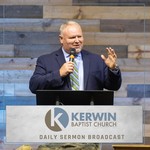
You've probably been there, weary and worn down from the burdens of life, exhausted in your body and soul. For these times, Jesus offers an invitation. Today on Turning Point, Doctor David Jeremiah reveals that invitation and the relief that comes from accepting it—a welcome respite from the battles of spiritual warfare. Listen now as David introduces today's uplifting message: rest for your soul. Do you know that the Bible says that God wants to provide rest for our soul?
Do you have a tired soul? Are you worn out spiritually? Do you wonder sometimes if the walk is worth it?
Well, don't miss today and tomorrow for a great passage of scripture from Matthew chapter 11, and from the book "The Battle for Your Soul." We're going to talk about rest for your soul. In this new book, "The Battle for Your Soul," the first section of the book is called the War Zone, and the War Zone for every believer is your soul.
So many people go through their whole life not even realizing that they have a soul, or that their soul is who they really are. And we've written this book to fix that problem. I hope you'll get your copy of it, either by sending a gift to Turning Point during the month of October and requesting your copy, having it sent to your home, or by going to. To one of the major bookstores in your community and getting it. It's available now in all bookstores, available for you to get and start to read.
And hopefully, these words that were written for you will strengthen and help you in your walk with Christ. Hey, don't forget. Turning Point has a magazine. If you're not getting it, you should ask about it when you call or write. We'd be happy to provide it for you, and it will be a blessing to you.
It will feed your soul—that's for sure—and it'll be something you will want to continue to get month after month. Right now, we're going to begin this two-day discussion of rest for your soul from Matthew chapter 11. When you hear the passage, you'll remember it, and God has something special to say to you today. On August 6, 1930, Supreme Court Justice Joseph Crater vanished on the streets of Manhattan near Times Square. He was 41 years old, well-dressed, highly respected judge, and he has simply disappeared without a trace.
His sudden disappearing launched one of the largest investigations in New York history. Captured the attention of the entire nation, and newspapers called him the missingest man in New York. Investigators explored every possibility imaginable: kidnapping, murder, organized crime, even suicide. Theories multiplied, but answers never came. And despite years of searching, authorities never did determine exactly what happened to Joseph Crater.
But among all the mysteries surrounding his disappearance, there was one haunting piece of evidence. Back at home, his wife discovered an envelope stuffed with cash and a short handwritten note from her husband containing only five words: "Am very weary, love, Joe." I think if we consider that, most of us will say there have been times when we have been very weary—not just weary in body, but weary in soul. When I ask people how they're doing, quite often they say, "You know, Pastor Jeremiah, I'm really tired," and I know what they mean when they say that—they're kind of worn out from the pressures of life. And maybe you're tired from trying to hold your family together. Maybe you're carrying financial pressure, going through a health struggle, or the weight of expectations that never seems to let up.
Maybe you lie awake at night worrying about the future. A writer by the name of Jane Wagner once said, "Listen to this: reality is the leading cause of stress for those who are in touch with it." Someone has said we all experience the five Cs of life: change, conflict, criticism, concerns, and crisis. And if one of those hasn't worn you down yet, just wait—it's on its way. The question before us today is this: What does Jesus have to say to people who are carrying heavy burdens? Does He care about those of us who are exhausted and overwhelmed?
I believe he does, and I want to show you why I believe that from the Word of God. In Matthew 11 verses 28 to 30, we read these special words. These are the words of Jesus: "Come to me, all you who labor and are heavy laden, and I will give you rest." Take my yoke upon you and learn from me, for I am gentle and lowly in heart, and you will find rest for your souls. For my yoke is easy, and my burden is light. Through the centuries, these words have captured the hearts and imagination of countless people, artists, hymn writers, preachers, ordinary believers.
Have all tried to portray the beauty of this invitation. One of the most famous statues in the world is called Christus, sculpted by Danish artist Bertel Thorvaldsen. It portrays Jesus standing with outstretched arms, inviting weary people to come to Him. And the inscription at the base of the sculpture just reads, "Come unto Me." That statue captures the spirit of this portion of God's word. Jesus' words are unique to Matthew.
In other words, they're not in Luke and John and Mark. But here in this setting, we see Jesus looking out over the people of his day and seeing them as sheep without a shepherd. And underneath all their religion, confusion, questions. He saw weary souls that were searching for God, so he gives an invitation. What is an invitation?
It says, "You are welcome here. I want you to come." And the Bible contains a number of unforgettable invitations. Remember when Noah invited all the people into the ark, and Moses called Israel to walk out of Egypt into the Promised Land. Isaiah the prophet. Records these words: Come, everyone who thirsts.
And at the end of the Bible, in the book of Revelation, we read: Whoever desires, let him take the water of life freely. But, ladies and gentlemen, there's never been an invitation like the one Jesus gave in Matthew eleven twenty-eight. Wasn't addressed to kings or celebrities. It was given to ordinary people who carry burdens just like you and I carry, that sometimes just seem too heavy to bear. Matthew eleven twenty eight Come to me, all you who labor and are heavy laden, and I will give you rest.
When Jesus said come, he wasn't making a casual suggestion; he was giving a clear and compassionate invitation. He saw people burdened by life, and he called them to himself. He said, "If you're burdened, come to me." I want you to notice with me who was on this invitation list: those who labor and those who are heavy laden. Those two phrases I want to unpack for a moment because together they describe so many of us: the burdened, those who labor. This describes people who are completely worn out.
It speaks of someone who has pushed himself to the limit, working, striving, worrying, and trying to hold everything together until they are drained physically, emotionally, and spiritually. Jesus is not talking about someone who just had a bad day. He's talking about the person who says, "I've tried." I've carried this as long as I can, and I don't know if I have anything left. I don't know if you've ever been there, but I know a lot of people who have. While I may not have been there, I've been close.
But this invitation goes even further. It also is directed toward those who are carrying crushing sin. The psalmist wrote. My iniquities have gone over my head like a heavy burden. They are too heavy for me.
There is a burden that comes from living apart from God.
Some people think they don't want to be Christians because they will lose all of their fun. They won't have fun anymore. What they don't realize is they carry a burden that is exactly the opposite of fun. There is stress in sin. Paul Myers, who founded the radio program Haven of Rest, described the crushing burden of sin in his own life before he came to Christ.
He said, "One winter morning in San Diego, after I had wandered many miles along the waterfront in a daze, I turned my steps toward my hotel room." I had been drinking heavily for weeks. My mind was tortured by the thoughts of the wife and four children I had deserted. I had dragged my family down with me until they were living in a little hovel, and then, I just deserted them. I had suffered a complete nervous breakdown, and the future held no promise. What he said is a description of what happens to so many people.
You may not know it because it's not usually described, but if you get into their lives and they come open to you, you discover they're living a life that is described like that of Paul Myers. That is what sin does. It drains your hope. It leaves your soul exhausted. But the good news is that Jesus is the great sin bearer, and He comes to you to lift your burden of sin from you.
Behold, the Lamb of God who takes away the sin of the world. Or First Peter two, who Himself bore our sins in His own body on the tree, that we, having died to sins, might live for righteousness. By whose stripes you were healed. Often, when people have become Christians and they have talked to me, they have described it like this: They've said, "Pastor, it felt like a weight was lifted off my shoulders. It was the weight of sin." In John Bunyan's classic allegory, *Pilgrim's Progress*, he pictures Christian beginning a journey, carrying a heavy burden on his back, a symbol of the guilt and weight of sin.
He travels through dangers and struggles and doubts, searching for peace with God. At one point in the journey, Christian comes to a hill where a cross stands above an open tomb. The moment he reaches the cross, the burden suddenly slips from his shoulders, and tumbles down the hill and falls into the tomb and disappears forever. For the first time, Christian feels completely free, overcome with joy and gratitude. He stands there amazed that the cross could remove a burden he had carried for so long.
Tears fill his eyes as he realizes he has found rest through Christ's sacrifice. Bunyan's description is unforgettable. Jesus invites the weary and burdened people to come to Him. Not to earn salvation, but to receive it as a free and undeserved gift. Notice, Jesus does not say, "Try harder." That's what most of us do.
Jesus says, "Come to me, the burdened." And then He adds to His description of those for whom this invitation is intended, "the burned out." And then Jesus said. All you who are heavy laden, here Jesus was describing people carrying burdens placed upon them by others. The religious leaders of his day had turned God's law into a crushing system of rules and expectations.
Some experts say there were more than five or six hundred of them, beyond the law, beyond the Ten Commandments. People were exhausted trying to keep all those rules and all those measurements. And here is how Jesus described what was going on. In Matthew 23, he says, "The scribes and the Pharisees bind heavy burdens, hard to bear, and lay them on men's shoulders, but they themselves will not move them with one of their fingers." Jesus was addressing people who were experiencing what we call burnout.
Now I've heard that term all of my pastoral life. Probably have even said something like, "I fear that I might be headed toward burnout." But, ladies and gentlemen, burnout is not working too hard. Burnout is working too hard at something you can't do. It's working too hard at something that won't work. Burnout is not just working hard.
It's working toward something that cannot be achieved. It is fatigue and frustration from efforts that don't bring any fulfillment. In Jesus' day, people tried desperately to meet the overwhelming demands, yet they knew inwardly they could never do it, and the result was exhaustion of soul, burnout. Things haven't changed much, have they? I mean, burnout has been called the malady of the overcommitted, and it is more prevalent now than ever.
Because those who truly want their lives to matter often feel the strain, but let me tell you something: burnout will come when you keep trying to do what you can't do. And as unbelievers, trying to go to heaven in your own strength is an undoable task.
So many people feel like if they just do enough good things, they will be all right for heaven. But heaven isn't about people who do good things. It's about God who did the one thing, which was necessary. He gave us His Son to be our substitute.
So when we put our trust in Him, we can go to heaven. Listen to what Jesus says. He says, "Come to Me, and I will give you rest." It's just that simple. All you have to do is accept Jesus' invitation and give your heart to Him, and He's promised you a different kind of life. Years ago, there was a famous scholar named John Duncan who taught at the Edinburgh University.
He was famous for his knowledge of Hebrew and the ancient languages. It was so extraordinary that students jokingly said he probably prayed in Hebrew as well. But one evening, two students quietly stood outside his bedroom door, expecting to hear deep theological prayers filled with impressive language and scholarship. Instead, through the keyhole, they heard a simple, childlike prayer. This great intellectual giant prayed, "Gentle Jesus, meek and mild, look upon this little child.
Pity my simplicity. Let me come to you." That is the heart of this invitation. You don't have to impress Jesus. You don't have to come to Him polished and all cleaned up. You simply have to respond to Him as you are.
He invites you to come. Come to Me, all you who are heavy laden and burdened. But then, after the invitation in this passage of Scripture, we have some instruction in verses 29 and 30. We are told how to find rest. Very interesting passage of scripture, Matthew eleven twenty nine.
Take my yoke upon you, and learn from me, for I am gentle and lowly in heart, and you will find rest for your souls. For my yoke is easy, and my burden is light. In Bible times, a yoke was made to fit around an animal. And skilled carpenters would smooth the rough places and shape the yoke carefully so that it would rest on the shoulders of an ox. A bad yoke rubbed and wounded.
A good yoke fit well. When Jesus removes our burdens, He gives us another one. This one is entirely different from the one we carried before. Dr. Paul Brand explained it this way: Jesus offers us each a well-fitted yoke.
He does not call us to the kind of rest that means inactivity or laziness, that would lead to spiritual atrophy. Instead, he promises a burden designed to fit my frame, my individual needs, my strengths, and my capabilities. I come to him weary and heavy laden. He removes those crushing burdens that would destroy any human being, and replaces them with the yoke of appropriate stress designed specifically for me. I've read this passage as you have all my life, and I remember when I first read it, I had this picture of a yoke of oxen with Jesus on one side and me on the other side, and together, me and Jesus.
We were pulling the load, but when I studied the passage more carefully, I discovered that is not what Jesus meant at all. You see, in Jesus' day, taking someone's yoke was a common rabbinical expression for becoming that person's disciple. To take a teacher's yoke meant to place yourself under his instruction. Under his leadership, under his authority.
So when Jesus says, "Take my yoke upon you, and learn from me," he is really saying, "Become my disciple. Bring your life under my direction. Let me shape the way you think and live." If you study the life and teaching of Jesus, you discover something very clear: Jesus asks for everything. He doesn't say, "Give me ninety percent of your life. You can keep ten percent.
Do what you want." No, he says, "Give me everything, every area, every corner of your heart. Bring that under my authority." That's difficult because we naturally want to hold something back. I'm that way. You're that way. We want Christ to guide part of our lives, and we continue controlling the rest.
But the truth is this. No Christian can ever truly experience peace while fighting against the lordship of Christ. Let me tell you where stress often comes from in my life. Over here is one circle representing what I believe God wants for my life and my ministry, my vision, my goals. Over here is another circle which represents my own ambitions, my preferences, and my plans.
And the exhaustion comes from when those two circles do not line up. God is leading in one direction in this circle. I'm going over here in my circle, and until you can get those circles to come together, there's this tension that pulls apart. What he wants, what you want. As a Christian, you know better.
You know that what you're doing is not necessarily the Lord's will, but you pull against it. And then we wonder why we have stress. Jesus is teaching something very simple here. If you want rest, bring those two circles together. Let His will become your will.
Let your will become His will. Stop trying to live for two different agendas at the same time. And that is exactly how Jesus lived. You know, one of the things I always have thought was strange about Jesus, and you can disprove this for me if you're a New Testament reader. But Jesus never seems to be in a hurry.
Have you ever noticed that? I never noticed Jesus running from this place and running from that place in a frenzy like we normally do. He was always at peace, and he walked. You remember when Lazarus died? Jesus took a day off before he went to take care of it.
He was always at peace, and one of the reasons he had peace in his life is described in words that come from his own mouth. Very seldom do you see this in the New Testament, where Jesus describes his inner feelings. But in John eight twenty nine, he said, "This I always do; those things." That pleased him. Jesus was at peace because he lived under one agenda. He didn't have to worry about what anybody else wanted him to do.
He always did those things that pleased the Father. One reason many of us live with so much stress is because we're trying to manage too many agendas. We're trying to please ourselves, our friends, our families, our employers, our culture, our teachers, and somewhere in the middle of that, we try to please God too. When I came here back in 1981, this church was one church in three locations. I try not to think about it too much.
It was a very stressful time. Every church had their own ideas of what I should do and who I should take care of. If I was here, I should have been downtown. If I was downtown, I should have been up north. It all came to grips one night when I was downtown after church on a Sunday night.
One of the ladies of the church—I don't remember who she is—and I'm kind of glad because I'd probably still be mad at her. But she came up to me, and she said, she stuck her finger in my face. She said, "I just want you to understand something, young man." She said. You work for me. You work for us.
You get your check from us. You do what we tell you to do. You work for us, and you know the thought of working for that woman really was stressful to me. First of all, it wasn't true. But if it were true, that would have been an awful experience.
And I remember thinking, you know what? I don't work for you. I work for Almighty God.
Now that doesn't mean I'm not concerned about what others say. But if you're a pastor of a church of eight thousand people or whatever we have, and you think you're going to be able to please everybody in that church, you're in for a rude awakening. I have never been able to prove any way possible for anyone to make everybody in this church happy. Most of you are happy, and for that I'm glad. But somebody's always got an issue, and they always think you're the one who's supposed to fix it.
Early in my time here, I came to grips with the fact that I must live out my life before an audience of one. The most important thing for me to do, and the best thing I could do for this church, was to walk every day as best I knew how in the will of God. I discovered that. Everybody I met had a determination about who I should be and what I should be, and those first few years were very confusing to me. Until I settled in on this truth: I stand before God, and one day I will give an account to Him—not of just what I do in the church, but my whole life, my priorities, my personal walk with Him.
And what is true for me is true for you. Hey, tomorrow we'll finish up this discussion on Matthew eleven twenty-eight to thirty, rest for your soul, and then on Thursday and Friday we're going to talk about restored souls. Do you remember what the psalmist said? He restoreth my soul. Two days of discussion about what that means coming up Thursday and Friday from the book The Battle for Your Soul, the 240-page hardcover that just was released in the early days of October is available now to you.
Yours for a gift of any amount to Turning Point. When you ask for this resource, we'll send it to you right away. Thank you for your gift. We'll see you tomorrow. For more information on Dr.
Jeremiah's series, "The Battle for Your Soul," please visit our website, where we also offer two free ways to help you stay connected: our monthly magazine, Turning Points, and our daily email devotional. Sign up today at davidjeremiah.org/radio. That's davidjeremiah.org/radio, or call us at eight hundred nine four seven nineteen ninety three. Ask for your copy of David's helpful new book, *The Battle for Your Soul: Thirty-One Biblical Secrets of Spiritual Warfare*. It's yours for a gift of any amount.
You can also purchase the Jeremiah Study Bible in the New International and New King James versions, complete with notes and articles from Dr. Jeremiah's decades of study. Get all the details when you visit our website, DavidJeremiah.org/radio. This is David Michael Jeremiah. Join us tomorrow as we continue the battle for your soul on Turning Point with Dr.
David Jeremiah.