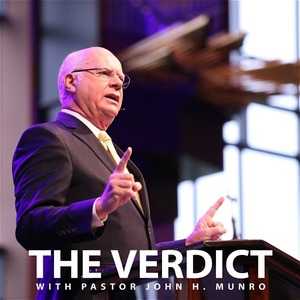
Today on the Verdict with Pastor John Monroe. I've called this message on the way to the cross, and I'm saying we are to follow Jesus on the way to the cross. That the cross is always to be before us. How can you refuse to serve others as you stand at the foot of the cross and look at the marvelous Christ who pours out His blood so that you and I, sinful men and women and boys and girls, may be redeemed. Welcome to the verdict, featuring the Bible teaching of Pastor John Monroe.
Pride is often called the universal sin because we all want to put ourselves first. Even the disciples of Jesus argue about who will be the greatest in the kingdom of heaven. Today, we're discussing the response of Jesus as he teaches his disciples on the way to the cross.
So, continuing our study in the Gospel of Matthew, here's Pastor John Monroe to introduce today's lesson. Many years ago, Muhammad Ali said, "I'm not the greatest; I'm the double greatest. Not only do I knock him out, I pick the round." We smile when we hear comments like that, but isn't it true that we all think we really are great? The twelve disciples were certainly not exempt from pride or ego. In the Gospels, we read of them arguing among themselves as to which was the greatest.
Scripture tells us that God is opposed to the proud and gives grace to the humble. Yet pride impacts us in all different kinds of ways. Let's listen to Jesus teaching his disciples on the way to the cross. This is a passage I turn to frequently. To be reminded of what it means to be a humble follower of Jesus.
Have you noticed in the world of social media the rise of pride, the rise of arrogance, the rise of hubris? Everyone apparently claims to be an expert on social media. Have you noticed that? Use however bizarre. Are stated with supreme certainty.
Anyone who takes a different view is regarded as an idiot. Their view is absurd. Pride. Is rampant all around us. We see it in social media.
We see it in politics. We see it wherever we go. Indeed, we see it in our own lives. You may have heard of the writer who talked non-stop about himself for about thirty minutes, and then said, "Well, let's stop talking about me. What do you think of my new book?" Isn't it the case that pride is?
All too obvious in others, but often we fail to see it in ourselves. Repeatedly, the Bible warns us of pride, pride and arrogance, and the way of evil are perverted speech. I hate Proverbs eight verse thirteen, Proverbs sixteen verse eighteen, a very familiar verse. Pride goes before destruction. And a haughty spirit before a fall, Satan was cast down by God because of his pride.
He says, "I will ascend above the heights of the clouds; I will make myself like the Most High." Arrogance, hubris, pride—in Satan himself. David had several sons. One of them was Adonijah, and Adonijah said on one occasion that he exalted himself, and he says, "I will be king." King Nebuchadnezzar. Recorded in Daniel says, "Is not this great Babylon, which I have built by my mighty power, as a royal residence and for the glory of my majesty? Look what I have achieved!
You ever hear yourself saying that? Look at what I have done!" Look at my business. Look at my education. Look at my resources. Look at what I have done.
Look at me. How wonderful I am! Pride. T.S. Eliot said, "Most of the trouble in the world is caused by people wanting to be important." Think about that.
You want to be important. Lives, homes, businesses, friendships, relationships, governments, and churches are shattered over people wanting to be important, wanting to be consulted, wanting to think that their view is more important than anyone else's view, looking down on others. Pride. In 792 BC, a young man of 16 was anointed king of Judah. His name was Uzziah, which means "My strength is the Lord." What a name for a king, recognizing that his strength came from the Lord.
And he was a great king. He ruled in Judah. We are told 52 years. Under his reign, the people of God flourished. The Bible says that King Uzziah was marvelously helped.
That is, he was helped by God. But at the pinnacle of his power, he fell. In fact, he fell in love with himself, and he forgot that it was God who had marvelously helped him. He forgot it was God who had given him success. And the Bible says in Second Chronicles twenty six verse sixteen, but when he was strong, he grew proud, to his destruction.
And one day, mighty King Uzziah marched into the temple to burn incense at the altar of incense. You say, well, that was a good thing to do.
Well, it was a good thing that he wanted to worship, but he forgot and ignored. That in Israel there was a separation of the powers, just as we have—at least we're meant to have—in this country, in our government, separation of powers. In Israel there was the king; he was the king, King Uzziah, but there was also the prophet, and there was also the priest. And King Uzziah forgot or ignored. Or didn't care that the priests were to offer the incense, and as he goes into the temple of God, he's prevented by offering and burning the incense at the altar by wonderful priests, Azariah and eighty other priests tell him, "No, you can't do that." But King Uzziah thinks the law of God doesn't apply to me.
And when the priests ask him to leave the sanctuary of the Lord, in anger he refuses to do so. He's the king. He's king, Uzziah. And right there, you can read it. Right there, right in the temple, the Lord struck him.
That's what the Bible says. And the Lord struck him, and leprosy broke out on his forehead. And for the rest of his life, King Uzziah, a great king, a man who'd accomplished much, a man that God had helped marvelously, lived the rest of his life as a leper, isolated and alienated from his people, cut off from the house of God. Uzziah is a sobering example of pride leading to destruction. What do you think?
Today we're going to meet. Twelve men, very much like us, twelve disciples, who instead of focusing on the crucifixion of the Lord Jesus, are arguing among themselves about personal greatness. That would never happen in your relationships, would it? One of the things we love about the Gospels is how real they are, and these twelve men were real men. And sometimes they stumble, and sometimes they fail, and they're arguing about personal greatness.
Who is the most important? Who is number one among the twelve disciples? Who should get the best seats when Jesus comes in his messianic kingdom? Pride enters the rank of disciples.
Now, as we read the passage, I want you to do something which is going to be very difficult for you. But we prayed that as we think of pride, you don't think of someone else. You say, "Oh, I know a lot of pride, pride people." I'm sure you do. Don't want you to do that. Don't want you to think of anyone else but yourself.
This message is for you. This message is. For me, Matthew chapter twenty. If you've got your Bible there, turn with me, and we're going to read from verse seventeen. Let me read the previous verse because it is important.
Matthew twenty verse sixteen.
So the last will be first, and the first last. And as Jesus was going up to Jerusalem, he took the twelve disciples aside. And on the way, he said to them, "See, we're going up to Jerusalem, and the Son of Man will be delivered over to the chief priests and scribes, and they will condemn him to death, and deliver him over to the Gentiles to be mocked and flogged and crucified, and he will be raised on the third day." Then the mother of the sons of Zebedee came up to him with her sons, and kneeling before him, she asked him for something. And he said to her, "What do you want?" She said to him, "Say that these two sons of mine are to sit, one on your right hand and one at your left in your kingdom." Jesus answered, "You don't you don't know what you're asking." Are you able to drink the cup that I am to drink? They said to him, "We are able." He said to them, "You will drink my cup, but to sit at my right hand and at my left is not mine to grant, but it is for those for whom it has been prepared by my Father." And when the ten heard it, they were indignant at the two brothers, but Jesus called them.
And said, "You know that the rulers of the Gentiles lorded over them, and their great ones exercised authority over them. It shall not be so among you. But whoever would be great among you must be your servant, and whoever would be first among you must be your slave. Even as the Son of Man came not to be served." But to serve and to give his life a ransom for many. What a great writer Matthew is!
We're going to see first of all that true greatness is not having power and prestige, but it is selflessly and sacrificially serving others. Notice that you want to be great, you want to be important. You want to be great in the eyes of heaven. Here it is. It's not found in having power and prestige, but it is found in serving others, selflessly and sacrificially.
True greatness is the opposite of power and prestige and prominence and position. And the Lord teaches us that. Look at verse twenty-five. He contrasts what he wants with the secular world—the Gentiles, the Romans, and the Greeks. They consider it great if you can lord it over people, if you can exercise authority.
In the secular world, you are considered great, you are considered important, you are considered a success if you have power, if you have influence with the movers and the shakers. If others listen to your brilliant ideas and carry out your brilliant ideas, greatness is found in having a position of power and influence. And that very common attitude—that attitude had gripped the disciples, and that attitude grips us. They are thinking that greatness. Is found in power and prestige, but I had read the context, verse sixteen.
The Lord had just taught them and they'd forgotten it already. Verse sixteen: the last will be first, and the first last. And here, once again, as we've seen repeatedly in the teaching of Jesus in Matthew's gospel, that Jesus. Inverts the standards of the world. Verse twenty six: It shall not be so among you.
Self-seeking and prideful attitudes have to have no place among followers of Jesus.
Now notice the context as well. Notice what Jesus had been doing in verses 17 through 19. He had once again been predicting his own death. The disciples and Jesus are approaching Jerusalem. The events of what we call Palm Sunday are about to unfold.
They're going up to Jerusalem. Why are they going up to Jerusalem? Jesus is from Galilee, and the disciples are from Galilee. But now they have travelled, and they're on their way to Jerusalem. And what's going to happen there?
The crucifixion. They're approaching Golgotha. It's just days away, the place of the skull, where Jesus is to be crucified. And so the disciples are at a very crucial point in their training, but they still do not understand what it means to be great in the kingdom of God. And so Jesus had been telling them on the way, as he takes them aside, verse seventeen.
We're going up to Jerusalem. That is, we're going up, and I am going to be crucified there. The Son of Man will be delivered over to the chief priests and scribes, and they'll condemn him to death, and deliver him over to the Gentiles to be mocked and flogged and crucified, and he will be raised on the third day. He's just been telling them that, and along comes the mother of James and John. You say, "What on earth is she doing there?" Well, she's got a very high opinion of her boys, as she wants the best for her boys, and she knows they're following Jesus.
And so she comes, and she requests prominent positions for her boys when Jesus comes in His Messianic Kingdom. When you come, I understand you're going to be at the seat of honor, Jesus. But I want my boys, James and John, to be there, right with you—one on the right and one on the left. And clearly, her boys agree. After all, we're part of the inner circle.
We were the ones that Jesus told to go up the mountain of Transfiguration. We're very close to Jesus, and we realize there is twelve disciples, but we're number one and we're number two. We realize that Peter can be a bit of a handful, but not Peter, not Philip, not Andrew. We want to be right there. But Jesus had talked to them about self denial.
He said, "If anyone wants to follow me, he must deny self, take up his cross, and follow me." Instead of self-denial, there is self-promotion. There is selfish ambition. They think they are more important. They think they're more spiritual. They think they are closer to Jesus than the other apostles.
They're thinking of greatness in terms of power and position. Jesus is predicting his death, and what they what are they talking about? They're talking about what's in it for them, and they do not understand that suffering is prior to glory. This cup that Jesus refers to in verse twenty-two, are you able to drink the cup that I am to drink? This is the cup of suffering.
This is the cup of death, which Jesus. Is going to drink, and James, James, and John very quickly say in verse twenty-two, "We're able to do that." You are going to be the very ones that are going to desert the Lord. I am talking to you about the cross. You are the ones that are going to fall asleep in the Garden of Gethsemane. You are the ones that are going to desert me.
And did you notice the reaction of the other ten when they hear it? The other ten, when they hear that James and John are asking for these prominent positions in the Messianic Kingdom, they say, "Yeah, that sounds right." James and John are very spiritual. You go ahead, James and John. Notice what the text says: when the ten heard it, they were indignant at the two brothers. You can imagine it, can't you?
Who are they to think that they can get these prominent positions in the Messianic Kingdom? Who are they to think that they are more important, more spiritual, more deserving than we are? Pride has entered the ranks of the disciples. I notice how the master teacher now deals with this in verses 25 through 28. What is true greatness?
It's selfless, sacrificial service. Do you want to be great? Do you want to be the important person? Do you want to be great in the kingdom of God? Do you want to be successful, if we can use that word, in the eyes of heaven?
Here it is. Here is the answer, and it's open to every single one of us. Here it is. Be a servant. You want to be number one?
Be a slave of all. Verse twenty six. It shall not be so among you. Don't. Go the way of the secular world with the Gentiles.
Whoever would be great among you, here it is, must be your servant. The Greek word diakonos, from which we get the word deacon. You want to be great? Here is the way: be a servant. Whoever would be first among you, oh, I want to be first, don't you?
Must be. Your slave, Dulos, a slave, a slave. What does a servant do? A servant takes care of the needs of others. You go into restaurant, the waitress comes.
How can I serve you? What do you want? What do you want to drink? What do you want to eat? Can I help you in any way?
They are serving us. The servant puts the needs of others before his or her self. That's what a servant does. That is being great in the eyes of heaven. When you are serving others, what about a slave?
A slave is even worse than a servant. A slave, in a sense, is even lower than the servant, because the slave has absolutely no rights at all. You still holding on to your pride, to your rights, to your demands, to your entitlements, to what you think you should deserve. Do you understand that a follower of Jesus? Is a slave of Jesus.
Here is Paul, the great apostle, brilliant intellect, wonderful education. Zalus seems to be brilliant at whatever he does, and he begins to write the majestic exposition of the gospel of Jesus Christ in Rome. Sixteen chapters in Romans. How does he begin? How does he describe himself in Romans one verse one?
Paul, a servant. He doesn't even say servant. He says a slave, doulos, a slave of Christ Jesus. It's translated in ESV, bond servant, but the word is slave. I'm a slave of Jesus Christ.
This is the verdict, featuring the Bible teaching of Pastor John Monroe. There is still more to hear when John returns in just a moment, so stay with us. From matters of truth and identity to the subjects of love and grace, our world seems more confused than ever. But to find truth and certainty about who we are, and find peace, we must turn our attention away from the world and look to the Word of God. To help you do that, John wrote a booklet titled "Eternal Security: Finding Certainty in a Chaotic World." Through this special resource, John shares his personal testimony along with a careful examination of Scripture to offer us clarity on matters of eternity.
Get your copy today by visiting our website at theverdict.org. While you're there, consider making an investment in this Bible teaching ministry. Whether it's five dollars, fifty dollars, or more, your gift today helps cover the cost of sharing these gospel messages to listeners around the world. And if you haven't already, be sure to subscribe to the Verdict podcast, featuring John's weekly podcast exclusive called Avizandum. It's available wherever you get your podcasts, or simply go to our website.
Again, that's theverdict.org. The Verdict is a ministry of Calvary Church in South Charlotte. We're located on the corner of Highway 51 and Ray Road. If you've been looking for a church home or a community to help you grow in your walk with Christ, we invite you to join us for our Sunday services. For more details about Calvary and our service times, visit theverdict.org.
Now, here's Pastor John Monroe.
Well, what's your verdict? Would you say you're a proud person? It's difficult to admit, but isn't it true of all of us? Don't seek power and prestige, but rather seek to serve someone. This week, take the lowly place and follow in the steps of our Lord Jesus, who came not to be served, but to serve, and to give His life a ransom for many.
You don't want God to oppose you, but Scripture clearly says that God opposes the proud. Be humble, and receive the grace of God in Jesus Christ. Thanks for joining us today on the Verdict. I'm Michelle Davies. Today's program with Pastor John Monroe was produced and sponsored by Calvary Church in Charlotte, North Carolina.