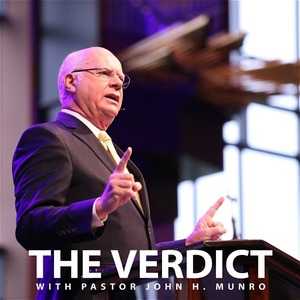
Today, on the verdict with Pastor John Monroe. I'm going to challenge you to take a stand for God. Today, in God's grace, take a stand for God. Will you do that? Will you draw a line and say, Now, in God's grace, I'm going to take a stand for God?
Welcome to the verdict with Pastor John Monroe. Jesus tells his followers that we are to be salt and light. But how are we to live and interact in a dark and often hostile culture? Today on the verdict, we continue our new study in the book of Daniel. We're going to learn much from his example on how to stand strong for God when it might be so easy to compromise.
So let's join Pastor John Monroe for today's message titled Taking a Stand for God. Today we continue our new study in the book of Daniel. In chapter 1, we meet four young Jewish men. who had been taken prisoners by the Babylonians. They are not only in a foreign culture, they're surrounded by a pagan religion.
This culture could not be more different than the upbringing and the teaching they received in their homeland of Israel.
Furthermore, Daniel and his friends have been selected by King Nebuchadnezzar. to receive a prestigious Babylonian education. How are they going to do? Will they take a stand for God? Or will they just blend into their new life in Babylon?
What would you do? How do you respond when your beliefs are challenged? Let's see how Daniel and his friends respond to the commands of the king. How is a Christian to relate to and function in our culture? How are we to relate to and function in our society?
Increasingly, Christians are at odds with our culture. If that is the case, how are we who are followers of Jesus Christ who owe our top allegiance Not to a government, not to a country, not to ourselves, but to our Lord Jesus Christ, how then are we to relate to our culture? Our Lord Jesus reminds us that although we are in the world, we are not to be of the world.
Well, what does that mean? What does it mean to be in the world but not of the world? The media often portrays Christians, particularly we who are evangelicals, as non thinking bigots with not enough brains to give ourselves a headache. boycotting Disney World, bombing abortion clinics, putting pressure on school boards to throw out the teaching of evolution in the public schools. In this view The Christian is red faced with rage, shouting at those who are trying to destroy, quote, Christian America.
And such Christians relate to the culture by protesting against it. Then there are other Christians who isolate themselves from the culture. They enjoy Christian fellowship, they have strong Christian views, but they kind of exist in a Christian ghetto. Oh, they go to church, they're very sincere, they say their prayers, but their faith is largely privatized. Their faith is a matter largely between them and the Lord.
Their impact on the culture is minimal. because they largely isolate themselves from the non-Christian culture. Then there are other Christians. who don't attack the culture. They don't isolate themselves from the culture, but rather they assimilate.
With the culture. They embrace the culture, they accommodate the culture. In fact, as we look at some Christians, it's very difficult to know if there is any difference between them and the non Christian culture. They believe that in order to reach the culture Christians must become like culture, but such a view seems to be in direct contrast to the teaching of our Lord, who told us we are to be light in the midst of the darkness, we are to be salt penetrating the corruption, and Jesus Christ Himself was always very countercultural.
So what does taking a stand for God look like in our culture? I believe that the Bible gives us a wonderful model of a believer who stands for God. in a foreign culture. Who stands for God in a pagan and in an idolatrous culture. We're going to learn this morning from Daniel chapter one.
that we are neither to assimilate with the culture Nor to isolate ourselves from the culture. Not to be characterised by in-your-face protests against the culture this morning. We will learn from the example. of this young man, Daniel, who as a teenager stood for God. In a hostile Culture.
Let me ask you. Have you ever taken a stand? For God. At the end of this message I'm going to challenge you to do that. I'm going to challenge you to take a stance.
Yeah. We live In a Christian culture, I would say, perhaps in a subculture, in a kind of cultural Christianity where so many of us have sold out to the culture. There is so little difference between us who profess To follow Jesus Christ. And those who who are professed unbelievers. Isn't it time?
Brothers and sisters, that we who say That we choose to bow to the King of Kings and Lord of Lords, that we end our mediocrity. Our cultural accommodation and take a stand for God in this culture. Daniel is going to help us to do that.
Now, let's open our Bibles to the book of Daniel. We are going to read the whole of chapter one. We read the first eight verses But today we're going to look At the whole chapter. Daniel 1. Verse one.
Here is the word of God to us this morning. And it's a thrilling Story. Daniel 1 verse 1 In the third year of the reign of Jehoiakim, king of Judah, Nebuchadnezzar, king of Babylon, came to Jerusalem and besieged it. And the Lord gave Jehoiakim king of Judah into his hand. with some of the vessels of the house of God.
And he brought them to the land of Shinar, that's Babylonia. to the house of his God and place the vessels in the treasury of his God. Then the king commanded Ashpenaz, his chief eunuch, to bring some of the people of Israel Both of the royal family and of the nobility, youths without blemish, of good appearance and skilful in all wisdom. Endowed with knowledge, understanding, learning, and competent to stand in the king's palace. And to teach them the literature and language of the Chaldeans.
The king assigned him a daily portion of the food that the king ate and of the wine that he drank. They were to be educated for three years, and at the end of that time they were to stand before the king. Among these were Daniel, Hananiah, Mishael, and Azariah of the tribe of Judah. And the chief of the eunuchs gave them names. Daniel he called Beltishazzar.
Hananiah, he called Shadruch. Mishael he called Mishach, and Azariah he called Abednego. But Daniel resolved that he would not defile himself with the king's food or with the wine that he drank. Therefore, he asked the chief of the eunuchs to allow him not to defile himself. And God gave Daniel favor and compassion in the side of the chief of the eunuchs.
And the chief of the eunuchs said to Daniel, I fear my lord the king, who assigned your food and your drink, for why should he see that you are in worse condition than the youths who are of your own age?
So you would endanger my head with the king. Then Daniel said to the steward, whom the chief of the eunuchs had assigned over Daniel, Hananiah, Mishael, and Azariah, Test your servants for ten days. Let us be given vegetables to eat and water to drink. Then let our appearance and the appearance of the youths who eat the king's food be observed by you. And deal with your servants according to what you see.
So he listened to them in this matter and tested them for ten days. At the end of the ten days, it. was seeing that they were better in appearance and fatter in flesh than all the youths who ate the king's food.
So the steward took away their food and the wine they were to drink and gave them. vegetables As for these four youths, God gave them learning and skill in all literature and wisdom, and Daniel had understanding in all visions and dreams. At the end of the time, when the king had commanded that they should be brought in, the chief of the eunuchs brought them in before Nebuchadnezzar. And the king spoke with them, and among all of them, none was found like Daniel, Hananiah, Mishael, and Azariah. Therefore they stood before the king, and in every matter of wisdom and understanding about which the king inquired of them, he found them ten times better than all the magicians and enchanters that were in all his kingdom.
And Daniel was there. Until the first year. of Cain. Cyrus. What an amazing story.
of integrity. First of all, let's think of Daniel's captivity. We saw last week that Daniel The other three teenagers are taken Captive. Nebuchadnezzar, the king of the Babylonians, the superpower of the day, besieges Jerusalem in six hundred and five BC and takes these captives. Babylon, as we see from verse four, was more concerned with their physical looks, their eye cue, their human wisdom, rather than godliness and character and virtue.
What is Babylon going to do? as they take these young men the hundreds of miles back to Babylon. Babylon is going to try and indoctrinate and brainwash these young men with a three pronged approach. First, They are going to be given a pagan education. Look at the end of verse four.
to teach them the literature and language of the Chaldeans. They begin a three year degree, as it were, in the University of Babylonia. What's the point? Nebuchadnezzar and his officials are going to turn these young Jewish men, these very bright young men coming from royal and nobility back in Judah, they're going to turn them into Babylonians. They are going to do that by giving them this pagan education.
Second, They are going to be given special food and drink verse five. The king assigned them a daily portion of the food that the king ate. and of the wine. that he drank.
Now think of this. If you come from another culture, you'll understand this perhaps better than those of you who have only lived in one culture. Food is a very, very important part of any culture. You know that if you travel outside the United States, not everyone eats like Americans. That may come as a shock to some of you.
Think of the Italians and their pizza and their macaroni. or the Germans with their Frankfurters and their sauerkrauts. Or the Mexicans with their tacos and enchilados and burritos. And so this question of given special food and wine To these Jewish young men, Is nothing that is unimportant. You say, well, it doesn't matter what you eat.
Oh, yes, it does. It's a reflection of the culture as we will see. Food is very important to a culture. The three pronged approach first, their education, secondly, their food and drink. Third, A change of the names, verse seven.
And the chief of the eunuchs gave them names, Daniel. He called Beltishazzar, Hananiah he called Shadrach, Mishael he called Meshach, and Azariah he called Abed-Nigo. Daniel and his three friends had names which all pointed to the one true God. As part of their names, the either had El, the abbreviation of Elohim, the Hebrew word for God. or Yah, the abbreviation of God's personal name, Yahweh.
So then yell E L at the end, Misha L. Elohim, God, is the very part of their name. The other two, Hananiah. Azariyah, the abbreviation of Yahweh, God's personal name. These Jewish boys had names which reflected their belief in the one true God, the Creator of the heavens and the earth.
What did the Babylonians do? They give them Babylonian names. And their Babylonian names, we won't go into the details, all point to Babylonian gods. In effect, they are saying to these young men forget about your God' When you left Judah, we left him there. Our gods clearly are superior to your gods.
After all, your god didn't help you. We are the superpower. We have defeated you, and we're going to demonstrate that we are superior to you by giving you Babylonian names.
Now think of it. These young men. fifteen, sixteen, seventeen years old. Hundreds of miles away from home. subjected to a pagan, hostile environment and education.
The Babylonians are going to indoctrinate these young Israelis. They want them to have a Babylonian world view, we would say. Question: How will they survive? in that Culture. How would you have survived?
How do you survive? In this culture, which is increasingly hostile to biblical values and our Christian heritage. Daniel's captivity. Secondly, Daniel's choice. and it is a very, very courageous Choice, Daniel's choice.
Do you notice that Daniel and his friends don't protest? The Babylonian education and the change of name. Through their training, Babylon is trying to change Daniel's way of thinking. They're trying to get into their mind. Pagan education is destroyed is designed to destroy their faith.
But Daniel and the others, as the text clearly says, master the Babylonian education, but Babylon never ever masters them. They learn It's But they never Embrace it. Can I say that secular education doesn't need to destroy our Christian faith?
Some of you have young men and young women. And some of you are in secular Education A state school I can say, speaking personally, all of my formal education, apart from seminary, was secular. I remember well being taught evolution and being examined in school by the teacher asking me questions, by writing about it in exams. I was taught it. But I never believed it.
Secular education. can be mastered without it mastering us. And that's what happens with Daniel and his friends. They also appear not to protest. the change of their names.
In one sense, there was little they could do about it. The change of names was subtly designed, or perhaps not so subtly, to separate them from their Jewish identity and their Jewish faith. But Daniel, throughout the book of Daniel in the twelve chapters, never ever refers to himself as Belteshazzar. He's Daniel. And there's a much older man in Daniel 6, verse twenty.
When Daniel goes to pray, years and years later of being in Babylon, do you know what he does? He opens his windows towards what? Jerusalem. Jerusalem. And in chapter nine, verse twenty one Verse 21.
He talks about a situation taking place about the time of the evening sacrifice. And that at a time when Daniel had not seen an evening sacrifice for about seventy years. What's the point? The point is this. Babylon could change his name.
But they could never, ever change his heart. Daniel's heart, however he long lived in Babylon, his heart was still in Jerusalem. They might teach him Babylonian thought, but he still thought as a child. of Gods. Babylon, try as it might, could not change the identity of this young man.
Daniel and his friends were in Babylon, but Babylon was never in them. They were in the Babylonian world. In fact, as we're going to see, very successful in the Babylonian world. But the Babylonian world was never. In them.
Now, Daniel. takes a stand. for gods. regarding the king's choice food and wine verse eight. Look at it with me.
Daniel resolved that he would not defile himself with the king's food or with the wine that he drank. Daniel purposes in his heart that he will not The file. himself. He takes a stand for God. I love this, don't you?
He takes a stand for God. against the most powerful man in the world, Nebuchadnezzar.
Now you say why take a stand on food and drink? Compared with the Babylonian education, compared with the change of name, that may have seemed the least significant. We might have said Daniel, don't make a fuss over food and wine. That can't harm you. There's a time to take a stand, but not here.
You're making us look ridiculous. Let's Let's compromise a little bit. Let's go and see what happens. No doubt at some point there's a time to take a stand for God, but not on this. But Daniel doesn't think like that at all.
Daniel draws a line. Where the word of God draws it. To some extent he can accept the Babylonian education, but he cannot. And he will not go against the clear teaching of the Word of God. Daniel understands this.
That God's word applies. Irrespective of the culture, irrespective of our circumstances, irrespective of whether we're in Jerusalem or Babylon or Timbuktu, God's word applies, and Daniel says, no, I am not going to defile myself.
Now why was that?
Well, we would say the food wasn't kosher. Turn back to Leviticus. The third book In the Bible Writings that Daniel would have been very familiar with, no doubt. Leviticus 7. Verse twenty six.
Just part of the Mosaic law. Part of the Levitical system. Moreover, You shall eat no blood whatever, whether of fowl or of animal, in any of your dwelling places. Whoever eats any blood, that person shall be cut off from his people. No bloods.
in the meat. or in the file. Leviticus chapter 11 gives a long list of the animals. and creatures which are clean and those which are unclean. This food that is being offered to them is contrary So the Tata Contrary to the mosaic system And even, I think, even more repugnant to Daniel and his friends is the fact that this food and wine, in all probability, were dedicated to the false gods of Babylon.
The Ten Commandments are clear idolatry is a sin. And part of the reason for the Babylonian captivity was spiritual defilement of Judah. And this young man realises I am not going to be spiritually defiled. He believes that to eat the food and to drink that wine is a spiritual defilement. He will not compromise.
He will not defile himself. and while Daniel and his three friends are in Babylon. They will not Confirm. to Babylon. He would have agreed with the way the Apostle Paul was going to put it many, many years later, don't be conformed to this world, but be transformed by the renewing of your mind.
How is your mind renewed by the word of God? Don't be conformed to the world. And Daniel says, No, I am not going to be conformed to Babylon. I don't care what other people think. I am taking my stand.
And he takes a stand for God. He will not compromise when it comes to the Word of God. How about you? Any compromise? And your life?
compromise in politics. in business in our personal lives. In the church. is all around us, isn't there? But let me ask you a personal question that only you can answer.
Is there any compromise? in your life. Is there? Is there any area where you are not taking a stand For God. Are you in danger of losing your Christian identity?
Could it be that you've begun to go down a slippery slope of compromise. And your clear-cut identity as a follower of Jesus Christ. has been compromised. This is the verdict, featuring the Bible teaching of Pastor John Monroe. There's still more to hear when John returns in just a moment, so stay with us.
From matters of truth and identity, to the subjects of love and grace, our world seems more confused than ever. but to find truth and certainty about who we are and find peace, we must turn our attention away from the world and look to the Word of God. To help you do that, John wrote a booklet titled Eternal Security, Finding Certainty in a Chaotic World. Through this special resource, John shares his personal testimony, along with a careful examination of Scripture, to offer us clarity on matters of eternity. Get your copy today by visiting our website at theverdict.org.
While you're there, consider making an investment in this Bible teaching ministry. Whether it's $5, $50, or more, your gift today helps cover the cost of sharing these gospel messages to listeners around the world. And if you haven't already, be sure to subscribe to the Verdict Podcast, featuring John's weekly podcast exclusive called Avizandam. It's available wherever you get your podcasts, or simply go to our website. Again, that's theverdict.org.
The verdict is a ministry of Calvary Church in South Charlotte. We're located on the corner of Highway 51 and Ray Road. If you've been looking for a church home or a community to help you grow in your walk with Christ, We invite you to join us for our Sunday services. For more details about Calvary and our service times, visit theverdict.org.
Now, here's Pastor John Monroe.
Well, what's your verdict? Don't you admire these young men? Scripture tells us to be strong and courageous in difficult circumstances. Can you imagine being taken from your family and your home by a conquering army? Yet Daniel and his friends remain obedient to God.
We can learn so much from their wonderful examples. If you are a follower of Jesus Christ, take a stand. Don't compromise. Be true to your beliefs. God will honor you.
and join me next time as we continue to learn how to survive in our pagan culture. Thanks for joining us today on The Verdict. I'm Michelle Davies. Today's program with Pastor John Monroe was produced and sponsored by Calvary Church in Charlotte, North Carolina.