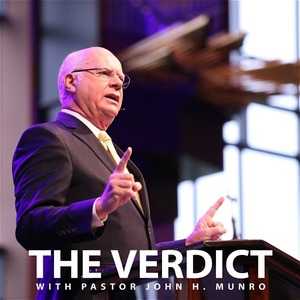
Today on the verdict with Pastor John Monroe. Prayer. and evangelism. These are two essential areas for us: prayer and evangelism. And you'll note in this passage that Paul links prayer and missions because they must never be divorced.
That is, a church on its knees. Will also be a church on its feet. Glowing with the gospel. Welcome to The Verdict, the Bible teaching ministry of Pastor John Monroe.
Some people think that going to church and being kind is what Christian living is all about. But followers of Jesus Christ are to live out the gospel in every area of our lives. Today we're going to see how prayer and evangelism are essential. and naturally flow from our love for Christ.
Now here's Pastor John Monroe with his message on prayer and evangelism. Today, we're considering the important subjects of prayer and evangelism. which Paul writes about in the opening verses of Colossians chapter four. Prayer and evangelism go together hand in glove. If you believe in the gospel of Jesus Christ, you understand that you're saved by the grace of God.
and that we are to trust him in every area of our lives. And as we think of sharing the gospel, we know. That it is the Lord who must touch and change hearts.
So, prayer is vital. Paul was a mighty apostle, but frequently asked for people to pray for him. Let's learn about prayer and how important it is that we're wise in our relationships with unbelievers. We are to display and proclaim Jesus with grace. and truth.
Colossians 4 There's 2. Continue steadfastly in prayer. Being watchful in it with thanksgiving. At the same time, pray also for us. that God may open to us a door for the word.
To declare the mystery of Christ. on account of which I am in prison. that I may make it clear Which is how I ought to speak. Conduct yourself wisely toward outsiders. Making the best use of the time.
Let your speech always be gracious. Seasoned with salt.
So that you may know How you ought to answer each. person. In verses 2 through 4 then, we have a call to prayer. God commands us to prayer. And God is very pleased.
when we pray. If you're a parent, it gives you great joy. When your son or your daughter comes to you and asks for something which is good. And it pleases our Heavenly Father when we, His children, come to Him humbly. in prayer.
And the exhortation here in verse 2 is to pray, continue steadfastly in prayer, says Paul. and also be watchful in prayer first. We must continue steadfastly in prayer. or, as some translations say, be devoted to prayer.
Now what is prayer? Story is told of D. Al-Mudi. In the 1800s, as he was evangelizing in the United Kingdom, he went to Scotland and he met with a large group. of the school children.
Elementary school children. And Moody stood in front of this school and asked this question: what is prayer? And to his surprise, just about every hand went up. He couldn't believe it. And he called on a little boy sitting in the front seat.
As he asked the question, what is prayer? And the little boy said this: Prayer is an offering up of our desires unto God. In the name of Christ, by the help of His Spirit, With confession of her sins and thankful acknowledgment of his mercies. Answer seventy eight of the Westminster Confession. Taught in the schools in Scotland.
No longer the case. Sadly. The Westminster Confession got it right. The little boy got it right. What is prayer?
Prayer, the little boy had been taught, is an offering up of our desires unto God. You've got these desires. You've got these wishes, you offer them up to God, and you do that, please notice, in the name of Christ. A lot of prayer today is just prayer to God. We do not come into the presence of a holy God by ourselves.
We come in the name, in the merit, in the standing of our Lord Jesus Christ, who said, No one comes to the Father apart from me.
So again, The Westminster Divines got it right. It's an offering up of our desires unto God in the name of Christ. By the help of his spirit. Paul says in Ephesians 6 that you're to pray in the spirit. That prayer is not mechanical, it's not just repeating a prayer which someone has written down.
No, it is an immensely spiritual matter that we Have these desires, and we realize sometimes we can hardly articulate them. And so we need the help of the Spirit that we're praying in the Spirit. With confession of our sins. How can you and I come to a holy God and not confess our sins? And it is a thankful acknowledgment of His.
Mercies. And that is part of prayer. It is giving thanks. Paul is saying this here in verse 2. Continue steadfastly in prayer with thanks.
Giving.
Now, if you look at verse 2, these words continue steadfastly. can be translated devoted. It's the same word used in Acts 1, verse 14 when the early disciples were in that upper room and they were devoted to prayer. It's the same word used as in Acts 2:42, where the early disciples were devoted. to the apostles' doctrine, to the breaking of bread, to prayer and to Fellowship.
So it's the same word used in Acts 6, verse 4, where the Apostle says we need to appoint deacons to deal with the problem relating to the widows so that we can devote ourselves to prayer and the ministry. of the word. Devoted to prayer, continuing steadfastly, says Paul. in prayer. We've all had the experience, haven't we, where we've started to pray for something.
And then we run out of steam.
Someone says to us, Will you pray for me? And we say yes, but by the end of the week, we stopped praying for them. That's not what Paul is saying. Continue steadfastly. and prayer.
Are you continuing steadfastly? In prayer? These desires that you have, these requests that you have. That thanksgiving that you have, continuing steadfastly in prayer. Could it be true?
That we are continuing steadfastly in prayer, that we as a congregation are devoted to prayer. This means that prayer is a regular, it's an integral part of our lives. Not praying in a casual, haphazard way, but being devoted. to prayer. Continuing steadfastly in prayer, so that you cannot envisage one day.
that you're not on your knees before God.
Now how are you on this? I want to encourage you. Brothers, sisters, to continue steadfastly in prayer.
Now, secondly, says Paul again in verse 2, we must be watchful in prayer with thanksgiving. Alertness is the point. Have you ever started praying and fallen asleep? That's really embarrassing if you're on your knees. in a prayer meeting.
I've known that to happen. You think this brother is really spiritual? We're all standing up and he's still on his knees praying. No, he's fallen asleep. Paul says no, be watchful, be alert, watchful in prayer.
This is a translation of the Greek word from which we get the name Gregory. Many in the early church called their sons Gregory, a good name, because they wanted their children. To be alert, to be watchful. in prayer. Why are we to be watchful in prayer?
We're to be alert. Because we have an enemy. We are also to be watchful as we look for the answers to our prayers. Isn't it true? That you have prayed for something, and God has answered it, and sometimes you're not even aware of the answer.
because of our casual, haphazard way of praying. In prayer, As we see in verse 3, we must be aware of the needs of others. Paul says at the same time, pray also for us. Pray. For us.
Think of the example of Daniel in Daniel 6, who continued to pray steadfastly in spite of the opposition there was. Says Paul, I want you when you pray to be very thankful. Having a thankful heart is essential to a vibrant and meaningful prayer life. Not just on Thanksgiving season. Where we utter a few clichés, thank God for mom and America and apple pie and all of that.
having a thankful heart. that we radiate thankfulness. Part of the Fallenness of human nature is that we all look at that which is negative rather than that which is positive. No, the Lord wants us. to be thankful.
And this theme of thankfulness is one which Paul develops throughout Colossians. We won't have time to trace that in his epistle. But we've noted it before.
Now, think in verse three of the content. of his prayer. At the same time, says Paul. Pray also for us that God may open to us a door for the word to declare the mystery of Christ. on account of which I am in prison.
He is praying. for an opportunity for evangelism. It's true that Paul had many personal needs. Including his own imprisonment. Isn't it interesting that he doesn't pray?
For some Personal need, although he had many. If you and I were imprisoned, that would have been the top of the list. If we were imprisoned, if I went to China and was imprisoned, And I am texting someday, or emailing someday, or getting word through a letter, or some way, do you guess what would be the top of my list? Pray that I would be released. Not Paul.
Notice what he prays for. That God may open to us a door for the word to declare the mystery of Christ or the mystery which is. Christ. It's amazing. As Paul proclaims the gospel, He realizes that doors must be opened.
and that he cannot by himself open these doors. And so he prays. that God in His grace would open doors for the furtherance of the gospel. This is the mystery of Christ, the mystery which is Christ being made known. Open doors.
for the word. I believe that one of the main focuses In our prayers. is for open doors. Not so much for ourselves. but for the gospel.
Well you pray. Through the world. that doors would be open. for the gospel. in Muslim countries, in communist countries, in Hindu countries.
Where many doors are closed, that God would open the doors. Pray for increased opportunities in the prisons through our prison ministry, in our neighborhoods, in difficult home situations.
Some of you come from homes where people don't want to hear the gospel, and you try to explain the gospel, and people cut you off and tell you, a parent or a Or a brother. Or a spouse says, I don't want to hear that. Pray for the open door. Pray that hard hearts would be opened. Pray that in seemingly impossible situations in your neighborhood, At your workplace.
Doors for the gospel. We'd be open. That's what Paul is asking them to pray for. Keep praying. For open doors for the gospel.
That impossible person at work, That difficult, argumentative Hard-hearted relative of yours. That colleague. Whoever it is, pray. For the open door for the gospel. Pray.
for the spread of the gospel. Through the people and the ministries. of church.
Now what's the purpose of the prayer? Verse four. Says Paul, that I may make it clear. Which is how I ought. to speak.
You say, Paul, you're a master speaker. You're a master communicator, says Paul. No. Listen, I'm very, very conscious. that I need God's help.
When you pray, Yes, pray for the open doors, but pray. That I, the Apostle Paul, may make the gospel clear, which is how I ought to speak. Paul wants to communicate a clear gospel. The gospel is Christ-centered, verse 3. It is a mystery of Christ.
The gospel also must be presented clearly. And Paul is an example of one who presented the gospel boldly with courage. And that is so essential for us as a church. We must make sure that the message that we are proclaiming is indeed Christ. centered.
That the message is always clear. On Tuesdays, I listened to Billy Graham and listened to Franklin Graham. I was impressed once again. of how clear the gospel message is presented. And all of his wonderful Simplicity.
Not in a simplistic way, but in a simple way, so that a boy, a child can understand. The people throughout the world, even as the message is translated, will understand of God's love. Understand the grace of God, understand the need of the gospel, that it would be clear. And you pray that for me as I proclaim the gospel. You pray that for our missionaries.
Pray that for our Sunday school teachers. Pray that for yourself as each one of us spread the gospel. That it would be centered on Christ, that we would present it clearly, and we'd present it with boldness, with courage. In a world In a world that is very bold. With his lies.
Very bold with its error. Why should we, as the people of God, not present the message with boldness? And For that we must pray. James Montgomery described prayer as the believer's native breath. For the believer it should be a natural thing to do.
Just as your wee boy, your wee girl comes to you and says, Mom, Dad, can I get this? They don't make a speech to you. They just know that they come to you and they're asking for something.
So we come in a very natural way with reverence, of course it is, but we come to our Heavenly Father and pour out requests to Him in the name Of Christ. This is the call. to prayer. Ian Bounds writes No man can do a great enduring work for God who is not a man of prayer. And no man can be a man of prayer if he does not give much time.
to praying. Here then is a call to prayer. And then secondly, a call to evangelism, verses five and six. Conduct yourself wisely toward outsiders, making the best use of the time. Let your speech always be gracious, seasoned with salt.
so that you may know how you ought to answer each person. A call to evangelism. Do you understand that each follower of Jesus Christ has to evangelize? Paul is not the only one to communicate the gospel. He's writing to believers in Closse.
He's urging them to present the message. You see, every follower of Christ is to share Christ. In this sense, all of us are evangelists. No, not all of us have the gift of evangelism. But all of us are to share Christ.
All of us are to point people to Christ. We are to display Christ, we are to proclaim Christ.
Now, this call to evangelism is twofold. First of all, says Paul, conduct yourself wisely toward outsiders. Interesting, isn't it? Our conduct is to be wise and it is to be consistent with our profession. As we share Christ, we are also to display Christ.
We're not to cajole, we're not to be pushy, we're not to be self-righteous. Rather, we're to be tactful, we're to be sensitive, we're to be thoughtful, prayerful, gracious. wise, and in a sense, a natural communication. Use wisdom towards outsiders. Why?
Making the best use of the time. The time is short, Christ is returning. You don't know how long your neighbor is going to stay next to you. You don't know when you will next have the opportunity to share Christ with that colleague. Make the best of the opportunity.
Take that opportunity. Psalm 90, verse 12: Teach us to number our days that we may get a heart. Of wisdom.
So first, conduct yourself wisely. Secondly, Verse 6, your speech is always to be Gracious. Our manner of speaking as well as the content of her words. is to be gracious. It's possible to say the right the right thing.
in the wrong way. We're saved. By God's grace. were to demonstrate that grace. in our speech.
People marveled at the gracious words which proceeded from the lips of Jesus. We read. in the gospel. And Christians particularly Christians. Our speech should be should always Always.
Be gracious. I praise God that I was raised in a home. where we were taught to speak. Graciously. My mother never allowed us to say shut up.
We weren't allowed to use any expressions that were vulgar. or rude or bad mannered. Why? Our parents were trying to teach us. That your speech is to be Gracious.
Speech today is often very vulgar, isn't it? And even among Christians, our speech sometimes is harsh. And it's vulgar and it's like the world. We are to demonstrate that we are different. By the choice of our words and our attitude, as well as the content.
That we are winsome. that our speech is attractive, that the words are skilfully chosen. that their very demeanor is one which commands the gospel. I think that's what Paul is saying here in verse six. Let your speech always be gracious.
Parents, teach your children to be gracious. And if you're working in the Sunday school or if you're working with children, let's make sure our speech is always gracious. And when you're Spreading the gospel. We're always to be. Gracious.
And we're to season our words with salt. Seasoned with salt says. Paul. That is, our words are also to be interesting. Yes, they're to be gracious.
But not in a dull, wimpish kind of way. Howard Hendricks used to say to us at Dallas Seminary that it's a crime to bore people with the word of God. Don't be boring. Our speech Is to be seasoned with salt, is to leave, as it were, a lingering taste. In the person's mouth.
They may disagree with us, but there's something winsome about it. It's words wisely chosen, words of grace, a bit of bite to them, that's true. And so while his speech is gracious, It's never to be sickly, sentimental with no bite. No, as well as displaying Christ's love and grace, we are to proclaim his truth in a persuasive, interesting way. Says Paul at the end of verse 6, so that you may know how you ought to answer each person.
Yeah. I'm glad he said that.
Sometimes we're told that there's only one way to present the gospel, and this is what you must do. The person says this, and you do that, and it's kind of reduced to a formula. A kind of standard cookie cutter approach. I don't like that. I don't think Paul would either.
No. So that you may know how you ought to answer each person. Think of the way of our Lord as he dealt with different people, the women at the well. Nicodemus The leper. The child.
You say he was God, he was all wise, that is true, but that is our pattern. Getting to know the individual. How can I relate to this? Individual Give me Wisdom, Lord, give me grace. Give me great skill so that we respect the integrity of every individual.
That how we communicate to a child, obviously, is going to be different From a senior. And how we communicate the gospel to someone who is a Muslim is going to be different from someone who is a cultural Christian. That there is wisdom and there is grace. and that we are trying. With God's help.
to uplift Christ. in all cases. This is the verdict, featuring the Bible teaching of Pastor John Monroe. There's still more to hear when John returns in just a moment, so stay with us. From matters of truth and identity, to the subjects of love and grace, our world seems more confused than ever.
but to find truth and certainty about who we are and find peace, we must turn our attention away from the world and look to the Word of God. To help you do that, John wrote a booklet titled Eternal Security, Finding Certainty in a Chaotic World. Through this special resource, John shares his personal testimony, along with a careful examination of Scripture, to offer us clarity on matters of eternity. Get your copy today by visiting our website at the verdict. org.
While you're there, consider making an investment in this Bible teaching ministry. Whether it's $5, $50, or more, your gift today helps cover the cost of sharing these gospel messages to listeners around the world. And if you haven't already, be sure to subscribe to The Verdict Podcast, featuring John's weekly podcast exclusive called Avizandam. It's available wherever you get your podcasts, or simply go to our website. Again, that's theverdict.org.
The verdict is a ministry of Calvary Church in South Charlotte. We're located on the corner of Highway 51 and Ray Road. If you've been looking for a church home or a community to help you grow in your walk with Christ, We invite you to join us for our Sunday services. For more details about Calvary and our service times, visit theverdict.org.
Now, here's Pastor John Monroe.
Well, what's your verdict? How would you assess your prayer life? Will you ask God to help you develop a consistent prayer life?
So that when you speak to outsiders, you do so with grace and with wisdom. God is faithful and will give you what you need for each day. I also ask that you pray for me. as I continue to proclaim the Word of God through the verdict.
Next time we'll look at the closing verses of Colossians as Paul gives examples of how individuals are transformed by the gospel. Thanks for joining us today on The Verdict. I'm Michelle Davies. Today's program with Pastor John Monroe was produced and sponsored by Calvary Church in Charlotte, North Carolina.