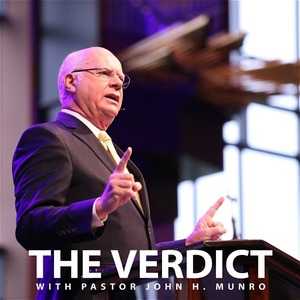
Today, on the verdict with Pastor John Monroe. This is a very simple message, but a very practical one. Principle one, employees must work hard. for their employers. Principle number two: employers must treat their employees fairly.
and justly. But here is the basic principle. Work Is God ordained? We are serving God when we work. Welcome to the verdict with Pastor John Monroe.
There are some who think that work is punishment. But today, as we near the end of Colossians, we're exploring a biblical view of work. Work was actually given to man by God before the fall. And work presents a privilege and an opportunity to minister to the glory of God. Today, you might view your work in a completely different way.
Here's Pastor John Monroe with his message, the Christian at work. One of our greatest needs today is for authentic followers of Jesus Christ to live and shine for the Lord Jesus in every aspect of our lives. Indeed, in every workplace. We've been studying the book of Colossians, written by the Apostle Paul. Paul has explained.
That the gospel transforms our relationships, our conduct, and our home.
Now he's dealing with the difference Jesus makes in the workplace. last time we saw, that employees are to work diligently and with enthusiasm. as an act of worship to the Lord. But Paul not only addresses the employee, He also speaks to employers. Whether you are an employee or an employer, God has something to say to you today.
Listen carefully. This is the Christian at work. Colossians 3 then There's Twenty Yeah. Slaves, obey in everything those who are your earthly masters, not by way of eye service as people pleasers, but with sincerity of heart. fearing the Lord.
Whatever you do, work heartily as for the Lord and not for men, knowing that from the Lord. you will receive the inheritance as your reward. You are serving The Lord Christ. For the wrongdoer will be paid back for the wrong he has done, and there's no partiality. Masters Treat your slaves justly and fairly.
knowing that you also Have a master. in heaven. Here is the Christian at work. True, it is written in the first century, but the principle here applies to the twenty first century. I realize Paul is writing to masters and slaves, but the principles apply to employer and employee.
Because the gospel of Jesus Christ works. It transforms not only our personal lives, not only our homes, but it transforms our work.
So let's look. At the Christian at work. I think there are two obvious basic principles in this passage, and the first we see in verses 22 through 25. that employees If we put it to a principle, employees must work hard for their employers. Do you get that?
Employees must work hard for their employers. Verse 22, slaves. Obey in everything those who are your earthly masters. Go back a few pages to Ephesians. And we will see the same principle.
Ephesians 6. Verse five. Slaves, obey your earthly masters with fear and trembling, with a sincere heart, as you would Christ. Not, by the way, have I service as people pleasers, but as servants of Christ Doing the will of God from the heart, rendering service with a good will as to the Lord and not to man, knowing. That whatever good anyone does, this he will receive back from the Lord, whether he is a slave or a Free.
Work hard. For the boss.
Now at the time of riding, At the time of Paul writing to the Colossians, about half of the population. With slaves. Many of the masters were harsh and demanding, but still Paul gives the command. Slaves and certainly employees must obey their earthly masters and work hard. Do you hear it?
Now, this obedience to our earthly masters, to use the Words of verse 22 is not to be mechanical, but is to be enthusiastic. Says Paul, don't serve by way of eye service. That is, don't just work hard when the master's eye is on you. You see, the motivation is not merely to please the boss. You have to work hard.
particularly when no one is looking. We are. Verse 22, to work with a sincere heart. and a clear conscience. That is, the Christian is to be the best of workers, the most loyal of workers, the most hard-working.
The obedience is done, Paul says, it's done fearing the Lord. In other words, what motivates us is not the fear of man, but the fear of God. And the fear of the Lord is the beginning of wisdom. We are to work sincerely with a singleness of heart, not in a phony, superficial way. We are to realize that we are working in the very presence of the Lord.
Paul is saying that he is supreme.
So the Lord Jesus Christ is supreme overall. That's the great theme of Colossians, and He's certainly to be supreme in the workplace. And how totally unacceptable. And how dishonoring for the Lord. for the Christian.
not to work hard. No, the Lord is looking at and the Lord is evaluating. Your work. No sweeping under the carpet. This biblical response means that the employee will never do anything which is dishonest.
or unethical or immoral. The Christian employee will never lie for the boss, will never lie to a customer, will never lie to a colleague. They will never do anything which is against scripture, which is against their conscience, which would harm innocent people. We see here in verse 23 that the command is for all of us to work enthusiastically, whatever you do, work heartily as for the Lord and not for men. The slave then was not to work in a sullen, mechanical way, even when doing menial and drudging tasks.
Now the slave wasn't paid. Paul does not say to slaves that they should rebel. Rather, the transforming power of the gospel is to be seen in the worst of situations, that is in slavery. And if the unpaid slave was commanded to work enthusiastically, How much more we who are paid are to work enthusiastically? You ever worked with somebody who doesn't work enthusiastically?
Who's sullen? Mechanical. Just getting through the day. Five o'clock comes, and they're out of the door as quickly as they can. I've known Christians to complain and moan at work.
Do you work enthusiastically? And Paul is saying here in verse 24: you will receive the inheritance as your reward. You're serving the Lord Christ. This is very serious, isn't it? First principle then.
employees must work hard for their employers. Principle number two, employers must treat their employees fairly, verse four. Chapter 4, verse 1: Masters, treat your slaves justly and fairly, knowing that you also have a master in heaven. Look back to Ephesians 6. Paul says much the same thing.
Ephesians 6 verse 9 Masters do the same to them. And stop your threatening. Knowing that He who is both their Master and yours is in heaven. and that there is no partiality With him. Colossians 4 verse 1 was revolutionary.
Treating slaves fairly was revolutionary advice in the culture where about a third of the people of the Roman Empire were slaves. And slaves, we know, were an important part of the Colossian church. Paul has just addressed the slaves. As the letter was being read in the assembly at the little church at Colossa, there were slaves sitting there. And Paul had taught.
In chapter 3, verse 11, that in the church of Jesus Christ, in God's new society, The Christian slave and the Christian master are spiritual equals. Look at chapter three, verse eleven of Colossians. He's saying here That is in the new society. There is not Greek and Jew, circumcised and uncircumcised, barbarian, Scythian, slave or free, but Christ is all and in all. In the church, there are no slaves, there are no masters.
We are all one in Christ. Christ is all, He's supreme, and this Christ who is supreme is in all of us. And such teaching was eventually going to lead to the downfall of slavery.
So Paul is not advocating or condoning slavery. That was a political, social, economic reality at the time. What he is saying is he recognizes the reality that masters have to be just. And fair to their slaves. In fact, a Christian master and a Christian slave are brothers.
Onesimus, who is a slave, is accompanying the letter. We see that from chapter 4, verses 8 and 9. He said, I've sent him to you for this very purpose, that's Titicus, that you may know how you are, how we are, and that he may encourage your hearts, and with him, Onesimus. Our faithful and beloved brother, who is one of you, who was anesmus? Read the story in Philemon, he was the runaway slave.
Running away from Philemon, but coming to Christ. And Paul says, in Philemon, let me just. Read it Philemon. Verse sixteen. He says, I want you to take him back, Philemon Anesimus, this runaway slave, no longer as a slave, but more than a slave, as a beloved brother, especially to me, and how much more to you, both in the flesh and in the Lord.
How beautiful. In the church. There's no slaves. There's no masters, all one. In Christ.
But masters. Chapter 4, verse 1, are not to take advantage of their position. But Christianity makes a radical difference. To the slave-master relationship and to the employer-employee relationships. Slaves were not to be treated in a degrading or capricious way.
Employers are to be just and fair to their employees.
Some of you are employers.
Some of you are supervisors, some of you are managers, some of you are directors, some of you are over other people. You may not be an employer, but you're in a supervisory position. You are to be just and fair. to employees. You have to keep.
To the terms of their employment contract. You're to give just and fair remuneration. In fact, a Christian employer should be generous and considerate, giving a fair wage, a generous wage for the work being done. It's sad, isn't it, when we hear of Christian employers who have the reputation of being greedy? Or over-demanding in the treatment of employees.
No, this principle of justice and Fairness. Applies. to anyone here who's in a supervisory position. How would those That you supervise, how would they look on you? Would they say you're a just person?
Would they say that you're a fair person? If you're an employer, if you're a boss, if you're the owner, would they say that you're a generous? Person. We must be because Paul is saying here that employers are also accountable to their master in heaven, knowing that you also have a master in heaven. Heaven.
That is, the Lord is looking on. You say, Is the Lord interested in the marketplace? Yes, He is. The Lord is watching you at work tomorrow as an employer. He notices.
How you treat your employees. He notices how we treat others. All masters are accountable to a higher master. as to how they treat their employees. What have you learned?
This is a very simple message, but a very practical one. Principle one: employees must work hard. for their employers. Principle number two, employers must treat their employees fairly. and justly.
But here is the basic principle. Work. Is God ordained? I want you to grasp that. I don't want you to forget this.
We are serving God when we work. When we work, we serve God. In the New Testament, there is no sacred secular division. Don't say, well, I just work to put bread on the table, but I'm really serving at church. I teach Sunday school, I work with the homeless, I go on a mission trip.
That's my real ministry. My work is just incidental. No, your work when you're working. You're serving or should be serving The Lord Christ. Yes, when I preach, I'm serving the Lord.
But when you make that sale, when you look after that patient, when you dig that ditch, you also are serving the Lord. the Lord. And we must acknowledge that no work situation or no job is perfect. All have their weeds, all have their thorns, all have their thistles and tears. And work sometimes can be very, very tough.
And we know that. And no job is perfect. But tonight What you think? of something that is very difficult. that you have to do at work.
Perhaps as a boss, perhaps as an employee. Perhaps working with your colleagues. Can you think of something that is very difficult for you in your work situation? Then, would you complete this sentence? This week when I will do whatever it is.
I will do it. as an act of worship. to the Lord. Take that situation at your work, which is hard for you. Perhaps relating to a colleague, perhaps a business partner is very difficult to get on with.
Perhaps you do something which you think is very demeaning. You think people at work are taking advantage of you and you always end up with a tough job. Whatever that difficult thing is, before God. Will you say this? When I will do.
Such and such. I will do it. as an act of worship. to the Lord. See, these principles will transform you.
and will transform your workplace. Think how your boss, or your colleagues, or your customers, or your fellow employees will react. When you say to them, How may I Help you. What would you like? Me.
To do Today. To say to a colleague, how could I Lighten your Lord. You you seem to be under a little bit of stress. What could I do to to help. Whether you're an employer or an employee or a colleague or a business partner, whoever you are.
Dealing with people? To come in a spirit of kindness, a spirit of help, a spirit of service, because in this passage we're learning that we are serving the Lord. Christ. When you're serving that person, When the waiter is serving the customer, in fact, the waiter is serving, the Christian waiter is serving Jesus Christ. If the Lord Jesus came to your place of work, And asked you personally to do something for him, would you do it?
Of course you would. You would do it without hesitation. You would do it without grumbling. You would do it obediently. You would do it enthusiastically.
You would tell people how amazed you were that Jesus asked you to do this and what a privilege it is to serve Christ. But he does ask you to do these things. He asks you to go to that bank. and to serve some of these difficult customers that come in. He asked you to be a flight attendant.
and deal with people who are cursing because they can't get their huge overhead bags in that little place. Serving The Lord Christ. Also, will you complete this sentence? At my work. I will change this attitude.
or this conduct or habit. Have you adopted a bad attitude?
Some habit you've got into. And as you listen to this teaching of Scripture, you realize that needs. That needs to change. Over the weeks, over the years, I I've I've got into this very bad habit. Perhaps you're a rather lazy Employer.
You take advantage of your employees. Perhaps you're a lazy employee. Perhaps you're a lazy supervisor. Perhaps you've been cheating the boss, you've been dripping off the boss. You say Christians wouldn't do that.
Christians would do that. I've known Christians to do that. Perhaps you've been stealing something. Perhaps you've had long lunch breaks. Perhaps you've been spending too much time in the break room.
Perhaps you've been spending time complaining and gossiping. about your colleagues, about your boss, about other people. And you've got into a bad habit. of that and it's brought a negativity into the workplace. And you know that it's eating.
at your testimony of Jesus Christ. Tonight. Would you just decide before the Lord to end that sinful behaviour at work. Here is a way That we shine for Jesus Christ. Here is a way that we make a tremendous impact.
by kindness and compassion and And handling adversity and difficulty in a godly Way. You see, when you put these principles into practice, it will be a powerful testimony to your boss, to your colleagues, to your clients, to your customers, to your employees, to those around you. The Lord is asking you to glorify Him at your work. In your business, in your professions, in your studies, in whatever you do, because your work matters to God. Whether it's delivering pizza or delivering babies, it matters to God.
Our mission at church is what? It is to make authentic followers of Jesus Christ. That is, we say. That being a Christian makes a difference. That we believe in hope.
We believe in God's transforming hope. And the gospel changes us. God's truth doesn't change, but God's truth changes us. It changes attitudes. It changes conduct.
It changes frustrations in the home, it transforms our home, it transforms the work, it transforms society. And as I say, our world is weary of Christians saying so much. But so little difference being made. One of the huge impacts we would have if we put these principles into practice. How does this Christian faith that we profess work in the Workplace.
display Christ. display his love. tomorrow. display his compassion, Display his kindness, display his truth, display his integrity, display his righteousness, and then, when the doors open, as inevitably they will, as people see something of Jesus in you. You then will be able to point them to the one who is the truth.
And the one who came to seek and to save. The lost. that your work Matters. To God. Let me give you a few minutes.
I give you some challenging questions of saying this week. I will change this. This week, when I do that difficult task, I will do it as an act of worship. to the Lord. Eternal God and our Father, we thank you.
for work. for the privilege of work. And you've challenged us that we would do this as an act of worship to the Lord, and so help us. I pray for my brothers and sisters here. They come from different work situations.
But all of them need your help. And we pray that we will display the love of Christ, and proclaim the truth of Christ. in our situations at work. Again, we pray. For those who are out of work, who would love to work, but who are presently unemployed.
And we know how that is difficult for them, and so we pray for employment. We pray that you will work supernaturally. in their situation. We pray for those who have deep, deep financial pressures, who perhaps are working hard but find it difficult to make ends meet. And we pray.
Father, as they walk humbly before the Lord, that you will provide for them in a way that only you can. and that people will see something of Jesus Christ in us. As we do everything heartily as unto the Lord. And so help us, our Father and our God. In Christ's name we pray.
Amen. This is the verdict, featuring the Bible teaching of Pastor John Monroe. There's still more to hear when John returns in just a moment, so stay with us. From matters of truth and identity, to the subjects of love and grace, our world seems more confused than ever. but to find truth and certainty about who we are and find peace, we must turn our attention away from the world and look to the Word of God.
To help you do that, John wrote a booklet titled Eternal Security, Finding Certainty in a Chaotic World. Through this special resource, John shares his personal testimony, along with a careful examination of Scripture, to offer us clarity on matters of eternity. Get your copy today by visiting our website at theverdict.org. While you're there, consider making an investment in this Bible teaching ministry. Whether it's $5, $50, or more, your gift today helps cover the cost of sharing these gospel messages to listeners around the world.
And if you haven't already, be sure to subscribe to the Verdict Podcast, featuring John's weekly podcast exclusive called Avizandam. It's available wherever you get your podcasts, or simply go to our website. Again, that's theverdict.org. The verdict is a ministry of Calvary Church in South Charlotte. We're located on the corner of Highway 51 and Ray Road.
If you've been looking for a church home or a community to help you grow in your walk with Christ, We invite you to join us for our Sunday services. For more details about Calvary and our service times, visit theverdict.org.
Now, here's Pastor John Monroe.
Well What's your verdict? If you are an employee, Don't be so concerned about what your boss should be doing. Think of your work. Think of your effort. If you are a boss or an owner or a supervisor, treat people fairly, kindly.
Don't take advantage of them. How we handle our work situation is a very good barometer of the authenticity of our Christian faith. What about you? What do you see in your own life?
Next time, we're thinking of prayer and evangelism as we continue looking at this marvelous book of Colossians. Thanks for joining us today on The Verdict. I'm Michelle Davies. Today's program with Pastor John Monroe was produced and sponsored by Calvary Church in Charlotte, North Carolina.