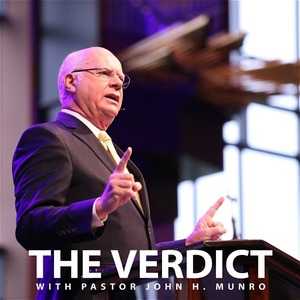
Today on the verdict with Pastor John Monroe.
Now what's the theme of Colossians? The theme of Colossians is the supremacy, the incomparability, the centrality, the complete sufficiency and adequacy of Jesus Christ. How wonderful. Welcome to the verdict with Pastor John Monroe, Senior Pastor at Calvary Church in Charlotte, North Carolina. Today, we're beginning a brand new study on the New Testament book of Colossians.
And while this small book is only made up of four chapters, it contains crucial lessons for us today. As we grapple with questions on faith and false doctrine, the book of Colossians is an essential guide. To get us started, here's Pastor John Monroe. It is with great joy today that I begin our new series in the book of Colossians. It was written 2,000 years ago.
To a very different culture from ours, but it is the eternal Word of God and speaks to us today. Colossians is one of the shorter letters of the Apostle Paul in the New Testament. Written to the congregation in Colossi in Asia Minor around AD 60. We're going to see that Paul writes to address the false teaching which is impacting the church in Colossi. This false teaching suggested that people could pick and choose what they believed.
Now, there are only four chapters in Colossians, but we will discover that they are packed with great truth. Focusing on the preeminence of our Lord and Savior, Jesus Christ. We begin our exposition of the book of Colossians, and perhaps someone's asking: why study a book of the Bible? Why not rather speak on topics of popular interest? Why would we spend time working our way through the book of the Bible?
Well, from time to time I do speak on issues from a biblical perspective.
However, we must remember. That all of the Bible is relevant. All of it is relevant because all of it comes from God. It's God's eternal word, and that which is eternal is obviously relevant. Paul said to the Ephesian elders in Acts chapter twenty, He said, I did not shrink from declaring to you anything that was profitable.
and from declaring to you the whole council of God. Again, he writes, 2 Timothy 3:16 and 17: All scripture is breathed out by God and profitable for teaching. for reproof, for correction, for training in righteousness, that the man of God may be competent, adequate, equipped for every good work.
Now, don't you think God knows better what we need, what is profitable for us than we do.
So, why should I try and figure out what I should preach on when God has given us His revelation, His Word? And that's why I preach. The Bible. This study in Colossians is also relevant because of its subject matter. Colossians, a fascinating little book of only four chapters.
You can read that, these four chapters in about 15 or 20 minutes, depending on your speed of reading. But this little book, only four chapters, contains some of the richest theology in all of the New Testament. False doctrine was impacting the ancient church at Colosse. And Paul writes to address this false teaching. And in so doing, gives us very, very relevant teaching, as we'll discover in our study in Colossians.
This false doctrine drew from several sources. People Like to draw. and form a kind of syncretistic religion. That is, as human beings, we like to pick and choose what we believe.
So today people take a little bit of Christianity.
Some Eastern philosophy. Throw in a little bit of Hinduism. Add a little mysticism, mix them all up. And then make their own decisions and base their lifestyle based on their own prejudices and desires. Underlying that approach, which was also true in the first century, is the popular idea that one religion is as good as another.
We're told today, instead of drawing from just one belief system, Why not get the best of all of the religions and have a mixture? Isn't that the best way? To go.
So today In our society, there's an increasing tolerance of all beliefs rather than the true belief. which states that Jesus Christ is not just one among many different religious leaders. No, Jesus is God, Paul is going to tell us. He is the only way of salvation. Religious syncretism in the first century and in the 21st century rejects the biblical revelation of God as revealed in Jesus Christ.
So today, don't be surprised. At the increasing attacks on the uniqueness of our Lord Jesus Christ. Have you noticed? How more and more in our society there are people who are attacking the uniqueness. of Jesus.
So studying the book of Colossians is very helpful and it's certainly very timely. Positively, Paul presents the uniqueness of Jesus the Christ. Negatively, he refutes the false doctrine. And in so doing, he also gives us very practical Christian instruction for living in a pagan and decadent society. This evening in our introduction.
To Colossians, we're going to consider the background, the false doctrine, the theme, and then the greeting of the opening two verses. Let's open our Bibles. To Colossians 1 then. And read verses 1. And two.
You say, wow, he's really going to go slowly through this book, isn't he? Listen, this is an introduction. Don't knock me before you hear the message. Keep your criticisms to the parking lot, right? Colossians 1.
Verse one. Paul, an apostle of Christ Jesus. by the will of God and Timothy our brother. To the saints and faithful brothers in Christ at Colosse. Grace to you and peace for you.
From God our Father.
Now let's think of a little of the background of Colossians. Think of the church that was planted at Colossi. Klase was located in Lycas Valley in present-day south-central Turkey. Colossa was about 120 miles east of Ephesus. It was a neighbouring town to Laodicea.
12 miles away, Hierapolis 15 miles away. The principal industry of ancient Colosse was the manufacture and preparation of woolen fabrics. It wasn't a very famous city, not as well known, for example, as Ephesus. And today, Colossee no longer exists. It's in ruins.
We know from this little book, chapter 2, verse 1, that Paul never personally visited Colossae. He says to them in chapter 2, verse 1, we haven't seen each other face to face. The church, rather, was probably founded by Epaphras. Look at chapter 1, verse 7. As he talks about the gospel, he says, just as you learned it from Epaphras, our beloved fellow.
Servants. Epaphras probably was converted through Paul. When Paul was in Ephesus, 120 miles, away from Closie. Colance was also the home of Philemon and his slave Anesimus. You may recall on Paul's third missionary journey, he came to Ephesus and stayed there for two years.
years. And from Ephesus the gospel spread. Coming probably through this wonderful manupaph, coming to Colossi. Paul now is probably in prison. Look at the last verse of This little book, Colossians 4, verse 18.
Paul says, I, Paul, write this greeting with my own hand. Remember my chains, grace be with you. Paul is writing in prison, probably in Rome, and he's sending this letter. with Titicus and Anesimus to the believers at Colosse. We know that from chapters four, verses seven through nine.
And he's writing. As we read in chapter 1, verse 1, in his capacity and with the authority of an apostle. This little church at Colosse was comprised mainly of Gentile believers. But there's obviously a fairly strong Jewish influence. And when this false doctrine which we'll think of in a minute, began to permeate and impact the church.
It seems that Epaphras went to Paul for help. We'll have given them an update on the church. And also, would have told Paul of the false teaching which was threatening this new early small church. in the first century. And this book of Colossians is Paul's response.
to these problems. A little bit on the background.
Now The false teaching, secondly, the false teaching in Colossi. What was the nature of the false teaching? There's a lot of speculation as to the nature of this false teaching here being promoted at Closse. And It's difficult for us to know exactly what it is because Paul doesn't expressly spell it out. Remember when he writes to Galatians, he clearly specifies the nature of the false doctrine which was impacting the Galatian churches.
The false doctrine impacting the churches at Galatia was an attack on the gospel of the grace of God. But in Colossians, Paul doesn't give a definitive description of this false teaching. Obviously, it's known to him and known to the apostles, but he does refer to it. Look at chapter 2, verse 8. See to it, he says, that no one takes you captive.
by philosophy an empty deceit according to human tradition. According to the elemental spirits of the world and not according To Christ.
Some features of the false doctrine are mentioned. Chapter two. Verse 16. Therefore, let no one pass judgment on you in questions of food and drink, or with regard to a festival, or a new moon, or a Sabbath. These are a shadow of the things to come, but the substance belongs to Christ.
Let no one disqualify you, insisting on asceticism and worship of angels, going on in detail about visions, puffed up without reason by his sensuous mind and not holding fast to the head, from whom the whole body, nourished and knit together through his joints and ligaments, grows with a growth that is false. From God. Verse 20. If with Christ you die to the elemental spirits of the world, why? As if you were still alive in the world, do you submit to regulations?
Do not handle, do not taste, do not touch. Referring to things that all perish as they're used, according to human precepts and teachings, these have indeed an appearance of wisdom. In promoting self-made religion and asceticism and severity to the body, but they are of no value in stopping the indulgence. of the flesh.
So it appears that this false doctrine was a mixture of legalistic Judaism. and asceticism with some mysticism as well. In chapter 2, verse 18, the verse I read, there's a reference to worship of angels. It's difficult to know whether these false teachers were advocating that worship had to be offered to the angels, or whether they were saying in their visions, no doubt some kind of occultic experience, that they saw angels worshiping in heaven. That is, it may be they said we either had to worship angels or we had to have this higher experience whereby we got into heaven and saw the angels actually worshiping.
They were claiming a direct experience of the presence of God, they said. Falsely. In order to experience these mystical and Esoteric visions and spiritual experience, this full knowledge they were advocating. They said the physical body had to be prepared. by these legalistic and ascetic practices.
So the heresy was not a complete denial of the Christian faith. It wasn't that simple. We could say it never is, is it? When false teaching comes to the church, It's never Totally erroneous. There is always an element of some truth.
But this false teaching was a Christianity plus. It was Christianity plus legalism, chapter 2:16. The festivals, the new moon, the Sabbath had to be observed. A reference to the Jewish holidays. It was Christ plus asceticism.
Chapter 2, verse 18, insisting in asceticism. A belief that the body is basically evil and therefore a A pure spiritual experience had to be sought. Verse twenty one. It was Christ plus mysticism. Chapter 2, verse 18, the worship of angels going on in detail about visions.
We're caught up, they say, in these wonderful visions, very mystical, they're saying. Perhaps some occultic, even magical practices were involved.
So the false doctrine was not a complete denial of Christ. But the view that was being promoted in the church at Kalasai. Was a very serious error because underlying it was the view that Christ was not enough. A higher, deeper, fuller, more mystical, esoteric wisdom and knowledge were being advocated. A spiritual elitism.
Where some people claimed a deep knowledge of God only promised to a select few. Christ was not openly rejected by these false teachers, but Christ was being relegated to a lesser place. to experience the spiritual fullness These false teachers said Christ was not enough. More was needed.
So the false teaching then was an attack. On the all-sufficiency And the preeminence of the Lord Jesus Christ. One commentator, Vaughan, writes this way: while at its heart, It was a combination of Judaism and paganism. It wore the mask. of Christianity.
It did not deny Christ. But it did dethrone him. It gave Christ a place. but not the supreme place. This Christian facade made the Colossian error all the more Dangerous.
What was the error? It was a de-emphasis, a depreciation. A dethroning. of Christ.
Now Paul says here chapter 2 verse 8 that we must always be on the alert against false Doctrine. In Acts 20, when Paul is talking to the elders at Ephesus, he warns them that fierce wolves will come in among you, not sparing the flock. True in the first century, true in the 21st century. And those promoting this false teaching were characterized by pride. and spiritual superiority.
FF Bruce writes, Some people today, as then, love to make a parade of exceptional piety. They claim to have found a way to a higher plane of spiritual experience. As though they had been initiated into sacred mysteries, which give them an almost infinite advantage over the uninitiated. Others are all too prone to be impressed by such people, but Paul warns them against being misled to such lofty claims. Those who make them, for all their lofty pretensions, for all their boasting of the special insight which they have received into divine reality, are simply inflated by unspiritual pride.
and are out of touch with Him who is the true Head and Fount of life. and knowledge.
Now let me ask you, do you think an evangelical church today We should be concerned about false teaching.
Sounds kind of negative, doesn't it? This is the age of tolerance.
Someone says they love Jesus, isn't that enough?
Well, we're surrounded by false teaching. The evangelical church today, we're awash in subjectivism and emotionalism. We largely lack discernment. And we embrace sadly everything and anything.
Someone has to write a bestseller, bring out a DVD, promote something new. And millions of us go after it in this desire to enter into something fuller and more special. How important it is. that we listen. to the message of Colossians.
Look at chapter 2, verse 7. Or start with verse 6. Here's Paul. Therefore, as you received Christ Jesus the Lord, so walk in Him. Rooted.
And built up in him and established in the faith, just as you were taught, abounding in. Thanksgiving. This is why doctrine, why biblical preaching, is so important. We are To be built up in Christ, we are to be established in the faith just as we were taught. But sadly today many Are like the children, Paul refers to in Ephesians 4, verse 14.
He says, You're like children tossed to and fro by the waves, carried by every wind of doctrine, by human cunning, by craftiness and deceitful schemes. We're just blown back and forward. Let's embrace this. This must be okay. This is a nice person.
And Paul says, you're like Children. Blown around by every wind of doctrine. God doesn't want us to be like that. We need to be established. We need to be firm in the faith.
This is why we need solid doctrine. Paul says in chapter 1, verse 28, that his goal is, at the end of the verse, that we may present everyone mature in Christ. That we will be established in our faith.
Now how Is Christian maturity achieved? How are we established in our faith? Through the Word of God. Through reading? Through studying.
And obeying and learning the word of God. That's why preaching the Bible. is so important. Are there false teachings today attempting to dethrone Jesus? Many.
We need to be warned, we need to be established in our faith, otherwise, we will be devastated by them. Think of the popular mantra: there are many ways to God. All religions basically say the same thing. Jesus is a good man, possibly even a prophet, but he's only one way. We are bombarded by such views.
This of course dethrones Jesus. who is not just a prophet, not just a miracle worker, not just a guru. He is the King of kings and Lord of lords. He's God incarnate. He's the Alpha and the Amiga, the one who was dead and is alive forevermore, and the one who said, I am the way and the truth and the life.
No one comes to the Father apart from me.
Now, if you think I'm exaggerating about the problems we have today. Let me quote from Newsweek. Not Christianity today. Newsweek magazine. Lisa Miller in an article Called We Are All Hindus Now.
Rights. She's writing to Americans. Saying that a philosophy of Hinduism has permeated. America, including the evangelical church. Here is what's your rights.
Quote Recent poll data shows that conceptually at least We are all becoming more and more like Hindus. And less like traditional Christians in the way we think about God. ourselves, each other, and eternity. Sadly, I think she's right. I mean, she's saying this is probably a good thing.
I go on quote. The Rig Veda, the most ancient Hindu scripture, says this: Truth is one, but the ages speak of it by many names. A Hindu believes there are many paths to God. Jesus is one way, the Koran is another way, Yoga practice is a third. None is better than the other, all are equal.
Sound familiar? The most traditional conservative Christians have not been taught to think like this, I would add thankfully. But she says obviously it's a problem. They learn in Sunday school that their religion is true and others are false. Jesus said, I'm the way, the truth, and the life.
No one comes to the Father except through me. Here's Newsweek quoting the word of God. Listen to what she says, Americans are no longer buying it. Do you think she's right? Of course she's right, sadly.
According to a 2008 Pew Forum survey, 65% of us believe. That 65% of Americans believe that many religions can lead to eternal life. including Thirty-seven percent of white evangelicals. This is the verdict, featuring the Bible teaching of Pastor John Monroe. There's still more to hear when John returns in just a moment, so stay with us.
From matters of truth and identity, to the subjects of love and grace, our world seems more confused than ever. but to find truth and certainty about who we are and find peace, we must turn our attention away from the world and look to the Word of God. To help you do that, John wrote a booklet titled Eternal Security, Finding Certainty in a Chaotic World. Through this special resource, John shares his personal testimony, along with a careful examination of Scripture, to offer us clarity on matters of eternity. Get your copy today by visiting our website at the verdict.
org. While you're there, consider making an investment in this Bible teaching ministry. Whether it's $5, $50, or more, your gift today helps cover the cost of sharing these gospel messages to listeners around the world. And if you haven't already, be sure to subscribe to the Verdict Podcast, featuring John's weekly podcast exclusive called Avizandam. It's available wherever you get your podcasts, or simply go to our website.
Again, that's theverdict.org. The verdict is a ministry of Calvary Church in South Charlotte. We're located on the corner of Highway 51 and Ray Road. If you've been looking for a church home or a community to help you grow in your walk with Christ, we invite you to join us for our Sunday services. For more details about Calvary and our service times, visit theverdict.org.
Now, here's Pastor John Monroe.
Well, what's your verdict? Are you going to read and study the book of Colossians? Don't you agree? that not only was there false doctrine in the first century, There is much false doctrine today. Many churches pride themselves that they don't teach doctrine.
They believe that doctrine divides. Not only is that naive, it's very dangerous. and I know you don't want to miss the next broadcast. as we continue to be on the alert against false doctrine. Thanks for joining us today on The Verdict.
I'm Michelle Davies. Today's program with Pastor John Monroe was produced and sponsored by Calvary Church in Charlotte, North Carolina.