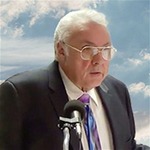
Today, on the verdict with Pastor John Monroe. A foolish king. at the instigation of an evil man, Motivated by Satan, agrees to exterminate a whole race, God's chosen people, the Jewish nation. Haman is an agent, an instrument of Satan. seeking to thwart the eternal purposes of God.
Welcome to the verdict with Pastor John Monroe. Throughout history, God's chosen people, the Jews, have been challenged, oppressed, and hated. not just by other people, but by Satan himself. And today, on the verdict, we'll witness the reality of the spiritual battle between God's people and the forces of darkness.
Now, to introduce today's message titled, Satan Hates the Jews, here's Pastor John Monroe. The Old Testament story of Esther is a fascinating one. It is all the ingredients of an exciting drama. It has a beautiful heroine. and an evil villain.
Today we'll meet the villain, Haman. and learn of his hatred of the Jewish nation. Last time we saw that rather than Mordecai being promoted by King Ahasuerus because he revealed a conspiracy to kill the king, the king promotes Haman as a kind of prime minister. Haman is proud, evil. Vicious.
He hates all of the Jews, and in particular Mordecai. What's going to happen? How is this story going to unfold? What do we learn about the personification of evil in someone like Haman? And why do so many throughout the world today still hate the Jewish nation?
In difficulties, in conflict, God will take care of you, but the reality is. uh life on earth can be difficult. First of all, Although we're called to serve Christ, Um And his kingdom in this world, we are not to be conformed to the world. And that tension between living in the world but not being of the world produces conflict. Secondly, there is internal conflict, isn't there?
That we who follow Jesus Christ I receive the gift of the Spirit. And he indwells us, but yet there is still indwelling sin, as Paul would say. We still have the flesh, and so there is this conflict, this struggle between the flesh and the spirit. And then, third, There is a conflict. Uh because of our enemy.
uh the devil himself, who's totally opposed to To all that is holy, totally opposed to God, totally opposed to his church. Totally opposed. to us when we seek. Uh to live a life uh reflecting the glory of our Saviour. Jesus in the Gospels describes the devil as the father of lies and a murderer from the beginning.
And in this chapter this evening, as we look at Esther chapter 3, we see an example of the work of our enemy, Satan himself. Uh we will see his lies. And we will see his murderous intent against the people of God. Of the three animates, the world, the flesh. And the devil, of course, the devil is the most devious, the most intelligent, the most powerful of them all.
And yet, James reminds us in James 4, verse 7, that even when a young believer The youngest believer can resist the devil and he will flee from us. Do you believe that? I do. Resist the devil, and he will flee from you. That's a tremendous encouragement to us.
But we find ourselves. In this battle, a battle between right and wrong, between good and evil, between God and Satan, between light and darkness, between the kingdom of God and the kingdom of this world. Between heaven And hell. But this is the truth we're going to grasp this evening: that in spite of the opposition, and the tension, and the conflict, and the persecution, and the trials, and tests, and tribulations which come to us all, God, as we sang, always takes care of His people. Isn't that good to know?
I know we don't always feel that. I know it's not always obvious to us, but God promises that He will take care. Of his people. Jesus said in John 16, verse 33: In the world you have tribulation, but take heart. I have overcome.
The world. Will you take heart? Life is tough. Our Saviour has overcome the world. Paul says in that great verse in Romans 8:31, What shall we say to these things, if God is for us?
Is God for us? Is God for us? A few of you believe he is. In some churches that would be a little louder. Is God for us?
If God is for us, who then can be against us? It's a rhetorical question. If God is on your side, There is no opposition. which can stand against him.
Now we see this hostility, this hatred, this persecution against the people of God, the Jews. In our passage today, here are the people of God, some of them, some of them are back in Jerusalem, back in the land, but others are still living in pagan Persia. And behind the darkness, behind the persecution, behind the scheming of this evil man that we're going to meet this evening. The invisible hand of God is at work. Setting the stage for the deliverance of his people through the appointment of this Jewish.
Queen, Esther. who becomes a very queen in the Persian court. And also God is going to orchestrate events so that Esther's cousin Uh Mordecai. It's going to be in a position of influence.
So let's open our Bibles this evening to Esther chapter three. This is our third study in the book of Esther. And we're going to uh meet this man, this terrible man, this wicked man, Haman. And we see his promotion. In verses one through five.
Let's read verse one, first of all, where Haman is. elevated where he is Promoted. Esther 3, verse 1. After these things, King Ahasuerus promoted him in the agagite. The son of Amin.
Ahmed Atha, and advanced him and set his throne above all of the officials. who were with him. Between the end of chapter 2 and the beginning of chapter 3, there's a period of about four years. Esther is still queen in Persia. And you will remember if you were here last week and read Esther 2.
At the end of chapter 2, Mordecai reveals a conspiracy. by two men who were conspiring to kill King Ahasuerus. And uh strangely Rather than the king immediately honoring Mordecai, the king promotes this man called Haman. And we're now introduced to the villain. of the story, the villain of the drama.
In synagogues, I'm told when Haman's name is mentioned, children boo and stamp. And when they cheer, when Mordecai's name is mentioned.
So if you want to boo and stamp. When Haman's name is mentioned, go ahead. You've got my permission. Heyman. One or two stamping, right.
Okay. Verse 1. Notice, the king advanced Haman and set his throne above all of the officials who were with him. He becomes, in effect, prime minister. There's the king, and next to the king is this man, Haman.
Second only to King Ahasuerus throughout the immense empire of Persia, which stretched from what we know as present-day, probably present-day Pakistan. uh away right over To present-day Ethiopia, Sudan, a huge empire.
Now, Mordecai had done the right thing in reporting the conspiracy, but instead of him being elevated to a position, Of importance and awarded this evil man, Haman, becomes Prime Minister, and this man, Haman. is the kind of individual you may have met him or her who uses his power and his position for his own ends as he tries to control and indeed manipulate events. People like that in our society today, aren't there? And we sometimes wonder why wicked people, evil people, manipulative people, seem to prosper. Perhaps you're a faithful individual at your work seeking to display Christ, but one of the most unscrupulous of your colleagues is promoted and placed in a position of authority, possibly over you, and it seems so unjust.
And it is unjust. What are you to do? You have to remember that God is sovereign. That God is in control, not you. And you're to continue to trust the Lord.
in that difficult circumstance, knowing that God is at work. often as it as is the case in Esther invisibly behind the scenes.
So first of all, he's elevated. In verses two through five, he is provoked. Verse two. And all of the king's servants who were at the king's gate bowed down and paid homage to Haman. And I'm sure he loved every moment of it.
Can you just picture him? For the king had so commanded concerning him. But Mordecai Don't you love this man? Didn't bow down. or pay homage.
Then the king's servants, who were at the king's gate, said to Mordecai, Why do you transgress the king's command? And when they spoke to him day after day, and he would not listen to them, they told Haman in order to see whether Mordecai's words would stand. For he had told them This is interesting. He had told them that he was a Jew.
Now you recall. during the beauty contest. Esther had not to reveal that she was Jewish, but now it comes in the open. Mordecai makes it known he's a Jew. Verse 5.
And when Haman saw that Mordecai did not bow down or pay homage to him, Haman was filled with with fury.
So the king makes this command that all of the king's servants, everyone, including Mordecai, who may be in some position of authority, as he's at the king's gate, as we saw last week, they are to bow down and pay homage. to this important man in the kingdom, Haman. And Mordecai, the Queen's cousin, refuses to do so. And this matter becomes the talk of the town. And although Mordecai is told by others to bow before him, he consistently, day after day, refuses to do so.
And we ask why. Why does Mordecai not bow and pay homage to Haman? It wasn't wrong for a Jew to bow before someone in authority. That wasn't worship. Esther is going to fall at the The feet of the king in in chapter 8.
Wasn't it just a matter of court protocol to bow before the Prime Minister? After all, he was a very important position, and after all, the king had commanded everyone to bow and to pay homage to Haman?
So, what's going on here? Is Mordecai just one of these awkward individuals? Is he too proud, too stubborn? Was it kind of envious of Haman's success and he's just being a sort of petulant? I don't think so.
If you look at verse 4, the text gives us the reason, I think. The end of verse 4. For he had told them that he was a Jew.
Now this is key. Notice also how Haman is described in verse 1. He's described as being an agagite.
Some have said that Agag was merely a province of Persia, and that's all the significance there is in Haman being described as coming from this province of Agag, but I think there's much more. Haman is a descendant of Agag the Amalekite. Do you remember the Amalekites? She's reading your Bible? Who are the Amalekites?
The Amalekites were Israel's ancient enemy. Turn back with me to Deuteronomy. The fifth book of the Old Testament. Deuteronomy chapter 25. And let's read a little bit about the Amalekites.
Deuteronomy twenty-five, seventeen. Yeah. Remember what Amalek did to you on the way as you came out of Egypt, how he attacked you on the way when you were faint and weary, and cut off your tail. Those who were lagging behind you, and he did not fear God. Therefore, When the Lord your God has given you rest from all your enemies around you, in the land that the Lord your God is giving you for an inheritance to possess, you shall blot out the memory of Amalek from under heaven.
You shall not. Forget.
Now do you remember The first king of Israel. Who was the first king of Israel? Saul And you remember When he was the king of Israel, The king of the Amalekites was called Agag. You read about it in 1 Samuel 15. And Saul is going to attack the Amalekites, which he should have done.
He's commanded by Samuel to do so, but Samuel tells him. That when you attack the Amalekites, you've got to wipe them out. You've got to destroy them. That was the commandment of God. They were the instruments of the judgment of God.
on this enemy. Symbolized by their king, King Agag. What does Saul do? Saul tries to be more spiritual than the commandment of God. And when Samuel comes towards Saul, He hears The sound of the cows, and he hears the bleating of the sheep.
Which belonged to the Amalekites. And he says to Saul, What's going on here? You were commanded to completely destroy not only the Amalekites, but everything they possessed, to wipe them out. What does Saul say? Oh well, I kept some To do a sacrifice and an offering to God.
That sounded so spiritual, didn't it? What does Samuel say to him? Obedience is better than sacrifice. and to hearken than the fat of rams. In other words, of prime importance, Saul, a good lesson for us.
Is it good to make a sacrifice to the Lord? Of course it is. We should live sacrificial lives. But of first importance is obedience. And, Saul, you have disobeyed the clear command of the Lord.
Such was the poor first king of Israel. And when King Agag comes to Samuel, remember he says to Samuel. Surely the bitterness of death Has passed. In other words, you're not going to kill me, are you? I mean, surely there's been enough killing.
And Samuel and Ascend system, I'll show you the bitterness of death. And the Bible says he hacked. agag to pieces before the Lord at Gilgal. You say that's tough. Agag, of course, is a picture of the flash.
It's a picture of the enemy. Which, if you don't deal with it, will kill you. As John Owen said, kill sin, or it will kill. You.
Now that is the history.
Now here then, the writer is telling us that Haman This evil man was an agite. And he's making it very clear then that Haman Was an enemy of the Jews. He's anti-Semitic. Look down at verse 10, at the end of verse 10. Notice what it says.
About Haman, the Agagai, the son of. Hamad Asa. The enemy of the Jews. That's significant, isn't it? He is the enemy.
of the Jews. And Mordecai is certainly not going to bow to the implacable enemy of the Jewish people. Nordic kind like Saul comes from the tribe of Benjamin. We've seen that earlier. He would be very, very familiar with the story of Agag the Amalekite.
And perhaps Mordecai had told the story to the king's officials. And when Mordecai, in my view, commentators dispute this, but in my view, when Mordecai refused to bow to Haman, Haman is, did you notice verse 5? He is filled with fury. Why are you so furious? All of the people are bowing down.
You're the Prime Minister, and there's just this one man who doesn't bow down before you, and he's absolutely furious. He is an agagite. And he knows now that Mordecai is a Jew. What's he going to do? What's his plan?
Verse 6 through 15. First of all, his plot. From verses six through Nine. But he disdained to lay hands on Mordecai alone. He's going to bide his time.
So, as they had made known to him the people of Mordecai, Haman sought to destroy all the Jews. The people of Mordecai throughout the whole kingdom of Ahasuerus. Doesn't want to just kill one man, one Jewish man, he wants to wipe out. All of the Jews. In the first month, which is the month of Nisan.
Great name for a car, wouldn't it? In the 12th year of King Ahasuerus, they cast pure, that is, they cast lots before Haman day after day. And they cast it month after month till the twelfth month, which is the month of Adar. Then Haman said to King Ahasuerus, Can you hear the evil? There's a certain people scattered abroad and dispersed among all the peoples in all the provinces of your kingdom.
Their laws are different from those of every other people, and they don't keep the king's laws, so that it is not to the king's profit to tolerate them. If it please the king, let it be decreed that they be destroyed. Think of what he's saying. And I will pay 10,000 talents of silver into the hands of those who have charge of the king's business that they may put it into the king's. Treasuries.
This man has the power to put Mordecai to death. But Hayman's fury, Heyman's hatred, extends well beyond Mordecai as an individual. He sought, verse 6, to destroy all the Jews who were throughout the whole kingdom of Ahasuerus. We don't know how many there were, but there were many thousands. He wants to commit genocide.
He planned he is planning a Holocaust. to wipe the Jewish nation From the face of the earth, put an evil, wicked man. He doesn't know, however. That the very course which he's embarking on is going to result in disaster. for himself.
Do you really think you can oppose God? Do you really think? That you can continue to rebel against God and win? Is this man so foolish? Didn't he know the history of his people?
Didn't he know the history of the Jewish people to that point? Do you think you'd ever heard of the Abrahamic covenant where God promises Genesis twelve verse three, I will bless those who bless you, and him who dishonors you, I will curse. Haman, do you want to get God's judgment on you? conspire against the Jews. This evil man, did you notice that this evil man him and is superstitious?
And he seeks guidance from astrology. Don't you find it amazing that people reject the word of God? And then look at horoscopes and astrologers and mediums. And get your PAM read, or someone to read the cards, or the tea leaves in the bottom of your cup. It's incredible, isn't it?
And here verse 7, he casts lot. Pure is the Persian word for lot. Later in the book, we're going to learn about the Feast of Purim. The plural of Pur is Purim. But even in the casting of the lots by this evil man, We see the sovereign hand of God.
Is God so great that you can throw a dice and God can bring up the right number at the right time? Of course, he can. I don't know what kind of lots they were casting here as they kept doing it. Haman, as he was plotting and conspiring against the Jews. Proverbs sixteen, verse thirty three says, The lot is cast into the lamp.
But it but it's every decision is from the Lord. Isn't that great to have God on your side? God can oversee. The throwing of a dice. God can oversee the casting.
of a lot. And these lots, these purim were like dice. And the day selected for the genocide was about a year ahead. which gave the Jewish people time to prepare for the coming Holocaust. It's wonderful to know, isn't it, when we think that God will take care of us, that God not only is over the control of the events.
God is in control of the timing of events. This is the verdict, featuring the Bible teaching of Pastor John Monroe. There's still more to hear when John returns in just a moment, so stay with us. From matters of truth and identity, to the subjects of love and grace, our world seems more confused than ever. but to find truth and certainty about who we are and find peace, we must turn our attention away from the world and look to the Word of God.
To help you do that, John wrote a booklet titled Eternal Security, Finding Certainty in a Chaotic World. Through this special resource, John shares his personal testimony, along with a careful examination of Scripture, to offer us clarity on matters of eternity. Get your copy today by visiting our website at theverdict.org. While you're there, consider making an investment in this Bible teaching ministry. Whether it's $5, $50, or more, your gift today helps cover the cost of sharing these gospel messages to listeners around the world.
And if you haven't already, be sure to subscribe to the Verdict Podcast, featuring John's weekly podcast exclusive called Avizandam. It's available wherever you get your podcasts, or simply go to our website. Again, that's theverdict.org. The verdict is a ministry of Calvary Church in South Charlotte. We're located on the corner of Highway 51 and Ray Road.
If you've been looking for a church home or a community to help you grow in your walk with Christ, We invite you to join us for our Sunday services. For more details about Calvary and our service times, visit theverdict.org.
Now, here's Pastor John Monroe.
Well, what's your verdict? How do you treat Jewish people? Why is it that historically so many have hated, persecuted and even killed Jews? In this ancient story, we see the hatred of Satan and his servants for God's people. and Satan is still active today against the people of God.
We're also going to be reminded that Almighty God is in charge. And his purpose is will be carried out. Don't forget to tune in next time as we continue this exciting story of Esther, Mordecai, Haman, and the Jews. Thanks for joining us today on The Verdict. I'm Michelle Davies.
Today's program with Pastor John Monroe was produced and sponsored by Calvary Church in Charlotte, North Carolina.