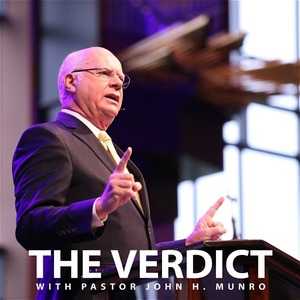
Today on the verdict with Pastor John Monroe. Here is Peter, a man who denied the Lord not once or twice, but three times. He denied the Lord yet. out of the ashes of his defeat and denial. Our Lord graciously recommissions Peter.
To be a shepherd. to feed the flock. The tens. The lambs. Welcome to the verdict, featuring the Bible teaching of Pastor John Monroe.
Senior pastor of Calvary Church in Charlotte, North Carolina. What does faithful leadership look like in the church? Today we're learning about the crucial role of spiritual shepherds. As someone who failed and was then restored, Peter offers unique insights on servant leadership.
So, continuing our journey through 1 Peter, here's Pastor John Monroe with a message about faithful shepherds. Is your pastor a shepherd? Over the years I have observed many who call themselves pastors. but many of them are not true shepherds. They may be administrators or counselors or small group facilitators or teachers, but the designation of shepherd.
does not accurately apply. The essence of pastoring is being a shepherd. and in her study the Apostle Peter now gives teaching to elders who have the responsibility of looking after the flock. It may not be very flattering to be referred to as sheep, But that's what we are. and sheep.
Need a shepherd. Praise God that Jesus Christ is the eternal Good Shepherd. He loves us so much that He gave His life for us.
Now the Apostle Peter writes as a shepherd to other shepherds. Let's look at 1 Peter chapter 5.
Well, last time we looked at the closing verses of 1 Peter chapter 4. For those of you who are newly here, We're going consecutively through this wonderful letter written by the Apostle Peter. We're almost at the end of it. Uh we're now into the last chapter, chapter five.
So, if you have your Bible, as I hope you have. Turn there with me to 1 Peter chapter 5. And Peter is teaching us how to respond biblically. To suffering. We're in a suffering world.
He's reminded us that our Lord Jesus Himself suffered. And that we who are his authentic followers of Jesus Christ are not to be surprised when we go through that fiery trial, when we find ourselves in the refiners. Furnace. And because of this, he has earlier told us several times that we are to love one another as the people of God. That we are to serve one another.
God has gifted us. We're to use these gifts not to exalt ourselves. to promote ourselves, but rather to serve one another. We are to encourage one another as followers of Christ. We're to bear one another's burdens and pray for one another.
And while all of us who are followers of Jesus Christ are to do this, God in His sovereign purposes, Provides within the Church of Jesus Christ, within each local assembly of believers, He provides a group which have a particular responsibility to care for others. They are our spiritual shepherds. And that's what we're going to learn about today. We're going to learn the importance of faithful shepherds in the Church of Jesus Christ. What are their responsibilities?
What should we expect from them? This is our subject. Faithful shepherds. Read with me in 1 Peter 5, then, as we'll read the first four verses.
So I exhort the elders among you. as a fellow elder and a witness of the sufferings of Christ. as well as a partaker in the glory that is going to be revealed. Shepherd the flock of God. That is among you.
exercising oversight. not under compulsion, but willingly as God would have you. not for shameful gain, but eagerly. Not domineering over those in your charge. but being examples to the flock.
And when the chief shepherd appears, you will receive the unfading crown. of glory. Peter As he comes towards the end of this epistle, writing to these believers who are scattered throughout the Roman Empire because of the persecution. He is writing in these verses to shepherds. He himself is a shepherd and he's making an appeal.
To shepherds. Notice how he first describes himself as a fellow. Elder. As you began his letter, he described himself as an apostle of Jesus Christ, but here he's not using his apostolic authority, as it were, but is humbly placing himself. on the same level as these other elders.
I think that's wonderful. Think of Peter, he was the leader. of the twelve. Think of all that he accomplished as you read the book of Acts. But here he describes himself.
As a fellow Elder, can I just pause there and say That there are to be no celebrities at the Church of Jesus Christ. Peter doesn't come over as it were. Of speaking down to them, but says, No, I'm a fellow elder with you. In the church, There is one only one celebrity. I hate the word celebrity.
But that is King Jesus. Do you really want to compete with him? Do you really think the church is about you? Is there any of us who are going to be so proud to exalt ourselves? Peter's going to tell us, as we'll see next week, about humility, how key it is that all of us, and I would say particularly those of us who are in leadership, to be humble.
Peter knows the joys and challenges of being a spiritual shepherd. You remember at the end of John's Gospel, John chapter 21, our Lord, raised from the dead, comes near to Peter and tells him to feed my sheep, to tend my lambs. He'd received that injunction from the Lord himself, and now, as a fellow shepherd, as a fellow elder, He's saying to these men whom God has appointed in these churches. It's a shepherd. My vlog.
So first he describes himself as a fellow elder. Secondly, he says he is a witness of the sufferings of Christ. Peter was an eyewitness to some of Christ's suffering in the Garden of Gethsemane. He saw the Lord suffering there with that sweat, as it were, like blood. Yes, he observed certainly from afar at the trial.
He also personally experienced Christ's suffering in the sense that he also suffered. As he followed. His savior. And church history tells us. He's going to be martyred.
He's going to be put to death. for his Faith. About the sufferings of Christ. And then he says, and this is wonderful, isn't it? He says, A partaker in the glory that is going to be revealed.
This concept of suffering followed by glory is repeated several times in Peter's letter here. Peter is confident. of the revelation of the glory of the Messiah. And although he understands the fullness of that glory is yet future, he has a foretaste of it. In chapter 1, he talks about rejoicing with joy inexpressible and full of glory.
And now he says to the faithful shepherds, Hey. and undoubtedly himself. Is going to receive the crown. of glory. It's a good reminder, isn't it?
When we suffer. that is going to come to an end. And we're going to enter into endless glory.
So here he is, an elder, and he's writing to elders. In the New Testament, The biblical form of Church government. governance is ruled by a plurality of elders. Not one person.
However, gifted, however, able, however charismatic, not one person, but a group, a plurality of elders. We see that, for example. In Acts chapter 20, Paul is at Miletus and he's about to to leave. And what does he do? Acts 20, verse 17.
Now, from my leaders, he sent to Ephesus. and called the elders plural. Elders of the church that come to him. He's going to speak. to the shepherds, not just a shepherd.
But the elders of the church. Verse twenty-eight.
Well, verse 27 says, I didn't shrink from declaring to you the whole counsel of God. He was a bold Apostle was Paul. Pay careful attention to yourselves and to all the flock. in which the Holy Spirit has made you overseers. Plural.
to care for the Church of God. which he obtained with his own. Blood. And the New Testament sets out the qualifications for the elder, for the man of God. These are given in 1 Timothy 3 and Titus chapter 1, recognizing that not all of the elders, not all of the shepherds in the church have the same gifts, but they are to share the joys, the sorrows, the burdens, and privileges and responsibilities of shepherding.
So he writes to elders. And now he's going to give this exhortation. He himself is a shepherd. And he's going to exhort The shepherds. Notice what he says.
Verse two. Shepherd the flock of God. There is Among you. Isn't it wonderful what God does? Here is Peter, a man who denied the Lord not once or twice, but three times.
He denied the Lord yet. out of the ashes of his defeat and denial. Our Lord graciously recommissions. Peter. To be a shepherd.
to feed the flock. to tens. The lamps. And now Peter are much wiser Man, with all of the experiences that he had. As he's writing to these believers, and now particularly to the shepherds in these various churches, he's encouraging the shepherds to do what?
Verse 2, to shepherd. the flock of God that is among you. This term shepherd. It gives a beautiful description of the work. of the pastor.
We just sang the hymn which is based on the most famous of all of the Psalms, Psalm 23, where David, himself a shepherd. not just a shepherd of sheep, but the shepherd of people, he writes, The Lord is My Shepherd. The wonderful to do. That this great almighty God is our Shepherd, what a beautiful picture. And now The good shepherd Is delegating some of his authority in the local church to a group of men called shepherds, called elders, called.
Pastors. What does a shepherd do? A shepherd leads. Feeds, cares for. and protects the sheep.
And fundamentally, the shepherd, certainly the good shepherd, not the hireling, but the good shepherd. Nose. The shape. You look at a flock of sheep and they all look alike, don't they? Not to the shepherd.
Recently Good and I were in at uh Biltmore for an event and Ms. Goodney was having lunch with some of her friends. I was isolated. And I was wandering around. Built more.
And I came across this field. And uh there was a flock of goats, not sheep, but goats. I know more about sheep than goats. But I stopped looking to these goats. Smelly creatures, they were.
And a young woman came and started feeding them and got in a conversation with her. And she said she worked there and she was feeding the goats. And as she was doing this, I thought, this young woman really cares for these goats. I mean, he wants to connect with a goat. And I said to her, you seem to know these goats.
She said, oh yes. She said, I raised them. And she started referring to them. By name. I don't who wants to name a goat.
And I thought, well, you name your cat, you name your dog. You may give a name to your goldfish. I mean, what about a goat? Remember what the Lord Jesus says in John 10? When he says he's a good shepherd.
He says the good shepherd calls his sheep By name. And the sheep know his voice. That's an incredible thought, isn't it? And the shepherd, the good shepherd, In the church of Jesus Christ. nor's the sheep.
Peter says, shepherd the flock of God that is among you. I've known over the years, I've known elders and pastors who don't like people. That's amazing. They don't like the smell of sheep. I mean sheep can be nasty, sheep can bite.
As some of us know. But if you don't like sheep Don't be a shepherd. Over the years I've inter interviewed a lot of young men who want to go into the pastorate. Applying for a position. And I sometimes ask him, where do you see yourself?
in five years from now. Here's a young man perhaps applying to be a youth pastor, and they pause and say, Well, I'd like to write a book. And I think, oh no, not another book that no one else is going to read. Everybody wants to write a book.
Okay, you're gonna write a book.
Well, what else?
Well, I see myself at conferences telling other people how to do ministry. Oh, okay. You're at the center, obviously. Yeah, anything else? Very rarely, sadly, Do they say I want a shepherd.
I want to care. For people.
Some people in leadership, some pastors only want to preach. They want to teach. They want to be center stage. I say to them, don't call yourself a pastor. Say you're a Bible teacher, say you're a communicator.
Say you're a professor. But a pastor in the spiritual sense is among the sheep. knows the people, knows the flock. Elders, pastors, deacons, let me say to you. If you are in that position at church, you need to know the flock.
You say, well, I can't know everyone, I know that, but you can know some. Know them by name. know where they are spiritually. learning to love them. And here is Peter, a shepherd.
He's encouraging the Overseers. He says here Shepherd the flock of God that's among you, exercising. Oversight. Elders exercise. Exercise oversight as they look out for all the flock of God.
Notice that. The wise shepherd, the good shepherd. keeps an eye on the whole flock. Seeing the big picture. caring for all of the sheep.
Not cultivating a little group of groupies, as it were. With himself as a kind of guru. I've seen that over the years.
Someone in leadership and they cultivate a little group. Almost of yes, men and women. exalting themselves. Reminds me, remember King David? Here's some No very good sons.
One of them, Absalom. Samuel tells us That Absalom stole the hearts of the men of Israel. He worked against the king. He wanted to be king. He wanted that crown, and so he stole the hearts of Israel against the will of God.
There was another king of David. Abijah He says, I will be king. David is dying, he's coming to the end of his life, and here's another man wanting to exalt himself. Do you think that happens in the church? You know what happened in Corinth?
What's the problem in cars? Division? Oh, I like Paul. No, I like Peter. Oh, I like Apollos.
He is so eloquent. And so they were divided. You know what? Paul says that that's a characteristic of immaturity. What was their problem?
They were man-centered rather than God-centered. The faithful shepherd Points people not to themselves, but points people to the Lord Jesus Christ, to King. Jesus. But in our flesh, In our pride, There's a tendency. for all of us, yes, including spiritual shepherds.
to put themselves first. Not a new problem. You may recall in the Gospels They're on their way to Jerusalem. And Mark records that on the way, The disciples were arguing. And so Jesus asked them.
and says, What were you what are you talking about on the way? And they kept silent. Do you know why? Because they were arguing about this. Who is The greatest.
Who is Number one. That's not a good shepherd, is it? The good shepherd, Peter, says, Cares for the whole flock of God. We must always remember. Those of us who are in leadership.
that our flock belongs not to us but to our Lord Jesus Christ. How is the shepherding done? Peter gives us great insights in verses 2 and 3. How are we to do that? And he deals with some of the dangers.
Three great dangers as we shepherd. Laziness. Materialism. And a thirst for power, a thirst for. Control.
And he's going to eliminate all of these as he describes the manner. We are to shepherd. First of all, he says verse 2. To the elders, Shepherd. not under compulsion, but willingly.
Verse 2. Shepherd the flock of God that is among you, exercising oversight, not under compulsion. but willingly as God would have you. The spiritual shepherd isn't a conscript that someone's twisted his arm, someone has put some guilt on this person to serve. No, the shepherd isn't a servant of a false sense of duty.
Paul tells Timothy that the elder is to have a desire for the work. The spiritual shepherd is to be called by God. We read the scripture in Acts 20 where Paul says it's the Holy Spirit that raises up shepherds. I hope I'm here. Not because I feel Charlotte's a nice place to live, which it is.
I'm here because God Called me. The shepherd is called by God. There's a willingness. Our Lord Jesus said of him, he delighted to do the will of God. He came not to be served, but to serve.
This is the spiritual example elders are to follow.
Now this first century Elders didn't have it easy. Think of the suffering. And if you know anything about the persecuted church, you know that the authorities and the devil target the leaders. They're on the front. Line.
And if you know the heartache of Pastoring or eldering. There may be a hesitation to serve. That may mean some men may question whether or not they should serve. And As shepherds serve the church. There is heartache.
They're stressed. There's discouragement. Among pastors, there's a very High rate of dropout. That was particularly during COVID. I forget the numbers, but a lot of Those in pastoral ministry gave up and went into some other occupation.
I would have to ask them, but didn't you? Weren't you called by God? Does the spiritual shepherd run away when the wild animals come? to attack the sheep. Is it a mark of the shepherd?
that in the face of danger he retreats, surely not. Yeah. Elders and pastors are sometimes criticized. Stuart Briscoe says that the qualifications of a Pastors are as follows. The mind of a scholar.
the heart of a child and the hide of a rhinoceros. This is the verdict with Pastor John Monroe and the first part of a lesson titled Faithful Shepherds. John has more to share in just a moment, so stay with us. Today's discussion about spiritual leadership reminds us of the importance of having a biblical perspective. And as we see increasing challenges in our world, it's important to understand God's plan for the future and how to live in the light of His priorities.
John has written a helpful resource, called For the Time is Near, that provides a Biblical introduction to the Book of Revelation. This guide will help you read and understand Revelation in context, exploring key themes like the centrality of Jesus Christ. God's prophetic calendar and our glorious future hope. Download this encouraging booklet absolutely free at theverdict.org. And while you're there, be sure to subscribe to John's monthly newsletter for ongoing biblical insights.
These daily teachings are made possible through the generous support of listeners like you. If God's word has strengthened your faith through the verdict, would you consider helping us reach even more people with a financial gift? Your contribution enables us to continue broadcasting these biblical messages to communities around the world. Donate today by visiting theverdict.org. And by the way, we'd love to welcome you this Sunday at Calvary Church, where John serves as senior pastor.
Join us for inspiring worship, warm fellowship, and the same solid biblical teaching you hear on the verdict. We're located in Charlotte, North Carolina, at the corner of Highway 51 and Ray Road. And you can also join us remotely through our live stream online. For more details, just visit theverdict.org.
Now, here's Pastor John Monroe.
Well, what's your verdict? If you are a leader in your church, are you truly a shepherd who leads, feeds, protects, and loves those in your flock? Shepherding is a holy calling. A way of life which serves God by leading and caring for His people. If you're not a leader, encourage the pastors and elders in your congregation to grow in their shepherding skills and responsibilities.
Pray for them faithfully. and support your leaders in whatever ways you can. The church today desperately needs faithful shepherds serving the flock. Thanks for joining us today on The Verdict. I'm Michelle Davies.
Today's program with Pastor John Monroe was produced and sponsored by Calvary Church in Charlotte, North Carolina.