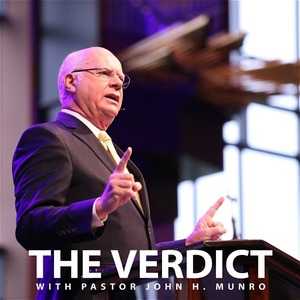
Today, on the verdict with Pastor John Monroe.
Now, what is Peter's pattern? Let's look. Verse 13, what does he say? Therefore, preparing your minds for action. You want to live a holy life?
You know where it begins? It begins in your mind. Preparing your mind for action. There is a constant need for spiritual. and mental alertness.
Welcome to the verdict, featuring the Bible teaching of Pastor John Monroe. This week, we've been exploring what it means to live holy lives in an ungodly world. Today, John addresses common misconceptions about personal holiness while presenting the biblical pattern. rather than seeking a special second experience. God's work in believers begins at conversion and continues throughout our lives.
Here's Pastor Jean Monroe with today's message. What comes to your mind when you hear the word holy? monks hidden away in monasteries, an impossible standard, I trust what comes to mind is a holy God. In the absolute sense, only God is holy. We who are his creatures are characterized by failure, and unholiness.
In the miracle of conversion, as we repent of our sins and look to Jesus Christ as our Savior, we receive His righteousness. We stand before God, clothed as it were, not in our own unrighteousness, but in the righteousness of our Lord Jesus Christ. What we're learning from 1 Peter That God who is holy calls his children to be holy. What does this mean? Is living a holy life an attainable goal?
Are there any patterns or models that will help us? This is our subject today. I invite you to open your Bibles to 1 Peter. That's in the New Testament, towards the end of your Bible. 1 Peter.
one verse thirteen. Peter says, Therefore, preparing your minds for action. And being sober-minded, set your hope fully on the grace that will brought to you. At the revelation of Jesus Christ. As obedient children Do not be conformed to the passions of your former ignorance.
But as he who called you is holy, you also be holy. In all your conduct. Since it is written You shall be holy. For I am Holy. God's goal for your life is holiness.
You shall be holy. For I am holy.
Now, this goal to be holy presents all of us with a tremendous problem because even the best of us are tainted by flaws and failures to say nothing of our sin. And we by ourselves cannot make ourselves holy. By ourselves, we can't live holy lives. God is holy. In Him, there is no darkness at all.
And yet it is at this very point, when we think of the holiness of God and our own unholiness, that the gospel shines in such brilliant good news. Because we learn from Scripture that our salvation is not based on anything that we do. It is not by our works, but it is based on what our Lord Jesus Christ has done for us in His death, His burial, and His glorious resurrection. And that is all of God's grace. And so for the believer in Jesus Christ, good works are not the cause of our salvation, but the consequence of our salvation.
They're not the root of our salvation, but the fruit of our salvation. That our good works don't save us, but because we are saved, because we are forgiven, we're now going to live a different kind of life. Because not only did Jesus die for our sins, and b and was buried He rose again, demonstrating. That he is God. that he is eternally alive.
And when we personally receive Jesus Christ as our Savior, our lives are radically changed. I think we've forgotten this in our contemporary church.
Somehow, people can claim to be followers of Jesus Christ, but their life is no different from the atheist who lives next door. or the man who says, I really don't believe that. No. True salvation results in transformation. Paul says to the Corinthians in 2 Corinthians 5.15 that for the Christian, we no longer live for ourselves.
That's what most people do. They live for themselves. Their personal happiness, it's all about them. It's all about their little circle. All about making life comfortable and successful for themselves.
They've made themselves a God. No. Following Jesus Christ is radically different. Jesus Christ not only is our Savior, He is our Lord. And now we who take the name of Christians are commanded in Scripture to live differently.
For the one who died for us, says Paul, and rose again, 2 Corinthians 5:15.
So, We're not to live for ourselves. But we're called to live holy lives. That's our subject, holiness. Last time we considered the call of holiness. Today, our subject is the pattern of holiness.
In our Immoral and unholy world. How are we to live? Holy lives. It's a very important question, isn't it? Really, that's why Peter is riding.
He's writing to Christians, we have learned, who are scattered for their faith. They're suffering. They're persecuted. Life is not easy for them. And now he's going to tell them in this letter that he wrote to them, he's going to tell them how they are to live in a pagan culture.
The emperor is Nero, at least at some of the time. They are part of the Roman Empire, a pagan culture with a pantheon of gods. Here they are, followers of Jesus Christ. What would you say to such people? Is they live And that pagan And a moral culture which is very hostile to them.
Some of them are going to be persecuted, some of them are going to be thrown to the lions, some of them are going to be killed. What advice would you give them? Would you say well You need to have a protest to their own emperor. We're going to elect uh a senator uh for the Roman Senate. But we go in the fall.
Form a political action group so that we as Christians have a voice. Are we going to just retreat into a holy bubble? Here it is. In the wonderful introduction Peter gives us in the first twelve verses, here is the first real command. Because of all that Christ has done.
I understand your suffering. I understand you're in a hostile society, but here is the call of God on their life and ours. You shall be holy. For I am holy.
would make a tremendous difference in our country, wouldn't it? Imagine if everyone who takes the name of Jesus were to live a holy life, our culture, our country would be transformed. That is the call. of the gospel holy lives Transforming a pagan culture.
Now, I want, as we think of the pattern of holiness, I want us to think, first of all, Of three false patterns. I want to go through this very quickly, and some of you are going to say you're being very negative, but I do want to clarify. Um Some false views. First of all, the pattern of Christian perfection. John Wesley was a great preacher.
Great man who proclaimed the gospel of Jesus Christ. John Wesley believed In a state subsequent to salvation, which was a gift of God, he said, to be received by faith.
So this was a second work of God. It was described as Christian perfection. Perfect love, entire sanctification, which is nothing less than freedom from the being of sin.
So, according to this teaching, we call it Christian perfection, you're first saved as a Christian, but then there is a second work. that you receive by faith. It is a second spiritual experience. You become, as it were. upgrade it to a higher level of Christian living.
You understand more vividly the love of God. you experience a greater love for God. Your heart is cleansed from sin, so that sin ceases to control the life of the believer. This perfection, full and genuine holiness of life, happens in an instant when the believer by faith is raised to a higher level of perfection. Christian perfection.
That In this theology is the pattern of holiness.
Now in that view, the believer can fall from that state of grace and so lose their salvation. I would kindly say that Christian perfection is not a biblical pattern. This view confuses Christian maturity with Christian perfection. In sanctification, remember we talked of it last week, holiness, in sanctification we grow in Christian maturity, but we never reach Christian perfection. We never reach entire sanctification until that great day yet in the future when we see our Lord Jesus face to face.
That then is our glorification. The story is told of Charles Spurgeon, a great preacher, that he had a man who believed in Christian perfection and was always complaining to Spurgeon that he wasn't preaching it. And Spurgeon was getting a little tired of it. And so one day as the man is telling Spurgeon that he needs to preach this theory of Christian perfection, Spurgeon said he got so irritated by the man that he deliberately stomped on his foot. Uh A preacher doing that, can you imagine?
Um And the man got very angry and said to Spurgeon, he said, you deliberately stomped on my foot. And he used a couple of words that Christians shouldn't use. And Spurgeon says, there you are. You're a sinner like the rest of us. The man had not reached himself Christian perfection.
No. When you read the New Testament, The scriptures present a tension in the Christian life. A struggle between the flesh and the spirit. In the wonder of conversion, we receive a new heart. It's called regeneration.
We're born again. We receive a new heart, but we still have The old flesh. We still have sinful desires. Paul writes, For the good that I wish, I do not do. But I practice the very evil that I do not wish.
That's Romans 7 verse. John the Apostle writes in 1 John 1: If we say we have no sin, Present tense: if we say we have no sin, we deceive ourselves, and the truth is not in us. He further says in 1 John 3, it has not yet appeared. What we shall be. know that Christian perfection That entire sanctification is future.
It is not experienced here and now. And furthermore, Scripture teaches that those who are truly saved by grace. will never be lost. We are eternally secure. Let me deal with another pattern, perhaps more common.
of classic Pentecostalism. You're familiar with the assemblies of God, some charismatics. They believe that the baptism of the Spirit. is the key to holiness. I still have people from time to time who call me and say, have you been baptized by the Spirit?
This is a belief The key to holiness, the key to the spiritual life. is the baptism of the Spirit. In classic Pentecostalism, There is this two-stage spiritual life. Stage one, conversion. Stage two, they say, is a second work of grace, the baptism of the Spirit, a second blessing.
You ask, how would we know if we have received the baptism of the Spirit? Very easily they say the initial inevitable Essential evidence of the baptism of the Spirit is speaking in tongues. And with the baptism of the Spirit, There is a speaking tongues, there's a victory over sin, and there's power for service.
Now we love our Pentecostal friends, but we have to say that's not a biblical pattern. The baptism of the Spirit. occurs not as a second work of grace, But it occurs at our conversion. Listen to Paul, 1 Corinthians twelve. Verse Yeah.
He says, for in one spirit We were all baptized into one body, Jews or Greeks, slaves or free, and all were made to drink of one spirit. All of the Corinthian believers, some of them had false doctrine.
Some of them were not living for Christ. But he says, all of you, all of us. were baptized into one body. This is the wonder of salvation. True salvation.
We're born again. and were baptized by the Spirit. Into the body, into the church of Christ. We're immersed by one spirit into one body. And as we read our Bibles, even in the first century, even in Corinth, not everyone spoke with tongues.
And millions and millions of mature, godly believers down through church history have never spoken in tongues. I remember having breakfast with an assembly god pastor and I broached the the subject term. And I said, is this your teaching? He said, yes, that's what we believe. And I said, well, I have to tell you, I've never spoken in tongues.
Learned a little Latin, French. Pharaohs, Spanish, Hebrew, Greek, but I've never spoken the tongues. Do you really believe then that I've not been baptized by the Spirit? He was very reluctant. He was a kind man, a godly man, and he was reluctant to tell me that I had not been baptized by the Spirit, but that is their belief.
The New Testament doesn't speak of a second blessing. The New Testament does not speak of a work of grace. Rather, Paul teaches Ephesians 1. Verse 3. that we have received.
How many blessings in Christ? One, two. Remember what he says? In Christ, you're blessed with every spiritual blessing in Christ. The true believer receives all of Christ.
All of the Spirit that Christ lives in us. It's not that you receive a little bit, and then as you grow, you receive a little bit more. No. and conversion. As you call out to Christ, He comes and He indwells you.
And now That life, that new life in us. Which is a gift of God's grace, is to be worked out in our life. Here is the third pattern. I'll call it Victorious Christian Living.
Some of you may have heard it, some of you may believe it. This belief is that resting in Christ is the key to holiness. Have you heard this like going like God? There's some truth in it, but there's it's not the whole truth, is it? In this view, the way of holiness is consciously to let Christ do things in and through you rather than trying to do them yourself.
You have to hand over your sinful urges to Christ. He will defeat them. In this view, victory over sin is emphasized.
So it's sometimes called victorious. Christian Living. Resting in Christ. And in this view, there is a need for a decisive turning point for the believer. A kind of post-conversion crisis experience.
It may be called the dedication, where the Christian sometime after conversion dedicates himself or herself, I'll use their words, in a complete crisis commitment of self for all the years of one life.
So what do we say to this?
Well again Scripture teaches that there is a continual battle between the flesh and the spirit.
So the New Testament writers urge What do they urge? For vigilance, for discipline, for endurance, for striving. G.I. Packer says that the Christian life is not so much let go and let God. But trust God and get going.
Paul writes, work out your own salvation with fear and trembling. Christ has given me all I need now that is to be worked out in my life, in my home, in my work, in my relationships, in my ambitions. Everything is centered on Christ. Yes, dedication to Christ is important. Paul urges us in Romans twelve, one and two, to present ourselves to God, to dedicate ourselves to God.
But it that is not a once and for all key to holy living. Throughout our lives, we may often dedicate ourselves to Christ. And this teaching May focus more on the victory of the Christian life, which is very subjective, rather than obeying God and living a life for God's. Glory.
Now, these patterns for holiness are well-intentioned. They're held by sincere Christians. What is one of the theologically, what would we say is one of the fundamental problems with these three patterns which all have this in common. It is this: they separate justification from sanctification. And some of you are saying, I've no idea on earth what you're saying, John.
I'm going to explain it. They see justification and sanctification as two distinct acts of God to be received by separate acts of faith. Biblically, We can distinguish justification and sanctification, as I'll do in a minute, but we can't. Separate them. What's the biblical pattern?
of sanctification. It's this. The believer's life of holiness, your life of holiness. begins At the moment of your conversion. Every authentic believer in Jesus Christ is sanctified from the moment of conversion.
Didn't we see that in 1 Peter 1 verse 2? As he talks about the elect, he says, according to the foreknowledge of God the Father. In the sanctification of the Spirit. Again, we looked at First Corinthians six Verse 11. A very key Verse in this connection.
He's talking to the Corinthians, some of whom had been involved in all kinds of sins, and he says to them, verse 11: Such were some of you. But you were washed. as by the blood of Christ. You were washed, and then he says, you were sanctified. You were justified in the name of the Lord Jesus Christ and by the Spirit of our God.
At conversion We are Sanctified And we're justified. Ad conversion. In the brilliant Plan of God's salvation, we become a new creation in Christ. Favorite verse for many of you, 2 Corinthians 5:17. If anyone is in Christ, He is a new creation.
The old is gone, the new has come. Right from the moment of my conversion I received The Holy Spirit. And in the grace of God, I became a new creation. I was justified, declared righteous by God. That because my Lord Jesus Christ took my sin on the cross, I am forgiven.
I am now declared righteous. justified a legal declaration by God. That I know that if I die and when I stand before God, I will be justified. I'm not going to be condemned. Why?
Because my Lord Jesus Christ has paid the price of my sin. But not only am I justified, I am sanctified. Last week we explained what sanctification was. Set apart for God. Set apart from evil.
Scripture now calls us saints, holy ones. We are holy. And normally in the New Testament, The references to sanctification refer to that initial sanctification. This is the verdict with Pastor John Monroe. and a message titled The Pattern of Holiness.
Just as we've been studying the call to holiness in 1 Peter, we also need to understand how that connects to God's ultimate plan. John's booklet, For the Time is Near, Lessons from Revelation. helps us develop a big picture view. In this straightforward guide, John unpacks key themes from Revelation that both inspire and inform our present walk with Christ. You'll discover how biblical prophecy clarifies our life today.
Gain confidence in understanding often misinterpreted passages and find renewed motivation for godly living. This valuable resource is yours absolutely free. Request for the time is near by mail or download it today at the verdict.org. While you're there, consider playing a part in sharing these biblical truths by supporting our ministry with a donation of any amount. Your gift helps deliver God's Word to new listeners in your community and across the globe.
Visit theverdict.org to give today. or call 833-551-2231. We'd love to welcome you this Sunday at Calvary Church, where John serves as senior pastor. Join us for powerful worship, warm fellowship, and the same biblical teaching you hear on the verdict. We're located in Charlotte, North Carolina.
And if you're in the area, we encourage you to come worship with us in person this Sunday. or join us from wherever you are through our live stream online. For more details, just visit our website at theverdict.org.
Now, here's Pastor John Monroe.
Well What's your verdict? Have you been caught up in one of these false patterns of holiness? I don't think many will follow. the path of sinless perfection unless we're terribly deceived. But some of you may have heard of or even embraced the so-called Second blessing or even The third blessing.
The idea that to experience victory you must receive a second or third work of grace. Let's reject these false patterns. and make sure you join me next time as we think of the biblical pattern of holiness. Thanks for joining us today on The Verdict. I'm Michelle Davies.
Today's program with Pastor John Monroe was produced and sponsored by Calvary Church in Charlotte, North Carolina.