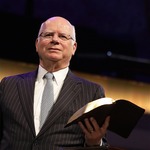
Known for his unique ability to simplify profound truths so that it can be applied to everyday life, Adrian Rogers was one of the most effective preachers, respected Bible teachers, and Christian leaders of our time. Thanks for joining us for this message. Here's Adrian Rogers.
Now we're going to read together verses 24 and 25. Jude ends this book on a note of praise. Really, here is a grand doxology. He says, "Now unto him that is able to keep you from falling, and to present you faultless before the presence of his glory, with exceeding joy, to the only wise God, our Savior, be glory and majesty, dominion and power, both now and ever, Amen." Now, folks, it is so very important. That in whatever endeavor that you have, that you have hope there.
I suppose that hopelessness is the saddest word in all of the world, and hope perhaps is the most beautiful word in all of the world. Let me illustrate. Let's take you on a Caribbean cruise. Let's suppose you're down in the Caribbean, on a luxurious cruise ship, and everything is beautiful. You have all of your best friends there.
The music is grand. The entertainment is wonderful. The sky is a topaz blue. The food it melts in your mouth. The sea is slick and calm, and just everything is wonderful.
You say this is the best time I've ever had on a vacation in all of my life, and then the captain comes on. He says, "Hey, I have an announcement, ladies and gentlemen. We're going to continue the entertainment. The chef is going to do even a better job than he normally does with the cuisine. The crew is going to go all out to make you comfortable.
We're going to have fun and games and entertainment and music, everything to meet every need." But he says there has been one change in the plans. We're not going to sail to any. Particular port, but we're going to go out here in the middle of the ocean, and we're going to sail around and around in a wide circle, and we're going to continue to sail in that circle until we run out of food, and run out of fuel, and run out of water. And when we do, we're going to scuttle the ship and sink it. At that moment.
No matter how much you're enjoying the cruise, it doesn't seem to be quite as good, does it? I mean, at that moment when you know that you're going around in a meaningless circle, not going anywhere, it doesn't matter how good the food, it doesn't matter how fun the games, it doesn't matter how beautiful the weather. When you have the idea that, as far as that particular cruise is concerned, it is a pretty hopeless matter, if indeed what the captain says is true, that takes the joy out immediately. And I'm telling you, dear friend, that the joy of the present will not diminish the fact there's no hope for the future. But on the other hand, let's suppose you're in the hospital, and that right now you are in excruciating pain, and and discomfort, and the doctor comes to you, and the doctor says, "I have good news for you." The good news is that while the pain will continue for a while, and while the discomfort may be there, and while you cannot go home immediately, at the same time, I have good news for you.
You will be cured. You will get well. And when he gives you that ray of hope and that glimmer of hope, and the doctor says you will get well, then you say, "Well, I'll be in here for a few weeks, and there may be pain, there may be difficulty, there may be all of these things that come with being in the hospital, but that's all right." I can look past that as long as I know there's hope. Isn't that right? It's hope, you see, that keeps us going.
Well, let me tell you something. In a greater way, dear friend, we live in a world where many people do not have much hope. And it doesn't matter how much they enjoy. It doesn't matter how many of the things of this world they have, or how much of this world's goods they have. If they have no hope, they are all men most miserable.
And on the other hand, if you are going through difficulty and trials and Right now, if you can have what the Bible calls that blessed hope, then you're going to make it, and that's what Jude gives us here in these last two verses. You see, Jude has been painting a dark picture. I mean, folks, it is a dark picture. If you remember the book of Jude at all, it's been a dark picture. But I thank God that when Jude comes to end this book, he just arches the rainbow of hope over the dark storm that he's given us.
And Jude tells us that if we're children of God, we can have that blessed assurance that we are going to make it. Because as we read the book of Jude about all of these people who turn apostates and turn from the faith and so forth, we might think for a little while, "Hey, hey, we're never going to make it." But Jude tells us that we can, we shall, we will, for three reasons. I want you to see them right here. The very first reason is what I'm going to call the sovereignty of the Savior. Look in verse 24.
Now unto Him that is able.
Now unto Him that is able.
Now he's talking about our Savior. He's the one who is able. He calls him in verse 25 the only wise God, our Savior. Be glory, majesty, dominion, and power, both now and ever. Amen.
All of these are just ways of talking about His sovereignty.
Now that word sovereignty is a word that we don't use very much in our ordinary language. We don't talk about this person being sovereign or that person being sovereign or this king being sovereign, not very much. But it's a good word, and it's used frequently in biblical discussions. What does sovereignty mean when it refers to God? It means He is a king.
A king is a sovereign. It means he's the only wise God. He is a king against whom there is no rising up. He is able to do anything he needs to do, wants to do, ought to do, and to do it right. He is completely, totally able.
And the reason that you're going to make it is not because you're able, but because he's able.
Now you see, it is not primarily your responsibility. It is your response. To his ability, Ephesians three verse twenty.
Now unto him that is able to do exceeding abundantly above all that you can ask or think. That's the one we're talking about. I got my concordance the other day, and I looked up all of the places where it says He is able, speaking of the Lord Jesus. And I thought in my sermon I would mention them right here, and then I thought better of it because I said I'll never get finished if I get into that. There's so many places where it tells us that He's able to save, He's able to secure, He's able to satisfy, He's able to take care of us.
Thank God for the ability of our wonderful, wonderful Savior.
Now. Many of God's children are going to be in trouble, and when you get in trouble, you might say, "Well, why doesn't God take me out of this trouble?" Maybe He's not able to do it. Oh, He's able if He wanted to. By the way, the Greek philosophers used to think about this, and they would talk this way. They would say, "All right, now if there is a God, and there's trouble, and heartbreak, and sorrow, and suffering, why doesn't God do something about it?" Well, they said maybe he's not able to do anything about it.
Well, they said if he's a god, he ought to be able. What kind of a god is it that's not able?
Well, they said maybe he's able, but he just doesn't care.
Well, they said, well, what kind of a god is that? Who is who is a a god who doesn't even care, even though he's able? Who wants to worship a god like that?
Well, they said maybe he is. Not able, and doesn't care. To make it even worse, they said, "Well, that's that's unacceptable." Well, they said, "Then on the other hand, maybe maybe he is able, and he does care." But if he is able, and he does care, why all of this problem? Why all of this sickness? There must not be any God at all.
Therefore, well, dear friend, they missed it. They fail to understand that God is able, but God does things according to His own plans, and God does things according to His own ways. He is able to do exceeding abundantly above all that we can ask or think. We might ask one thing, we might think one thing, but God works on a different plane. God's ways are not our ways; His thoughts are not our thoughts.
He is able to do above all that we ask or think, and that's what you must remember. That God, my dear friend. Being God works on a different plane. You remember reading in the Bible about how the snakes came in the wilderness to bite the children of Israel. It was a part of the judgment of God.
I'm certain many of them prayed, "Oh God, kill these snakes!" But God didn't kill those snakes. To the contrary, God told Moses to make a serpent out of brass and put it on a pole, and everyone that looked at it should live.
Now God did not kill the snakes, but to the contrary, He gave a different solution—one that no one else would have thought about. And that snake on a pole pictured the Lord Jesus Christ.
Somebody might say today, if God is so powerful, why doesn't God kill the devil? God doesn't kill the devil. He puts His Son, the Lord Jesus, on a cross. You see, Christianity, my friend, is not the subtraction of problems from life; it is the addition of power to meet those. Problems and God has a way for you, and God will make a way for you.
Augustine, Saint Augustine said, "God is an infinite circle, whose center is everywhere." And whose circumference is nowhere? What did he mean by that? He meant there's never a place where God is not. And when you're in a problem, when you're in a difficulty, God is right there in the midst of that problem. God is right there in the midst of that difficulty with you.
I found a good psalm I want to share with you. What a blessing it is! It is Psalm 147 verses three and four. Here's what the Bible says concerning our Lord: He healeth the broken in heart. And bindeth up their wounds.
Isn't that what you want? He healeth the broken in heart and bindeth up their wounds. He appointeth the number of the stars. He calleth them all by their name. There are more stars in our universe than there are grains of sand on all the seashores of all of the earth.
And God has numbered them and God has named them. But this verse says the same God that runs this mighty universe knows when you hurt. He's a God that cares about you. He is a God whose center is everywhere and whose circumference is nowhere. He is the sovereign God.
Hallelujah for such a God, my friend. I want to tell you that whatever God wants to do, He is able to do.
Now, that's the very first thing I want you to see, and that's the reason we're going to make it not because of who we are. But because of who he is and what he has promised, he is the God who is able.
So, point number one is the sovereignty of the Savior.
Now unto him who is able, and that point leads us right directly into the second point, which is the security of the saint. Look at it again in verse twenty-four.
Now unto him that is able to keep you from falling. When I talk about the eternal security of the believer, I'll always get some letters.
Somebody will tell me, "Now, Mr. Rogers, you ought not to tell people they are eternally secure in the Lord Jesus Christ. Why not?" It's what the Bible teaches.
Someone will say, "But wait a minute, that's dangerous. If you tell people they're eternally secure, that would be dangerous." Friend, truth is never dangerous. Error always is dangerous.
Now, wonderful little child did not know for one moment, or from the next, whether or not he was his father's child, his mother's child. What if he thought every time he disobeyed mother and daddy, he's no longer a member of the family? And he had to somehow get back in the family again. That little child would be a nervous wreck before long. I have met so many people along life's highway.
Are you saying, well, I used to be saved, but I fell into sin. I don't guess I'm saved anymore. And they get so discouraged that they fall away altogether. What that child needs to know is, no matter what I do, I am in the family of my parents, and if I disobey, they love me so much they're going to chastise me. But I'm still in that.
Family now unto him that is able to keep you from falling.
Now Jude begins this book of Jude, and Jude ends this book of Jude, talking about the eternal security of the believer. Because if he didn't do that, when you read what's in between, you'd get to thinking that Jude is talking about people who've lost their salvation. An apostate is not somebody who has lost his salvation. An apostate is someone who has received the truth, rejected the truth. Then begins to ridicule the truth and literally tries to replace the truth, but he has never been saved.
He's like Judas, who never was born again. But a person who is truly born again, a twice-born child of God, can never ever again be a lost soul. Not because they hold on to God, but because God holds on to them.
Now I want to review with you verse one of this book again, and I want you to look at it because this is how God is able to keep us from falling. This is how God holds on to us.
Now look at verse one again. Jude, the servant of Jesus Christ and brother of James, to them that are sanctified by God.
Now look at that word sanctified. It is better translated loved or beloved. It is the same word that is translated in verse three, beloved of God, and it talks of God's fathomless love. We are loved of God.
Now you're secure because you're secure in that mighty fathomless love. How much does God love you? In John chapter seventeen, Jesus Christ is praying, and he's praying, Father, the world needs to know that you've loved these your children with the same kind of love that you have for me. It's so beautiful. Here is what he says in in John seventeen, verse twenty three, rather, that the world may know that thou has sent me and has loved them, that is, my my saints.
Thou hast loved them as thou hast loved me. How much does God love you? God loves you as much as He loves His Son Jesus Christ. If I can understand this passage of Scripture.
Now, folks, I want to tell you something that's hard for me to take in. When the the apostle John was speaking about this love, he said, "Behold, what manner of love the Father hath bestowed upon us, that we should be called the sons of God." And you know why he said, "What manner of love?" In First John, because he couldn't think of an adjective. Evidently, maybe what colossal love, what stupendous love, what. I just can't even think a word. What what manner of love he just finally had to say?
The Father hath bestowed upon us that we should be called the sons of God. God loves you, my friend, and you are secure in God's fathomless love. The apostle Paul picked up on that in Romans eight verses thirty-eight and thirty-nine. This is what Paul said. For I am persuaded that neither death nor life nor angels nor principalities nor powers nor things present nor things to come nor height nor depth nor any other creature.
Shall be able to separate us from the love of God, which is in Christ Jesus, our Lord. He names ten strong opponents, and he says they cannot separate you from that great love.
Now listen, he's able to keep you from falling because of his fathomless love. He loves you as he loves his own dear son. Nothing you can do to make him love you more. Nothing you can do to make him love you less. He loves you because of His grace.
Second reason, listen: not only His fathomless love, but His infinite power. Look again in verse two. You are preserved in Jesus Christ, not pickled, preserved. That means kept, guarded. The word here means guarded, not so much as a a guard in a prison guards a prisoner, but as a mother protects and watches over her baby with tender, loving care.
He is able. In verse twenty-five, it speaks of of his majesty, dominion, and power.
Now, can you think of any power strong enough to take you out of the hand of God? People think that perhaps the devil could take you away from God. Jesus said in John chapter ten, verses twenty-seven and twenty-eight, "My sheep hear my voice, and I know them, and I give unto them eternal life, and they shall never perish. Neither shall any man pluck them out of my hand. My Father, which gave them me, is greater than all, and none is able to pluck them out of my Father's hand." Can you think of a power that can pry open the mighty hand of God and take out a child of God?
No, dear friend. Let me tell you. The first reason is God's. Love. The second reason is God's infinite power.
We are preserved by Jesus Christ. It is not a matter of your holding on to God. It is a matter of God holding on to you, and none is able to pluck you out of His hand. It just cannot be done. And the third reason is God's eternal purpose.
Look again in verse one, and He says, "Preserved in Jesus Christ and called." Now, this word "called" doesn't mean like. Like I might just call somebody on the phone, it actually is a Greek word for a summons. That is, God summons you. God called you.
Now you see the reason that you're saved is you answered the call. You see, it didn't originate with you. It originated with God. And the Bible tells us in Romans chapter eight and verse thirty, for whom He did predestinate, them He also called. And whom he called, those he justified, and those that he those that he justified, they are the ones he glorified.
Now you think of it: there is an eternal chain, a golden chain of redemption that cannot be broken. God predestined you, and then God called you, and then God justified you, and then God glorified you. You see, folks. Salvation is not your work; it is God's work, and that's the reason the apostle Paul said, "I am confident of this very thing, that he which hath begun a good work in you will perform it." Say Amen.
Now listen: what has been decreed by heaven cannot be annulled by hell, and what has been settled in eternity cannot be undone in time. We were in the heart and mind of God before He swung this world into space, and we are the ones that He has called.
Now, when you put those three things together, you're going to find that a threefold cord is not easily broken. It is impossible to break it, and here is why we're secure, and here's why He's able to keep us. Number one, His fathomless love. Number two, his infinite power. Number three, his eternal purpose.
Put those together, and folks, you've got security. Security—that's wonderful. That's glorious.
Now unto Him who is able to keep you from falling. It's not because you hold on to Him; it's because He holds on to you. You say, "Well, does that mean I'll never sin? Can't make any mistakes? Oh, you'll make a carload of them." But not a one of them can separate you from God's love.
Old Noah may have fallen down many times in that ark, but he never fell out of it, folks. Because when God put him in there, God shut the door and God sealed it. And the Bible says to us that after we have believed, we are sealed with that Holy Spirit of promise. Hallelujah! Praise God!
Now listen, folks. The reason that your salvation will see you through. The reason in these dark days that we have hope, reason number one, the sovereignty of our Savior.
Now unto Him who is able. Reason number two, the security of the Saint, able to keep you from falling. Reason number three is the sufficiency of the salvation.
Now watch it. One follows right after the other, because God is sovereign. I'm secure, and because I'm secure, the salvation is sufficient. You see, what does He present us to keep us from falling? That's only one half of the coin.
And to present you faultless before the presence of His glory with exceeding joy.
Now God is up to something, folks. You know what God is up to? Not to make you happy, not to make you healthy, but primarily to make you holy. You know what God is really up to? God wants to make you just like Jesus Christ.
You see, the Bible says we are predestined to be conformed to the image of God's Son. And what is God's Son like? He's faultless. And one of these days, I'm going to be faultless. And one of these days, you're going to be faultless.
You're going to be presented to Him faultless. This word "faultless" is the word that was used. Of a sacrifice, you remember the sacrifices had to be without spot or blemish. The word that's translated over in Peter, "without spot or blemish," means it's the same word right here—faultless, without any blemish at all. Can you imagine there being in you not one blemish?
Not anything that even has a vestige of sin can you imagine your being as pure as Jesus Christ is pure? One day you will be. One day you'll be presented to Him that way. And you know what this refers to? It refers to the rapture of the church.
It refers to the time of the second coming when we're changed. We're not faultless now, but one day He's going to present us to Himself. We're going to be faultless because we're going to be changed in a moment, in the twinkling of an eye. I've told you before that when you get saved, there are three stages to your salvation. When you receive Christ, at that moment you are immediately justified in the Spirit.
Then God begins to work on you, and you're progressively sanctified in the soul. But one day at the second coming, you will be ultimately glorified in the body, and at that moment, the last vestige of sin and failure will be purged away from us, and we will be presented to Him. Faultless to stand before the throne. That's going to happen, folks.
Now, what that refers to is when the bride is presented to the bridegroom. We are the bride; he is the bridegroom, and the bride is going to be presented to the bridegroom. Do you remember reading over there in Ephesians chapter five, where the church is spoken of as the bride of Christ, and the Bible says that Christ gave himself for the church. That he might wash it with water by the word and present it to himself a glorious church without spot or wrinkle, huh? A glorious church without spot or wrinkle.
When the bride comes, she's going to be absolutely radiantly beautiful, and he's going to present it to himself with exceeding joy. That's what he's talking about right here. Let me tell you how an old-fashioned Oriental wedding took place. First of all, there was the proposal.
Now the groom would leave his father's house, and the groom would go to the house of the bride, and there he would court her, and there he would propose to her. There would be number one, the proposal. After the proposal, there would be a purchase. He would have to buy her. That's not a bad idea.
I should have gotten back with my two son-in-laws and and done things right. But back in Bible times, he would save and and he would have to literally buy his bride and would negotiate with the father of the bride for price.
Now there would be a proposal and then there would be a purchase. After they had agreed on this and after he paid the price, then they would drink from a mutual cup. A communion cup, a cup over which a betrothal benediction had been prayed, and both the groom and the bride would drink from this cup.
Now the marriage has not yet been consummated, but she then belongs to him so much that if she were to go with any other person. She would be thought of as breaking her marriage vows and being unfaithful, though the marriage had not yet been consummated, and so they would drink of this cup of communion together.
So there would be a proposal, there would be a purchase. She belongs to him now; she is his betrothed. And then there would be a parting. He would leave. He would go back to his father's house to prepare a place for them to live.
He would go to prepare a place for her. And he would say, "I'm going to prepare a place for you, and I will come again and receive you unto myself." So he would go off and back to his father's house, and there, at that vast estate, if his father was very wealthy, he would prepare a special place for them. In the meanwhile, she began to sew her trousseau and to gather her ornaments for the wedding to get ready. Because in an Oriental wedding, there was something is very different from our wedding. The bride did not set the date of the wedding, nor did the groom set the date of the wedding.
The father of the groom. Would set the date of the wedding, and he would prepare a great, lavish marriage supper. And when things were ready, then he would send out and say, "All things are now ready. My son is going to be married." At that time, the son would come with the friends of the bridegroom over the fields, through the woods. Many times at night, the bride still doesn't know yet that the time.
You see, she just has to get ready and stay ready, folks. That's all. She just has to get ready and stay ready. And they come with torches, and and someone runs ahead, gets up near the bride's window. Perhaps she's already gone to bed, and he gives a shout: "Behold, the bridegroom cometh." And she knew he was coming.
She'd been told to expect him at any moment. She gathers her things, and she's swept away. And and there's a proclamation: He's coming. There's a shout, a trumpet will blast, and she's carried away, and then back to the groom's father's house, and there is feasting and merriment. A marriage supper is in progress, and all of the friends are gathered there, and the bride is presented to the groom, and oh, what joy the groom has!
As he presents to himself his bride, with exceeding joy, folks, that's what Jude is talking about here. The presentation of the bride is going to be so wonderful, so glorious. And listen, that bride would hardly have time to get herself ready. She had to stay ready. But when Jesus comes for His own, He's the heavenly bridegroom.
The same one who calls us is the one who's going to change us. In a moment, in the twinkling of an eye, we're going to be made like Jesus. And the reason that I say this salvation is sufficient because it does what it's supposed to do—make us one day like our Lord.
Now, folks, I may not look so saved, but you just be patient. God's not finished with me yet. Amen. He who hath begun a good work in you will perform it until the day of Jesus Christ. At the day of Jesus Christ, it'll be finished.
When Christ comes, it'll be finished. We will see Him as He is, and we will be like Him, one with our Lord. The church's one foundation is Jesus Christ, her Lord. From heaven, He came and sought her to be His holy bride. With his own blood, he bought her, and for her life, he died.
Why are you going to make it? Why do you have this security? Why do you have this blessed assurance? Why? Because of the sovereignty of the Savior, he's able.
Because of the security of the saint, he's able to keep you from falling. Because of the sufficiency of the salvation, and to present you faultless before the presence of his glory with exceeding joy. Through many dangers, toils, and snares, I have already come. Tis grace hath brought me safe thus far, and grace will lead me home. What a salvation we have!
Let's pray. Father, thank you for your word. Lord, thank you for the promise that you'll take care of those who commit their lives to you, and thank you for the unmistakable, unshakable, unchanging hope that we have in Christ. If you would like to learn more about how you can know Jesus or deepen your relationship with Him, simply click the Discover Jesus link on our website lwf.org. For a copy of this message or additional resources, visit our online store at lwf.org or call one eight hundred two seven four five six eight three.
Thank you.