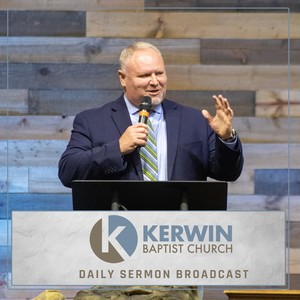
Welcome to the Kerwin Baptist Church broadcast today. Our desire is for the Word of God to be spread throughout the world so that all may know Christ. Join us now for a portion of one of our services here at Kerwin Baptist Church located in Kernersville, North Carolina.
We welcome you to the kitchenen' process today. It's amazing how many people go to good bible believing churches and they might not fully understand the significance of what we call Palm Sunday. Now the Bible doesn't use that term, obviously, but that's what we call Jesus, what we call His triumphal entry back into Jerusalem. What is interesting though is that when Jesus entered back into Jerusalem and all this worship and all the things that happened, it literally though was the beginning of the end.
Those very people that were worshiping him within a week said crucify him. And so while this is, it's triumphant, but at the same time it's tragic. And it's a reminder to us, and I want you to be able to understand today as we lead up to Easter obviously next week that we understand these things. Sometimes this is really good conversation at work for you to make sure that your coworkers understand and it's an open door for the gospel too. There is a lot of untruth out over the years and different beliefs about Palm Sunday, so we're gonna do our best. The gospels all cover this particular story that we're doing, but I wanna use Luke chapter 19.
Has some details in it that I like. And we're also gonna trace it back briefly and to where this was prophesied back in the book of Zechariah. Luke chapter 19, look at verse 28. The Bible says that when he had thus spoken he went before ascending up to Jerusalem. And it came to pass, this meaning Jesus, when he was come nigh to Bethpage and Bethany at the mount called the Mount of Olives he sent two of his disciples saying, go ye into the village over against you in the which at your entering ye shall find a colt tied whereon yet never man sat. Loose him and bring him hither.
And if any man ask you, why do ye loose him? Thus shall ye say unto him because the Lord hath need of him. They that were sent went their way and found even as he had said unto them. And as they were loosing the colt, now imagine this, this is somebody's property. They just go loosen it up to take it. And the Bible says that as they were loosening up the colt, verse 33, the owners thereof said unto them, what you doin' boy?
I'm sorry, that's a different version, all right. What it said unto them, why loose ye the colt? They probably pulled out a colt for, pulled out their own colt, you know, kind of a thing. And they said, the Lord hath need of him.
Now would that work at your house? And they brought him to Jesus, I guess it worked. It's amazing, God always provides what's necessary.
And he always makes a way when it's his will. The Bible says that they brought him, look at verse 35, and they brought him to Jesus. And they cast their garments upon the colt and they set Jesus thereon. And as he went, they spread their clothes in the way. And when he was come nigh, even now at the descent of the Mount of Olives, the whole multitude, this obviously entering Jerusalem, the whole multitudes of the disciples began to rejoice and praise God with a loud voice for all the mighty works that they had seen, saying, blessed be the king that cometh in the name of the Lord, peace in heaven and glory in the highest.
What a wonderful scene. And then verse 39, and some of the Pharisees, they always showed up, didn't they? From among the multitudes said unto him, Master, rebuke thy disciples. I believe Matthew has a fantastic account of this. It talks about the multitudes of people that were praising God as he was entering. We're gonna talk about that in a second. We've entitled this Palms of Victory.
Obviously, you know the old song that talks about that. But I wanna explain this to you today and why this is exciting to us as Bible-believing Christians. Lord, we love you. Bless your word as you always do.
Please help me to try to make a lot of material plain, simple, to the point, and understandable to our people. In Jesus' name we pray, amen. Let me describe it this way. Jesus and his disciples were traveling over the Mount of Olives on their way to Jerusalem. And they passed by a little village called Bethpage. And what Jesus did, he sent his disciples ahead, two of them, and he said, I want you to go up and as we enter Jerusalem, I want you to find me an animal to ride on. And this is what Jesus said. I want it to be a colt or a donkey. And this donkey would be an animal that nobody had ever sat on. Hadn't been broken, hadn't been the kind of animal that had been trained for somebody to ride on. And I don't know about you, but whether you're talking donkey, horse, whatever, you get on an animal that's never had somebody on them, that's a different experience. And this just goes to show that the power that Jesus had, not just over man, but every part of creation, it belonged to him. You know, and it's a sign that you would think of a donkey that nobody had ever ridden on, that the wildness, the stubbornness, the desire not to have anybody on your back.
And yet, this is a picture. And this begins the process of showing you all the pictures through Palm Sunday, what we're talking about here. This shows the process how that Jesus can bring peace into your life.
He can break the most stubborn individual and bring peace. What's interesting, the disciples said, well, you know, if we go get this animal, what if the owners have a problem? You know, we're gonna go find something. What if, and Jesus said, well, if they say anything, just say that the Lord needs them. So that's exactly what they did. They went to Bethpage and they found, obviously, you know, this donkey, and we find in Matthew, even an account that we believe that it was a colt, and then the son of that colt, or a donkey, and they brought both of these animals there to Jesus, and they put their clothes, their garments, the disciples did, they laid them on the animal, on this lowly donkey, and as they put their clothing on him, then they obviously began to lead into Jerusalem, is exactly what had happened. Now, if you'll notice in verse 31, the Bible says in Luke chapter 19, Jesus said, if any man ask you, why do ye lose him? Just tell him the Lord hath need of him. And that's exactly what they did, and this is another thing for us to learn, is that when Jesus tells you to do something, just do what he said to do, and it'll work out.
You don't have to add to it. Just say, well, Jesus said that the Lord has need of him. And miraculously, the owner's like, okay, let me help you untie him there. Amazingly, this owner let go of these animals, and exactly what Jesus said, what happened, happened, and as they went, they ascended toward Jerusalem, and a large multitude began to gather around as they entered into the gates of Jerusalem. And this crowd, I want you to understand today, they understood, in a sense, that Jesus was the Messiah. But what they did not understand is that it wasn't time for Jesus to set his kingdom up yet. You see, they thought when Jesus came into Jerusalem that day, the triumphal entry of the Messiah. They thought that he's gonna come, clean house, set up his kingdom, get rid of the political leaders, take over, and everybody's gonna live in peace because of the Messiah.
But Jesus, that wasn't his plan. What's interesting, if you will, look at chapter 19 where you're at, and I want you to look at verse 10. And he describes this, for the Son of Man has come to seek and to save that which is lost.
Same chapter, look at verse 11. And as they heard these things, he added and spake a parable, because he was nigh or close to Jerusalem, and because they thought that the kingdom of God should immediately appear. You see, the very people that said, well, I believe he's the Messiah, because they thought he was gonna set up his kingdom immediately. And when he didn't set up his kingdom immediately, but died on the cross for our sins, all of a sudden, they changed their tune, and now they're saying, crucify him. When he didn't do what they thought he should do, now they didn't think he was the Messiah. You know, it's amazing how many church people say they're saved, but when Jesus doesn't do what you think he should do, when he doesn't line things up the way you think he should line things up, and the way I think he should do things, it's amazing how we kinda take him right off the throne, don't we?
We get mad, we say he doesn't love us, and he doesn't do enough for us. It's amazing how so many things are similar. What's interesting is the crowd's action along the road, that's what gave rise to the term Palm Sunday. Now, the very large crowd, what they did, there's two different things, and there's different accounts.
Matthew 21, if you wanna write this down for sake of conversation, you need to do it for sake of time today. Matthew 21, verse eight and following, describes the process, but what happens is, as Jesus rode into Jerusalem, many people took their garments, and they would lay them in the road. And then, there are also individuals that took the leaves of palm trees, always a sign of peace, and it was the royal treatment.
Now, what you'll find in 2 Kings, if you wanna write this down for your own study, 2 Kings chapter nine, King Jehu, was given the same treatment when he was coronated. So what these people were doing was tradition. They believed that Jesus was the Messiah, so they took their garments out, and they laid them in the road for him to pass on. And then, many of them took those palm trees. Now, let me read you these verses so you know where you get palm trees.
John chapter 12, verse 12 says this. On the next day, much people that were come to the feast, when they heard that Jesus was coming to Jerusalem, took branches of palm trees and went forth to meet him, and cried, Hosanna, blessed is the king of Israel that cometh in the name of the Lord. So that's where we get the term Palm Sunday. It, you know, because some people threw their garments, Palm Sunday's better than Shirt Sunday. Or Coat Sunday.
So we went with Palm Sunday. But it's just simply describing what happened this day, which we believe is the Sunday before Jesus, actually on Easter, arose from the grave. Now, in their praise of Jesus, I wanna explain to you what was going on. If you wanna hold your place and see this, Matthew 21, verse nine, Luke has some details that I wanted you to see today, but Matthew 21, verse nine, I know I'm giving you some information, and we're gonna draw to a close briefly, but I want you to see what the crowd specifically said as Jesus was entering Jerusalem on that lowly donkey. You say, why do you keep saying that?
You'll understand. Matthew 21, verse nine, this is what they said. Hosanna to the Son of David. Blessed is he who comes in the name of the Lord. Hosanna in the highest heaven.
Now, where in the world would they get that? Psalm 118, write it down, verse 25 through 26. That's exactly what we call a messianic psalm. It's a psalm that speaks of the Messiah coming. And in Psalm 118, that's exactly, it said what would be said when the Messiah would come, and because they believed he was the Messiah, they quoted, the crowd literally quoted from Psalm 118. And this is why this is important, because when they did that, the Pharisees got nervous, because they knew that scripture, and they knew that scripture was set aside for the Messiah, and you know that many Jewish Pharisees and Jewish people to this day still think the Messiah is yet to come.
But I'm here to tell you, he's already been here. And he is sitting on the right hand of the throne of God right now. But when the crowd began to say this, they knew that the crowd believes this man, Jesus, is the Messiah, and that's a problem. That's why this was the beginning of the end. That's why they then sought to crucify and kill Jesus, because they said these people believe he's the Messiah, and they didn't, and this was gonna ruin business for them. So that's why it all started.
Now, let me mention this if I can. Some of the Pharisees in the crowd, when they heard it, if you'll notice in chapter 19 of Luke where you're at, that's why I want you to see, look at verse 39. The Bible says some of the Pharisees from among the multitude said unto him, Master. They looked at Jesus, and they said, Master, rebuke thy disciples.
You see, why it's so important? Because when the Pharisees heard all these people basically coronating Jesus as Messiah, the Pharisees got upset, and they went to Jesus, and they said, hey Jesus, you need to rebuke your disciples. You need to stop them from saying stuff like that. Now, notice Jesus' response, look at verse 40. And he answered and said unto them, I tell you that if these should hold their peace, in other words, if these people kept their mouth shut and they didn't worship me, he said, the stones would immediately cry out. Now, you can stop their mouths if you want to, but if I tell them to be quiet, the very stones on the ground are gonna praise me.
That really got them mad. Jesus was so politically correct, wasn't he? Jesus was so passive.
Let me tell you something. Jesus spoke the truth with love, but he still spoke the truth. You say, all right, all right preacher, I get this.
Now, let me tell you why I wanna bring into play today. Some four to 500 years before this day ever happened, Zechariah prophesied of this day, and I know you're aware of that, but what I decided today, instead of giving you my outline, I'm gonna put these verses up on the screen because I want you to see them while I explain them to you. Zechariah chapter nine, verse nine and 10, but we're just gonna leave verse nine up just for a little bit, and I want you to see that. Some four to 500 years before this ever happened in Jerusalem, Zechariah prophesied that this event, which we call Palm Sunday, would take place.
Now, the prophecy that he gave in this verse was fulfilled in every little detail. Unfortunately, the crowds, they looked for a Messiah, and I want you to get this, please, as you're looking at this, please hear what I'm saying. All these multitudes of people are what we call disciples which were followers of Christ, not the apostles. Disciples were people that were believers, supposedly, the people that followed Jesus. They thought that Jesus would rescue them politically or even nationally, but Jesus came to save them spiritually. First things first.
Hey, can I tell you something? We're not gonna fix America politically until we fix America spiritually. You and I often, we want to see something nationally or politically that know that he's God. He didn't come to save us politically or nationally. He came to save us spiritually. You can change the outside, but it won't last.
You gotta fix the inside. And the crowds didn't like it, because when they realized that he was crucified and killed, well, he didn't set up his kingdom. He didn't do anything of that nature while they just killed him. He must not have been the Messiah. Isn't that something? Look at Zechariah chapter nine, verse nine.
Words are on the screen. If you haven't turned to it in your own Bible, I want you to read it. This is what Zechariah prophesied. Rejoice greatly, O daughter of Zion, or Sion, some of your Bibles will say. Shout, O daughter of Jerusalem. Behold, thy king cometh unto thee. He is just and having salvation, lowly and riding upon an ass or a donkey, obviously, as we use nowadays, and upon a colt, the foal of an ass or donkey. That's the prophecy.
Isn't that amazing? Four to 500 years in this little inconspicuous prophet, just put this verse in there, just another little sign that the Messiah was coming, and this is exactly how it would happen, and sure enough, it happened exactly like he said. But this gives us even more information than all of the gospels combined.
Why? Because Zechariah, before Jesus even showed up, told us exactly what Jesus would be, and I want you to look at that this morning. Verse, we'll stay up here, I want you to see. Look at verse nine.
First, I want you to see this. He said, rejoice greatly. You and I have a whole lot of reason to be happy today. This Palm Sunday, we're getting ready to celebrate, obviously, a great day for us, which is Easter. But can I tell you, Palm Sunday is great for us because he wouldn't have risen if he hadn't come. And Zechariah said, in order for him to be the Messiah, this is what he has to be, and this is exactly what Jesus was. Notice verse nine. He said, behold, thy king cometh under thee.
Notice number one, he is just. Now, this word just is the Hebrew word zadik, and it means this, it means lawful. It means righteous. That means if he's gonna be the Messiah, he has to be a person without sin. Now, he just gives these three little words, he is just, but can I tell you something? Those three words are almost an unbelievable aspect to our Savior. The fact that he could be born man and God, live here on earth, suffer on earth, be treated the way he was treated on earth, and never one time sin. Bible says he was tempted in all points like we are, yet without sin.
Why is this so important? Well, to bring grace instead of the law, the law had to be fulfilled. See, you and I enjoy grace today, but in order for us to enjoy grace, the law had to be done away with, and the only way the law could be done away with is if the law would be totally, completely fulfilled. Now, to bring grace instead of the law, the law had to be fulfilled, but to be forgiven for sin, God had to be appeased with a perfect, pure sacrifice.
So you got two things going on here. The law has to be fulfilled, and God has to be satisfied. So Jesus came.
Now, I want you to get this. To be forgiven of sin, God had to be appeased with a perfect sacrifice. Jesus was righteous and lawful. He fulfilled the law, and he became a pure, unblemished sacrifice for our sin. He had to be just, righteous, perfect, pure in order for us to even have the chance to approach God. And Jesus, as Zechariah said, is just. Dear friend, if those three words couldn't be said about Jesus, we wouldn't be meeting this morning. We'd be burning in hell.
There would be no hope. But Jesus was righteous. Notice the second thing he says about him. He is just, Zechariah said, and having what? Salvation. Where would we be without salvation? He showed up, born man and God, lived a perfect, holy, righteous life.
But guess what? If he had lived a perfect, holy, righteous life, he could have gone right back to heaven, and we would have been just like we are. But he brought salvation. That makes all the difference in the world.
Can I say this? He didn't go get a bottle of salvation somewhere and bring it. What did the Bible say? He had it. He didn't go get it.
He already had it. That means this, he didn't go buy something so he could give some salvation to a bunch of people. He is salvation. That's why he came. He came to save. Bringing us salvation isn't a byproduct of him being here. That's why he came, was to bring salvation. He is just having salvation, wow.
Notice number three. Look, if you would, at verse nine, what does the Bible say about him? Lowly.
Right after that perfectly crafted English semicolon, you have one word and then a comma. Zechariah, as the prophecy came to him through the leading of the Holy Spirit of God, he said he is just, he is having salvation. Lowly. Notice he didn't say low. He said lowly. That means this, lowly means although he was as high as you could possibly get, he made himself low.
Now you get this. He rode on a lowly, unbroken donkey. Military leaders would have ridden in on strong horses. Political leaders would have ridden in golden chariots and a whole array of different things.
Wealthy zealots of society would have showed up in some train of chariots or whatever the case might be. But our savior who was righteous was lowly. He held the highest office but he was lowly. He owned the cattle on a thousand hills but he was lowly. He had legions of angels at his beck and call but he was lowly. He was wealthier than all the wealthiest of the world combined but he was lowly.
Don't you love our savior? Wow, he was humble, number three. He was lowly.
Number four, he is peaceful. If you'll look at verse nine, as we've said, I want you to notice this phrase. It says he was lowly and he was riding upon a donkey for sake of you understanding we don't want kids to hear words and repeat them in different things. I know what it means nowadays.
It's a shame that the world perverts things. He was lowly in riding upon a donkey having a colt the full of that donkey. Now you gotta understand why is this significant because you say he is riding in as king but kings would have ridden in on a big grand horse or in a chariot or something. He was peaceful, why?
Because strong horses always meant a military presence. It means a fight was coming. He wasn't coming to fight, folks. He already won.
How you gonna fight a fight when you've already won it? He didn't ride in on a horse taking over. He already won. He wasn't coming to fight. He already had the victory.
Listen to me, he wasn't coming to be politically correct. He was already God. He wasn't coming to rage war on the people. He came to defeat Satan. So instead of riding in like some political motivated leader or a military general, he came in on a lowly humble donkey to let the people know I come to bring peace. Now I can rage the greatest war that's ever been raged and win it because I've already won it but I didn't come to fight you. I came to save you.
He was peaceful. May I say this last? We're almost done here and I'm excited about this one. Did you notice the very first thing that Zechariah said about him before he even started describing him in verse nine?
I love this. Rejoice so greatly, oh daughter of Zion. Shout, oh daughter of Jerusalem. Behold, thy what? Last, he's king.
He is righteous, he's the savior, he is humble, he is peaceful, Zechariah said. But he said in verse nine, he's the king. Notice verse 10 if we can put verse 10 up on here.
I want you to see what he said. And I will cut off the chariot from Ephraim and the horse from Jerusalem. Jesus came in on a donkey and he will overcome those in chariots and those on the horses.
I'm the only one excited about this but just leave me alone, okay? But look at verse 10, and the battle bow shall be cut off. Nobody gonna fight against him.
Listen to this, I love this. And he shall speak peace unto the heathen and his dominion shall be from sea even to sea and from the river even to the ends of the earth. What does it mean dominion? He's king. You say well they didn't treat him like a king. Oh they're saying oh Hosanna to the highest. The Messiah has come and in just a few days they were yelling crucify him. You say well he wasn't treated a whole bunch like a king.
Well hold on. You know it's amazing that a whole bunch of people whose garments had been taken off, thrown on the road, people that had taken the time to cut down palm branches and throw them on the road. It's amazing that all these people shouted for joy but they missed the real reason Jesus came. They could neither see nor understand the cross. And I want you to get this, in Luke chapter 19 where you're at hopefully still, I want you to look at verse 41.
Look at this. This is why Jesus wept so much as he entered Jerusalem and they're praising him left and right. He knew in his heart that they would turn their backs. Look at verse 41. And when Jesus came near he beheld the city and you would think oh here's my time. Everybody's ready.
I'm gonna come in as the king. No the Bible says what? He wept over it.
Why? Look at verse 42. Saying if thou hadst known even thou at least in this thy day, he's talking about Jerusalem, the Jewish people. If you had only known the things which belong unto thy peace but now they are hid from thine eyes.
Before Jesus ever even went to Jerusalem he knew they couldn't see him for who he really was. Thank you for listening today. We hope you received a blessing from our broadcast. The Kerwin Baptist Church is located at 4520 Old Hollow Road in Kernersville, North Carolina. You may also contact us by phone at 336-993-5192 or via the web at kerwinbaptistchurch.com. Enjoy our services live and all our media on our website and church app. Thank you for listening to the Kerwin broadcast today. God bless you. We'll see you next time.