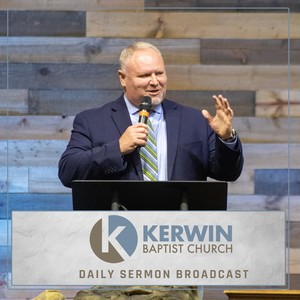
Welcome to the Kerwin Baptist Church broadcast today. Our desire is for the Word of God to be spread throughout the world so that all may know Christ.
Join us now for a portion of one of our services here at Kerwin Baptist Church located in Kernersville, North Carolina. This is something that God has laid on my heart that I think each of us deal with in day-to-day life. So I want you to look at verse one, to the chief musician, even to Jonathan, a psalm of David.
And this is what David wrote. He said this, I said, I will take heed to my ways that I sin not with my tongue. I will keep my mouth with a bridle while the wicked is before me.
I was dumb with silence. I held my peace even from good. And my sorrow was stirred. Verse three is a couple of additional phrases that just seemed to really hit home with me. My heart was hot within me. I was using the fire burned.
Then spake I with my tongue. Boy, a whole lot to talk about here as before we even kind of get to the heart of the message. But David in these first three verses, it kind of describes David's wrong actions. And verse four and following, we're going to talk about David's right attitude. We're going to talk about some things that we knew we weren't supposed to do. We know we shouldn't do.
We're not arguing that point. We just kind of the heat of the moment. The anger, the frustration, the hurt inside of us just came out. And this is what happened to David in this passage.
So I want to talk about it a little bit today. And we're going to pray. And I just want to start first with just looking at that little phrase, I will take heed to my ways.
Let's pray. Lord, I love you. I thank you for all that you've done. Lord, I thank you for technology in place that can allow the things you've laid on my heart to get to listeners all across in different areas. It's an amazing thing, Lord, I think of the way things were at the time that this Psalm was written. To think all these years later that there would be able to stand in a room and through something like internet and technology and computers and phones to broadcast this to whoever would like to listen.
Something like this, Lord, would have just been unthinkable to David or anyone alive at this point. And Lord, we know as everything, it can be used for bad or it can be used for good. And Lord, I asked today that this would be used for good.
It would be used for good every day if we've taken the time to even turn on the TV or listen to anything. But Lord, today, I just want to hear from your word. And Lord, I think that each of us have this inward battle that David so wonderfully described. I pray, Lord, that you'd help us in Jesus' name we pray.
Amen. Verse one, David said, I will take heed to my ways. Now, David, for some reason, seemed to have been in a difficult situation when he wrote this Psalm. And for one reason or the other, and we don't really know why, David was very uneasy.
And as I have found in my life, I'm sure you found in your life that it is not easy being uneasy. When there's just turmoil inside, when there's just frustration, many times that frustration on the inside is because of circumstances or individuals on the outside. And that's when things get to us.
And it happened to David here. Now, he was kind of taking on a difficult task as we begin to read these verses. And this was the difficult task.
He was trying to somehow conquer his passion and literally compose his spirit. And that's not easy when things aren't going well. He is reminding himself here to take the good advice that he had given to others. I could give you verses in Psalm 37 where David had talked about, listen, wait on the Lord, rest in the Lord, wait patiently on him, don't fret. And yet, even though that good advice was given, it was difficult for David to take his own advice. We all know that it is easier to give good advice than it is to give a good example. We're very good at telling people what they need to do, what they should do.
But it's very difficult for us to take our own advice. Now, we don't know what happened here. There are times in David's life where he felt things, and we know exactly what was going on.
There are instances when Saul was chasing David, instances where David had messed up with Bathsheba, instances where David was running for his life, instances where David as a king was fighting enemies, instances where he fought a lion, and instances where he fought a bear, and instances where he fought a giant in Goliath. And we could go on down, and we know a lot of things that happened in David's life, but we don't know what happened. We don't know what happened here. It could have very well been that maybe somebody hurt David.
I don't know that. We don't know the particular trouble. It could have been that maybe these individuals had it coming. What we do know is that somewhere along the line, David said some things he shouldn't have said, because in verse eight, he apologizes to God for it. And what he did was that David had blown up. David had let it out. David had said some things that he knew he wasn't supposed to say. And as soon as he realized what he had done and the mess he had made and how he had lost control, his first reaction was he just kept quiet.
And that is fantastic advice. It might have been that maybe this was David's own brother. Some believe here in Psalm 39 that this was written by David as a young man, maybe before he ever had been anointed king. That it was still at a time when maybe he was watching his father's sheep.
It could have been after he had been anointed to be the king, but wasn't yet king and was still watching his sheep and still tending his sheep and doing what the task that his dad had asked him to do. And we know that there was tension between he and his older brother. It could have been out of his own family that something was said, something was done, and it just had erupted as David describes it that that things were stirring inside and it had gotten the best of him. And it just was blurted out.
And I will say this, although this isn't a COVID message. Sometimes when we're around individuals a lot more, we can have the tendency to do just what we're talking about here. I know that this was a trial of David's patience. And we do know here from this passage that David had enemies that were watching and they were looking for a way to reproach him. They were looking for some kind of accusation against David. And that's why it could have been before he was ever even technically king that even his own family and maybe individuals were trying to find weaknesses and trying to exploit him, trying to create scenarios, and maybe they were jealous.
We just don't know what happened here. We know this, that as the passage begins to unfold, that David kind of talks about the struggle that he had inside. And it was a struggle between confidence and corruption. It was a struggle between passion and patience. Don't we all fight that one? It was a struggle about being angry and being appropriate. It was a struggle about temper and temperance. This is a struggle.
Maybe I'm the only one that fights these struggles, but maybe you do also. If you will, I want you to notice in verse one, he says, I'll take heed to my ways. I will take heed to my ways. If you and I could only stop and think before we act. If only you and I could get our passion and our anger and our confusion and our frustration under control before our mouth speaks.
If only you and I could go at others. It's a difficult task for me and maybe for you also. And as David describes this internal struggle, I want you to notice this because I found this very almost comforting that I wasn't the only one that deals with this sometimes. Verse two, David said this, I was dumb with silence. I held my peace even from good.
In other words, David said here, now listen, I've flown off the handle. I've said some things I shouldn't say. So I just stopped and I kept my mouth shut. I didn't say another word.
Because I know I was wrong. And he said this, I didn't even say some things that I had the right to say. He said, I kept I kept my mouth shut even from good, even from the right that I had to say some things that even though that I had a point, even though that it was something that they were trying to do.
And even though I had the right argument and even though I could have made my point and even though I might have been justified, I just kept my mouth quiet. That's the hardest thing for us to do. He said, I held my peace even from good and my sorrow was stirred.
Have you ever been there? Where the things you're dealing with just begins to weigh on you and weigh on you and weigh on you something that somebody said, something that was done, some injustice that you think was done to your life. And often it's from those that we love the most and we care about the most and we just weren't expecting it from them or whatever the case might be. But the sorrow begins to stir inside. May I say this morning that Satan knows how to stir your pot. When there is sorrow there and when there is hurt there and when there is anger there and when there is frustration there, Satan knows how to stir that up. This is a confusing time in our country.
This is a confusing time for us, for you, for me, for our children. And often times when we're taken out of our routine and we're thrown into unfamiliar circumstances, our passions and our emotions can just be ready to fly off. They burn. They burn. It's pretty difficult for something on your body to burn and you not know it. My wife burnt her hand on the oven this week.
Not real bad. I came home and she had a mark there on her hand. She said she had burnt her hand on the oven. And I said, you know, are you okay and everything?
She goes, yeah. She said it was quick. But boy, I felt it. You don't burn something and not fear.
And I felt it. And David's heart was literally hot within him. It had put him on fire. And if you and I are not careful, things on the inside can begin to burn.
Satan's stirring that pot. Our own flesh is stirring that sorrow inside and it begins to boil and it begins to bake and burn. And David's heart became hot within me. You know why we're hot on the outside is because we were hot on the inside.
You know why we spew out lava at others is because that lava was on the inside before it ever came out. Then David said this, while I was musing, the fire burned. Interesting word, not used much, obviously, in God's word, the word musing.
It means to literally to think about things. I would just kind of look back and think about it. And David said, every time I would just kind of look back and I would think about it, the fire burned. It was literally like every time that I just reimagined what that person did or what that person said or that circumstance, that uncontrollable circumstance that happened in my life. It was kind of like taking a log and throwing it on the fire. It just built that fire back up. It just would flare back up. It was just burning me. I have found my tendency in life is to do just that.
My dad was an individual that never looked back just about at anything. It happened. It was done.
It was gone. And he just didn't. Now, as he got older, he would think back of wonderful things and people that had meant a lot to him. And oftentimes, as you know, you can kind of sense the feeling of what happened is coming.
Dad would talk about something years ago with individuals and what a blessing and recall how this had happened. But what I found with my dad was is that if somebody did or said something to my dad, my dad was just a person. His feelings just didn't get hurt a lot. Now, I know a lot of people, their feelings get hurt so easy, every little thing, because somebody didn't do what they expected that they should do, or they didn't do what they thought they should do, or they feel like they have been somehow, you know, been treated wrongly, and it wasn't fair for them. And you know what, folks, that's nothing but selfish pride when that happens to us.
And we're stirring our own pot with emotions like that. But my dad was a person, if somebody did or said something, and by the way, that happened a lot over the years, it was literally done with my dad. He didn't sulk on it. He didn't think about it. He didn't talk about it. He just, it was done. He went on with life. It didn't matter to him. It was, you know, it was history, and he just moved on and never thought a thing about it. Never remember dad.
Just sitting around talking about how such and such had really hurt him years ago and how this person had this or what. My dad just did not do that. But I'm ashamed to say that his son does. That's one of dad's good characteristics that I didn't get. And I got my dad's metabolism. Thank you, dad. And I got my dad's hairline. Thank you, dad, for that. I didn't get things ran off my dad like we would say water off a duck's back.
But me, I'm news about things. I think back, I look back, I remember. And when that happens, we throw logs right on that fire. And it just begins to kindle and burn. And may I say this?
It's difficult saying it with I hate faces looking at you. But I have met people that have been stoking that fire for years. They just keep tossing logs on every day. They rehash it and rehash it and rehash it.
And they sit in church and they're good people. And I was musing the fire burned. Maybe today, in the middle of all this, I have found that when you get out of your routine and you've got some time, you're going to think about things. And it's going to either be good things, like God says to think about whatsoever things are true and honest and pure and all those things.
Or we're going to hash up stuff like this. And if you're not careful, you're going to assume you like it did David. So David makes a change here.
Now here's what happens. We know from the end of the passage that David had said some things that had lost control before the passage ever started. Because like I said in verse eight, he asked God's forgiveness for all these things. So we know the order of events here was that David had said something, blurted out stuff, just kind of made a fool of himself, let his emotions get the best of him. And then he realized what he did. And then he just stopped and he kept his mouth shut. And he describes what had caused it and how he had just let these things happen. That literally that his sorrow had been stirred, that his heart was burning and that as he was thinking about it and rehashing it, it just kept growing and growing and growing.
And finally, it just came out and he just stopped and kept his mouth shut. But at the end of verse three, we find that David talks again. Look at the end of verse three, David says, then I spake with my tongue. So now David's gonna talk again, but this time he does it right because now he's talking to God. The first thing he says in verse four is Lord, Lord. David gives four specific prayers here.
And I wanted to give these to you. You say preacher. Kind of weird for a Sunday morning. Kind of weird for an online service.
Kind of strange for the circumstances of our country. But you know what? I have found something. God's ways are perfect. Who knows why God laid these things on my heart this week. Maybe it was just for me.
Just maybe it was for you. As he goes to the Lord, he gives his first prayer and his first prayer was this. Number one, Lord, make me.
In other words, David is saying this, what I'm getting ready to ask you to do, God, will not come naturally to me. It must be done by you. If this is going to happen, you have to do this work. I can't just make myself. I can't talk myself into it. I can't take some kind of a pill that will calm me down and I'll get over this. I can't get some kind of a bottle of some kind of drink that'll just soothe my anger away and that I can just kind of think of other things and numb the pain for a while.
God, if this is going to happen, you're going to have to do it. And dear friend, I may tell you this, that you can take some time off. You can go take a walk by the lake.
You can go walk on the beach at the ocean. You can do anything you want to do. But if there's changes that are going to be made and if you're going to somehow quench this fire that can burn inside of us, God's going to have to do it. You just can't. And this is what David says first. He says, Lord, make me to know. To know what? Number one, David said first, God, Lord, make me to know the brevity of life.
Isn't that odd? At a time where David had just lost it, the first thing he says is, God, you're going to have to help me to remember how short life is. Look at verse four. He says, Lord, make me to know mine end and the measure of my days, what it is. Now, David here is not saying, God, would you tell me exactly how much time I have left? So I know what to do.
So I know what I can get in. Listen, David didn't pray that prayer because that would not be a biblical prayer. We know from the Bible that God numbers our days. We know from the Bible that God will never give us that information, that we have no right to that information. We know how many days we have, how many days can I live. God, tell me when I'm going to die. That's just knowledge that we do not know. And may I say, we don't need to know.
And may I also say, it would be horrible if we didn't know it. What David is saying here is, God, help me to remember how short my days are. In fact, in Psalm 89, later on, David literally says this, remember how short my time is.
He's saying, God, help me to remember that my life is short. And I cannot waste another moment of this life being burned from the inside out. I can't spend what days I have letting them be ruined by turning a fire inside of myself and every day waking up and throwing another log on the fire.
I can't do this with the little time that I have. God, help me to remember how short my life is. God, help me to remember life short. We can't let bitterness and anger and resentment and lack of self-control, we can't let that ruin what little time we have. David said, God, help me to know the brevity of life.
Help me to measure it, God, help me to see how little there is and how much I need to do. Secondly, he said, Lord, make me to know the frailty of man. Not just the brevity of life, but the frailty of man. David is saying, God, help me to know how weak I really am.
Notice verse four. David said, Lord, make me to know mine end and the measure of my days, what it is that I may know how frail I am. I can't do this on my own and I can't trust my flesh and I can't trust myself and I can't keep pushing it off saying, you know what, I'll get a handle on this. Hey, I'll be okay. Hey, I'll get over this eventually.
David said, God, help me to understand and realize that I need you, that I'm weak without you. I've been through some things now. Find out somebody's mad at you or leaves the church or frustrated at this or that, you know, at first it just devastates you. And as time goes, you realize, you know what, I can't spend three weeks out of joint because somebody's mad. You just, you know, you kind of try to get a little better resistance and a little better resistance and realize you can't please everybody.
In fact, I found rarely can you please anybody for long. But you know what, as soon as you begin to think, well, you know what, I think I can take this now. Hey, I think I can do this now. Hey, I think I can handle this now.
You are in trouble. David said, Lord, I've got to get a handle of this fire inside of me. And Lord, I need to realize how short life is. And God, I need to realize how weak I really am. It's what we call humility.
It burns the heart. Notice, may I say this, that the first step to becoming strong is to understand how weak you really are. That's the first step to becoming strong is to realize how weak you are. You see in this verse, as David was crying out to God and saying, God, help me to remember and realize how frail I am. David didn't realize that that was that first step of gaining strength. Notice thirdly, David said, Lord, make me.
You're gonna have to make it happen. You're gonna have to do this work. Make me to know the brevity of life. Make me to know the frailty of man.
Notice thirdly, David says, make me to know the vanity of accomplishments. Look at verse five. David said, behold, thou hast made my days as an hand breath. What is a hand breath? A hand breath is the span of four fingers. David is saying this, that literally those four fingers, what is that as compared to the universe? It's nothing.
And that's what our time on earth is. It's short. It's brief.
It's small. He says, thou hast made my days as just a little hand breath, just four fingers. For thee, verily every man, listen to what David says here.
Please look at your Bible if you can. Verily every man at his best state is altogether vanity. David says this, literally the best that we could ever do is still vain.
This best state literally means that the peak of your life, it means your greatest accomplishment maybe when you're the strongest, maybe when you're the healthiest, maybe when you had the most energy, and maybe when we're at our prime, and maybe when we found what we need to do, and we're good at it, and all these things, and the making of money, and position, and accomplishment, and all that. David said at man's best, it's nothing. Our best is vain. Why is it vain? Does it mean it's meaningless? It doesn't mean anything? No, it doesn't mean that at all.
There are plenty of verses that talk about our actions, what they can mean, and the good that they can do, and how God can use that. What it means is this. The best that you and I ever are or will be is temporary. It only lasts for a brief moment. Let me tell you something. I used to love sports and still love sports, love to play sports, but I'm gonna tell you something. I peaked a long time ago. Man, you in high school, you go play basketball 10 hours on a Saturday, start early that morning, go out to the park, and, man, we had a group of guys.
We'd play ball all day long, and, man, you know, you just can't wait. Man, I'm gonna get better. I'm looking forward to this and this and this, and you know what I have found? Whatever my peak was, wherever that was, it did not last long.
It's gone. You know, our best state, and let's not even mention our worst state. Let's not even mention the mediocre state that we're in most of our lives. Let's not even mention the best that we could do, the best that we could come up with, David said, God, it's vanity. The vanity of accomplishment.
Notice what he says in verse 6. Surely every man walketh in a vain show. It's an illusion, and all of us are very good at putting out that illusion, and here's what David means, that even the things inside of me of thinking how great I am or maybe how much I'm doing, that's something that I've accomplished. That's an illusion. It's something you've convinced yourself of, but it's just a show. It doesn't matter for an eternity. It doesn't last for an eternity. The best that we could do and the best that we could put forward or to show others is nothing but vanity. It's vain.