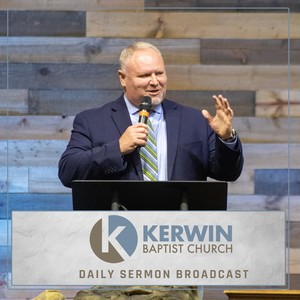
Welcome to the Kerwin Baptist Church broadcast today. Our desire is for the Word of God to be spread throughout the world so that all may know Christ. Join us now for a portion of one of our services here at Kerwin Baptist Church, located in Kernersville, North Carolina. I'm speaking to you tonight on the subject of we need to talk and every guy in the room just kind of had PTSD they kind of had a shocked look on their faces I don't like that nobody yeah right several of you getting up and leaving you know I don't think anybody in the history of the world has ever heard those words and thought oh yeah that's that's what I want that would be fun I would enjoy that I'm gonna tell you I go into like survival mode I hear we need to talk, and I start thinking, well, man, what did I do? What did I say?
What did I forget? Is this something that happened last week? Is this something from 2007? I don't know what to expect. And thank you.
A lot of times you don't get all the details. It's just in a text. Hey, we need to talk later. Or he's in a phone call. Hey, when you come home tonight, we need to talk about some things.
And you start thinking, man, what in the world could this possibly be about? You know, is it something that I, you know, was it my tone? Was it something that happened? Was it something I thought was funny and she didn't think it was too funny? And a lot of times, us men, we get accused of not listening.
Not hearing what's being said, you know, just a few weeks ago, I thought I'd do something nice for my wife. That never turns out well. But I thought I would just do something nice for her. And a lot of times I will bring her lunch home to work, or while she's working, she works from home. And so I thought, well, I'll just get her lunch and I'll take it home to her.
I won't call her, I won't tell her about it. And so I go to one of our favorite places. We go to Jimmy John's. Is that okay? Rose says, Jimmy John's.
Okay, not too greasy. It's a little more on the, I guess, healthier side than Chick-fil-A. I don't know. Um but anyway, I thought we'd go by Jimmy John's and grab a couple sandwiches, take them home for lunch and So I get there and I walk in, she's not at her desk. And so I thought, well, maybe she's taking a break.
I go through the house. Her car's not there. And so I called her, I'm like, where are you at? She said, I'm at work. I'm like, no, you're not.
I'm at home, and you're not at work. She's like, I had to go into the office today. I was like, oh, I didn't know you had to go into the office today. She's like, I told you that. I was like, when did you tell me that?
She said, last night before I went to bed, I was like, I'm sitting there thinking, I'm like, last night, that was when the Braves were playing. And I remember they were in the ninth inning and they had the bases loaded, and Matt Olson's batting, and you probably, I didn't hear any of that. There was one thing that I was concerned about in that moment, and that is that the Braves win this game. And so she said, I tell you that last night. And tonight, I think we're going to talk a little bit about the conversations that we have.
Most of us don't struggle with having conversations, we talk all the time. We talk at home, we talk at work, we talk on the phone, we talk at church, we talk through text messages, we talk online. The problem is not that we are having conversations. The problem is that we're not having the right kinds of conversations. And let me say this: that tonight, is not about us helping you communicate better.
This is not about your communication skills. Tonight is about understanding that every conversation that you have. Every interaction that you have has the potential to be a gospel conversation. It has the potential to turn into talking about the Lord Jesus. It has the potential for you to be able to share God's love and God's acceptance and God's grace with people at home.
At work with your neighbors, with your friends, with your family. And you know the way we we talk is either opening up doors for the gospel. or it's closing doors for the gospel. And so that's what Paul is talking to us about here in Colossians chapter number four. If you take your Bible, I don't think I told you that, Colossians chapter number four.
This evening, and we're gonna be looking at just two verses, really. I'm gonna give you some context on a few verses leading up to these verses, but verses five and six. Are essentially just going to be the two verses that we cover and look at and go through. Here this evening, but I did want to give you a little bit of context to verses 2, 3, and 4 and kind of show you what Paul is talking about here. Here in chapter number 4, Paul is writing to the church.
And I'm just going to be honest, I'm going to address it. If my voice cracks saying Paul, okay, it's done it at least two times while I've been in here, and teenagers have it on video and they show it to me constantly. They send it to each other constantly. I actually don't like speaking from anything Paul wrote anymore. Like because my voice cracks when I say it.
Right, so if it does crack, you know what, just get over it. It's not that funny. It's really not that funny. That was really in the flesh. I got really in the flesh.
We need to talk later.
So if it does crack, just laugh and we'll move on, okay? But Paul Paul here is is saying in verses 2 3 and 4 Let me show you what he's saying here. He says he's wrapping up this letter here to the church at Colosse. And he's bringing it to a close. And here's what he says in verse number two: he says, continue in prayer.
And watching the same with Thanksgiving.
So he's saying to the church at Colosse, he says, continue to pray. Continue to approach God. Continue to bring Him your requests and all of those things, your praise, your worship. And then notice what He says in verse number three: He says, With all praying, also for us.
So He says, While you're doing your praying, He says, here's what I would covet. I would ask that you pray for me also. And he doesn't say, hey, would you pray that I would be safe? Would you pray that I would get out of prison? Would you pray that I wouldn't face any more stonings or shipwrecks or anything like that?
Notice what he says, I want you to pray for. He says in verse number three, he says, That God would open unto us a door of utterance. to speak the mystery of Christ for which I am also in bonds. Verse 4 says that I may make it manifest. as I ought to speak.
And so here's what Paul prays for. He says, You pray. Right, and when you do, remember me. And would you pray that I would have opened doors to share the gospel? Would you pray that I would be able to clearly manifest Christ so that people could understand?
He's literally saying, Would you pray for me while I preach and teach and share the gospel of Jesus? That was Paul's heart. That was his heartbeat, and everything that he did. And so then in verse number five and six, he kind of helps them how they can share the gospel the way that he is. And so that's the context here that we get.
So let's read verses 5 and 6. And look at what Paul says here, talking about our conversations that we have. The way that we talk to people, look at verse number five with me. He says, walk in wisdom. Look at this.
Toward them that are without. redeeming the time. Let your speech be always with grace, seasoned with salt. That you may know how you ought to answer every man. Four things tonight.
We'll go through them quick. And I want to show you these things that Paul's talking about. And hopefully, as you go to work, as you go into public this week, as you go to the restaurants, as you see family and friends, as you're in your neighborhood. That we would be able to share the gospel clearly, and that we would have open doors to be able to do so. This week.
So, number one, I want you to see, number one, see your opportunities. Paul, I believe, here says to see your opportunities that you have. He says in verse number five: walk in wisdom. toward them that are without. Redeeming the time.
Paul here, before he ever tells us what to say. Before he ever goes into any kind of presentation of how we should say things and what we should say and all that, he tells us how we should see people. He says, walk in wisdom, and notice this old phrase: toward them that are without. What does that mean? Toward them that are without.
It doesn't mean people that don't have money or don't have possessions or don't have what you have. What he's saying here are: these are people who are without Christ. These are people who are outside the faith, people that you work with. People that you live in the same neighborhood with, people that you share a family with, people who are out in public, people that you interact with every day. He says that we should show wisdom.
To those who are without.
Now, what does it mean there to walk in wisdom toward them? It means that we don't just go through life on autopilot. You understand this as well as I do, but I think sometimes in the hustle and bustle of life, and all the things that we do, and as busy as we are, and we have all this to do, and get here and get there. We forget that every single person Every single person that we come in contact with every single day is going to spend eternity somewhere. They are either going to spend eternity with Christ in heaven.
Or they are going to spend eternity apart from Christ and separated from Him forever. And so, Paul here says that we need to be aware of that. We need to be intentional in the way that we talk to people and in the way that we share the gospel with people. We need to pay attention to the opportunities that we have on a daily basis. And then he says, when we do that, right, we live in wisdom, walk in wisdom toward them that are without.
And then he says this phrase, redeeming the time.
Now what does that phrase redeeming the time means? Here's what it actually means if we look it up and we define it. It means buying up every opportunity that we have. Buying every opportunity that we have. How many of you ever played Monopoly?
All right. I love to play Monopoly. I'm not very good at it a lot of times.
Now, I don't know. Probably everybody has this strategy. I don't know. But my strategy is: now, I don't know if this is the right rules or not, but we've always played that you have to go around the board one time before you buy anything. Is that accurate?
Does everybody do that?
Okay.
Some of you are shaking your head no, some of you are like, yeah, so we're divided here, okay? But here's my strategy: I go around the board one time, and then everything that I land on, I'm buying it. You don't have to ask, would you like to buy it? Yes, I want to buy that. If it's Baltic Avenue, I want it.
It was Mediterranean. I want it. If it's the little power plant, I want that. I want park place. I want boardwalk.
If I land on the jail, I'm going to try to buy the jail. I want every single piece on the property. I want to absolutely destroy you in Monopoly. I'm gonna put hotels, I'm gonna put houses on it, I'm gonna do all that. But that's the idea: is that every opportunity you have, you don't miss out on a single one.
Every opportunity you have to share the gospel with someone or share the love of Christ with someone or tell your story to Jesus to someone, you don't miss out on it. What if our conversations and things are not just random things? We got to stop thinking of our lives as just these random disconnected events. Right? What if that conversation you have with your neighbor in the driveway?
Right? It was more than just, hey, we were both out walking our dogs. What if, right? Just think, what if that was orchestrated by God? What if tomorrow you go into the break room at work and you end up with one of your coworkers in the break room?
And what if they're going through something that you don't know anything about? What if they have questions that you don't know anything about? And what if that's more than just a random encounter with that person in the break room tomorrow? What if Almighty God puts your paths together so that you would be there at the exact moment that they are? We gotta stop looking at our lives as these disconnected events.
We gotta start seeing the moments in our lives as opportunities that God gives us. On a daily basis, I'm a firm believer that God does not place people randomly into our lives. I believe that he is at work in all of those things. I don't believe they're a coincidence, they're an opportunity for the gospel. It's our theme.
That's why we give themes so they can be on your mind throughout the day. During the week. For the gospel.
So, what does it look like to see every opportunity? What does it look like to walk in wisdom toward them that are without Christ? What does it look like to redeem the time and buy up every single opportunity? It doesn't mean that you have to insert a sermon into every conversation that you have. It doesn't mean you've got to carry your Bible around with a three-point outline and a poem, ready to share it, right?
One in the chamber, getting ready to just share God's wrath and all of that with everybody that you come in contact with. But what it does mean is that you're paying attention. What it does mean is that you're looking for open doors and opportunities to insert Jesus into your conversations and in your talks. You're willing to go a little bit deeper in the conversation if the moment presents itself. Let me say it this way: is that every conversation is an opportunity.
For the gospel, if we will learn to see it and recognize it.
So, number one, see your opportunities. And once you see your opportunities, now what? Number two, he says, To speak with grace. Look at verse number six, if you would. He says, Let your speech be always.
With grace.
So, Paul goes from seeing the opportunities, recognizing the opportunities that we have on a daily basis, to now how we actually speak to the person. And a lot of times, this is how we get in trouble.
Sometimes. Right? How you say something is more important sometimes than what you say. How you say something is more important sometimes than what you say. And I'll give you an example.
All right, for us men, let's say you're going to take your wife. Listen, we're the only ones that say dumb things. Sure.
Okay.
Right, right? We're the only ones that ever say anything dumb. But anyway.
Alright, let's just say you're going to go on a date with your wife. And you walk in the bedroom and you see her outfit laying there on the bed. Right? And you say something like this to her. You're gonna wear that?
Anybody ever said this to their wife? Anyone ever said anything that stupid to their wife?
Okay.
No, I don't mean anything by that. Right? M my thinking is... At least that's what I'm gonna say. My thinking is, oh, it's a really nice outfit.
Yeah, that's that's a great outfit. I've I haven't seen her wear that in a while. What she heard was, You're gonna wear that? Ugh, what in the world? That's a horrible.
That's what she heard. Right? What I say. And how I say something is way more important. than what I say a lot of times.
What about this question? You go up to your wife and you ask her, hey, is everything okay? She says, what? Nick, I'm fine. What does that mean?
What does that mean? That could mean 15 different things. It could mean she's literally fine. It could mean she's not fine at all. And the most dreaded one of all is: I'm not fine, and you know exactly why I'm not fine.
When in reality, I have no idea. I don't know. Ladies, there's nothing going on behind what we say, we're idiots, okay? I'm just gonna tell you, we're idiots. But how we say things Amen.
How we say things. is more important a lot of times than what we say. And that's exactly what Paul is saying here. My voice cracked a little bit right there. Did y'all hear that?
It was a little bit. I'm gonna go ahead and recognize it. It's exactly what Paul is saying, is let your speech Be always with grace. Because it's not just what you say, it's how you say it. And so the question is: what is Paul talking about here?
What does it mean that our speech should be always with grace? We pick, we cut up, we laugh at certain things. But what is he really saying? Paul is really saying here is that our speech should be kind. It should be gentle.
It should be patient. It should be not harsh, not cutting. And notice what he says. He doesn't just say, let your speech be with grace. He says let it be what?
Always. with grace. Which means, even when you're not in a good mood. Even when the other person doesn't deserve it. Even when you're not at church.
Right? He says, let it be always with grace. That means even when you're frustrated, even when you're tired, even when you're in an argument. Because that's when it matters the most. It's easy to speak gracefully to someone who's speaking gracefully to you.
It's easy to speak to someone kindly when they're being kind to you. I think it's much more important for us to make sure that our speech is always kind of Seasoned with grace. Even when we're not receiving that from someone else, if that makes sense. Yes, that's right. You can be right in what you say.
and be completely wrong in how you say it. You know, a person needs more than honesty when you're talking to them. They need grace. And let me explain it to you this way: let's say you have a coworker at work, and man, you know they're not saved. You know, they're not Christians.
They don't go to church. There's no fruit there. There's nothing there. And let's say they've got some sin in their life and they're vocal about that sin. Let's just say that they're liars.
Let's say that they're thieves. Let's say that they're blasphemers. Maybe they've used God's name in vain. They curse them. Maybe they're adulterers.
I don't know. But let's just say you go in tomorrow at work and you say, Well, man, our youth pastor got up and said, I need to talk to you about Jesus, and you're a sinner. And you're going to hell, and you're a liar, you're a thief, you're an adulterer, you're a blasphemer.
Now, all of those things are true. Based on what we just described, yes, all of those things are true. But let me ask you this: is your conversation with them going to be a good conversation? No. They're not going to listen to anything you have to say.
They don't want to hear anything you have to say. That's why Paul here says, man, you're going to come across some people that you need to be honest with, but you also need to show them some grace. You also need to have your speech. Be labeled with grace. Speak with grace.
I think it's attractive. to people. I want you to notice number three, he says to season your words. Look at verse number six. Let your speech be always with grace.
Look at this. Seasoned. With salt.
So now Paul moves from kind of the tone and how you say things to the actual words that you are going to be saying to them. And he says, your words should be seasoned with salt.
Now it doesn't mean you get to be salty with people.
Now some of you are good at that. I'm good at that at times. How many of you wish Paul was saying you could be salty with people? All right, man, they say something to me. I'm about to season this conversation up, man.
I'm telling you. I can season a conversation with the best of them. You let me hit my toe on something on the bed, hit my thumb with a hammer, I can season a conversation. But that's not what Paul's talking about. Paul is not talking about adding a little attitude or sarcasm to your conversation.
He's not talking about using some words you're not allowed to use at church. What is Paul saying here? He says your speech should be seasoned with salt. He's talking about making it better. We have to talk about what salt means in God's word.
What does it mean in Scripture? It means that it adds flavor to it. It's a preservative. It improves what's there. Nobody has ever eaten a meal that I know of, except for maybe Rosa.
And ever said, you know what? You know what this food needs? Less seasoning, less salt, less flavor. It needs more flavor. I need more salt.
And my arteries right now are screaming because I like salt. Right. That's what he says that our conversation needs. It needs more seasoning. You add salt, it enhances it, it makes it better, and that's Paul's point.
is your words should make things better, not worse. Right, to season your words with salt means to build people up and not tear people down. It means to help people and not harm people. It means to bring clarity and not confusion. And if we tie this into what Paul's talking about, in verse number three, he says, pray for me.
That I would have open doors and opportunities. What if Paul got those open doors and opportunities, but he didn't speak to people with grace? He didn't season his words with salt. He didn't take the opportunities that he had. He says in verse number five: he got to redeem the time.
You got to take and buy up the opportunities. And that's when he says in verse 6, that your tone matters. That your words matter. And so, what does it look like to season your words? What does that look like on a daily basis?
And I wrote a couple of things down. Number one, You look for ways to encourage people. I'm not very good at that. I'm just going to be honest with you. I have to work at that.
But look for ways to encourage people in a culture that does not look to do that.
Now for any of you that have social media at all If you ever watch any of the reels or videos or things, if you ever go to the comment section. People are awful to people. And people look for any reason in a video or a reel or a post or anything to tear that person down, whether it be their appearance, whether it be how they dress, whether it be their ideas, whether it be their home, whether it be their car, whatever the case may be. We live in a culture that does not look to encourage and build people up. In a culture that is consistently and constantly tearing people down, you'd be different.
Season your words with salt. Look to build someone up. It also means that we don't have to skirt around the truth.
Sometimes you need to say what needs to be said. But you can do it in a loving way. The Bible says speak the truth.
Some of us have no problem speaking the truth. We'll tell the truth. The problem is that we don't do it in love. A lot of times. I wrote this down.
Season words. don't sting, they strengthen other people. And so I would challenge you: as you speak words to people, make sure that they are seasoned with salt. Make sure that you're making Jesus look better. Notice number four, he says to shape your response.
Look at the end of verse number six. He says, let your speech be always with grace, seasoned with salt. Look at this last phrase, that ye may know. How ye ought to answer every man. Anyone ever have a grandpa or a parent that said the word ought?
I don't know how many times my dad's sitting right back here. I don't know how many times I did something stupid as a teenager. And he'd say, You ought to know better. Anybody ever heard that? You ought to know better.
You were raised better than that. What is that phrase, you ought to know how to answer every man? It means that you should know how to give an answer. Right? He says that you may know how you ought to answer every man.
Now, we don't always respond the right way. I don't always respond the way that I should.
Now, you know, if there's one thing that I've learned in my life, now listen, I I'm not as old as some of you. I'm older than some of you. I'm kind of somewhere in the middle. And I don't know a lot in life, but there's one thing that I have learned in this life is that. I can't control what other people do.
I can't control how they talk to me. I can't control what their attitude is toward me or what their words to me are or what their tone is to me. There's only one person in this world that I control. That's me. I control my words.
I control my attitude. I control how I respond. to people. But Paul here is talking about more than just responding to someone who has said something wrong to you or done something wrong to you. He's talking about something a whole lot bigger.
If you remember what he said. Just before he gave us these verses, he's talking about people who don't know Christ. He's talking about people who are outside the faith. He's talking about open doors and opportunities to share the gospel. And so when he says that you may know how you ought to answer every man, he's not just saying watch your attitude with people.
What he's saying is that you and I need to be ready. When the conversation gets a little bit deeper.
Now, most of our conversations are just normal conversations. Right, most of us, we keep our conversations to the small talk side. Right. What's going on in the news? Current events, podcasts that we've listened to, weather, HC the ball game last night.
Oh, yeah, man, what a game. Most of us keep our conversations in that range. except for our few family and friends that we're really close to. But what Paul is saying is that you and I need to be ready when that conversation sometimes takes a turn, when somebody looks at you and they say, you know what? I've been struggling lately.
When somebody looks at you, and maybe they know you go to church, they know you serve Jesus, they know you love God. And they change that conversation. You say, you know what?
Some things happened, and I don't know why God allowed that. I don't know why God allowed this to happen or allowed this to be in my life. And so when that conversation takes that turn, How are we going to answer those questions? Do we just ignore it? Do we just push it to the side?
Or are we ready? To give an answer. That's what Paul here says. We ought to be ready. to answer every man who has any sort of a question.
Now listen, you and I don't have all the answers. And we can't answer every single question. But I think a lot of times we we ought to have an answer for people. Who have questions? Our lifestyle and our conversation should be such an influence on them.
that they would know, you know what? I've got some questions and I think that person can answer them. I think that person can give me some advice. And so, when these people ask these questions to you, how are you going to answer them? Did you hear the one about the guy who went into work one day?
And he got asked by his coworker, he knew that he went to church, he says, what do you believe about God? And the guy said, well, I believe what my church believes. And the guy says, Oh, okay, well, you know, what does your church believe about God? He says, Well, they believe what I believe. And God's like, okay.
So he said, What do you and your church believe about God? He said, Well, we believe the same thing. We need better answers than that. I'm not saying you gotta have the answer to every question. Right, sometimes people are gonna say, man, I don't know why God allowed this.
I don't know what's going on here. I'm having a tough time. You may not be able to answer every single question, but what you can do is say: you know what? I don't know why God allowed that in your life either. But you know what I know from scripture is that God loves you.
God cares about you. God wants to have a relationship with you. It says right here in this word that you know what, you may go through some tough times, but you know what Jesus promises? that you'll never have to do it by yourself. That he will never leave you, he will never forsake you.
He died on a cross for you. You may not be able to answer every single question that they have, but you better have an answer ready. If somebody comes to you, because if they come to you and they are that vulnerable with you and they tell you, hey, listen, I'm struggling, I don't know what's going on, I'm having a tough time in life, or I don't know why God allows you, you better have some sort of an answer, or they're not coming back.
Sometimes we get one shot at this. And you say, well, how in the world do we stay ready to do this? Paul says we ought to know. How to answer every man. How do we stay ready?
In order to do that, you need help from the Holy Spirit of God. And you need to study the scriptures. We need to be in God's word every single day. And not just to check off a box. We need to be in God's word to know God.
To know what he's like, we need to know the promises of God, we need to know the doctrines of God. And I love this verse here that Paul writes to Timothy. Look at 1 Timothy 4, verse number 13. I think this is such a practical verse to a young man who Paul is mentoring. And he says this: he says, till I come.
He's telling Timothy, I'm coming to see you, I'm coming to visit you, I'm going to be there. But until I do get there. He says, give attendance to reading. to exhortation to doctrine. Here's what he said.
He says, Timothy, there's three things you need to be doing constantly. That is reading the scriptures and studying them. You need to be encouraging other people. And you need to be teaching people about who Jesus is and the doctrines of the Bible. He said three things.
I feel like. We're doing everything but those three things. I feel like sometimes I'm doing everything there is to do. Except for those three things. I love what John Phillips said, and we'll close with this.
John Phillips made this quote, the great preacher. He said, We should study the great doctrines of the faith.
so that we can be ready ministers of the word. instruments available for the Holy Spirit to use. What if? Just hear me out. What if that was every single one of our desires?
is that we would be ready ministers of the word. What if our soul desire in life was to be an instrument. for the Holy Spirit to use. I'm going to tell you, this church couldn't hold the people. If we were all desired.
No, listen, I'm not saying, I'm not the poster boy for this. I'm not. I'm as bad at this as anybody in the room. But I do want to be there. And Paul gives us the outline here.
We don't have to have all the answers, but we should be ready to give an answer. From scripture. To these people who are hurting and struggling. There's a world out there that is full of questions. and they're looking for truth.
And so here's the challenge: is this week when the door opens, when the opportunity presents itself. When the monopoly board is there and you land on that space, buy up that opportunity. Don't let any opportunity slip away. And so here's what I would say is to be looking for opportunities this week. Thank you for listening today.
We hope you received a blessing from our broadcast. The Kerwin Baptist Church is located at 4520 Old Hollow Road in Kernersville, North Carolina. You may also contact us by phone at 336-993-5192 or via the web. at Kerwin Baptist Church.com. Enjoy our services live and all our media on our website and church app.
Thank you for listening to the Kerwin Broadcast today. God bless you.