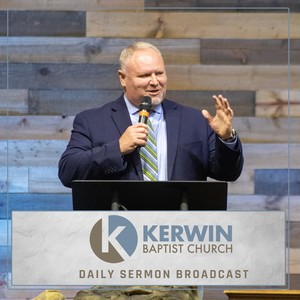
Welcome to the Kerwin Baptist Church broadcast today. Our desire is for the Word of God to be spread throughout the world so that all may know Christ. Join us now for a portion of one of our services here at Kerwin Baptist Church, located in Kernersville, North Carolina. There's somebody saying Praise the Lord. Don't I think you tell you what, I think God was honored in that this morning.
So good to be with you today. Looking forward to this praise challenge Sunday. Praise Challenge Sunday. You know, Psalm 119 has an interesting verse that says, seven times a day will I praise thee because of thy righteous judgments. And if David wrote that, it's not like he didn't have anything else to do if he was the king.
But he said, seven times a day will I praise thee. Who's ever heard of OCD? OCD? Obsessive, compulsive. Disorder.
Let's have a little survey here this morning and see if anybody's got OCD. How many look at your phone? Seven times a day. Hands up. How many look at Facebook seven times a day?
I mean, he complains seven times a day. How many eat seven times a day? How many talk seven times? How many watch the weather forecasts seven times a day? OCD.
Well You got any friends that's got OCD? Have you diagnosed them? Don't lift your hand on this one. You got any family that's got OCD? How many of you have OCD other than me?
Anybody got kind of obsessive, compulsive all the time?
Well, you know David, he didn't have obsessive, compulsive disorder. He had an obsessive, compulsive discipline. He said, seven times a day will I praise thee.
Now he had mastered the rhythm of praise. And that's what today is all about, is mastering the rhythm of praise. Seven times a day will I praise thee.
Now imagine that.
Now this was not a weekly ritual or an occasional burst of devotion. This was a lifestyle. And he didn't just write about praise. He practiced praise seven times a day. He mastered praise and weekend too.
So this morning, I want you to understand what praise is. Praise is esteem for a person, an accomplishment, or a virtue. Praise is esteem for a person, an accomplishment, or a virtue. 25% of the Bible has to do with prophecy. 25%, one quarter of the scripture has to do with prophecy.
But the next major theme is praise, worship, and thanksgiving. AI says 15% of the Bible is comprised of praise, worship, and thanksgiving, a dominant theme. The word praise mentioned 214 times in the scripture. Praise the Lord, hallelujah. That's what hallelujah means.
It means praise the Lord. 35 hallelujahs in the Bible.
So praise is not a side note. It's central. You know, Charles Wesley was the greatest hymn writer, one of the greatest hymn writers of all time. He wrote 6,500 hymns. And three days after his conversion, he wrote that song, oh, for a thousand tongues to sing.
Praise God in his spirit from the moment the Holy Ghost came into his being. I'm just here to tell you that the Psalms, it's the Old Testament hymn book, right? It's the hymnal of the Old Testament. And the word psalm simply means psalm. And I want us to look this morning at Psalm 150.
I invite you to stand. Stephen's going to lead us as we read Psalm 150 out loud together. All right, out loud together, starting in verse 1 of Psalm 150, it says this. Let's read it together out loud: Praise ye the Lord. Praise God in his sanctuary, praise him in the firmament of his power.
Praise him for his mighty acts. Praise Him according to His excellent greatness. Praise Him with the sound of the trumpet. Praise Him with the psaltery and harp. Praise Him with the timbrel and dance.
Praise Him with stringed instruments and organs. Praise Him upon the loud cymbals. Praise Him upon the high-sounding cymbals. Let everything that hath breath praise the Lord. Praise ye the Lord.
Yeah. All right, this is one of the hallelujah psalms. We looked at Psalm 147 in Sunday school, but this morning we're going to look at Psalm 150, a hallelujah psalm. And Psalm 150 answers four basic questions about praise.
So we're going to talk about praise basics. praise basics in this hour from Psalm 150. Let's just bow our hearts and just offer a word of praise from your heart to the heart of God. Just a quick word of praise from your heart to the heart of God. Oh, Heavenly Father, you're greatly to be praised.
Father, may we give you the praise that you're due and worthy of and what you deserve and desire. We give you blessing for instructing us in this holy art of praise. In Christ's name with thanksgiving, all God's people say. you can be seated.
So here's the praise basics here this morning. Four basic questions. Number one, where should we praise? Where should we praise?
Well, look at verse 1, what it says. Praise God in his sanctuary. praise him in the firmament of his power.
Now the word praise in Hebrew can be translated to shine. to celebrate. to rave or to boast and psalm 150 identifies two specific locations where people should praise the lord number one in the sanctuary Now the sanctuary is the sacred place. The sanctuary in the Old Testament was the tabernacle and then the temple. And in the early church, the sanctuary was the synagogues.
homes or the open field any public gathering and i believe that uh praise has a corporate application that praise is meant for corporate a corporate worship in sacred settings but notice second we're to worship him under the firmament of his power how many thankful for 70 degrees and sunshine say amen right there man we're freezing up and running okay i'm telling you this is great now under the open expanse of the heavens is where we ought to be praising god so praise extends out of the sanctuary into creation outdoors blue skies and starry nights i was walking to the mailbox the other day we live out in the country walking down the road the sun was shining the grass was green the sky was blue and it dawned on me praise god in the open front this is the perfect place to praise the lord So I had a little praise fest walking to the mailbox.
Now, you don't need stained glass or bluegrass to praise the Lord. You can praise God anywhere, anytime, with other people or even by yourself. I mean praise has a corporate and an individual application. We're to praise him in the closet as well as in the congregation. You know, the psalms were sung personally as well as communally.
I mean, they sang them together, and David sang them alone.
So true corporate worship always begins. On the private level, I believe that public worship, Brother Hawtry, should be an extension of our private worship. And what we're doing at home is naturally what we should be doing in public. And if you ain't lifting hands at home, don't lift them here. But if you're lifting in the sunroom, praising God, go ahead and have it here.
I believe that public worship is only an extension of our private worship of God and what's going on in our homes.
Now, speaking to yourselves in Psalms. hymns and spiritual songs.
Now where shall we praise the Lord?
Well we praise him in the sanctuary together corporately. We praise him under the firmament of his power alone, personal praise.
So that's where we should praise the Lord, together and alone.
Now, why should we praise the Lord? Why? Another grace basic. Why should we praise the Lord? Did you know that self-love...
Can lead you to pray. Self-interest can lead you to pray, but it's love for God that leads you to praise.
Now, listen up. Psalm 150 in verse 2 says, Praise him for his. mighty acts. Notice, praise him according to his what? Excellent greatness.
Two reasons to praise God here. Number one, for his mighty acts, for what he does.
Now look, his creative power defies imagination. In the beginning, when there was nothing, the Spirit of God moved upon the face of the deep and God spoke and the universe was born. His mighty acts, his wonders are unsearchable. His substitutionary death on the cross. Incredible.
His resurrection. is reviving down through church history. The mighty movements of the Holy Spirit are the reason we're here. If God hadn't intervened and interrupted, we wouldn't be sitting here this morning. And I'm just here to tell you, friend, that God stepped in, God moved, God stepped down, God revived, God restored.
Praise him for his mighty acts. Whoever offers praise glorifies me. Hallelujah. Means praise the Lord. No, we're going to praise him for his excellent greatness.
Now, can I just say, it's impossible to exaggerate the greatness of God. You could never tell it like it ought to be told. I could not even begin to tell her. And by the way, Pastor Haltry introduces me as Dr. Vaughn.
I'm not even a nurse's assistant, all right? I mean, I don't really came up with that, but. But anyhow. You cannot exaggerate the goodness of God. We praise God for his excellent greatness.
His immensity. I said immensity is beyond human measure. His holiness is unutterable. His presence is overwhelming. Think about his omni-presence.
He's everywhere at one time. Think about his omniscient. Omniscience. He knows everything. Think about his omnipotence.
He's all-powerful. The omni attributes of God proclaim his unparalleled majesty. And the more you know about God, the better equipped you're going to be to praise him. Do you realize before you can praise God like you should, you have to make an appraisal of God? You have to make an appraisal of God before you can praise God as you should.
My son just sold his house and property, had to bring in an appraiser. The appraiser comes in, evaluates everything, looks at everything, compares it to similar properties, comes up with a value, places a price tag on the thing. There's an appraisal.
Well listen. You've got to make an appraisal of God before you can praise God like you should. And the more you know about God, the more you're going to be able to praise him. He's deserving of continual... Praise, the word praise comes from a German or French word, praiser, praiser, praiser.
And you know what that means? The value. to recognize worth, to adore, or to prize. It says in Psalm 66, sing forth the honor of his name, make his praise glorious.
Now do you know that that names have meanings? I know what my name means. Frankly, H-A-R-O-L-D. Who would name somebody with a name like that? I never have liked my name.
The second name's even worse, but I know what it means. It means he who leads his people to victory.
Well, your name means something. Can I tell you God's name means something? And in the Bible, there's about 30 or 40 titles or names. God's names reveal his character. In the authorized version, we have G-O-D.
But I'm telling you, G-O-D has much deeper, deeper meaning. It has about 30 or 40 different titles. Let me give you a couple of them. Elohim. Elohim.
What does that mean?
Well, one, he was great, mighty, and majestic, and dreadful. Adonai, what does that mean? The owner and the ruler of everything, Adonai. What about El Shaddai, the almighty God who is able to completely nourish and supply? Uh Jehovah, Yahweh, what does this mean?
the self-existing eternal God. God reveals his nature through his names. If we're going to praise God, we've got to know who he is. We've got to understand his names. Jehovah Tiskanu, what does that mean?
God, your righteousness. What about Jehovah in Kadesh? I am your sanctification. Say hallelujah right there because I ain't got none. He better be my sanctification.
I'm just telling you. Jehovah Shalom, what does that mean? He's got our peace. What about Jehovah, Rapha? I'm God, your healer.
I'm your healer. What about Jehovah, Jireh? I'm your provision, the God who sees before. You see, when we understand what his names are and what his nature is, then we're able to praise him as we should. He's Jehovah Eliad.
I am the Lord most high. We're to praise him for his mighty acts. We're to praise him according to his excellent greatness. Why should we praise the Lord? But what about how should we praise the Lord?
You know, a lot of dispute on this. This is a cultural phenomenon worldwide. Different people express themselves differently. Can I just say that God desires musical praise? Boy, I really love the music here this morning.
I think it honored the Lord.
Well, God desires musical praise, so we praise God with music.
Now, look in Psalm 150. Look at this, Psalm 150. I praise him with uh Say it out loud.
Sound of the trumpet. Praise Him with the psaltery and harp, stringed instruments, organs, loud cymbals, high-sounding cymbals. All right, we got some instruments up here. But Psalm 150 names different instruments. God desires musical praise.
So we're to praise God with music. We're to praise him with our mouth. And we're to praise him with movement. Biblically speaking. You praise God with your mouth.
Now, listen to this: my mouth shall speak the praise of the Lord. Praise God in the sanctuary. Praise God. What is this? Verbal praise.
It's words coming out of our mouths, which come out of our hearts to the heart of God. We're to praise God with our verbal praise, our tongues, our lips. the spoken word. You know, praise is utterance. But worship is an attitude.
Praise is utterance. And we're to praise God with our mouths. Second, we're to praise God with music. With music.
Now, notice, notice here, the diverse Instrumentation. Blessed it. And I just want to say a few things right here, that God likes vibrant, exuberant praise. This is not a funeral dirge. 40 years ago I was in Canada preaching in a German Baptist church.
First service was old German people. Second service was younger English-speaking German people. And in the first service, they had a chancel choir. You ever heard of a chancel choir?
Well, a chancel choir sits in the balcony.
Now, here we are sitting out here like this, like this, and behind us in the balcony was this choir, which we couldn't see. And the idea is, you're supposed to hear them and not see them, right? Humility, I guess, was the idea. It was kind of. Kind of weird.
I didn't get invited back, but anyhow. Here in the Psalms, there's a trumpet. Brass, a harp. Uh uh tambourine. Go down to the holiness crowd and borrow one of them and bring it back tonight.
That Bible says right here: a tambourine. That's what it says: tibbral, stringed instruments, cymbals.
So what's the idea here?
Well There's excitement and exuberance, and God likes exuberant praise. I just believe this.
Now, personal preferences and backgrounds. Depending on where you went to school, Can cause you to minimize the importance of music in worship, but Psalm 150 encourages us to embrace it wholeheartedly. How many understand a lot of culture goes into the preference of music? Oriental music. I don't like it.
Arab music I personally don't like it. Is rightly music. I'm really not into it. I grew up in Southside, Virginia, man, where we had fiddles and banjos and that's what I grew up on. And then some people, they like different kinds of music.
Is that fair? Like like some some people they love that operatic Yodelin. Yo, yo, yo, yo, yo, yo, yo, yo, yo, yo, yo, yo, yo, yo, yo, yo, yo, yo, yo. They like to hit that, whatever that thing is called, vibrating. I don't know what it's called, but some people like, it ain't doing nothing for me, but it does something for some people, and that's okay.
Are y'all with me right here? What I'm telling you is this, that God likes praise that comes from the heart. It's not limited to the talented. It's not about the performance, it's about the heart attitude.
So we're to praise God with music, praise God with our mouth, but we're to praise God with movement, according to Psalm 150. What about this? Biblical praise includes bodily movement. Listen to 2 Chronicles 20, and Jehoshaphat. bowed his head.
Movement. To the with his face to the ground, and all Judah and the inhabitants fell. before the Lord, worshiping the Lord, movement.
Now look in verse 4 of Psalm 150. The Bible here mentions dance. Hmm.
Now I want to say this. Israelite dance was never sensual. It wasn't shindig or hullabaloo or hoochie-coochie. It wasn't none of that. That's not what Israeli dance is all about.
It's not. It was never sensual. And David in the Old Testament was so overcome with joy. He danced before the Lord. That's what it says.
His wife didn't like it, but... He was not putting on a show, he was expressing his heart. And scriptural praise is never about exhibitionism. It's never about drawing attention to ourselves. It's not a display of talent or emotion, but it's an outward overflow of inward esteem for God.
And I believe that praise that begins in the prayer closet will naturally express itself in public settings. I just believe that. Rejoice in the Lord. For he is upright, and praise is comely for the upright.
So lively praise honors God, it begins in the heart. It's jubilant, it's exuberant. And biblical praise includes bodily movement. Let me give you a few examples. Nehemiah 8.
And the people answered amen and bowed their heads. That's movement. 2 Chronicles 20, all Judah fell. I mean, they fell before the Lord. That's bodily movement.
Paul said in Ephesians 3, I bow my knees. Before the Lord Jesus Christ. That's bodily movement. It includes movement. What about Jesus lifted up his eyes?
John 11. He lifted up his eyes. That was bodily movement. What about Paul when he said, I will therefore that men pray everywhere, lifting up Holy Hands. You say, well, that's metaphorical.
Really? Is the modesty verse right there with it? Is that metaphorical or is that literal? The 70 references to lifting holy hands in the Word of God. What about clapping?
Oh, clap your hands. All ye people. Bodily movement. All right, now y'all are pretty stove up, so let's practice a little scriptural praise here this morning. How about a hand clap of praise for the Lord Jesus Christ here this morning?
Woo! What about that? You remember that woman with the alabaster box? Remember this? and the box had to be broken before the perfume could be released.
We got a lot of boxes. In churches, that I think ought to be broken. We got the box of restraint. My son Stephen, he just went to Africa, had a prayer advance, and they were teaching and preaching. And he wrote back and said, Hey, Dad, they don't need a praise chat.
They pretty much got the praise down. What they need is some content. What they need is a little doctrine here.
So the box of restraint.
Well, we're afraid and all. I'm just telling you: be yourself, be your sanctified self in the presence of God, and everything's going to be all right. What about the box of reputation?
Well, we don't do that here, Brother Frank. We ain't that kind of church. I was at a conference one time. I don't know if you were there or not. I was at a conference one time, and they had a quartet.
in life. I thought it was really good. Like real good.
So I'm enjoying it. Spoke one of the speakers. A friend of mine came up and said, Harold, You keep acting like that? You're gonna have to fight a different crowd. I wasn't dancing on the ceiling.
I wasn't swinging from the chandeliers. I wasn't talking in tongues. I was just enjoying the service. You're going to have to find a different crowd. I have an announcement.
I done found my crowd. I'm a friend of all the friends of Christ. His friends are my friends. His enemies are my enemies. And people that praise the Lord, I'm right in there with them.
In fact, I had to get up this morning and turn on the YouTube to get my fix this morning of praising the Lord.
So so you know The Bible says, praise ye the Lord. Say that out loud. Praise ye the Lord. Say it real loud. Praise ye the Lord.
So how should we praise the Lord?
Well, we're to praise him with our whole heart, all that's within us. Bless the Lord, oh my soul. We're to praise him with gratitude. Don't forget his benefits. Listen, you praise God when you feel like it.
Or You praise God. Until you feel like it. And you don't have to wait until you feel like it to praise the Lord. Just go ahead and do the right thing and your emotions will catch up.
Now, giving thanks is a bridge to gratitude. And if you don't feel grateful, just start thanking God. If you don't feel like praising God, just go ahead and start praising God anyhow. It builds a bridge.
Now, number four, who should engage in praise? Praise basic number four. Who should engage in praise?
Well, read this out loud. Let everything that hath breath. Praise ye the Lord. Let everything that has breath. In other words, every living being is summons to praise.
Hebrews 13, let us offer the Sacrifice. A praise, the fruit of our lips giving thanks to God. Do you realize every breath is a tool for worship? Every breath is a tool for worship. Let everything that hath breath praise the Lord.
This is a universal call. to all living beings.
Now let's see if you qualify. Put your hand up in front of your mouth like this right here. Put your hand up there.
Now blow in your hand. If you got bread, you're qualified to praise God. You just met the one qualification? Ain't nothing else to it. And you've got breath.
You ought to be praising the Lord. Every breath is an opportunity to honor the God who gave it to you. And if you're breathing, you're called to praise. There's no age limit. My granddaughter got her learner's permit.
Hmm.
There's no age restriction on praise. All ages. and both agendas. We're called to praise the Lord.
Now praise is not optional for the believer. Because praise is just man's response to greatness. This is what praise is. It's man's response to greatness. Let us offer the sacrifice of praise to our God, a continual offering to a worthy king.
Now God inhabits the praises of his people.
So who should engage in breathing? Everybody that's breathing. Where are you supposed to praise? Praise them in the sanctuary. Praise him under the sky.
Praise him for what he's done. Praise him for who he is. Praise him with instruments.
Now listen up.
Some of us have no musical talent whatsoever. Can't sing. I can't play. But buddy, you got Apple music, don't you? You got YouTube, don't you?
And if you can't do it by yourself, there's plenty of help available. And you need to identify the music that elevates God in your mind, that draws out your worship. What about that gratitude song? That didn't do anything for you. Say hallelujah, somebody.
A lot of Presbyterians and British in your church down here, brother. I'm just telling you, a lot of reserved people down here in this. And that's okay. Not everybody's the same. It's okay.
It's all right. But what I'm saying is this: that. We're to be praising God with our voices. We're to praise God with our whole heart. Praise God with joy.
Praise Him privately. Praise Him publicly. If you got breath, praise the Lord. Remember the triumphant entry? Listen to this.
As they went, they spread their clothes in the way. And when Jesus was come now, nigh, even at the descent of the Mount of Olives, the whole multitude, listen to this: the whole multitude of disciples began to rejoice. And praise God. with a loud voice. Mm-hmm.
for all the mighty works they had seen. And they said, blessed be the king that comes in the name of the Lord. Peace in heaven, glory in the highest. And some of the Pharisees. Yeah.
They didn't like it.
Some of the Pharisees from among the multitude said, Master, rebuke your disciples. It's getting out of order. Yeah. We don't do that here. We're Jews, man.
We're Orthodox. We're not like that. We're not like the Samaritans. Rebuke your disciples, tell them to shut up. And Jesus said, if these would hold their peace, the stones would cry out.
It'd be a sad thing that God would have to summon an inanimate object to praise God because his people are not praising him as they should. That'd be a sad situation. We're called to praise.
Now look, your church is undertaking a 21-day praise challenge. That's why we're here. We've got a book right here. I'm going to give this to you. It's not only has 21 devotionals.
It has a bonus chapter. You've got 22 devotionals. It's got a scripture and explanation and praise projects and related scriptures for every day. And I just want to say this. This is one of the most...
Neuroplasticity and plasticity changing. In other words, this can change the way you think. It can change your brain thought patterns. It can change your attitude. It can change your perspective.
It's the 21-day praise challenge. And we're going to give you one of these books, and I'm going to challenge you to dedicate 21 days, 21 days, one chapter per day, and practice these takeaways.
So read the Blaze book daily.
Now, number two, set some praise reminders on your electronic device. I got Stephen to put seven buzzes on my phone. Praise reminders. Mm-hmm. Oh.
Time for a praise, Bray. I was in the restaurant yesterday having breakfast with a guy. My phone's sitting there on the mmm. I said, hey, brother, time for a praise break. Let's praise the Lord.
And we just bow our head right there in the restaurant, shut up a quick prayer. And when your phone goes off, you don't have to do a 30-minute, and just may praise the Lord, bless the Lord. Hallelujah. Thank you, Jesus. Or if you got time, then cut on the gratitude from the Knoxville Choir or the Kerwin Choir and whatever your preference is, and just tune in to some musical prayer.
I'm just telling you, it will. It will help lift you out of the pit. It will help get your mind off all the people that's done you wrong. It will help you. Thank you for listening today.
We hope you received a blessing from our broadcast. The Kerwin Baptist Church is located at 4520 Old Hollow Road in Kernersville, North Carolina. You may also contact us by phone at 336-993-5192 or via the web. at Kerwin Baptist Church.com. Enjoy our services live and all our media on our website and church app.
Thank you for listening to the Kerwin Broadcast today. God bless you.