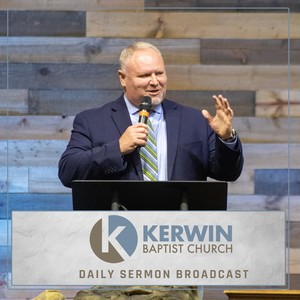
Welcome to the Kerwin Baptist Church broadcast today. Our desire is for the Word of God to be spread throughout the world.
so that all may know Christ. Join us now for a portion of one of our services here at Kerwin Baptist Church. Located in Kernersville, North Carolina. Psalm 46. Today is going to be just a little bit different.
Um I wanna If I can, teach you Psalm 46. But there's a reason that Psalm 46 was written. There is an Old Testament story that inspired Psalm 46. and the things that are written in there. Martin Luther wrote a wonderful song.
Out of Psalm 46, you've heard it. A mighty fortress is our God. He wrote that song out of this psalm.
Now, I want us to notice a couple things, and I want to kind of just give you the outline of what this says about our God, but then I want to show you. in the Old Testament Why these things were said. And then we'll let you go this morning. I want you to notice number one, and Brother Frank, I appreciate him reading our passage. But number one, out of verse one, notice this: he says, God is our refuge.
Now, who wrote Psalm 46?
Well, we don't really know for sure. It's attributed to the sons of Korah. This was musicians, and we don't know exactly who. But we do know this, that this psalm was literally written as a song. to praise God for something that he had done.
And that attributes all the way back to the book of 2 Kings.
So, notice this first to the chief musician for the sons of Korah, a song upon Alamoth. Here it is: God is our refuge. Number one, I want you to see today: this psalm says that God is my shelter.
Now, this word refuge is literally a Hebrew word, and it's machaset, which means literally shelter. You and I would use the term shelter, where it uses refuge here.
Now, what is a shelter for?
Well, a shelter is obviously for shelter. It's for safety. It's for rest. It's for shade. And what it's basically saying is this, there's times in your life.
Where it it it because of circumstances in life, because of what's going on. That you're having a difficult time, and you need somewhere to go, and you need someone to go to. And to the child of God, and let's just be honest: in the world, they go to a lot of different things. They run to a bar. They run to a bottle.
Come on now, y'all. Christians are getting afraid to even say amen to this anymore. Are you listening to me? People run to a bottle. They run to alcohol, they run to drugs, they run to all kinds of things because they can't handle what's going on.
Look at me, to the child of God, we are to run to Him. He's our shelter. He's our refuge. Notice secondly in the verse: God is my, not just shelter, God is my strength. Notice what it says.
Look at verse 1. God is our refuge and strength. By the way, this is a promise. We're still in our promise series. We are promised here that God will be our refuge.
And that God will be our strength. Notice this: this word strength is the Hebrew word roz.
Now, here's what's interesting about it: it means strength in various applications. It's not just talking about one certain kind of strength, it literally means force, security, boldness, might, power, strength. What it means is this: that God gives us strength. For various things in our life. Whatever you need strength for, God has provided that for you.
Now look at me. I needed strength for certain things in my 20s, and I need a different kind of a strength for different kinds of things in my 50s. Listen, I needed strength for a lot of things when I was a youth pastor. I need a different kind of strength for things as a pastor here. It means this: whatever you face, wherever you go in life, God has the strength that you need, and God will supply that.
Now, I want you to notice this. Isn't it amazing that the Bible says that God is my shelter? and my strength.
Now think about the dichotomy of that. The shelter is where you run to hide. Strength is what you have to fight.
So God says, I'm your shelter. And I'm your strength. That means that sometimes we need a shelter.
Sometimes we need the strength.
Sometimes we need to run to him.
Sometimes we need to run through him.
Sometimes I need to hide.
Sometimes I need to work. The problem is, you and I, we don't mind God being our shelter. We want to run and hide. Hey. I get it.
The problem is, a lot of Christians don't access his strength to come out of the shelter and start doing something for God. God said, I'll be your shelter. But I'm not your shelter just for you to stay there and hide there. and never do anything. I'm also your strength.
Notice thirdly, in verse 1, it says, God is our refuge and strength, a very present help. Notice that phrase, very present. Number three, God is steadfast.
Now, this phrase, very present, in the Hebrew, would be similar to the phrase you and I use, which means this, clearly proven. Clearly proven. When it says here that God is a very present help in time of trouble, what it means is this. He's very present. He's always proven himself to be there.
It means it's the concept that God has done this before. He's doing it now. I believe he always will. He will always be a help when you need him. It means this.
He's not just there, he's been there. He's not just here now, he always has been. And that means he always will be. He's always been there. He's always been faithful.
He's always been present. Past experiences, history that you've gone through, it shows that God is worthy of our trust, that He will always be a very present help in time of trouble. Of all the verses in the Bible, this probably is one I use the most of any of them in counseling. I can't tell you how many times, and many of you sitting in this building, I have quoted this verse to you at times when I've talked to you that God has promised to be a very present help in time of trouble. When everybody else runs out, that's when God runs in.
Now, you have some friends and family in your life that have not been a very present help at times.
So do I. And let me just say as a sidebar, Satan's going to make sure he lines it up that when you need people the most, that's when they're not going to be there. Satan's going to use that. He's going to arrange that. It doesn't mean they don't love you.
It doesn't mean they don't want to be there for you. We're all busy. We all have things going. And guess what?
Sometimes we hurt each other. We don't even mean to, and we don't want to.
Now, if this one starts breaking, I got a problem with somebody. All right. God's just against me today. I don't know what's going on here. All right.
But look at me, a lot of times. When you need somebody is when they're not going to be there. And here's the whole point. How do you get beyond junk like that? Quit depending on people.
Quit waiting on them. Listen, God said, I'll be your shelter. I'll be your strength. God said, I am steadfast even when others aren't. Are you with me this morning?
Say amen. Notice number four, in verse one, God says that God is our support. He is a very present, and here's the word help. He's a very present help. This word help.
is the word Ezra. In Hebrew.
Now, we have a Bible. That has a book in it. Named Ezra. And here's the deal. You know what Ezra means?
It means helper. That's exactly.
So literally, the book of Ezra comes straight from the Hebrew word Ezra. And obviously has become a name. As we know, even in the Bible, and it literally means helper, God says this: sometimes I don't need the strength to do.
Sometimes I just need the strength to continue.
Now, God said, Listen, I'm going to give you strength that you need, but here He says, This: I'll be a very present help. in time of trouble. You know, sometimes I don't need God to give me strength to go out and do something.
Sometimes I need God to give me strength just to stay faithful. at what I'm already doing. Can I have an amen right there? I mean, you know, many of you have here, I think of Roger and Brenda Smith, and Roger's one of our deacons, and I can't tell you how many years they ran bus route here. I look at Scott up here.
Now, Scott, how many Sunday mornings? It wasn't just that you needed God to give you the strength to get on that bus and drive. You needed God to give you the strength just to stay faithful doing it. Are you looking at me, folks?
Sometimes you don't need the victory of accomplishment, you just need the victory of consistency. God said, I am a very present Help. I'm a helper. To you. And I, where you and I get in trouble is when we try to do it on our own.
When we do it through our own strength, that's where we mess up. I want you to notice also in verse 1 next. We're told here that God is my sufficiency.
Now, look if you would at verse 1. He says, I'm a very present help. Notice where. In Trouble. You know, Psalm 9, verse 9 says this: The Lord also will be a refuge.
for the oppressed. a refuge in times Of trouble.
Now, here's what's interesting: this word trouble in the Hebrew literally means a confined space.
Now, how would that translate for you and me? Let me ask you this. You ever been in a tight spot? It's what you and I would call being in a tight spot. I don't know what to do.
Whatever I do is wrong. You ever been in a tight spot in your life? I don't know what next step to take. I know that I can't stay like this, and I know that things aren't the way they need to be, but I don't know what I need to do next. And many times, if I do this, I hurt this person.
If I do this, I hurt that person. If I do this, this person is going to be mad at me. If I do this, that person is going to be mad at me. Listen, pastoring is a tight spot. It's a tight spot.
And here's what God said: I will be a very present help. when you're in a tight spot. When you don't know what to do, or how to do it, or even what needs to do, and then you don't even know if you have the strength to do it. God said, I will be a very present help. in times of trouble.
In your tight spots.
Now, why is all this coming together? Why is Psalm 46 saying all these things about God? I want you to notice, number six. In verse 2, we find that God is my stability.
Now this is an interesting verse because it begins to introduce us. To where this comes from in the Old Testament. Look at verse 2. Therefore, will not we fear. Notice this: though the earth be removed, And though the mountains be carried into the midst of the sea, though the waters thereof roar and be troubled, though the mountains shake with the swelling thereof.
Now, think about this. Symbolically, these verses refer to natural disasters. What happens in natural disasters?
Well, the sea begins to change. Here's the mountains begin to be removed into the sea. It means this: when things begin to happen that all of a sudden they're catastrophic, you can't depend on it. What you depended on now is being moved. It's literally that stuff is shifting in your life.
I thought I could trust this person, but I can't. I thought I could trust the job that I had, but I can't. I thought I could depend on this, but I can't. It's literally like a natural disaster that people are trusting the ground that they're standing on, but an earthquake will happen, or a volcano will erupt, or whatever the case might be. It's literally God is saying this: that when everything around you.
you begins to shift. And everything around you begins to change. Notice here, he doesn't even just talk about natural disasters, he talks about the nature of the sea, how the waters begin to roar, and how the waters are hard to trust. And if you let water control you, it's gonna take you up and down, back and forth. It can't be trusted, and we all know that.
What is God saying? Look at these verses: Malachi 3:6. For I am the Lord. Listen to this. I choose.
Change not. Therefore, ye sons of Jacob. The Jewish people are not consumed. The only reason you're not consumed Listen to me. And you need to hear this.
If you had to rely on yourself or others or circumstances in your life, you would be consumed. But the reason you're not consumed is because we serve a God that doesn't change.
Now look at this verse, Hebrews 13:8. Jesus Christ, the same yesterday. today. And forever. What is God saying?
Listen, everything around you is going to shift, everything around you might change. You can't predict. Listen, a lot of these natural disasters, this verse is talking about, it's talking about things you can't predict. You didn't know it was going to happen. Can I tell you something?
There's a lot of things in your life you didn't know was going to happen. I went to bed Friday night. I felt great. I woke up an hour and a half later, and I'm about dead. Listen, you can't, there's a lot of things you can't depend on.
But here's the whole point. God said: even though the mountains shift, even though the water can't be trusted, even though all these things change. I don't change. I'm steadfast. God doesn't change.
Now, I want you to notice this. Look, if you would at verse 4. And this begins to all of a sudden now we know where we're going. In verse 4, we see this, number 7, that God is my sustainer. Psalm 46 teaches.
What do you mean? Look at verse 4. There is a river. And this was a song too, by the way. The streams whereof shall make glad the city of God.
What is the city of God? We're talking about Jerusalem. Jerusalem is known as the city of God.
So it says, there's a river, the streams thereof shall make glad Jerusalem. The holy place of the tabernacle of the Most High. And through that description, we know exactly what we're talking about. We're talking about Jerusalem. This verse mentions the presence of a stream.
of water. that blesses Jerusalem. The city of God.
Now, scripturally speaking, as we look at prophecy, streams and rivers are a common symbol of God's abundance and the source of God's abundance. But hear this: in Ezekiel 47 and even in Revelation 22, it talks about the going forth of the temple in the millennium when Jesus Christ comes to rule and reign on the earth, and when He creates a new heaven and a new earth, that there'll be a river out of the city of God. And we understand that there is prophetic things here, but let me tell you something else: He is talking specifically about Jerusalem, and Psalm 46 was written to give testament of a miraculous deliverance that God gave. His people under King Hezekiah. when the Assyrians came after them.
The Assyrians were attacking and they were killing all kinds of different people and groups of people. And all of a sudden, they come after Jerusalem, and Hezekiah is king. And so here's what's interesting, and we find out later in 2 Kings 20, and please get this. God led Hezekiah to build an aqueduct in Jerusalem. And the aqueduct collected And it took water, which was literally from what we call Kidron.
It's a spring that comes out of Kidron, and it connects to the pools in Jerusalem. Look at me, and here's the whole point. It means even when the enemy was attacking, even when storms were happening, even when spears were flying, and even when anybody was coming at them, guess what? Because they had a direct source connected to the main source. No matter what was going on around the city, they always had what they needed in the city.
Y'all get it? Here's what he's beginning to try to tell us. God is our sustenance no matter what's going on around. We are connected to the main source.
Some of you have a whole lot going on around you right now. I know I sure do. I'm going to tell you, I'm your pastor. I'm struggling right now.
Now I know pastors don't normally say that. My wife will tell you. She's tried to help me. I'm struggling. I'm struggling with some things.
I'm struggling. Hey, am I where God wants me to be? Am I doing what God wants me to do? I'm struggling with, listen, and there's going to be all kinds of things that's going to go on around you in life. But here's the whole point: God says: you are connected to the main source.
God is your sustenance. You don't need the approval of people to be your sustenance. You don't need your own accomplishments to be your sustenance. God is your sustenance. So now we understand we're talking about Jerusalem.
Now we understand we're talking about literally when nations have attacked, that there was a source there for them. All of a sudden, we get to verse 5, and now we're going to have the connection. Notice number 8, we see in verse 5: God is my satisfaction.
Now look at verse 5. God is in the midst of her. Her. Jerusalem. She shall not be moved.
God shall help her. And that right early. Notice for six. The heathen raged past tits. The heathen raged, the kingdoms were moved.
Assyria had launched an attack against The different nations. And under the king Sennacherib. They were going after nations, they were conquering people. And here's what they would do: they would go in and they would conquer these people, and then they would begin to brag: hey, the God that these people worship didn't help them. And they would go to the next kingdom and they would tell them this: hey, listen, the gods that the kingdoms worshiped back then didn't help them.
Your god's not going to help you. And this went on. And here's Hezekiah at the time, king here in Jerusalem. And all of a sudden, now Assyria is coming after him.
Now, we're going to look at it, but look at the rest of verse 5. The heathen raged, the kingdoms were moved. He, meaning God, uttered his voice. The earth melted.
So now think about verse 6. Look at the first part you have all the bad that's happening. The second part you have God took care of it. Notice this: the heathen raged. The kingdoms were moved.
It's bad. All of a sudden, He uttered his voice. All of a sudden, in the middle of all that bad, God decided to speak up. Guess what happened? The earth melted.
We're done. End of story. The heathen raged. God spoke their history. Are y'all with me?
Now notice if you go to verse 7. The Lord of Posts is with us. The God of Jacob is our, here we go, all the way back to verse one. our refuge.
So now we have a whole sermon in these seven verses. That no matter what happened, God has always been our satisfaction. What in the world?
So, what we know is this: God has been our shelter, God is our strength, God is steadfast, God has been our support, God is our sufficiency, God is our stability, God is our sustainer. We've gone through all these things.
So, what in the world does this come with? And guess what?
We're almost done, but you've got to see where this all started. I want to show you, if you don't mind, in 2 Kings 9. Yeah. Shalmaneser, often referred to in the Bible, we're talking about Sennacherib. We know in Isaiah, here he is, king of Assyria.
And I want you to follow this. He had been Conquering nations. And he sends a letter. to King Hezekiah. And he lets him know: guess what?
All these kingdoms that we've defeated, their gods didn't help them. And we're coming at you now, and your God's not going to be able to help you. If their gods didn't help them, your God is not going to help you.
So, I want you to follow this trail real quick. Look at verse 1, 2 Kings 19 is on the screen for you if you need it. And it came to pass when King Hezekiah heard it. That he rent his clothes. Covered himself with sackcloth and went into the house of the Lord.
And he sent Elachim to Isaiah the prophet, the son of Amos.
So here he is. He hears about what's going to happen. Here's a king that's bigger than them, has more soldiers than them, that's stronger than them. He's taking over all these nations. And now he's coming at Jerusalem.
And Hezekiah sends for the man of God. Notice verse 3. And they said unto him, Thus saith Hezekiah.
Now look at it. Look at it real close. This day. Is a day of trouble. Have you ever had one of those days?
You ever had a day of trouble? We ever had some bad days.
Some hurtful days. You find out somebody said such and such. And it hurts. You find out somebody did something. You find out this.
You find out the doctor said, Listen, I sat down. Friday, because I had two funerals yesterday, it was a busy day. And let me do remind you we have the viewing today at 1 o'clock and Myers for Join Lee Lawson and then 2 o'clock will be the funeral.
So Friday I went and sat down with Barbara and Johnny Wilkins and Barbara's been told she has cancer and she's got surgery coming up. Here in just a little bit, and it's going to be a pretty evasive surgery, and they're going to remove either part or all. of her kidney and They're going to have to test some things and and and and different things and She has cancer she's dealing with in colon and kidney and all these different things. I just sat down and talked and, you know, Barbara's so She's such a servant of God. I don't know what can get her down.
She's just always encouraging. We sat there and laughed more than we cried, and we were just joking about things and different things. I told her, if you needed attention, you didn't need to go get cancer. You know, I'll come visit you if you want me to. You didn't have to do it.
She's laughing. You know, I know that sounds cruel, but I'm that kind of weird pastor, okay? I joke about stuff. And we were sitting there laughing, and Johnny was laughing, and Barbara was talking about when they told her. about this cancer and she just thought, goodness gracious.
You ever had a Day. Of trouble.
Some of you have had that day. You found out what your husband or wife did. You've had that day when you found out the tragedy that took place. You you you found out that report. From the doctor.
Some of you have had, and Hezekiah calls for the man of God. As around here, many times I get a call from somebody, they've had a day of trouble. Have you ever had a day of trouble? You ever been there?
So he calls for Isaiah. He says, this day. It's a day of trouble. I want you to look at verse 14.
Now follow the trail here. And Hezekiah received the letter. of the hand of the messengers. and read it. This is the letter saying we're coming at you.
Let me tell you, all those nations, their gods couldn't help them. Your God's not going to help you, Hezekiah. And here, Sennacherib sends these letters to Hezekiah to let him know: we're coming at you, you're not going to stop us.
So the Bible says in verse 14, Hezekiah receives the letter. Notice this of the hand of the messengers and read it. And Hezekiah went up into the house of the Lord.
Now notice this, Kirwan. And spread it before the Lord. He took that letter. With all that bad news and all those threats. He didn't know what to do.
And he took that letter and he went up to the house of God. Got around there where nobody else was. And he got him a table and he Laid out the letters. Before God. Look at verse 15.
And Hezekiah prayed before the Lord and said, O Lord God of Israel, which dwellest between the cherubims. Wow. Thou art the God. Not a god. Not a god.
Thou art the God. Now those gods didn't help those nations, but you're not like those gods. You're the God. Even Thou Alone. of all the kingdoms of the earth.
Thou hast made heaven and earth. Lord, bow down thine ear. And here You ever been there? God, would you hear me? Can you even hear me?
Notice what he says here. I love this. Open, Lord, thine eyes and see. Hear the words of Sennacherib. This is what he said.
Here's the letters. This is the threats he's made. This is what he said he's going to do to your people. which hath sent him to reproach. The living God.
Of a truth, Lord.
Now, here, notice, here's Hezekiah praying. Listen what he says: of a truth, Lord.
Now, notice what he says. I love this. The king of Assyria have destroyed the nations and their lands. Hezekiah said, no, Lord, in this letter, he said that he's destroyed all these other kingdoms and their gods didn't do them any good. And now he said he's coming at you.
And now he said he's coming at us. And that our God's not going to do us any good. And he said, now, God, it is true that they have conquered all these nations. That part is true. What is Hezekiah saying?
God? Don't let it be true. That he's bigger than you.
Now I love this. Look at verse 18. And they have cast their gods into the fire, for they were no gods, but the work of men's hands, wood and stone. He's talking about all the gods of these other kingdoms that didn't help them. They're just man-made.
They're wood and stone. Therefore, they have destroyed them.
Now, therefore, O Lord our God, I beseech thee, save us out of his hand, that all the kingdoms of the earth may know that thou art the Lord God, even thou only. Look at me this morning, Kerwin.
Some of you have some letters that you need to spread out before God.
Some of you need The greatest news that anyone can receive is the news of the free gift of salvation found in Jesus Christ. It is our desire for you to know him personally. Would you take a moment to hear this today? Every man is born with the sin nature. Romans 3.23 says, For all have sinned and come short of the glory of God.
No matter how hard we try, We're not good enough to obtain God's glory. or to get to heaven. Because of that, sin carries the penalty of death. Romans 6.23 says, For the wages of sin is death. But the gift of God is eternal life, through Jesus Christ our Lord.
The wages of our sin, or the payment of our sin, only equals death and separation from God. But it's only through God's gift salvation through Jesus Christ that we can accept him as our Saviour. Jesus Christ paid for your sin debt. The Bible says in Romans 5:8, But God commendeth his love toward us, in that while we were yet sinners, Christ died for us. All you have to do is receive Christ.
by faith as your Saviour. Romans ten nine says That if thou shalt confess with thy mouth the Lord Jesus, and shalt believe in thine heart that God hath raised him from the dead, thou shalt be saved. Verse 13 continues, For whosoever shall call upon the name of the Lord shall be saved. It's as simple as admitting that you're a sinner believing that Jesus is the only way. and calling upon his name.
Bible says whosoever, that's any one. can call upon the name of the Lord to be saved. Have you accepted Christ as your personal Savior? There is no greater day than today to take care of this. Would you accept Christ as your Savior?
If you have any questions, please give us a call at 336-993-5192 or visit our website at Curlin Baptist Church. Dot com. or visits that person at one of our three service times. We hope you have a great rest of your day. God bless you.
Mm-hmm.