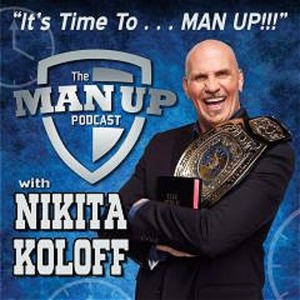
You're listening to the Truth Network and truthnetwork.com. Now, The Devil's Nightmare. Welcome back to another episode of It's Time to Man Up.
Well, what about producing history? In what way are you impacting the world around you? I'm excited today. I have such a special guest today because this is the man who actually is responsible for producing all the Man Up shows, Q&A with Koloff, none other than Nick Korners. Nick, welcome to the Man Up show. What's up, Nick? How you doing?
Nick and Nick, Nick at Nighters. Well, it's not nice. Anyway, I'm doing great. And man, it's it's great to have you really kind of on this side of the camera. You're always kind of the man behind the scenes. Right. I turn on the mics and that's right.
That's right. And so so do you are you comfortable on this side of the camera or do you have a would you prefer being behind the scenes? What's your preference?
I like both of them. As long as good quality audio is coming out or, you know, good quality, you know, we're making some good stuff. That's all I really care about. That's what matters most. Absolutely. As long as we sound good.
That's all that matters. So we're going to dive into you are a man who is producing history. Well, we'll dive more into that here in just a moment. You know what? What your passion is beyond producing the Man Up show and Q&A with Koloff. So so you're you're on staff with Truth Radio Network. Mm hmm.
I have. And and you you produce more than just my show. Like give us a glimpse into some of the other projects or things you work on with Truth Radio Network. Yeah. So we have a lot of shows here at Truth Network and I have under my bill about 20 shows.
Oh, wow. And that includes, you know, that includes podcasts and, you know, other ministries. They send in their audio and I mix it down.
That way it can be played on the airwaves. And I also work with Robbie Dilmore, the Christian car guy on his mini shows. Christian car guy. We do that on Saturday morning, masculine journey. I don't do masculine journey. OK. No one else does that.
But yeah, I do Christian car guy. That is 10 a.m. to 11 p.m. Eastern Standard Time and then Kingdom Pursuits 11 to 12 Eastern Standard Time. And that's on Saturdays. We do that show live. And, you know, that's my Saturdays for every you know, my Saturdays.
I'm with Robbie and you live things live. And I also do Stu's show. Truth Talk Live with Stu Epperson.
You know, 4 p.m. to 5 p.m. right. Which I've been special host on that a few times. And I, you know, I suppose we have a lot of special guest hosts.
You included Alicia Grimes and Joey Hudson. We have a lot of people that, you know, fill the seat of Truth Talk Live. And I love when Stu's not available. He's all over the place.
He's all over the place. But, you know, he's the founder in case people don't know the truth. Yeah. Truth. Truth Network. And I'm blessed that, you know, the CEO of the company, you know, trust me with his show.
So I'm definitely blessed about that. OK, so let me let me interrupt just for a moment here. So roughly 20 shows. So I just if I heard you right.
Understood. So not only like I come in the studio, you know, typically a couple, maybe two, three times a month and record a lot of shows. And you produce those shows.
You go back, edit and produce. Get those ready for for both the airwaves on Saturdays. The Man Up show here is, of course, 1230 and most markets on Saturdays. But that goes up on the podcast platform all over the world.
And I think to date, I think according to Robbie Dilmore, it's been downloaded in over 100 countries so far. But I heard you say. So do do others like record like maybe in their own studio and then send you over the files that you then prepare and get ready to put up on the airwaves? Yep, exactly. Like that I get.
OK, I get those files. What kind of an insider about radio is, you know, we try to stay close to, you know, we try to stay in the time range. So, for example, for your show on Saturdays, you have a 27 minute window for your show. And, you know, other people, you know, they have an hour, three to 54 minutes and 50 seconds. And, you know.
Oh, wow. Yes. So so for radio, it has to be exact. However, for podcasts, it can be as much time as you want. So as long or short as you want it to be.
Yeah. So a little bit about what I do is I would, for example, get audio, take the the breaths out and, you know, that way. And I can reduce that time.
And that way, you know, kind of condense it down and get it within the time frame or the parameters. And I'm sure there's lots of on my part that you've had to work with. But I appreciate that you make it.
So in other words, as a as a producer, technician, you you make us sound good. I policy fair to say. Yeah. I polished off a little bit.
I need a bunch of policy. Well, that. OK, so that's that's that's pretty cool. And and you've been roughly how long with Truth Radio Network? Couple, three years. As of right now, I'm about a year and a half. OK. Yeah.
So a year and a half. And you obviously you seem to enjoy what you do. I do enjoy what I do. Yeah. I always like to my mom, like it feels good to go to college and do what you're doing from college. You know, so I went to college for audio and, you know, music.
And now I get to include audio in my career. OK. So, you know. Yeah.
Which which was going to be actually kind of my next question. So so you so you went to school for this. So you already kind of answered that. And how did you know you wanted to to get into this or what age were you? And you kind of thought, hey, that's what I want to do. Yeah. Well, it all started, you know, at five years old playing the piano.
Wow. So I started playing. I was definitely I loved music. I was musically like inclined. I was the only one in my family that I knew of that, you know, was into the arts and into music. That's all the only child.
I was raised as an only child. And then I got to, you know, continue on through school with marching band and concerts and phonic band. And then by the time I was about, I believe, a junior in high school, I took my first audio in audio engineering class, where it was kind of like the basics and intro into recording music and learning about audio microphones, cables, the switchboard and, you know, different effects that we can use in audio.
And that was kind of the stepping point. And, you know, after that class ended, I took that summer. I continued on my learning by myself. I didn't get to do it the senior year just because scheduling conflicts. But then once I got to but then once I got to my whole senior year, I was thinking about that class.
Like that was like one of the best class I've ever took. So I thought about that senior year and I was like, you know, I think I want to do that. So as I continue on with my learn with learning by myself, you know, I was like, I like this. And I decided, you know, I want to go to school for this.
I want to learn more about this and, you know, get practice and, you know, end up doing something with it, in which I am. And the best part about it is I get to do it and incorporate God with it, too. So that's important to you. Yeah, yeah, yeah. Your faith is important to you.
Absolutely. Faith is important. You know, raise Baptist and yeah, yeah, yeah. And so so you so you taught yourself a lot of this. You studied a lot of it just on your own. And I wrote down self-taught. So there's a lot of it. But then that in learning that you felt like you needed a little bit more formal education.
Just maybe a few things you learned there that you weren't learning on your own. Correct. OK. I need I need some more expertise.
OK. You know, yeah. So more kind of outside, maybe outside influence or experience. And so so how many years is it school into to perfect your craft? It took it took five years and it took so long because I went to school in the era of covid and and, you know, doing slow things down. It definitely slowed things down, especially since the curriculum was hands on.
OK, that would make it difficult. Yeah. So, you know, it took me a little bit long. But, you know, during that time, it taught me to not give up on the race. You know, it doesn't matter how that's good, how fast it takes you to get from the line to the finish line.
As long as you get to the finish line. That's what's important. Well, you make me think of probably our listeners out there. Got a visual. I got this visual, the tortoise and the hair. You know, almost everybody has a reflection of that picture of, you know, that everyone thinks that the rabbit jumps out to a lead. But, you know, the old adage is the tortoise, who's steady and consistent and persistent and perseveres, ends up crossing the finish line first. I'm reminded of I'm not a track and field guy, but I think about that person who thinks I'm just going to just bolt out of the gate. And they're running long distance, but they're running so far, so fast that they end up running out of gas. And then the person who's just methodically, just consistently running that endurance race, sometimes ends up crossing the finish line first. I almost ran out of gas.
Like there was a time where I definitely did want to give up. But with the guidance of my mom, you know, she encouraged me to like continue on and, you know, be someone. Because my mom, she's the first one in our family to get a college education.
Oh, wow. And then I think I'm about second or third behind my cousin. And yeah, so, you know, and she worked in public education for a long time, so for over 20 years. So I definitely had a lot of influence in education growing up. Because of her. And off the air, your mom has come up in a lot of our discussions. You seem pretty close to your mom.
Oh, yeah. Yeah, I'm a proud mama's boy. I am a proud mama's boy. And I will say that to the end. Nothing wrong with that.
Nothing wrong with being a mama's boy. And like, yeah, she's, you know, she's been the rock, sword, and shield for like all my life. And, you know, and in some ways I'm her rock, sword, and shield too. You know, we just have a really good connection. And, you know, as we get older, the connection just gets better and better. So the relationship just is more and more and more enhanced. I like that, man.
Maybe somebody out there, like, think about their mom and maybe they've never looked at that regard. But the rock, she's my rock, my sword, and my shield. That's a great visual of, I'm reminded of Ephesians chapter 6, you know. And we don't wrestle against flesh and blood, but putting on the full armor of God.
And, of course, you've got the sword of the Spirit, shield of faith, and all the armor there, the helmet of salvation, and all the armor there. And so she's a big inspiration too. Like you said, she really encourages you not to give up. So she's an inspiration, believes in her son. Yeah, absolutely. She believes.
Okay. You're listening to the Truth Network and truthnetwork.com. If you would like to support Koloff for Christ Ministries, for a gift of $25, Nikita will send you his two CDs, Adoration and Declaration. For a gift of $50, Nikita will include his book, Wrestling with Success. And for a gift of $100 or more, Nikita will include a signed copy of his newly updated life story, A Tale of the Ring and Redemption.
Go to www.koloff.net and donate today. In addition, he's a world-renowned speaker, writer, and author. Visit iAssociates.com for more information. You're listening to the Truth Network and truthnetwork.com. And you mentioned music, and I seem to recall from past conversations that music, in addition to producing shows and doing all you do here at Truth Radio, you do things outside of the radio station as well. Music, is that a passion for you?
Oh yeah. Like I said, I've been playing instruments, the first instrument was piano when I was five. I was in the children's choir, the band from middle school to high school. And I did one year at Wake Forest.
Okay. I did one year at the Wake Forest Marching Band, SotoGab. Wake Forest University, for those who may not know in other parts of the country or world, Wake Forest University, North Carolina.
Right here in Winston. I was in SotoGab and I played the tuba there. The tuba? The tuba. That was one of my... How much those things weigh? It depends. If you are the one that, if you have the tuba that you put over your shoulder, that can be anywhere around maybe 20, 30 pounds. And then if you have the one that wraps around your body, that's called a sousaphone. Okay.
That one, I think that can be around 20 to 30 pounds as well. So what's the longest you ever had, like an hour, two hours, like what's the longest you've had to hold either of those or one of those? What'd you say? I don't know. You're in the marching band, I mean like an hour? It would have been an hour, but it would feel like an hour.
It would feel like... Feel less or more? But the thing about it is, it's the adrenaline. The adrenaline from performing and during parades, the weight doesn't feel that heavy. But you know, during the practice, it's about a thousand pounds, like during practice. Wow.
I bet. I've driven by like high schools and stuff and seen the marching bands out in the parking lot, like practicing for the Friday night games and everything. And I'm like, wow. And it's funny because I guess certain instruments, they're often like little sections or whatever. I marvel though.
Here's what I marvel like. You look at some of those college marching bands. In my mind, maybe you can help me out real quick. To do all that movement and I don't even know what it's called, but to make little... Make formations. Formations.
I mean, animals. I'm like, how in the world do you guys even know? How do you do that? There's a lot of components to it. There's one about teamwork.
Definitely teamwork. Learning your stands and coordination and knowing where you're supposed to go, it takes memory too. Like left or right, back, forward, right? 45 degree angle to your right or 45 degree angle backward to your left or whatever. And like for all bands, it's different, especially with their style because there are, because I remember I did the straight leg marching. So that's the type of that's the type of walking that we do, you know, to our stands.
So we have to walk and instead of bending our knee so much, you don't want to bend your knees so much so that way it looks like a straight leg walking. Kind of like, kind of like in the Nutcracker. Yeah. You know, I guess that's a good comparison.
But yeah. What's your favorite kind of music? Oh man. I, if anything, I like the type of music that tells a story.
So, so when I, when I country western. No, I'm kidding. I'm kidding. I'm kidding.
It's all about like dogs dying and no, I'm kidding. All right. Keep going. Didn't mean to interrupt.
Go for it. Yeah. I, um, I kind of grew up with, you know, R&B music a lot. You know, the, Hey, I'm with you, man. Come on. My mom, my grandmother, you know, she, they, you know, they, they little town Motown. Come on.
Oh, it most time for sure. Um, my, my mom, she, I remember, you know, just us going down the highway and just, you know, kind of just cruising around and just listening to, um, whatever's on the radio. Yeah. And, um, yeah, so, you know, but I definitely like music that tells a story that's not so generic, you know, generic pop, you know, generic, um, you know, R&B talking about the same old thing.
You think the old, like the original motel, like, you know, like 50, 60, 70. Yeah. I think the music is, was better than the now, or, I mean, obviously it's different eras and different styles, but it's evolved. I think, yeah, I definitely think, you know, back then it was better, especially on how the music world was recorded because now music is recorded with like with MIDI and MIDI is an acronym, which means musical instrument, digital interface.
It's another way of saying, you know, sounds that come from the internet, from the, like the computer instead of sounds coming from actual instruments. Yeah. So I think, so I think that's why, you know, music back then is like a little bit is better.
Yeah. I have a friend who plays keys and violin and, and, and yeah, some of the, like the difference between even electronic violin versus old school, right. It seems to, and I don't have a, you have a, certainly an era four, but in one sense, it kind of all sounds the same to me, but I do know what you're talking about. Cause it's been explained to me that, no, there's just a, a, a much tr I guess maybe truer sound than, than the manufactured sound. Is that, does that sound right?
Am I making it? Yeah, that, that sounds perfect. Cause I see like some of those guys with their guitars and all that on, on stage and stuff, like with their foot, like pressing all these different buttons and, and I'm like, that's amazing. I mean, it is amazing how technology has advanced, but at the same time kind of take away in a sense, maybe from that old school sound.
Would that be fair to say? It takes away, it takes away kind of the, the authentic. Yeah. Just the heart of the person playing, right. You can, they can kind of, that's the other thing I, I watch like people's facial expressions and stuff where they're playing guitars or keys or, or even singing or whatever. I'm like, man, you can tell when their heart's like really in it.
So yeah. So, and I get the R and B thing you may or may not remember, but you know, I grew up in the projects of Minneapolis and Minnesota and an R and B man that like, like in the project, that was the thing. And I've just, I've never lost that. I've just always had, I love it still to this day. I love, I love Motown.
I love, love the R and B. So, so you're producing music or helping others produce music. What are you doing there?
I do both. You know, I have, I have had some friends that I've produced some, some, what they call beats for them. And then I, you know, I'm working on my own project as my, myself. I don't know where that project is going to go right now, but I'm really just drawing out the blueprint of what I want to put out and kind of getting a vision for what that looks like for yourself. So I've been, so I've been writing, I'm writing, I just have a whole new mind, a whole new mind space. And that's why my writing, I feel has improved a lot because before I could write maybe a couple of verses, but it wouldn't go anywhere. But now I'm in a place in my life where I can write music, I can go from point A to point B, like I said, it would take a little bit of time to go to point B, but it, it will make it. So you, so are you doing songwriting and then do you produce as well for yourself all the, I mean, is it a, I'm not sure what it's like, notes and.
Yeah, I can. Compose. Yeah, I do. I do both. You know, I have an equal love for writing and for composing music. Okay. Yeah, I love, I love both of them because I can make different sounds and then at the same time I can tell a story to try to match those.
That's cool. So, so I should get your autograph now. Like a lot of people want my autograph, but I should get yours now before you come like super famous, right? Is that what I'm hearing?
That's what I'm thinking. I need this man's autograph right now. Nick Cornish, just remember, remember that name. One day you're going to see him, his name in lights. So anyway, so, so are you looking to like produce, you know, some CDs or. I'm always looking.
Online stuff. I'm always looking for, you know, I'm always looking for creativity. I don't have, I don't have a lot of people in my life that are in the same boat as me as like, you know, trying to make, they make music.
You know, a lot of people, they want to make music to make a quick buck. Yeah. I want to make music for all this. Make it mean something.
Make it mean something. Yeah, that's really cool. Okay.
Hey, before we go, we got a couple of minutes left, but before we go, if I'm not mistaken. English isn't the only language you speak. You, you are bilingual. Yeah. Yeah. I want you to like, like encourage our Spanish listeners out there to listen to the man up show and or anything else you want to say. All right.
Roll with it. Hola todos y gracias por escuchar the man up show. I want to thank you so much for giving me the opportunity to work with you. To all those who don't know, stay safe and don't be afraid. Visiting calloff.com para más contenido que los puedo ayudar.
Y ata la próxima. Is it calloff.com or? Calloff.net? Calloff.net. That's right.
Just simplified, just narrow it down. Calloff.net. Calloff.net. Yup. And that's where we, uh, they can link, actually link to the man up show and, and truth network and, and man camps and all the different things we do there. Uh, that's so cool, man. I, I, I took, I might've told you that, but I think I took Spanish for four years in, in junior high and high school and I can count to 10. Like, like that's, uh, that, uh, uh, uh, there's a couple of little things that I don't even know how, you know what they mean.
But anyway, uh, so, so no, I love it. I love hearing other languages and we, you know, people are, are, are bilingual or, or have multiple, multiple. So just do so Spanish and English for you.
Yes. Spanish and English. It's fine. I'm like real quick story. One time me and my mom went to, uh, we went to New York, uh, for something I can remember. But as soon as we got off the plane in New York, you hear like a thousand different languages coming off the plane. Right. And so we were getting our luggage and then there was someone, you know, they were speaking in Spanish. And when people talk, when people talk Spanish or English, I don't pay them any mind.
Okay. But my mom, she was like, um, if anyone's talking, if anyone's talking about me, you know, you got to let me know. And I'm like, my, they're not even, they are, they're waiting for a car.
They were literally waiting for a car. I heard what they were talking about, but I'm like, don't mind them. They're not talking about you. They're not talking about you.
She's like, Hey, Oh my gosh, that, that, that's pretty funny. But that is true about New York. They call it the melting pot. Right. And, uh, you're right.
Probably about a thousand different languages there. So, so Nick Cornish and Hey, you go on the truth radio network, listen to live shows, or you go get the truth app. You can catch everything in anything and every, all of truth. Uh, but much of what you're listening to and what's being produced is by this man right here. A very gifted, talented man, Nick Cornish. And, uh, man, I look forward, uh, you, you're going to have to let us know. We'll have to bring you back and let us know what, like when you start producing, when you're getting your music out there. Yeah. So we can encourage people to go to, uh, so tick tock and Instagram and it's so far. Yeah. Okay. Give that site one more time. If people want to go check you out or, or listen to it or see what's going on.
Real simple. I am Nick underscore C I am an I K underscore C. Okay. Nick Cornish and, uh, appreciate you being on the man up show today, man. Thank you. And thank you for all your hard labor, not just for my show, but here at truth network. But, but, uh, certainly for, for the man up show Q and a with Cola for really, really appreciate it.
And one day, one day we're going to collaborate together for some YouTube stuff as well. Yeah. You're working on that. Yeah.
We're slowly working on that. Yes. Okay. We'll just tease our listeners with that. So, all right. So keep, keep your eyes open for, uh, the Nikita Koloff YouTube channel.
Cause what you see produce is going to be very, very heavily influenced by this man, Nick Cornish. Hey, go out today and have a God filled day until next time. This podcast is made possible by the grace of God and your faithful prayers, support, and generous gifts. May God bless you for your continual contributions, go to cola.net and donate today. If you are enjoying the man up show, would you help us spread the word? Tell your family, tell your friends, tell your neighbors to download, subscribe, and leave a comment. Hi, Nikita Koloff, be sure to check out the man up show now available on television, broadcast, and podcast. Go to MorningStarTV.com or the Truth Radio Network. Check out your local listings or better yet, download the Truth Network app today. Nikita Koloff here.
If you're needing to buy a car and have marginal credit and considering using buy here, pay here, that's worse than taking the Russian sickle. Winston-Salem motorcars will put you behind the wheel of a car you can rely on while helping rebuild repair or establish your credit score. Conveniently located on Silas Creek Parkway in Winston-Salem. Be sure to check them out today at wsmc1.com because you are number one. This is the Truth Network.