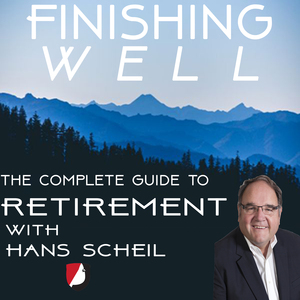
This is the Truth Network. Um Welcome to Finishing Well, brought to you by CardinalGuide.com with certified financial planner Hans Scheil, best-selling author and financial planner, helping families finish well for over 40 years. On Finishing Well, we'll examine both biblical and practical knowledge to assist families in finishing well, including discussions on managing Social Security, Medicare, IRAID, long-term care, life insurance, investments, and taxes.
Now, let's get started with Finishing Well. Welcome to Finishing Well with Certified Financial Planner Hans Scheil. In today's episode, we're continuing the financial plan series with episode five. of the eight and today's is on IR8 and 401ks. And so, you know, how all these things, when you s when you put them together, figure into this whole financial plan, you know, and when you think about it, wealth could be a whole lot more than just money.
And when you think about Moses, he knew, I mean, he was not going to go into the promised land.
So he spent actually his whole final season preparing in so many speeches and writings that you can see, especially in Numbers and Deuteronomy, how he planned on getting this wisdom. And not only to the next generation, but obviously we to this day continue to glean from his. planning.
So it's not what you accumulate, it's it's to some extent what you actually transfer on for the kingdom of God. And what a neat opportunity we have today with these precious assets in IRAs and 401ks, right, Hans? Right on. And today we're in the section of the seven worries. And let me just name them for a second.
And they're the seven boxes on the board. When we do our videos, Social Security, Medicare, long-term care. IRA 401K. retirement income, estate planning, in income taxes.
So those are the seven items, the seven worries, the seven subjects, that we address in a financial plan, retirement plan. For people, most of the time in their 60s, sometimes in their early 70s, sometimes. People are doing this in their fifties. For the most part, it's people in their sixties. that are getting ready to retire.
They're planning in advance. And so we do financial plans of which we charge $1,000. Yeah, and that's a one-time fee. Um once you go through this whole series and you listen to everything you get for that. Um It it it's quite a bit.
You know, when we have people that can't afford to pay. Or maybe they can afford to pay, but they don't have assets large enough that we feel good about charging them. You know, we do this kind of stuff pro bono.
So I don't want anybody to look at all these numbers. in any of the stuff. and say, oh, they only mess with people with a lot of money. You know, you got a problem, you got an interest, you need help with your money. Uh you you get in touch with us and but we're going to get you the help you need.
So this whole series. And there's eight different episodes, and we're zeroing in today on episode five. Which is Going over your IRA 401K and the decisions you need to make. And we're doing this for Uh one couple.
So through all eight episodes, We're looking at Tom and Susan. And Tom and Susan are 67, 68. turned sixty eight, she's sixty six, turning sixty seven. He's just retiring. And we're going through in this series and showing you the decisions that we help them make.
in all seven areas.
Okay.
So today we're talking about their IRA 401k decisions. Yeah, these are pretty much the same for everybody. Yes.
Somebody comes in, they hire us to do a plan. One of the first things we're going to want to know is how much. money do you have in your IRA or in your 401k. How much? accumulated savings that's in retirement savings And the key point is You haven't paid tax on this money yet.
So not all that money is yours.
So in Tom and Susan's case, they got a lot of money in an IRA. Um you know, almost 2 million bucks. Yeah. They're like a lot of people, that this money has grown substantially over the last 10 years. They didn't imagine that they would ever have that amount of money.
Yeah. where they can be led to believe, well, that's all ours. Boy, we got a lot of money to retire on.
Well then all of a sudden when you sit down at retirement, and you look through and you r remove his income. And you say, now we've got to start living off it. Uh there's a whole lot of considerations that come in. And so In this section and today, we're going to be dealing with How much is in their IRA? and that they haven't paid tax on.
And when are they going to pay the tax? And how much is that going to be? And what are the financial planning moves that we can make, what are the decisions that we can make? Two. minimize that.
And because you can't spend. money that you send to the government in taxes.
So I want to let you respond to that a little bit before I jump in, Robbie. No, I think it's absolutely beautiful because, again, anybody would look at a balance like that would naturally think, I'm set, man. I got $2 million. You know, wait a minute. You know, I paid 40% tax on that or something.
I don't know what the tax rates are. You do. But, you know, then all of a sudden, wait, wait, it's being shrunk. And what I love about the whole thing is there are so many beautiful strategies. To really make these numbers work for not just their own.
You know, pleasure in retirement, but actually to pass it on to the next generation, to charities, etc. It's just beautiful. All the things that I think you're going to go through. What, what you call the three main ingredients of this particular video. Yeah.
And those three main ingredients R. required minimum distributions, which these folks are five, six years. That's in front of them five or six years. In other words, he's 67. And when he's 73, RMDs are required minimum distributions, which the government's going to tell them you must take this amount.
this year. Um The second area is QCDs, and this is especially relevant to Christians who Um are going to be listening to the show here that that that that are gonna going to be giving part of their money every month and every week. to the church. And there's such a thing as a QCD or a qualified charitable distribution. where you can give money directly from your IRA.
to the church or any other charitable organization and avoid the taxes.
Now.
Well, I'm going to talk a little bit. You have to be a certain age to do this, and there's a bunch of rules, but we need to plan for those, and we need to ask people: are you interested in doing this? And you know, with most people that are coming in, yeah, and so we're going to plan for that. is to have some of this a large balance come out of there annually. and go straight to the church.
Um Third area is And probably the biggest area of interest with people is this whole idea of Roth conversion. We're going to finish the show talking about Roth conversion. We've talked about them before. We're going to keep talking about them. And it just, does this make sense?
Does it make sense for you? What a Roth conversion is, is paying tax on part of the money.
Now as opposed to waiting. And that that's a big hang-up for a lot of people. It uh If we pay the tax now, Then we convert it to a Roth, and now it's going to be tax-free. for the rest of your life and even on to your heirs. and it can grow tax-free.
So there's some advantages to doing that, and there's clearly some disadvantages.
So those are the three things. Ah. with just about everybody that comes through the door that has retirement money. We're going to look at RMDs. We're going to look at QCDs.
and we're going to look at Roth conversions. And then we're going to make recommendations Oh. what you ought to do in each area. within the financial plan.
Okay.
Beautiful. Absolutely.
So Tom is going to start his RMDs or required minimum distributions. in twenty thirty one.
So here we are in 2026. Yeah, it's five years away. And his first RMD isn't due until april first of twenty thirty two.
So You know, you say, Well, I thought you had to take it in 2031.
Well, actually, the first year. that you have an RMD. And we can help you calculate that. We're not going to get that deep into the video today of how you calculate it. But You're supposed to take your RMD in the year it's due.
But the first year, they give you three more months and the next year. to take and the problem with waiting until then is then if Tom waited until you know, say March of twenty thirty two he would have to take two during twenty thirty two, and so now it doubles up and raises his tax rate.
So some of these little intricacy things We don't really need to. dwell on a lot with a 65-year-old person. But we want you to we want to talk about them and we want to know that You know, if you're dealing with us, we're going to stop you from making these kind of mistakes because we're going to be right there with you, with the RMDs. Or we're going to write the plan in such a way. that your RMD is going to be taken care of automatically.
Um And so with RMDs, we're planning for them. And in their case, they're going to be drawing so much income out of their IRA every year starting now. Anyhow, That they're going to take care of their RMDs. just by virtue of the fact that they're pulling out money to live on. Yeah, they're like a lot of people.
Okay? Yeah, the You had made the point in the video, and I think it's very appropriate. Distributions, you know, we you know, we use that word, but that's like getting the money out. Like what were your plans? You know, in doing distributions, and a lot of what this video is explaining is there's lots of ways to go about that, right?
Well, there is. Yeah, just I like to take required minimum distribution, three words. and it has the acronym RMD, but I like to take them backwards.
So we'll start with the third word, which is distribution.
So this is you taking money out of your IRA. And then of course paying taxes on it, but after you pay the taxes, then you're left with whatever you're left with. Let's say 65% of it. And now that's your money. And so the distribution itself ought to be a good thing.
Is now your You're pulling money out and you get to keep some of it and use it as you wish.
So it's not necessarily that bad. And then you go backwards. And you go to the word minimum. which is the middle word So all the government is telling you is this is the minimum distribution, but you can take more. Oh, absolutely beautiful.
And it's actually a great place to point out that this show is brought to you by Cardinal Guide, CardinalGuide.com. And if you go to CardinalGuide.com, you're going to see these seven worries tabs that Hans talked about. And on this tab, which is the IRA 401k tab, you're going to see an amazing video with the show notes. Oh, so many details on what we're talking about today. It's all available there at CardinalGuide.com, along with Hans's book, The Complete Cardinal Guide to Planning for and Living in Retirement.
And there's a workbook that goes with that. And of course, the ever-present Contact Hans or Tom page. Easy way to get. Really, your customized plan. And so, we'll get right back in just a moment with a whole lot more on.
You know, episode five. Investment advisory services offered through Brookstrone Capital Management LLC, abbreviated BCM. a registered investment advisor. BCM and Cardinal Advisors are independent of each other. Insurance products and services are not offered through BCM, but are offered and sold through individually licensed and appointed agents.
Cardinal Advisors is not affiliated with or endorsed by the Social Security Administration or any other government agency.
Well, welcome back to Finishing Well as Certified Financial Planner Hans Schaal. Today's episode five of the eight of the financial plan series and we're talking about IRAs and 401ks and so we're talking about these required minimum distributions we just went through that whole understanding which to me is critical to the whole thing, like the the planning is the getting to the goods, right?
Well, it is. And so As far as RMDs go, we want to Just make sure you're compliant. And you know, it's five years away for them. But for some of you listening, It's like this year. Um, in our next year, some of you have been through it for several years and still don't understand it, so just understand.
That We're doing this for a financial plan in this series, but we have all kinds of people call us. where they have questions about this. They want to know, are they doing them properly? Uh and there's a whole lot of things so You know, give us a call. And then you can watch some of our other videos as well, where we really drill down.
and go over some of these strategies.
So next up is the QCD or the qualified charitable distribution. I'm just telling you the churches out there when you go in on a given Sunday, you got a lot of... Seniors Sitting in the church attending church. And my guess is: a lot of those seniors. have a lot of IRA money.
that they're not using much of. And they're even facing required minimum distributions and they're maybe grumbling about it because they got to finally pay tax on this money. And a Q C D Yes. You know, I've always thought that we could do some education in the churches. where I could come out and speak to people.
And just show them this thing there's You know, it's pretty simple. You have to be 70 and a half. her older.
Okay, for starters. And so Tom and Susan aren't there yet. But they're very interested in this and write in their plan we've put QCDs in there starting when Tom reaches 70 and a half. that year they're going to give $10,000 out of their IRA. to the church.
every year. Um Yeah, and I don't remember if we increased it or some years and Um But for the purposes of planning That that is the ultimate tax write-off because it it counts as an R and D.
So when you do a QCD properly, it counts as your required minimum distribution. You don't pay the taxes on it. And then the money goes directly to the church or the qualified charity. and they don't pay taxes. And so it's just kind of like a win-win for everybody.
Oh, absolutely beautiful. Just, you know, again, transferring it into the kingdom. And so we have other videos on that. And you want to do you can do Q C D's to multiple charities. But one word of caution that I'm going to give you is Don't try this at home on your own.
Don't try to do your own. you know, fix your own plumbing. or you're going to end up in a lake. um because there's just several steps that need to be done accurately So if you want to get started with QCDs, just give us a call. We'll help you out.
Okay.
Absolutely.
Now the next one is this topic of Roth conversion. This is one of the most popular topics. really of our whole YouTube series and people calling us in We all want to talk about Roth conversions, it just seems. Yeah. Because who's not going to be interested in tax-free money?
And once I point out everything you got to do, which is paying the taxes now.
Sometimes people cool off on this real fast.
So Um So we're going to talk a little bit about what that is.
So if we Like in Tom and Susan's case, they have almost $2 million.
So they're not going to convert all of it at once. But if they did They would probably pay $700,000 in taxes. Uh maybe a little more. in taxes, and then they'd be left with one point three million dollars And you say, well, that doesn't sound very good. Yeah, and it's really not if you did it in one big gigantic thing.
But that $1.3 million then is available to you tax-free. I mean, you can just pull it out at will, pay no taxes. And more importantly, you can leave it in there. And all that growth now is going to be tax free instead of tax deferred. and even pass it on to your heirs.
So I've just shown you the extreme example. And some folks that come into us want to know that. How about if I did it all in one shot? Yeah. That's a consideration, but what most people do.
Yes.
They do it little bits at a time. And so what we you know, what we came up with for Tom and Susan. Yes.
their choices of like kind of where they could convert.
So I'm going to give you an example of the choices that we did for them the top of the 24% federal income tax bracket is four hundred three thousand.
So you say, well, why are you giving me that number?
Well, It means on, you know, if you had an income of exactly four hundred thousand dollars as a married couple. your taxes on your last dollars would be federal taxes would be a twenty four percent tax break.
So As soon as you get a dollar above four hundred three thousand five hundred fifty one, the tax bracket goes to thirty two percent.
So a lot of people doing Roth conversions say I want to maximize, get maximum use of that 24% bracket.
So If you had a couple that otherwise had $100,000 a year income, that's what they live off of, and they pay taxes on. that would mean that we could do three hundred thousand dollars of Roth conversion in that given year. and they would pay at most 24%. Tax on the conversion. Am I making sense to you, Robbie?
Yeah. Of course I'm listened to it a lot of times, but it's It's a critical aspect of, you know, converting that over.
So the software that we use allows us to pick all these different points.
So what we showed Tom and Susan was Okay, so if we took And did three hundred thousand a year. I'm just guessing at these numbers. And we did that every year. for several years, there's going to reach a point where your whole IRA is going to be converted. And it's going to make the taxes less if you spread this out over.
five six seven eight nine year Now that's one strategy. Because then the next lower amount that the software will do is using two hundred eighteen thousand as the lid. And you say, well, why is that delayed?
Well, that's the beginning of Irma.
So You know, because we've got to think about that too for Tom and Susan, is that we start doing Roth conversions, we're going to jack their income way up. And then their income gets way up. And so now Now they're doing all this Roth conversion, but they're driving a bunch of Medicare tax.
Okay.
Yeah. So What we can do is we can show them Roth conversions where we stay just under that $218,000. And for them, That would be about 100,000, 110,000. of conversion every year. And that would take them probably 20 years.
to convert their whole but it would stop them from paying Irma.
Okay, and we can adjust these numbers for inflation, that kind of thing. But And there's several other breakpoints. And so they s Tom and Susan really settled on They don't want to pay Irma. And so they're going to do Roth conversions up to The Irma threshold.
Okay.
Command. Yeah, but so essentially Yeah. And I would kind of say the same thing, like w Since you know, 20 years from now, one way or the other. Uh if they're 65, they're both likely still going to be alive. then, you know, and it's all done, so the taxes are all been paid and away we go.
And I don't have to pay Irma if something happens in the meantime.
However, if somebody dies in the middle of that, does that mess up that strategy. For sure. I mean, there's a lot of things that could mess it up. And you're not signing up for that when we do the financial plan anyhow. You're signing up for doing it in 2026 and 2027.
and then we're going to meet with you regularly. We're going to refigure this number every year. on into the future. We're just trying to get from a planning, we're going to say here's the plan. This is how much we're going to do every year.
Yeah. with the goal being to get a pot of tax-free money. that we can access or we can just not have to take RMDs out of it. or we can just let it accumulate and then when we die, it goes to our kids. and our kids inherited tax-free.
so that they don't have high tax rates and it puts them even worse. when they get this inheritance. Um It's a good thing, it needs to be taken in measures, and then some people just flat reject it. They said we're not here to sell you Roth conversions. We're here to show you the advantages and disadvantages Pick the right amounts.
get a strategy and then it's up to you. We'll help you do it, but it's really up to you to make the decision. Um So what I want to do just in finishing here is I have a whole lot of things we've got to consider. Number one, the widow tax. And what that really means is like Tom and Susan, as long as both of them are still alive.
The top of the 24% bracket is $403,000.
So when they're filing a married, filing jointly tax return. They got a lot of room at low tax rates. to do these conversions. One of them dies.
Okay.
And now they're in the single taxpayer deal. And the top of the 24% bracket for a single is 200,000.
So you can see what we're talking about here. is people that have to Pull a lot of money out of a Roth IRA when they're, or excuse me, out of an IRA when they're single. and they're paying it single taxes. That's called the widow tax. much higher tax rates.
Okay.
There's a lot of folks that think that tax rates are going to be higher in the future. I mean, the tax rates are about as low. as they've ever been. And so that's just something to consider is if you pay the taxes now, get them out of the way, create a tax-free account. Perhaps you might be avoiding much higher rates in the future.
I'm just going to go through these quickly. Um Whose tax is the priority?
So then we want to know is it is it mom and dad's? Tax. Or is it the kids inheriting?
So if mom and dad are saying, I don't want to pay the tax, Well then don't do rough conversions and let your kids, you know, I've had a lot of people say, I'm not worried about my children's tax bill 20 years from now.
Okay.
Well then you probably Might want to think about not doing rough conversions.
Okay.
Um But then once I start showing them all that and then sometimes that the man talking and then the wife is, Whoa, wait a minute. You know, and then so then I got to get the couple on the same page. Um Because she may be more concerned about the kids paying taxes than he is.
Well, I'm afraid we're. Totally out of time. I hate that, but I gotta you know, a lot of times we run out of time before we run out of show.
So you can go to CardinalGuy.com and there watch the video on this. It's absolutely awesome. Under the Seven Worries tab, 41k and IRA. And of course, Hans's book, The Complete Cardinal Guide to Planning for Living in Retirement, and the Contact Hans page. It's all there at cardinalguide.com.
Great show, Hans. Thank you. You and God bless you. The opinions expressed by Hans Scheil and guests on this show are their own and do not reflect the opinions of this radio station. All statements and opinions expressed are based upon information considered reliable, although it should not be relied upon as such.
Any statements or opinions are subject to change without notice. Investments involve risk and, unless otherwise stated, are not guaranteed. Past performance cannot be used as an indicator to determine future results. Any strategies mentioned may not be suitable for everyone. Information expressed does not take into account your specific situation or objectives and is not intended as recommendations appropriate for you.
Before acting on any information mentioned, please consult with a qualified tax or investment advisor to determine if it's suitable for your specific situation. Finishing Well is designed to provide accurate and authoritative information with regard to the subject covered. Investment advisory services offered through Brookstone Capital Management LLC, abbreviated BCM, a registered investment advisor. BCM and Cardinal. Cardinal Advisors are independent of each other.
Insurance products and services are not offered through BCM, but are offered and sold through individually licensed and appointed agents. Cardinal Advisors is not affiliated with or endorsed by the Social Security Administration or any other government agency.
We hope you enjoyed Finishing Well, brought to you by CardinalGuide.com. Visit CardinalGuide.com for free downloads of this show or previous shows on topics such as Social Security, Medicare, IRAs, long-term care, life insurance, investments, and taxes, as well as Han's best-selling book, The Complete Cardinal Guide to Planning for and Living in Retirement and the Workbook. Once again, for dozens of free resources, past shows, or to get Han's book, go to CardinalGuide.com. If you have a question, comment, or suggestion for future shows, click on the Finishing Well radio show on the website and send us a word. Once again, that's CardinalGuide.com.
CardinalGuide.com.