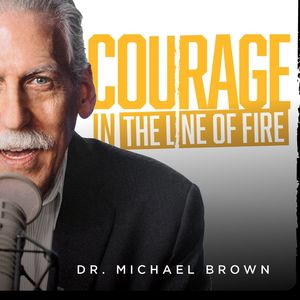
What did Jesus mean when he said He didn't come to abolish the law or the prophets. He came to fulfill. Does that mean that all followers of Jesus are obligated to observe every law of the Torah? Hey friends, welcome to the Line of Fire podcast.
So glad to be with you. This is Michael Brown. We continue to dig into the words of Jesus, asking God to speak to us, remembering. That he said in John 6, the words I speak to you, they are spirit. and their life.
He said in John 15, if you remain in me and my words remain in you, ask what you will and it will be done for you. And when Jesus was resisting the devil's temptations in the wilderness, he quoted from the book of Deuteronomy. When the devil said, turn these stones into bread if you're really the son of God, because you're hungry after 40 days. Jesus replied from Deuteronomy 8: Man does not live by bread alone, but by every word that proceeds from the mouth of God does man live.
So we live. By these very words of God, they are life to us. What did Jesus mean? in the Sermon on the Mount. When he said Do not think I've come to abolish the law of the prophets.
I've not come to abolish, but to fulfill.
Well, he goes on and continues to speak about it, but I want to step back. And look at the bigger structure here for a moment. The Sermon on the Mount begins in an introductory way with the Beatitudes. Blessed are the poor in spirit. Truly, happy are the poor in spirit down through.
Blessed are those who are persecuted for righteousness. Then, After that, still part of the introduction to his disciples, you are the salt of the earth, you are the light of the world.
Now it seems the main body of the Sermon on the Mount, this is really important, is from 517 to 712. 5.17 mentions the law or the prophets, which is shorthand for saying the entire Old Testament. The entire Tanakh, Hebrew Bible, okay? Obviously, it wasn't called the Old Testament then, but that's how Christians later described it. It starts with 517, mentions Torah prophets, and then 712.
Telling us that doing to others what you would have them do to you, that sums up. the law and the prophets. If you go through the rest of Matthew, you'll find maybe one more time when he mentions the law and the prophets. It's not a common term, but here he speaks of law or the prophets, law and the prophets, 5, 17, 7, 12. Think of those as like bookends.
the beginning and the end of the main heart content of the Sermon on the Mount, and then beginning in 7.13 and on, the final exhortations, enter the straight gate, beware of false prophets, build on the rock, etc.
So We want to find out why this is so significant because Yeshua did not simply say. Don't think I came to abolish the Torah, to abolish the law. I didn't. I came to fulfill it. He said the law or the prophets, meaning he didn't come to abolish.
the Bible coming before him. but he came to bring it to fulfillment. How does he do that? And then he focuses in on the Torah.
So how does he fulfill the law and the prophets, how does he fulfill the Old Testament?
Well, when it comes to everything having to do with approach to God. sacrifices, offerings, earthly temple. priestly ministry, he brings those to their fullness. He is the once and for all sacrifice, dying on the cross for the sins of the entire human race. He functions as the great high priest, making intercession for the transgressors and bearing their sins and iniquities on his very shoulders.
And He also creates thou a spiritual temple of believers in which we together form a temple by the Spirit.
So he brings these things to their Fullest meaning. When it comes to the moral commandments of the Torah, which we'll see in a moment, He takes them to their highest meaning. You've heard, don't murder. I'm telling you, don't murder in your heart, don't hate. He brings them to their highest and fullest meaning.
When it comes to Israel's calendar, He's the one who brings that to its fullness. He dies in conjunction with Passover. He rises in conjunction with firstfruits. He sends the Spirit in conjunction with Pentecost weeks. He and then his return.
is in spiritual conjunction with trumpets, and it goes on from there.
So even the calendar he brings to its fullest meaning, and then everything else he puts in its proper context. There are some who argue that abolished fulfill are Jewish legal terms and having to do with upholding certain Torah laws, etc. But because Matthew uses fulfill throughout his gospel, this happened to fulfill what was written. This happened to fulfill what was written. This happened to fulfill what the prophets said.
It's really best to understand this: bring it to its fullest and highest meaning. Take Psalm 22. The Psalm of the Righteous Sufferer, a Psalm of David and his suffering and pain, David never suffered everything that's described in Psalm 22. And David did not experience a deliverance the likes of which Jesus did by rising from the dead, a deliverance that reverberates to the ends of the earth, which is what Psalm 22 says.
So Jesus brings it to its fullest meaning.
So he's now going to show us. He didn't come to abolish. What, not just the law, but the law of the prophets. You can come to a balls for it to fulfill.
Well, what does it even need to say it? Probably because What he's about to say is going to rock some boats. What he's about to say is going to go against some of the traditions of his day. And based on that, people think, well, you're just abolishing it? No.
He's not, he's fulfilling it.
Now here's the deal. If the the way certain Christians understand this. to abolish equals fulfill. then his words are meaningless. In other words, If I say I'm not abolishing the speed limit of sixty miles an hour.
I'm not abolishing it, I'm fulfilling it. There is no more speed limit.
Well, I Just abolished it, didn't it? I might say I'm fulfilling it. You drive whatever's in your heart. That's how you drive.
Well, now there's no more speed limit.
So, if in the end, when you say he fulfilled the law, in effect he abolished it, that doesn't work. That doesn't work.
So what was he actually saying? Let's do our best to understand this. For truly I tell you, until heaven and earth disappeared as our first until. Not the smallest letter? Not the least stroke of a pen.
Will by any means disappear from the law until everything is accomplished.
So there are two untils. As long as this earth stands... As long as we're here in this world. and until everything is accomplished. To me, That's telling me that there is an ongoing fulfilling.
In other words, his death on the cross accomplishes certain things. His giving a Sabbath rest accomplishes certain things. Other aspects of the law find their fulfillment in him. But until it all comes to pass, for example, the rest of Israel's calendar will not be fulfilled until his return. The final meaning of trumpets, the final meaning and the fullest meaning of Day of Atonement, the final and full meaning of tabernacles.
So there is the ongoing fulfilling, and that will continue until. Heaven and earth no longer exist. In other words, this will continue until it reaches its full measure as long as the earth Stands. Therefore Anyone who sets aside one of the least of these commands and teaches others accordingly will be called least in the kingdom of heaven. But whoever practices in teaches these commands will be called great in the kingdom of heaven.
Now The way the way some understand this is Jesus was saying whatever is written in the Torah whatever law is in the Torah. Whatever purity law is in the Torah, whatever laws of marriage are in the Torah. Whatever laws are there, if you have a disobedient and rebellious son that refuses to repent, you stone him to death. If you curse your father and mother, that person's put to death. If you break the Sabbath, you're put to death.
That these are actually commands that continue until today, except we don't have the ability to carry out the death penalty, so we just live by the rule without the penalty. Is that what Yoshi was saying? Absolutely not. Absolutely not. God gave us a new and better covenant, putting Torah within our hearts, Jeremiah 31, quoted in Hebrews 8 and Hebrews 10.
It gave us a new and better covenant because of Israel's failure to keep the Sinai covenant.
So he takes his truth, his word, he puts it in our hearts. There are changes. Hebrews 7 says, because priesthood now comes through Judah through the Messiah, there must be a change in the law. There are certainly changes. For example, we do not need Yom Kippur, the Day of Atonement, every year to receive forgiveness of sins.
Because we have received once and for all atonement. Yes, in this world we receive daily cleansing and washing as we walk with the Lord and fall short. But in terms of righteous standing with God, that's been done by the cross. We don't need the day of atonement.
So obviously, changes have come with the new and better covenant and. Not only so, When we read through the rest of the New Testament, we see quite plainly that God did not call Gentile believers to observe all the laws of the Torah or mandate dietary laws and things like that.
So that's not what he's saying.
Well, some say, no, no, no, it's not a matter of salvation. In other words, it's not a matter of salvation. But if you teach people That they don't have to, that Gentile Christians don't have to celebrate the feasts. We'll just focus on Gentile believers for it. We'll even talk about Jewish believers.
If you say, Well, no, Gentile believers don't have to keep the dietary laws of the priest. You're still saved. You're the least in the kingdom of heaven. But if you teach they're obligated to do all these things, you're greatest in the kingdom of heaven. Again, I see the rest of the New Testament speaking contrary to that.
And I see Acts fifteen. Which seven, eight years later, by Acts 21, whatever the exact time frame is, is still being spoken about, that the Gentiles are not required to observe everything that's in the Torah. And then, with the destruction of the Temple and no functioning priesthood, 75% of the forever commands in the Torah we can't keep now.
So either God provided a better way Or we can't observe 75% of the forever, for all generations commandments in the Torah.
So w what's he actually saying here? And the next verse says, For I tell you, unless your righteousness surpasses that of the Pharisees and the teachers of the law, you will certainly not enter the kingdom of heaven. You won't enter. He's dealing with a couple of things. He's saying that mere outward observance, enough is not enough.
Alone, mere outward observance alone is done enough. And the Pharisees, who were considered To to be the most devout. by many of the people. They were highly regarded by many of the people according to some ancient contemporary accounts He's saying you got to do better. You've got to do better.
It has to go beyond outward observance, and it has to even be a matter of the heart. And you have rabbinic teaching that reinforces that notion later as well. That it's not just the outward observance, it's the matter of the heart. That's what the prophet said.
So on the one hand saying you're gonna have to do better. You're gonna have to do better. than they've done. I'm I'm I'm upping the ante. And also, because He perfectly fulfills the law with His own righteousness, He can die for our sins.
And we now enter in by His righteousness. We don't enter in by our righteousness. We become righteous by what He did and by putting our trust in Him. And He grants us repentance in a new life. But on our best day, we still fall short of God's perfection, of loving Him with all of our heart, soul, mind, and strength perfectly.
And our neighbor is ourself perfectly. Every moment of every day, we still fall short.
So we stand in His righteousness because He fulfilled it. He did it perfectly.
Now we enter in through His righteousness. But I believe he's giving us the key. When he says whoever teaches and practices the the least of these commands is is is is greatest. Whoever practiced them, excuse me, is is greatest. I believe by these commands he's talking about what he's now going to show us.
how he fulfills to, or how he brings it to its highest level. And that's what we find now for Matthew 5, 18. to excuse me Matthew 5 21 To Matthew 7:11, Matthew 5:21 to Matthew 7:11, which is the heart of his teaching. He's now going to show us how to live it out. That's what he means by these commandments.
So, as we dig in, this is for us, this is for today. This is a calling. In ourselves, we fall short. We enter by faith through His righteousness, but now, empowered by His Spirit, We live A new All right, a quick word from our co-sponsor, Trivita. Give it a good listen.
It's a great way where you can. Get some healthy supplements for yourself, as well as support the courage. in the line of fire broadcast. I'll be back with some closing words. I'm Paul Burnett, a board certified doctor of holistic health, and I want to take this opportunity to talk to you about the importance of healthy blood flow.
And at Trivita, we take blood flow seriously for our members, and we've developed a nitric oxide plus supplement that has been formulated with natural ingredients designed to maximize nitric oxide production in our blood vessels, which increases blood flow. One study that I came across revealed that by the age of 40, we only produce about 50% of the nitric oxide production as compared to our 20s. By the age of 70, the study showed that we're only producing about 15 to 25%. Bottom line, with more nitric oxide, we stimulate more blood flow to our vital organs and we experience more energy while supporting healthy blood pressure. Trivitas nitric oxide plus has been formulated to increase nitric oxide production and blood flow at every age.
For better blood flow and more energy, try Nitric Oxide Plus for yourself. Order today and use promo code BROWN twenty five to receive twenty five percent off your order. As a new customer, one hundred percent of the proceeds from your first order will go to support the Line of Fire radio broadcast.
So call now one eight hundred seven seven one five five eight four. one eight hundred seven seven one fifty five eighty four. or online at TRI VITA TRIVEDA. com. Thanks, friends, for joining us.
I want to remind you. to put your faith in the finished work of the cross. I want to remind you. while you strive to please the Lord and honor him. where you're quick to repent where you fall short, where you have a sensitive conscience because you want to please the Lord and honor him and do what's right.
Amen to all of that. Remember. Your boast is in the righteousness of the Lord. Your boast is in the blood of Jesus. Your boast is in the one who perfectly fulfilled every requirement of the law, the only human being who ever lived who did that.
And he did it. on our behalf as the mediator between God and man, that through him we can enter into God's perfect Rest and peace and joy. Knowing that Jesus Yeah. all and now by his power and grace we lead new lives. One more reminder.
If you're not getting our frontline newsletter, you'll love it. Inspiring article to lead it every month. Hebrew word study to give you some enjoyment digging into the original text. A free excerpt from one of my books, some great quotes, some testimonies. all to pour into you so that together we can make a difference.
If you're not getting the frontline newsletter, go to thelineoffire.org. Thelineoffire.org and click subscribe.