This past week, Dr. Shaw was able to attend both ETS and SBL in Boston, Massachusetts. Two major conferences where scripture, scholarship, and real-world biblical ministry come together. We're going to tell you more about it coming up right now. Hopefully, read tonight.
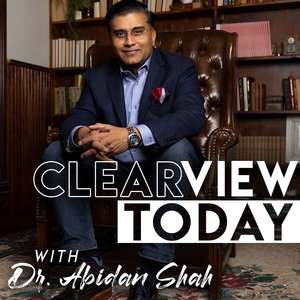
You're listening to Clearview Today with Dr. Abadan Shah, the daily show that engages mind and heart for the gospel of Jesus Christ. I'm Ryan Hill. I'm John Galantis. Welcome to the Clearview Today Show for another great week.
Thanksgiving is behind us. We are moving on towards Christmas. We got lots and lots and lots of great discussions planned for you this week. But before we get into any of that, I want to welcome our host, Dr. Abadan Shah, who's a PhD in New Testament textual criticism, professor at Carolina University, author, full-time pastor, and the host of today's show.
Dr. Shah, those titles are going to come in handy today because we are talking about some deep scholarly things, but also some things in ministry with ETS, SBL. But you know what? Let me not get ahead of myself. Welcome back.
It's good to see you. It's good to be home. I enjoyed my time in Boston. I was gone for almost nine days from like Monday to the following Tuesday. Not the next day, but following Tuesday.
So I would say, what, eight, eight? Eight days, yeah.
Well, it almost became nine because I came Wednesday morning.
So nine days of going away. And I like it. I enjoy the trip in the sense of being. Able to go there and learn and come back, but I'm always glad when I see the sign that says Henderson. Yeah.
Yes. Ready to get home. You see that? Do you see that? Did you come to the church or did you go straight home?
I went straight home. It was 4:35 in the morning. Yeah. It's good when we take trips because I always love to see our steeple that's lit up at night. Like I can see it over the trees before we get there.
I'm like, we're home. And my professor, under whom I did my PhD work, Maurice Robinson, he was there with me. We were rooming together.
So we were able to spend some time with them and went out to eat. You know, when the conference would end each day, we would sort of go out, spend some time with them. And uh, except for one night because uh we had a banquet there for ETS. And then he left that Friday morning. In fact, Abigail took him to the airport, Dr.
Robinson, and she was just like, Hey, look, let me come and take take you to the airport. He's like, Well, I don't want to get you out of the way, and it'll be too much trouble. She's like, No, I Trust me, I can get you to the airport and it'll be much simpler and easier for you. That's very sweet. And he's like, sure, if you don't mind.
So she did. And then. Nicole, uh About uh, let's say 10:30, 11 o'clock, I believe it was, that she left. Um, Raleigh, and she came to Boston.
So she flew in. She flew in. Gotcha. Dr. Robinson left, and Nicole came back.
So I was never without a roommate. There you go. That's not good. Which one would you prefer as a roommate? Dr.
Robinson or Nicole? That's a tough question. Tough question.
Now, I would say definitely Nicole. I mean, she's my wife. I would definitely prefer her. But I do enjoy my time with Dr. Robinson.
Of course, we're not in the same bed. Right. This is different. He doesn't snore, does he? Oh, gosh.
I wish you'd ask me. We can't divulge that information. No, well, he will laugh. If he was watching this show or listening, he would laugh. Yes, he does.
He doesn't? Yes, he does snore. But I cannot say anything because more than likely I snore too. At least Nicole doesn't snore. See, I say that.
So, what's the next question? I saw the picture of you guys doing the Abbey Road, like the Abbey Road, like Beatles walk across the walkway. That was kind of cute. It was Dr. Robinson, Abigail, and Jared.
And Jared. That's right. That was kind of cute. We had a good time. And maybe we can talk a little bit more about not only the conference, but the time we spent with them, touring Boston.
You know, first half was with Dr. Robinson, second half was with Nicole. Absolutely. You know, Abby's mom. And Jared's mother-in-law.
Yeah, let's do it. Yeah. So, so good to hear about those adventures. But, you know, here on the Clearview Today show, we know that sharing God's word, we know that it impacts you. We know that it impacts your life.
And none of that would be possible without our incredible sponsors. And that's why we want to let you know that today's episode of Clearview Today is brought to you by LeBlue Ultra Pure Water. You know, when you drink LeBlue water, I love this tagline. You're getting two ingredients, right? You're getting hydrogen and oxygen.
I don't want to mess it up. You know, they have a patented process. It removes every impurity. It gives you clean, crisp hydration. It gives you water that you can trust.
And I know that's what we're all looking for, especially in this day and age.
So if you're looking for the purest, healthiest water for you and your family or your office, you know, they deliver right to your office every single time that we go to the water cooler. It's a LeBlue water. They deliver it on time. It's reliable. It is the preferred water of the Clearview Today show.
And when you trust companies like them, you are really helping us share the hope and the word of Jesus Christ.
So head on over to LeBlue.com and any purchase that you make with the promo code today, T-O-D-A-Y. That's going to give you 10% off our order, and that money helps to us to continue to make this show possible for you. That's right. We're going to jump back into the show here in just a second. But before we do that, we want to remind you that you can always reach us here at the Clearview Today Show at 252-582-5028.
We love you as our listeners, as our viewers, and we want you to know that we are praying for you and we would love to pray alongside you.
So, if there's something that's weighing heavy on your heart, or if you're reacting to something that we talk about on the episode, you want more information about a particular topic, always write in and let us know. You can call that number as well. It's always active: 24/7-252-582-5028. Or you can email us at contact at clearviewtodayshow.com. Maybe you've got some wacky shenanigan stories from your time at ETS or your time at SBL.
We know that a lot of pastors go to these conferences. It's not just all work, right? There's got to be some play. And I know a lot of you guys get up to some shenanigans, some hijinks. I know Dr.
Robinson is known for that.
So, we're going to talk about that here in just a second. But, Dr. Shah, just first and foremost, how was it? How was everything? How were the conferences?
It was great.
So, this was my first time going to SBL. Never been. Never been to SBL. And it was only because it usually begins on that Saturday.
Okay.
So ETS. And SBL are back to back. In fact, is he really SBL that um decides where they're going to meet. Really? Are they the same thing functionally or are they different conferences?
Uh they may have the same procedures as in how they operate, but it is different.
So SBL was founded back in I want to say around 1880 by a group of scholars, people who came together and they felt like they needed a place where they can discuss the critical issues regarding the Bible. And some of the early names are like Philip Schaff, if you heard the history of the Christian church, names like that, powerful, powerful. Theologians, biblical scholars, historians, and um. You know, they wanted a place where scholars could come together to discuss issues related to the Bible. This is 1880.
So that's when SBL began. ETS is different. ETS began, I want to say, somewhere about 1940. I think somebody can check for us if they want to. I think it was somewhere about 1940.
1949. 1949. There you go. So if you do the math, that's about what, 69 years after. Just about 69 years?
Yeah, about that.
So it makes sense then that SBL will be the one that sets the location. Yeah, and it's not because they came first. It's because SPL is far Larger. As a body than ATS. And even still to this day?
Oh yeah.
So SBL is the bigger conference. Oh, much, much, much bigger.
So so have you just preferred ETS all these years? Or like do you have to be invited to SBL or can you attend at all? Or is it'cause it was on a Saturday? No, I preferred ETS because, for one, how do I say this? Over the years, This is after 1880 because of the of the Yeah.
I don't want to say influx because it was not just influx, it was more than that. It was, it was this, this, um, Invasion of German critical, historical critical studies that came into. Um The study of the Bible that denied the miraculous, that denied the resurrection. that denied the uniqueness of the Bible as the inerrant word of God, denied the the the uniqueness of Christ being the only way, truth and life. I mean, because of that, ETS was started in 1949.
You know, ETS is basically built on two premises or two principles. One is the Trinity. And the second is the inerrancy of Scripture.
Now, unfortunately, they are taking down the second one, as I, you know, they may not admit to that, but it seems like more and more scholars, even in ETS, are beginning to question that, albeit they do it kind of roundabout way. But it's like, you know, what is inerrancy? I mean, I call it this, or I'm a British evangelical. That doesn't make sense to me. You know, it's different ways they're trying to chipping away.
Chipping away, dismantling.
So when that happens, I mean, maybe we may need another society. I don't know. But. Sb L was founded first. Yeah.
ETS came in nineteen forty-nine as a reaction to the Liberalism that has come in in the study of the Bible.
Okay.
When it comes to setting dates and venues, it's usually i it is SBL that makes the call. They decide it's going to be Boston. They decide if it's going to be Denver. They decide San Diego.
Okay.
Atlanta, Washington, D.C. ETS was formed as a response to things they didn't like about SBL, but they still work together to make the to have these conferences concurrent. I'm not going to say they work together like out front, but I'm sure they have to work together behind the scenes. Because they are together. The conferences are together.
They're not like connected to each other. Uh Legally, they are connected to each other more in the sense of congeniality. Because ETIA scholars usually go to SBL. I would say SBL scholars don't go to ETS. That was going to be my question.
Like, do people from ETS attend SBL? If if that's the larger one, do people from ETS often attend SBL? Right. Or is it sort of a never the two shall mix?
Well, because to be a member of the ETS, you have to subscribe to its doctrinal statement. Which is Trinity and inerrancy. SPL does not have a doctrinal statement. ATS is more exclusive. ETS definitely is more exclusive in the sense of Convictions.
Okay.
Not exclusive in the sense of like we are better scholars than you. Right. Or we have better PhDs than you. In fact, some of the SBLs are far more Oxford and Harvard and Princeton and Yale and Stanford and Berkeley and Emory and Mercer. I mean Wake Forest, you name it.
Their PhDs are coming from some high level institutions. Gotcha. Does not mean that ETS scholars don't have Oxford and Harvard and Cambridge PhDs. They do too. But.
as an aggregate SPL definitely is more Um You know. heavy on the other institutions.
So you have presented at ETS before? Many times. My first presentation, okay, so there is a national ETS and then they have regional ETSs. My first paper was at a regional ETS. In nineteen ninety-nine.
That's young. Wow. How old are you? Let's see. I was 1999.
I mean, do the math. I was born in 73, so 83, 93, 26. 26 years old. Wow. Where I first read the paper at ETS, which was held at Southeastern Seminary in Wake Forest, North Carolina.
And my paper was Inerrancy in Textual Criticism.
So it was playing right into their theme. Yeah. To their doctrine.
Somebody else had written papers on that before. A couple of papers had been written, but I took it in a different angle and talked about. why inerrancy is why textual criticism matters. And why holding on to an AR and C is critical. And that was in 1999.
How did you get to present that paper? Did somebody ask you to present it, or is that something you applied for? I applied for it.
Okay.
Yeah. So I was in doctor Robinson's Greek class and I had by this time, 1999, I was already prepping for the PhD exam, which was going to come up that fall and all of that.
So I was already headed in that direction. And so when this Opportunity came up that ETS was going to be held, the regional ETS. I think it's Southeastern Regional, I believe, or Southern Regional. I don't know. Anyways, so it was going to be held on the, I think Southeast Regional, was going to be held on the campus of Southeastern Baptist Theological Seminary.
I was like, oh.
So I asked Dr. Robinson, I said, What do you think? Should I present this paper? He said, Yeah, I think you should. I think Some work has been done on it before, but I think if you Do a good job.
can get published. Do you still have that paper? Oh, yeah. Do you th would you publish it today, or is it like, ah, I wrote that when I was 26 years old. I've I've grown a lot.
I've changed my mind on a lot. I think my premises are still solid. In fact, many of them made it into my dissertation. Um My examples were okay. because I was uh looking at both the Old and the New Testament.
So, if I were to go back and redo that paper, I would probably dig deeper. And find some more complicated examples. Of how inerrancy was still solid in spite of where the text critical issues were. Happening. In your opinion, do you think it's a bigger achievement to be able to present at SBL than ETS?
Ha ha ha ha. I don't mean that as a loaded question. I just To be approved to read at SBL is tough. Yeah. Especially if you're coming from a Conservative background.
Really? They will.
So they're still pretty liberal in their. Yeah, I'm not saying every scholar who presents there or every scholar who's there is a liberal because a lot of them are ETS people who go on and stick around and go to the SBO. And some of the papers I attended were done by scholars who are conservative.
So no, I haven't I I won't say that every every person who is walking around is a flaming liberal. That's not true at all. But sometimes the gatekeepers are such that if they sense that your paper is coming from a conservative Backed. Agenda or strong on an uranium they will give you trouble.
So, when you say give you trouble, is that give you trouble in the sense that they'll just make it difficult for you to apply, creating barriers for you, or just outright like that doesn't align with our beliefs? You're not presenting that here. I don't think they're going to say as much align with our beliefs as they will find some technical reason to say, hey, this does not align with our.
Well, I thought you meant like they would heckle you after you give the not heckle you, but like they'll they'll start asking you questions and trying to stump you in front of you. They will do that too. They'll do that. They will do that too. Now, sometimes that can also happen at ETS.
Mm-hmm. But they'll be a little kinder. But at SBL, if you Is that considered rude or is that just part of scholarship? Like, do people, like, would other scholars be like, hey, man, don't, why are you heckling this guy? He's presenting a paper.
Or is it like, hey, man, you're a scholar. You better expect that. If you're giving wrong information. Yeah. So, so let me let's just talk about it.
I was at ETS, I want to say maybe, gosh. Eight. Nine years ago. All right, this is going back to like Oh, 2016, maybe.
Somebody was reading a paper up front. And this other friend of mine who was who I just saw at ETS, and he's, he's a, He's a great guy. Uh so he passes This Image of of an article from a dictionary to me. And I look at it. and I'm listening to what this guy is saying.
He pretty much like Plagiarized? Not I wouldn't say plagiarized because it's not word for word. But yes, gotcha. Wow. Talk, thought, thought for thought.
Wow. But he'd it before Chat GPT. Yeah, this is like 2016, 2017. Yeah. And then he passes somebody else.
And I was like, oh man. This is terrible. Because when I was listening to the guy, I was like, oh, that's pretty good stuff. But it seems like I've read it somewhere. It was on the papyri.
In papyrus, I can say, and it was an article in, I want to say, the dictionary of papyrology and And w the way he was telling all this, I was like That that's common knowledge.
Okay.
And then when he passed me that, I was like, oh, that's it.
So like, if you're going if you're gonna do that, at least do it from some like book no one's ever read before. Like, don't do it from the actual dictionary that everybody's read, right? Yeah. Did anybody call him out on it? At the pa paper I don't remember anybody asking any question.
They just kind of smiled.
So everybody was kind of like, okay, we don't even need to. And he was a PhD student.
So I'm hoping that His own professor, I don't think I saw him there because I know who his professor was too. I don't think he was there at the paper. I hope his own professor maybe had a conversation with him later and said, Hey, When you present papers like that, make sure. It's Original knowledge, or if it's not original knowledge, you give credit for it and then give your take on it or something. You cannot just almost photocopy it and rearrange the words.
And then, like, present it as though these are your findings. Did he present it as like, was it supposed to be here's a summary, and let me tell me what I think on it? Or is it like, hey, here's what this says? This is how the papyri is investigated, or something like that. He was discussing it.
That's like in dictionary. That's rough. Not good. Not good. Not good.
Any mishaps this year, or is everything pretty smooth this year? Uh this year At ETS, I did not see any mishaps. There were some papers that were weak, some were good, some were so focused that One or two people knew what they were talking about, which is not a good thing either, because you can be so focused on your subject. That, unless you give the people some handouts. To me, that's a big no-no.
Especially regarding textual criticism, where you have manuscript numbers and You know, you gotta let people see it because I cannot remember all the numbers you're reading off. Yeah. I can't remember that unless I'm writing everything down. Right. in like stenographer's hand.
I I don't I've So, you're supposed to give handouts to people so they can follow what you're saying? For text-critical stuff, I believe you should out of. Etiquette. At least do that because then we can keep up with where you are. Because if you've got manuscript names and designations and stuff like that, it's difficult to keep all that straight.
I can't do that. Or variant readings. You know, if you you know, in my field, it's variant reading.
So, okay, the the Greek here in let's just say uh uh olif. Reads like this, and in Codex Vaticanus, it reads like this, and Uh thirty three it reads like, Well, okay. But By the time you even finish reading, unless I have my own Greek New Testament, I can pull it out and look at the variants 'cause I have it on my phone. Yeah. So many times in Textual criticism seminars.
Be pick up the big principles. But the The examples, unless the listener is very aware of that example. We're lost. What is the ratio of people who come who are scholars trying to get their work out there in front of people versus pastors who are just trying to learn more about the Bible?
So, to be a member of, I think, both ETS and SBO, a full member. A full member, you have to have a PhD.
Okay.
Or a THD.
Okay.
I have a PhD, so I can be a full member. Full member is also a voting member.
So you can vote on matters of yeah, I don't go to any of their meetings. Sleep in, go get breakfast. Go to the book sales. I don't like they don't need my vote. Does Dr.
Robinson go or is he sleeping and get breakfast? Oh, no, he doesn't go to those meetings.
Now, I think when I went, when there were some issues going on regarding In Aaron C, there was an issue that came up. I want to say. Oh my goodness. ten, fifteen years ago. It was regarding inerrancy.
And it was uh especially with Old Testament scholar Peter Enz was there, Norman Geisler. I mean, this was uh for those of you who know, you know exactly what I'm talking about. It was a big, big Brouhaha, and I was there for the voting. Did it get heated? By the way, I could not vote at the time because I was a student.
Right. Mm.
So I was ten, but you weren't you weren't allowed to vote? I wasn't allowed to vote because my my badge did not have an F on it. It was just an um I think it was student or as a What's a Bruha look like at ETS?
Okay, so it it hasn't happened in ten, twelve, fifteen years now, but when it was happening, it was about Why is a certain scholar allowed to be a member of ETS when he desi he denies inerrancy? And this was a particular named person? Oh, yes. They had a whole panel of why is he allowed in? Yes.
Was he at the ETS? That particular scale was there, yeah. Oh my goodness. Wow. So let's say, let's say.
And then prior to that, I mean, the controversy goes back way earlier than that. There was a scholar by the name of Robert Gundry.
Okay.
Okay.
Robert Gundry interpreted the book of Matthew and some important portions as a midrash. It's not like a rational. Right, right. It's not like a rationale. It's known as a Jewish interpretive.
Technique means there are certain passages are to be interpreted more as an allegory rather than as. actual literal happenings. And so Robert Gundry, I think he's still living if I'm not wrong. Or maybe he's not. Uh he He decided to publish his commentary on the book of Matthew, and definitely he was unashamedly telling us, telling the world that, yes, it's Midrash.
Those things did not happen. He's alive, yeah, 93 years ago. 93.
Okay, there you go. Is he the one that they were trying to kick out of each? They did. They did. But it was him that it was revolved around?
No, this was not regarding him.
Okay.
So this was. this was this happened Then there was down the years another scholar by the name of Clark Pinnock. He was into open theism. Open theism is the view that God doesn't know the future. Yeah, that's problematic.
That's pretty bad. Yeah. But when you have scholars who may hold to inerrancy, but they also believe that. God doesn't know the future. they are partial to people who are like Clark Pinnock.
And so they were like arguing over should we let him in, should we keep him in, or should we kick him out, and all that stuff. And I think if I'm not wrong, I think Clark Pinner quit. But then I think They let him stay, but he quit anyway. Oh, no, no, wait. They let him stay.
They let him stay. They let him stay, And um When that happened, there were other scholars, and I hope I'm not confusing the stories who. Who decided to walk out? What do you think that would feel like to you? It was Norman Geisler, I think, who walked out.
You're a full member of ETS.
Now I am. I've been for since 2019. What do you think that would feel like if you went 2027 and they had an entire panel devoted to voting on whether or not you should be allowed in? And you're there sitting. You think he's sitting there in the panel, like listening to this happen?
Like, what in the world is that like? I don't know if Clark Pinnock was up on the panel or not, but there were other people who were discussing him. Then a few years later, Peter Enz, who's an Old Testament scholar, who was also, I believe, and again, maybe I'm confusing the details, so maybe the listeners of years can correct me if you need to. Please write to us. But I think Peter Enz, who's an Old Testament scholar, was somehow talking about Genesis being allegory or something like that.
So that's again, I mean. Took the old Jordan-Peterson method, huh? Yeah. I mean, this is. Compromising inerrancy, I would say.
I would say serious thing. Yeah. Serious thing. That has wide-reaching ramifications when you, I mean, as we've said on the show before, once you start poking at doctrine, it spider webs into other areas that you didn't even really intend.
So, do you feel like it's David just sent this to us? The creation story as a collection of ancient myths and allegories rather than. anything else.
Nowadays, ETS is pretty good at cracking down on that. That saying, no, scripture is in error and we're going to continue to fight for it. I don't think they're very good at cracking down. Really? I don't think.
I think. Because a lot of scholars Have connections with connections with connections with scholars who don't agree on that. On the Bible being the inerrant, infallible, inspired word of God.
So sometimes they are silent.
Sometimes they. Just are nowhere to be found when those issues are being discussed. I want to keep discussing this because I'm actually getting into this conversation. I think we need to, I think I want to explore on the next episode too, you know, what is the benefit to ETS and by extension, SBL for both a scholar and for a pastor. Right.
What does that give you? What do you gain from attending those things? I think that's an important discussion. Yeah, and maybe you can talk about that tomorrow, Dr. Sha.
Like, what is your goal? Is your goal to go learn what you can and then build our church? Or is your goal to get in and say, hey, listen, ETS is starting to chip away at what made it ETS. We need to make this right. And maybe we can kind of make this our mission for other pastors who are saying, you know, I want to start getting involved in the conversation.
Yeah. Yeah. Yeah. Guys, make sure you join us next time. Same time, same place.
We're going to be diving into this conversation further here on the Queer View Today show. Thanks again to our sponsors for making today's episode possible. And if today was your first time listening to us, we want to tell you we love you. We're glad that you joined the conversation. Make sure you write in and let us know what you're taking away from these episodes and how you're connecting with the content.
252-582-5028. That's right. Quiet reminders. Three quick reminders I want to leave you guys with. Number one, Clearview Today Show is coming to TBN Plus very soon, probably at the very beginning of the year.
Number two, NRB is happening in Nashville 2026. Clearview Today Show is going to be there. Dr. Abadan Shah is going to be there also as part of Pray.com. Make sure you come and see us, say hello.
Maybe you can do an episode with us. We can shout out your ministry and your show. And then, of course, the Apologetics Conference is happening here at Clearview Church, March 28th. Tickets are on sale now. Link is going to be in the description.
If you like apologetics or if your pastor or your ministry is really into apologetics, make sure that you are here at Clearview Church for your Apologetics Conference, March 28th. That's right. We love you guys. We'll see you tomorrow on Clearview Today.