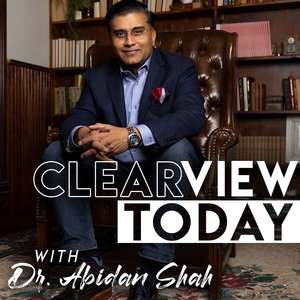
You're listening to Clearview Today with Dr. Abadan Shah, the daily show that engages mind and heart for the gospel of Jesus Christ. I'm John Galantis, and welcome to the Clearview Today Studio. We have got a great conversation planned for you guys today with our host, Dr. Abadan Shah, who's a PhD in New Testament textual criticism, professor at Carolina University, author, full-time pastor, and the host of today's show.
Dr. Shah, the weekend is upon us, my friend. Yes, it is. Welcome to the studio. It has been a great, great week.
It's been a good week. It's been a good week. Very productive. Yes. I miss Ryan.
Miss the staff. But it's been a good week here on the home front. And they're doing great over there. I mean, I've received reports from them. And then, of course, on social media, there's been a lot of posts about how our student ministry is doing on this mission trip.
And it's awesome for me to see, even though I don't have any middle school kids of our own, these are church kids, and you know, but they're still our kids. That's right. But to see them have fun, to see them. Worship, to see them do their Bible studies, and then to see them go out and serve. The community and they are helping also in the evening they're helping with their VBS at a church.
So, I mean, it's a full day for them. Oh, yeah. It's been a full week, but it's been a very, very productive and a good week. They work hard, they play hard. Have you been seeing the VB the recaps, the recap videos online?
Yeah, those are really fun. It brings back a lot of memories because, you know, we used to take the children to our students to the camp. And so it looks like camp life. Oh, yeah. Oh, yeah.
100%. Ryan's really good. Ryan is well versed in camp life. And Elizabeth as well. Both of them, yes.
Dr. Shah, today's check-in is coming to us from Parker W from Dallas, Texas. You know, we looked at our demographics lately. Lots of our audience. I would say over half of our audience is in Texas.
That's amazing. That's incredible. Thank you, Texas. Yes, Texas, we love you guys, and we'll be coming back to see you very soon. Parker W from Dallas says, Hey, Dr.
Shah, I've been listening to you on Pray.com for a while now, and I really appreciate how you make deep biblical truths so understandable. I've always had an interest in digging deeper into the Bible, especially from an academic angle, but I'm in my 40s and don't know where to start. Do you have any recommendations for someone on the older side who wants to get into serious study of the scripture? Also, is textual criticism the only path you can take, or are there other areas worth exploring in academics? Thanks so much, Parker W.
Well, to start with, you're not old at all. You know, I'm 52, so 51. We'll be 52 in a couple of months.
So, 40, you're still young and life is still very much in front of you.
So, I would say, when it comes down to studying the Bible more academically, decide if you want to focus on the Old Testament or the New Testament, or you just want to focus on the whole Bible, and that's fine as well. Then, spend some time getting into which book of the New Testament or Old Testament that you would like to really study. Let's say it's the New Testament.
Okay, let's say it's the New Testament. Then, if it's the gospel, great. Maybe it's John's Gospel. Maybe it's Paul's letters. Maybe it's something like Romans, or maybe it's the book of Romans.
Revelation. I mean, that's the big one people sometimes want to tackle. That's fine too. If it's the Old Testament, then maybe it is, say, Genesis, you focus on that. Or maybe it's Isaiah the prophet, which is a big undertaking, or Psalms, or something like that.
So decide which book you would like to really focus on and study. And then, you know, please let us know. We'd be glad to recommend some resources. Yes, absolutely. Absolutely.
There's a lot of academic talk on this show because you've been in that world for. Yeah. 30-something years. If it's Old Testament, I would say try Douglas Stewart's Old Testament Exegesis. It's a great book that helps you get deeper into the Old Testament side of things.
It will teach you a little bit of how to read the language, Hebrew. I'm not. I promise you that it will give you that you can pick up a Hebrew Bible and start reading it. No, it'll kind of introduce you to the language, then it will introduce you to the genres, word studies, how to do that, how to, you know, study the text of the Old Testament. And then, if it's New Testament, I would recommend, say, Gordon Fees' New Testament Exegesis.
Great book. Great. Introductory book. And it may be dated in places, but overall, they will still teach you things. Again, these are introductory works.
If you want to go deeper, then of course we can talk about that as well. New Testament and Old Testament, and then. you know, things like that, theology, there's so much out there. But To start out. Old Testament exegesis?
Douglas Stewart. New Testament exegesis is Gordon Fee. And exegesis simply means trying to let the text speak and guide. Rather than putting your own worldviews or your own presuppositions into the text. And we all come with suppositions, but this is to help you minimize your preconceived ideas about the Bible.
Do you ever feel like, like with me, I'm still in undergrad, right? I'm still trying to get my bachelor's, and everything is so broad. And by that, I mean, like, there's not, like, if there's classes that you're not interested in, you just got to take them. You just got to get all your classes done. But these are the classes that they're telling you to take within this super broad field of study.
And then, in on the other end, like, there's your PhD, your dissertation, which is almost microscopic in how narrow that it is, right? Do you feel like It starts to narrow down when you get into your master's. Like, okay, now you're actually focusing on what you want to devote your academic life to. Absolutely. Well, let me also say something, just like I said, something about your age or this gentleman's age.
John, you could have had your graduate degree by now. You were focused on getting your family going, getting the ministry, the worship ministry here, writing music, and spending time here. In many ways, we talk about subjects and topics that master's level students are doing in seminaries.
So, yes, you could have had it by now, but. You know, you asked me years ago, and I said, just take your time. There is no hurry.
Now, if this was going to give you some promotion. Baal means finish it. Right, right. And then be like, I'm done with it.
Okay.
Now, what are you going to do with that?
Well, it helps because, like, the culture at Clearview is such that, like, hey, as long as you want it, you're here. You know what I'm saying? You're here. And so, knowing that my life and making that decision with me and my family, like, knowing that my life is going to be here, it's like you said, there really isn't any pressure where it's like, I got to get this degree. This will give you a raise, but we're already giving you a raise.
Yeah, like, get the degree for what? I mean, the degree is important, but I'm able to, there's, there's a lot of freedom here at Clearview because I'm getting the degree for me. Right. Because, because I want to, and because I've really kind of fallen in love with the Bible and with the Word of God and learning more and more about it. But I definitely do feel like there are classes that, like, in the undergrad, where it's like, I would never have taken this unless it was required.
Right. But, like, then I'm starting to think about my master's. Like, okay, well, if I get my master's and if I go for it, like, how narrow can it get? I mean, I know at your PhD level, it's a very narrow field.
So, you cannot get to your PhD unless you go through your master's, and you cannot get to your master's unless you go through your bachelor's.
So, in many ways, Ways you have to go through those stages, those steps. And those stages begin very broad and then they begin to narrow.
So in bachelor's level courses, you're taking those general classes with like. College algebra. Yeah, yeah. And you know, I had to take introduction to computer, which some schools still offer. And I'm like, really?
Why? That's a waste of time. Did you feel frustrated in your bachelor's or in your master's because it wasn't narrow enough to be what you were focused on? Or were you still figuring out what you wanted to do by the time you got to your PhD level? My story was a little different because.
I was headed to medical school. Or Maybe Aeronautics Engineering. Right. Okay.
And so when dad told me that he wanted me to go. In a Bible college just for two years. And he did that because he wanted me to be grounded in scripture. That's the reason why I came to America. It really wasn't.
I wasn't planning on coming this way. There were some talks about one day maybe you can go and maybe build your life there, or maybe not. That was kind of left up to me. But when that happened, so I came. And I hate to admit, I mean The the level of difficulty was very low compared to where I was coming from.
Not that the school system is better or whatever. I'm not talking about that. And in some ways, it could have been, or maybe not. But Since I was headed to something like that, going to med school or engineering, and then all of a sudden I was sitting in. My my bachelor's classes like general college math and freshman comp.
I'm like, what am I doing here?
So my journey was a little different. I was a little and and What happened is Since I didn't study, I didn't study at all. On purpose or just didn't? I was like, this is a waste of time. What am I doing with this freshman comp?
Here, back in India, I was studying like, of course, Shakespeare and Spencer's sonnets, you know, Edmund Spencer and Geoffrey Chaucer and John Donne. I'm like, I'm reading those.
Now I am like. told to read some of the most basic was education more rigorous in india or no again i want to clarify that's not what my point is right right because i was going into that advanced degree My mind was at that place. Education, yes, but I went to private school. Sure, sure.
So it was a little higher. General public education, I wouldn't say it's better in India than it's here. You wouldn't say that? I wouldn't say that. I think the requirements are harder in India, but does not mean that if you go to a public school in India, you would, man, get top-notch education.
That's not true. Not true. People goof off, don't attend class, get in fights, drunk. I mean, it's pretty much like public school here. Yes.
Gotcha. Without guns, without any of that.
So, anyways, so. I actually wasted the first year and a half. And my GPA was like 1.5. Oh my this is that to go false. Oh my goodness.
Oh yeah. Yeah. I sat in the science class where they're talking about like, okay, in science there there are there is biology. And then there could be chemistry. Yeah.
And then there's physics.
Now, guys, we're going to spend some time on physics today. Oh, shoot. I'm going to spend some time on biology today. It's like, I I learned this in seventh grade. Can we please just.
Yes. And I'm like. I just came from Studying for my PMT, which is pre-medical test. Yeah. Which is what qualifies you to go to the medical school.
Right. Where we had to. Draw out the diagram for the eye. I mean, like. But every nerve and and You know, blood capillaries and everything, and draw the diagram for the heart.
It's kind of funny because it's like someone studying at this really prestigious art school, and then them going abroad, and then the first lesson is: all right, guys, can someone point to the color red? Who can tell me what red is? But this is not the story for everybody. This was just my story because I was going to that, and then I was here. Mm-hmm.
you know, taking Intra-level classes. But I really goofed off and my GP had dropped to one point five. And I I was like Oh, I need to study. You didn't tell your dad, did you? Maybe he found out somehow.
But it was it was bad. Yeah. And then it was in the fi I would say the third year Of college is when I, after I was married, and you know, well, was it third year? Yeah, somewhere about there. And And God called me in the ministry, that all of a sudden I became serious.
And I'm like, oh. What am I doing? That's a good, that's a good point. And maybe we can spend some time kind of discussing that because I'm thinking someone like Parker who's calling in and/or writing in saying, Listen, I want to serve the ministry. And I feel like academics is the way to do that.
And kind of same story with you. There are times, and I think we've said this on the show, but you've definitely said it to me before, where it's like, there are times in ministry where you don't need your degree. But if you want to do the serious, if you want to make serious impact, if you want to be taken seriously, if you want to actually have a voice, realistically have a voice in these conversations, that degree is a requirement. Oh, yeah. I mean, the reason I went all about all my life story was not just to take up time, it's to help people know that I wasn't serious until I had a direction in life.
And the moment the direction came, and I knew that, okay, I know where I'm going. God's calling me into some kind of a ministry. Which was not on my radar. But once I had it on my radar, that's when there was a new sense of motivation, and I began to study. I would I would tell people like Parker that Academics is very important.
Now, whether or not you go to college is up to you. Pray about that. Charles Spurgeon never went to college. Right. But.
No one can ever say that he was not academically gifted.
Now, he was not a scholar in the sense of writing scholarly papers, but if you ever read his sermons, you're blown away by the depth of his knowledge, whether it was for Greek or Hebrew or Latin or theological systems. He was very well versed and very well read. And we have interviewed people even on this show who are making. Impact in the field of textual criticism without like actual degrees. Oh, yeah.
Why did you feel like your degree was important? Because I think I think you made the right choice because it does lend you some credibility. But why did you feel like for me personally, for Abadan Shah, the degree is a must. For credibility.
Okay.
Because I felt like if I'm going to Down the road, and I figured that out once I got into the master's program. Because now, again, like you said, the triangle-you know, you start broad and then you're beginning to narrow down. In the master's level, my master's was in biblical languages, okay? Pastoral ministry, biblical languages, with emphasis on biblical languages. That's when I was like, Okay, I think I'm headed towards textual criticism.
And so To be able to to have a Good understanding and to be respected and have something to say and. And have the credibility to say it, I felt like I had to do a PhD. One of the things, I think that's a very wise outlook. Because one of the things we talked about early on when I started really getting serious about being here at Clearview is: Clearview is going to change the world. We're going to change the world.
God is going to change the world through this church, through this little town in North Carolina. And We always saw that, and your PhD was one of the things that were going to not kickstart that, but that was one of the things that was going to really, really serve that mission and that vision.
Now, Fast forward, you got your PhD in 2019. Fast forward to 2025. You're on prey. We're approaching 30,000 followers. We've got exclusive series on prey.
We've got this show. We're syndicated nationally through the Truth Network.
So I guess what I'm saying is we're making an impact. Do you think if this had come, all of this had come before you'd gotten your PhD, do you think that the goal or the vision would have been impacted at all? Great, great question. I personally felt like when I first um got into the PhD program that I wasn't ready. Really?
I wasn't ready. I wasn't ready for this kind of a platform. It would have been possible to get this kind of a platform. I just did not want it. I see what you're saying.
You were ready to be in the PhD program, but you weren't ready for like the, I'm trying to avoid using the word like fame. It's not that, but it's just big impact. But let's just put it this way: be an authority, be a person who others can say, I don't know, but I know he does, and I'm following him. And whatever he says, I know it's going to be rock solid, it's going to be well researched, it's going to be up to date, it will take into consideration all the ramifications of taking that position. This is the man I'm trusting.
And I was like, ugh, I'm not ready for people to say that about me. I was, again, not trying to brag, I was sort of the rising star. In the last years of my master's going into the PhD program. And then I personally, in many ways, wanted to back away. Not back away from doing my PhD or back away from academia, but I wanted to back away from becoming a leading, like a star.
I didn't want to do that because I was like, the lot of questions I have. Not faith questions, I'm settled there. But a lot of questions I have that I'm not very clear. Certain things I know very, very well, but then there are certain things I'm not quite sure about. And for me to get up there as an authority figure is going to really be a problem if somebody puts me to the test and I cannot answer with confidence.
Or even if I do answer, I lead them the wrong way. Have you seen that happen to others? Hundreds of times. Hundreds of times. Like pastors or leaders who have made it big.
Even academics. Even in academics, they quote unquote made it big, but then realized they weren't ready. They realized it fully. They may not realize it. We realize it.
Because they're taking positions and they're contradicting themselves and they're saying things. And as they're saying, you can see they're going, oh, shucks.
Now, some uh well that's a domino and but they double down on it Because they double down on it and they try to force their way through. And sometimes ended up some of them, they may not ever admit it, and that's fine, but they end up. Espousing positions that they don't fundamentally agree with. They don't even believe their own arguments. No.
Wow. But it's like they're stuck. Instead of just saying, Hey, I was wrong. Yeah, it's like this one-way street.
Now you gotta go through with this. Wow. That book got published. Ooh, yeah, that's rough. I didn't even think about that.
There's a book with all these states that you don't even really believe in it. That's rough. Yep. That's rough. And I think it's one of the things that you have helped teach me.
You know, you've fundamentally shaped who I am as a Christian and as a leader. And one of the things that I've learned through you is just patience: the things that you want in life-the album, the studio, the microphone, the platform-you're not going to have them in your 20s. And if you do, you're probably more than likely not ready for them. And even if you do, it may be like a shooting star. Yeah.
You know, you may have that big. Beam of light, and the next thing you know, who was that again?
So, that's a that's another good thing I wanted to ask you: was that do you feel like the academics, especially the degree, gives you a sense of longevity? Like, you can always be like a rising, especially in the pastoral realm, you can be the next like flash in the pan, big, big pastor with the lights and the LED walls and the huge worship team, but it doesn't give you that longevity that academia does. Yeah, I never wanted that. I wanted to have a powerful church ministry so that we could make impact on the ground level. Right.
But at the same time, I felt God calling me to make an impact on the academic level that would be. more long-lasting. Especially with regards to the nature of the word of God. Did you want that even as a young man? Like, even in your like 20s and 30s?
Yes, I did.
Okay.
I wanted to make an impact. And it was not something that I want to make it. I think God gave me that desire in my heart to do this. Like, you are going to do this, and you will be somebody who is going to do great things for God. That's how it was.
It was not like you're going to be a famous man. Right. No. You're going to do great things for God. And I always had that.
That you know feeling Or that Compulsion in my heart that I need to live my life in such a way that when that day comes, That I haven't disqualified myself by something back here or there. That I haven't wasted my time or made wrong decisions or got into wrong habits or got into bad. uh perspectives on life or Or theology, or whatever, I didn't want to do that. I didn't want to mess up and jeopardize that when the time comes, God says, Okay, now you be my spokesperson. Oh, wait, you did this and that, and I back away.
Yeah, I didn't want to do that. Yeah, it makes sense. Always had that in my mind. And I hope we. As parents are raising our children with that same kind of mindset.
Yeah, I think so. I mean, I see my kids falling in love with God's word. My kids, my four-year-old and my two-year-old, and I'm not saying this to brag. I'm very, very proud of them. They pray like grown-ups.
They pray like adults.
Well, that's how you're raising them.
Well, they see it here. You know, they see it modeled in you, and they see it modeled in the people that are teaching them in Blaze and in Sunday school. And I don't know parents of a two-year-old who could say that. I mean, of course, now I lay me down to sleep, of course. But even Holden will pray, dear God, thank you for today.
I hope that Papa feels better. Thank you for my church. I love mommy. I love daddy. Amen.
As a two-year-old, I wasn't doing that at two years old. Gavin, same way. Gavin doesn't even do God is great, God is good anymore. And he sees. And so I guess all that is just to say the impact that you're making on the ground level is certainly working.
I'm starting to see now the shadows of what I think. Are coming with, of course, with pray, but also with the Truth Network, with this show, with your sermons now going. I mean, we're getting people from Portugal, we're getting people from Pakistan, India, all over the East who are writing in and saying, listen, I love this message and I want this message here in the East. That's incredible. And it's really cool for me because it's all the things that you said to me 10 years ago now coming to fruition.
Because I would love to say that, oh man, we were so surprised by it. But at the end of the day, and this is not an arrogance thing, we're not surprised because we knew and you knew that. This was God's plan for that. That's right. That's right.
God has to make the man before he can use the man or woman for that matter. You know, we all have our callings. And so God is going to take you through that process of breaking you, shaping you, molding you, giving you that determination, that understanding, that sensitivity to his spirit, that sensitivity against sin, the sensitivity to the attacks of the enemy or even. People who are not good people. They may be in church, they may be outside church, but they're not good people.
So, God has to prepare you for that moment, for that time, for that period in your life. And that preparation sometimes may take a long time.
So, say we've got someone like Parker W. from Dallas who's saying, Hey, I'm in my 40s. And I agree with you. That's not an old age. But let's say they're in their 40s, or maybe they're in their 50s, 60s.
I don't think he's a pastor. He doesn't say that he's a pastor, but let's just say there's a pastor or there's a minister or someone who's in ministry and they're. maybe insecure or feeling like I'm on the older side. I've squandered my time. But I want to get right now.
I want my ministry to have an impact now. Is it too late? Yeah, I mean, definitely, as I mentioned earlier, time is relative.
Sometimes God prepares us for. Um uh years and years. To use us in that brief moment. And if you, if, if, if somebody had told me, you know, um, It may take you a long time to get to this point. Like in your 50s, you'll start making a big difference.
As a young person, I would have been a little disappointed. Same. It's like. Fifties. Fifties.
That's that's old. I want to retire by my fifties. Yeah, by the fifties, man. I I should be like winding down. Yeah.
But now I know why, because God had to spend those three decades in training me and shaping me. If I had to cut down a big, big tree. With an axe.
Somebody, this is not original to me.
Somebody else shared the story. What would you do? Would you start chopping on this like a big tree? Man, I got to spend. Days, I better get started now.
And this person said, no. What you should s do is spend majority of your time sharpening that axe.
So that when you re are ready to strike at that tree, that every Um Every shot that you take against that tree should make a difference.
So sharpening that axe sometimes takes time that people don't want to spend. Yeah. I completely agree with that and I can relate to that as well. And one thing I think that I've seen, and maybe you can speak to this as well, that as a leader, especially in ministry, the work that God does, like in your life, also benefits me because you've laid a foundation here at Clearview that now I don't have to rebuild. I don't have to now do the hard work that you did.
The work that I do is different and I'm building on something that's completely rock solid.
Well, I would never say you don't work hard because I think it's a different kind of work. Yes. You're not doing the same work I'm doing. Like. Let's say agriculture, farming.
Somebody has to plow the ground, somebody has to sow the seeds, somebody has to water the seeds, somebody has to make sure no bugs are eating and destroying, or no rodents are getting into the crops, and then somebody waits until the right time to harvest it. Yeah. If everybody wants to go plow, you're wasting your time. Don't do that. That's why people jump from church to church and they are always plowing.
They're frustrated. They never get to reap the harvest. That's right. Because they have totally misunderstood. The different roles and stages of hard work.
So there is a hard work of sowing the seeds. There is a hard work of walking through the rows and getting rid of those dead leaves or finding those bugs and critters trying to mess with the crops. That is hard work. Plowing is different. I have done a lot of plowing.
And I've told our team, hey guys, you guys. This is the platform. It's ready.
Now build on this and take it to as high as you can take it. I mean, that's. That's what y'all are doing.
So your har work is very hard. I mean, you're the mind behind Clear V today.
Well, thank you for saying that. But at the same time, I like to recognize that. I'm standing on the shoulders of someone who not only worked hard, but someone who was faithful. You know what I mean? Because I never want to.
The worst thing I think for me personally is to ever feel like I earned this. When I feel like I've earned something, especially like at home or just in life, I don't work for it. Yeah. Why would I work for something I've already earned? With the same token, I would say even I haven't earned it.
Although I've worked hard for the past three decades at the same church, only church that I've been able to be at, still, at the end of the day, it's a gift of God. True. It's God's blessing. We don't deserve anything. I mean, what do we deserve?
We deserve hell. We deserve hell forever. But it's God's grace that gives us the gifts we have beyond salvation. One last, one last quick, we got about 60 seconds left in the show. One last quick word of encouragement for anybody out there who feels like it's too late to make an impact.
It's never, ever, ever too late. Amen. Think about Moses. All those movies about Moses with Charlton Heston, all young and rich. They need to be scrapped.
Although I like Charlton Heston, Hester now. I love those old Cecil DeMille's works. But man, he was 80 years old. That's true. He was not forty.
Even the Prince of Egypt, they make him look like a 35, 45-year-old guy coming back and standing before Pharaoh. He was 80 years old. Yeah, he's all young and slim and that movie. He was 80 years old. It doesn't mean 80 is old.
Yeah. 80 is yesterday's 70s. That's right, right? That's right. But still, no, you don't have to do that.
Never feel like it's too late. That's right. Some of you, God may just be getting ready to throw you on the big scene. Amen. What a word of encouragement.
Thank you, Dr. Shah. Thank you guys for listening and make sure you join us next week, same time, same station. We're going to be diving into another great topic right here on the Clearview Today show. I want to thanks again for all our sponsors for making today's episodes possible, particularly the Mighty Muscadine and LaBlue Ultra Pure Water.
Links are going to be in the description below. And don't forget, you can always support us online by subscribing to the show on iTunes or Spotify. If you ever want to re-listen to any of these episodes, and you can support us financially at Abadanshah.com. We love you guys, and we'll see you next week on Clearview Today.