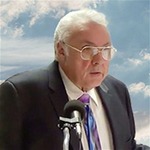
Here's Pastor Alan Wright with today's blessing—a biblical, faith-filled vision for your life. May you have the eyes of an eagle, not a chicken. Chickens have eyes designed for pecking at the ground up close, eyes good for seeing those little up close things, seeds and bugs and such. But they can't see far, maybe half a football field. But the eagle's eyes—they're made for the big view with clear focus.
If you exchanged your eyes for an eagle, you could see an ant crawling on the ground. From the roof of a ten-story building, an eagle can spot a rabbit from two miles away. Their superpower is an unusual ability to change both their eyes' lenses and corneas. It's about the capacity to focus on the distance. Beloved, is an unusual blessing, but you're no chicken.
As you put your hope in the Lord this year, may you mount up with wings of an eagle and soar to the heights of God's goodness. And focus with eagle eye clarity on God's big vision, your big purposes. I bless you to remain undistracted by the bugs in the foreground, so you can see the hope on the horizon. Pastor, author, and Bible teacher Allen Wright. Little buddy, what is wrong?
He said, "I just want to help you mow the lawn, Uncle Alan. I just want to help you mow the lawn." And I'm trying to console him, and I'm thinking, "What is wrong with this picture, child? I need to teach you that inside there's play. This is work. That is play." Inside Winnie the Pooh games, popsicles.
This is bad. That's good. Do you not understand the difference?
Something happened on the pathway to adulthood where the things that we would have longed to do for just the sheer joy of being used in a purposeful way became burdensome. That's Pastor Alan Wright. Welcome to another message of good news that will help you see your life in a whole new light. I'm Daniel Britt. Excited for you to hear the teaching today in the series "Gateways to Grace" as presented at Renolda Church in North Carolina.
If you're not able to stay with us throughout the entire program, I want to make sure you know how to get our special resource right now, which can be yours for your donation this month to Allen Wright Ministries. As you listen to today's message, go deeper as we send you today's special offer. Contact us at pastorallen.org. That's pastorallen.org, or call eight seven seven five four four forty eight sixty. That's eight seven seven five four four forty eight sixty.
While at our website, please let us know how we may pray for you. Submit your prayer request to our prayer wall and be uplifted and encouraged as the community around this ministry starts praying for you and receive notifications as you're. Request is prayed for. That's the prayer wall at Pastor Alan dot org. We're honored to stand with you in prayer.
More on all of this later in the program, but right now, let's get started with today's teaching. Here is Allen Wright. On the one hand, researching something now is way more time efficient than it was. But because it's unlimited and the availability, it actually makes us busier. And also, something happened in our country, and this is, I think, in some ways, not unique just to America, but in contrast to a lot of other cultures, it's unique.
That we move towards this. Appreciation of hard work becoming a celebration of drivenness. There was a scholar in 1899 who wrote a book about the leisure life of the wealthy, and in that book he was highlighting how the mark of prosperity is you had plenty of leisure time, and that's the way it used to be. Like if you saw someone who wasn't too busy, you assumed they're well-to-do. But now it's completely changed, and the assumption is, and it's accurate, that the more prosperous people are actually the ones that are busier, and those that are poorer than them are usually less working hard.
There was a study not too long ago that they took. Italian people and American people, and gave them the same images, the same depiction. And what they were showing is they first showed them a man who had a life that had a lot of leisure and extra time in it, and then a man who was working, working, working. And it was so interesting the responses. The Italians, a culture where it's mandated that every employee gets at least four weeks vacation paid, and all their holidays, and half the people just take off the whole month of July, versus America, driven, driven, driven.
And in Italy, the respondents they all said, "What do you think of these two men?" They said, "Well, this first man who has this leisure, he must have been very successful." And has a lot of money because he's got some time, and this poor person over here is probably behind and trying to catch up. And Americans said exactly the opposite. We were wrong about the technology thing, and something happened in our culture that put us off balance, and we have become a nation that applauds ambition and applauds. Drivenness, and sometimes it's like we feel like the postal worker is like, I don't know what to do with it. I am just going to dump the mail in the woods.
And all the stress, it's killing us literally. All the studies are showing it; it's making us sick and isolated. And most scholars agree it is an epidemic of anxiety and depression in our young generation.
So, what we're doing is not working, y'all. That's the problem. There's no rest. Instead, you could say the characterization of our nation is restlessness.
Now, here's the puzzle: If Jesus is going to describe what it is to rest in Him, why this image? If He's going to talk about rest, why not use an image of a hammock? Or a blanket on the hillsides of the Sea of Galilee, where you're having a picnic, or just some image of leisure. But instead, to describe resting in Him, He uses this image of the yoke. The yoke was a big wooden beam, and it had kind of these hooks that go beneath it that go around the animal's neck.
And at least two, sometimes more, animals would be yoked together, oxen, in a field for the purpose of plowing the field.
So, the yoke is about being linked. It's about two or more being connected in an inseparable way.
So, the yoke means you can't be going in different directions. And the yoke, therefore, is about moving forward in a common direction, and it is about more than that. It's about sharing in some very unique way. It's not just coexisting beside one another; it's sharing something, and ultimately, it's about fruitfulness. It's about the farm becoming more fruitful.
Well, you can begin to see the importance of the image to Jesus that. To take up my yoke, he's saying, is to be inseparably connected with me and moving in the direction that I'm moving. To be yoked with Jesus means you can't be moving this way and he's moving that way. It's his yoke, and you're wearing it also. But it means that there is, in some way, and some marvelous, uncanny way, that he's saying that there's a sharing that's going on between the two of us.
And that this is ultimately for a more fruitful life, and so that begins to get us to the image of the yoke. But still, why why an image of such hard work?
Well, part of the answer is that if Jesus had committed to his disciples and given them an image that said, "Come, follow me, and you'll have a life of leisure," it just wouldn't be true. I mean, it's amazing. It just wouldn't be true, and Jesus is the truth, and He cannot lie, and He never said that. He said, "In this world, you'll have trouble." In fact, He said, "Follow Me; you'll probably be persecuted." So He's using an image here that doesn't falsely convey that the life of the Christian is simply a life of leisure. Have you ever noticed that work is kind of an unusual thing?
And in the Bible, there was work. Before sin came into the world, works not the enemy.
So this image of work, the yoke, is not a negative one to Jesus. God put Adam and Eve in the Garden of Eden. This good arden garden, Genesis two fifteen. The Lord took man, put him in the garden. Even what to work it and keep it.
It's not arbitrary or meaningless work. It's purposeful. It's a vocation to care for, to do some hard work, to farm, to prune trees, harvest fruit. All of that. It's an act of God, trusting His human creature made in His image to take care of paradise.
So there was work when there was no sin. There is work in paradise, and you can very well expect. Therefore, there's work in heaven. Thank God. Because works a gift from God, purpose we are we are designed for purpose.
We're created for good works before we are even born. The Bible says, and if you don't ever find what your good works are that you're to be doing, then your life feels real empty.
So work is a gift, but something happened when sin came. Genesis three seventeen, to Adam after sin came in, God said, "Cursed is the ground because of you; in pain you shall eat of it all the days of your life." Pain entered in with the work, thorns and thistles. It's like now it's like it's a pain. The work feels like that, and He says, "By the sweat of your face you shall eat bread." So. Other words, work that was pure delight before the fall.
Now, for some reason, the same work seems like a heavy burden. This is what turned it into dreading Monday and looking forward to Friday. What happened here? It's it's a fall from innocence that caused us to feel like we work by the sweat of our brow. You ever know those little kids?
Long and begged to do the chores that we hate to do. Many years ago, Ann and I, when our kids were little, we babysit for Catherine and Kevin, Ann's sister, Catherine, Kevin, and they babysit for us. And one time, little Jake, he was three, and Ann and Catherine were coming over to our house. We were going to babysit. It was July.
And we had a fun afternoon planned and evening, and they were going out for a date. And you know, we had Winnie the Pooh videos ready and games to play inside, and popsicles, and we were doing all this stuff.
Somewhere in the middle of it, I realized that a storm was going to be coming the next day, and the grass was so high, and I hadn't mowed it, and it needed to be mowed. I said, "Hun." If you can just play with them a little bit, I'm gonna go out here and mow the grass. And she said, "All right." She said, "Well, hurry up, get back in here." I said, "All right." I go out and I cut about two swaths of grass, and it's hot. I mean, I'm sweating. It is the it's just the grass is up to my shins.
My one of my least favorite things to do. I'm out there. Oh, why do I gotta be doing this? And I'm thinking about them in the air conditioning. They're in there drinking lemonade.
I'm out here, and then all of a sudden, I'm going along and I look and I see little three year old Jake. Over on the sidewalk, and he's waving his arms. I've waving his arms like this. I turn off the mower, and I said, "What? What?" He said, "I want to help you, Uncle Alan." So I gave him a little broom.
I said, "Here, you you sweep off the sidewalk here, you know, and stay away from the dangerous mower." And I go back to mowing again. I mow a couple another swaths of grass, and I look over, and he is just sobbing on the sidewalk, just crying his eyes out. And I go over, I say, "Little buddy, what is wrong?" He said, "I just want to help you mow the lawn, Uncle Alan. I just want to help you mow the lawn." And I'm trying to console him, and I'm thinking, "What is wrong with this picture, child? I need to teach you." That inside there's play.
This is work. That is play. Inside Winnie the Pooh games, popsicles. This is bad. That's good.
Do you not understand the difference?
Something happened on the pathway to adulthood where the things that we would have longed to do for just the sheer joy of being used in a purposeful way became burdensome. Grandbaby Mia. She loves her toy kitchen and her toy vacuum cleaner. She loves to help. She loves to wipe off a table.
What what changed? One thing is pretty simply this: soon as sin came in the world, shame came to the world, and with it came fear. Shame is simply the fear that I don't measure up, and I need to do more in order to measure up. As soon as you introduce fear into the equation, you put some law into it, and you have to do this, or else it's not fun. I like to do the jumble every morning.
If I have time, sitting there doing my breakfast, the jumble—you unscramble four words and then use letters out of those to solve a puzzle and put together some other words. I don't do it because I'm trying to keep my brain sharp. I don't do it because somebody told me I ought to do it. I just like doing the jumble. I'm pretty good at the jumble.
Some mornings it's just like I'm sitting there. I'm eating my breakfast. There's a jumble, and it's like they just stand out and really, like, boom, boom, boom, boom, boom, boom. I got it, you know. And sometimes that is fun.
But if you told me that tomorrow I had to report at 8 a.m. to some classroom somewhere and take a jumble test where I was going to be given 20 jumbles under a timer, and if I didn't get them right, that I was going to have to go to jumble school for the next six months. That'd be a burden. Same thing, different perspective. Introduce a little law, then you introduce fear, and it's not fun anymore.
We're getting closer to understanding why he would use the image that he uses when he says, "My yoke." Is pleasant. It's light. It's not like that of the Pharisees that put law on you and threaten you and shame you. Mine's completely different than that. It's almost like he's saying you're going to be yoked to someone or something.
Get yoked with me. Take my yoke, verse twenty-nine, upon you, and here's part of the key to understanding this image. Learn from me. The word for learn, mathano, is the word that, when it becomes a noun, is the word disciple, matetes.
So, in the New Testament, the word disciple means learner. Dallas Willard and John Mark Comer, who's been writing a lot since, like to use the word apprentice. It's a great image. In Jewish families, the kids started school around age six in what was called bet sefer, and the goal of this was to mainly learn the Torah, the first five books of the Bible. And when successful, the children would memorize the entire first five books of the Bible.
And so, this phase of learning was just about taking lots of knowledge and putting it in. But then, around age two, the Hebrew student would enter into what's called Bet Talmud, and they would be from about age ten to age fourteen.
Now, not just Taking in knowledge, but learning how to think, not just memorizing, but learning how to ask questions and answer them. And they'd study the rest of the Hebrew scriptures. And if a child showed special promise and was a very gifted academic student, then they might be invited into what was called bet midrash. And this is basically an apprenticeship with a rabbi, and some rabbis are so highly regarded that you could imagine it was just a a wonderful thought if you could ever get a chance to go study with a rabbi. You could think of this period of study like an internship.
Or an apprenticeship, like like a young man learning from an expert plumber, who gets to go and work with that plumber, and learn how he does things, and learn his ways, and learn what to look out for, and learn what. Or maybe you could think of a fellow. You know, someone who's finished residency and they're going to do a fellowship, and they get to work with the surgeon they wanted to work with. Maybe they're going into orthopedic surgery, and they love the way that this orthopedist does the posterior approach to hip replacement surgery, and wants to learn the nuances of that because he's been very successful. You see, this is a real privilege when you get to go learn that closely with someone.
For a period of time, the bet midrash, the rabbi would welcome you into learning, essentially saying, "Come, learn from me." Pastor Alan Wright, our good news message, resting in grace, from the series, The Gateways of Grace. Stay with us. Pastor Alan is back here in the studio, sharing a parting good news thought for you and me in just a moment. What if growing closer to God isn't about trying harder?
So often we approach spiritual growth with a list of things we need to do: pray more, read more, be better. But what if the secret to spiritual transformation isn't found in greater effort, but in experiencing more of God's grace? In his book *The Gateways of Grace*, Pastor Alan Wright invites you to discover a fresh perspective on spiritual growth through timeless practices like scripture, prayer, meditation, wonder, and rest. You'll discover how to create space for the Holy Spirit to work in your life. These spiritual disciplines aren't obligations that earn God's favor.
They're gateways that open our hearts to experience more of God's goodness, peace, and transforming grace. When you give to Allen Wright Ministries, you help share the gospel with listeners around the world. And when you give today, we'll send you Pastor Alan's book, *The Gateways of Grace*, as our thanks to discover these aren't just disciplines; they're gateways. Step through them and discover the grace that's been waiting for you. The gospel is shared when you give to Allen Wright Ministries.
This broadcast is only possible because of listener financial support. When you give today, we will send you today's special offer. We are happy to send this to you as our thanks from Allen Wright Ministries. Call us at eight seven seven five four four forty eight sixty. That's eight seven seven.
Five four four forty eight sixty, or come to our website. PastorAllen. dot org. Back here now with Pastor Alan in the studio, and resting in Christ. And if we pick back up on the previous teaching about the growing process of a tomato in that illustration, I think there is some similarities here.
You can't force the growth. There is a bit of there is a bit of this waiting, and might I say, some resting involved. Yeah, I think that the The way in which we have to wait on growth to come is—it's just hard for us because so many things in our society are instant. And I just feel like that—that part of the invitation of Jesus is to follow Him in a way that any disciple would be in the dust of His Rabbi, like learn from Him His whole way of being. And when you look at Jesus, it is true.
Often said of his ministry, he was not in a hurry, and yet was where he needed to be. And so, I don't think there's any turning back from the fast pace of life that we've got, but discovering some rhythms, but and and really discovering what it means to take on Jesus' yoke as a gift is the is the key. Thanks for listening today. Visit us online at pastorallen dot org or call eight seven seven five four four forty eight sixty. That's eight seven seven five four four forty eight sixty.
If you only caught part of today's teaching, not only can you listen again online, but also get a daily email devotional that matches today's teaching, delivered right to your email inbox, free. Find out more about these and other resources at PastorAllen.org. That's PastorAllen.org. Today's good news message is a listener-supported production of Allen Wright Ministries.